New Jersey Letter from Tenant to Landlord responding to Notice to Terminate for Noncompliance - Noncompliant condition caused by Landlord's own deliberate or negligent act
Overview of this form
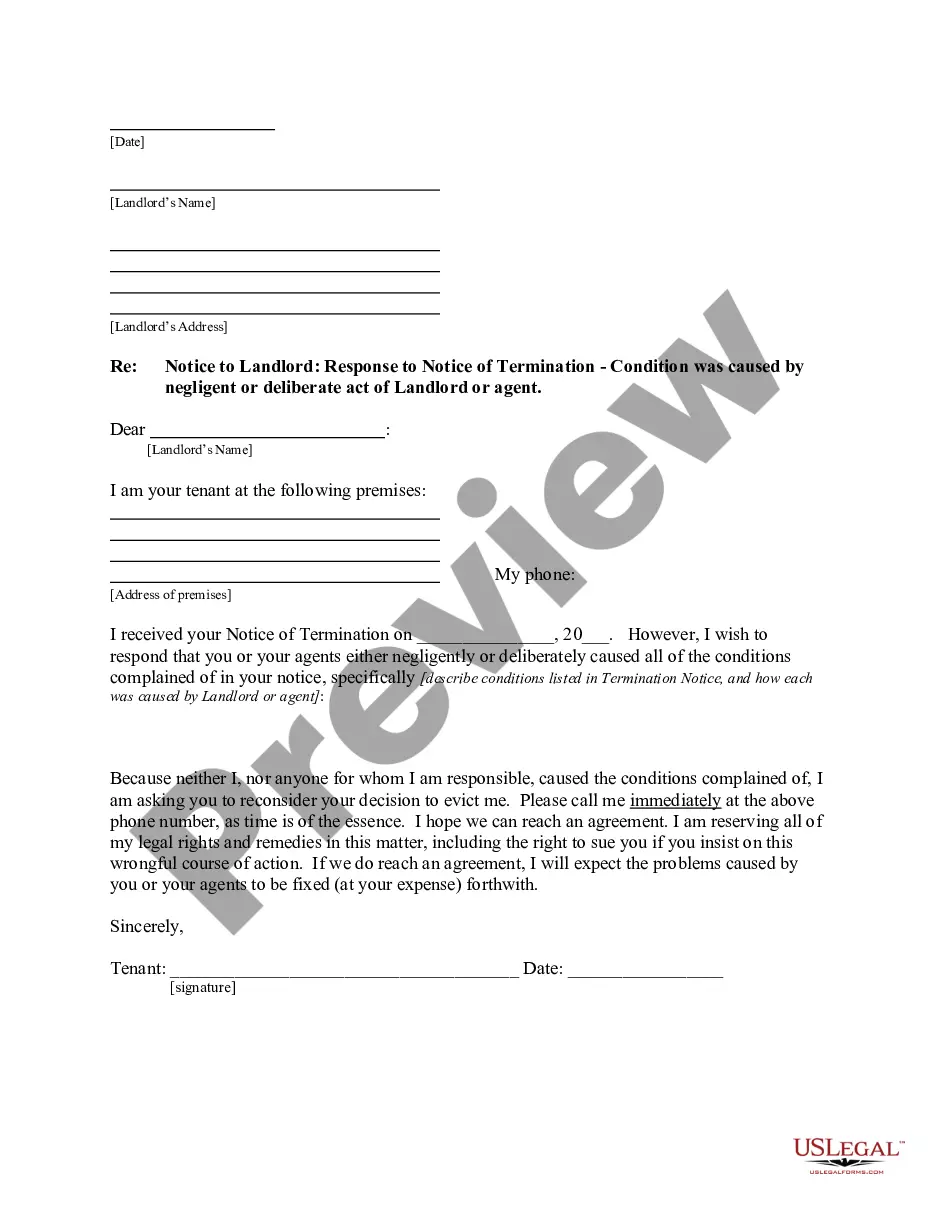
This form is a Letter from Tenant to Landlord responding to a Notice to Terminate for Noncompliance. It is specifically designed for tenants who believe that the reasons for eviction stem from actions or negligence on the part of the landlord or their agents. By using this letter, tenants assert their position against eviction while requesting necessary repairs and maintaining their legal rights.
Main sections of this form
- Tenant's assertion of noncompliance due to the landlord's actions
- A request for immediate repairs to the rental property
- Statement reserving the tenant's legal rights
- Signature and date fields for the tenant
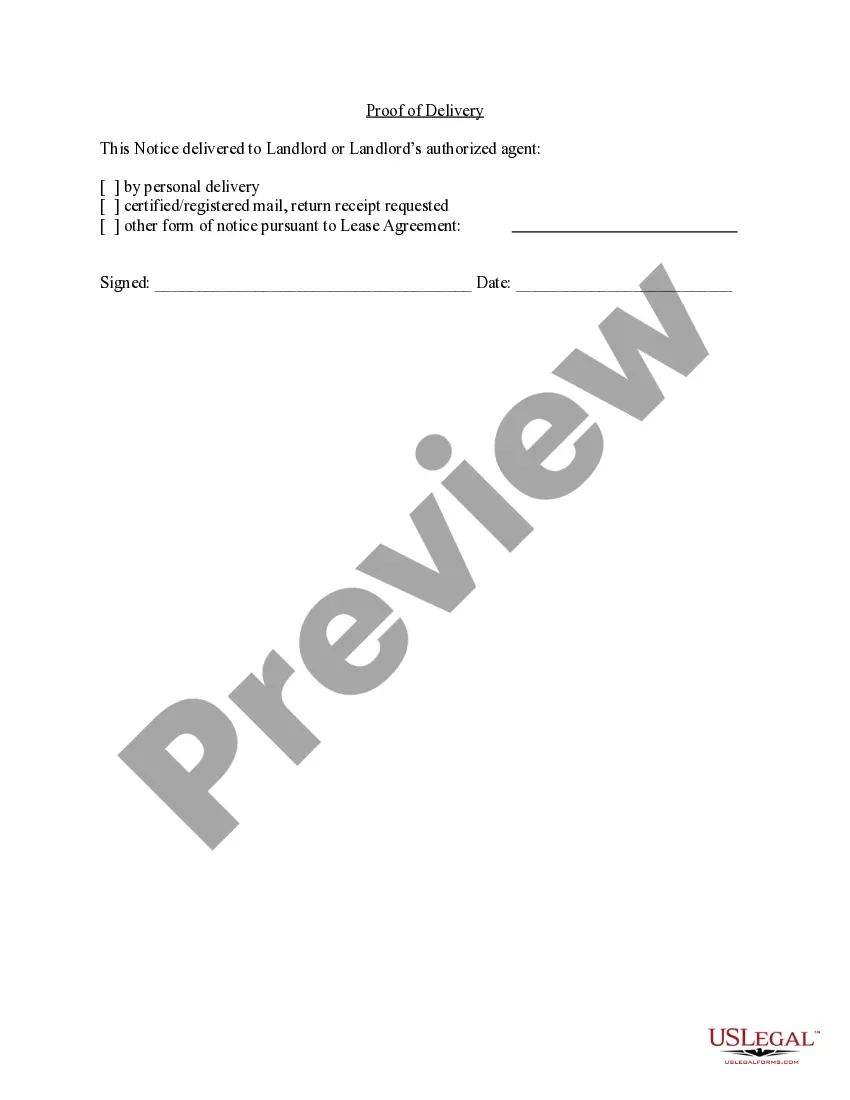
- Proof of delivery options to the landlord



When to use this form
This form should be used when a tenant receives a notice from the landlord indicating an intention to terminate the lease due to noncompliance. It is particularly relevant if the tenant believes that the alleged noncompliant conditions are the result of the landlordâs own deliberate or negligent acts. By filling out and sending this letter, the tenant seeks to contest the eviction notice and prompt the landlord to make necessary repairs.
Who needs this form
- Tenants who have received an eviction notice from their landlord
- Individuals residing in rental properties where the landlord has caused noncompliance
- People seeking to assert their rights before eviction proceedings commence
- Those needing a formal method to communicate their intention to remedy conditions
Steps to complete this form
- Begin by identifying the parties involved: include the tenant's name and address at the top of the letter.
- Specify the details of the notice received, including the date and reasons for termination.
- Clearly state the noncompliant conditions caused by the landlord's actions.
- Include a request for immediate repairs and outline your intent to contest the eviction.
- Sign and date the letter, ensuring that you keep a copy for your records.
- Deliver the letter to the landlord via personal delivery or certified mail, ensuring you have proof of delivery.
Is notarization required?
This form does not typically require notarization unless specified by local law. Ensure you check any specific requirements that may apply in your jurisdiction.
Get your form ready online
Our built-in tools help you complete, sign, share, and store your documents in one place.
Make edits, fill in missing information, and update formatting in US Legal Forms—just like you would in MS Word.
Download a copy, print it, send it by email, or mail it via USPS—whatever works best for your next step.
Sign and collect signatures with our SignNow integration. Send to multiple recipients, set reminders, and more. Go Premium to unlock E-Sign.
If this form requires notarization, complete it online through a secure video call—no need to meet a notary in person or wait for an appointment.
We protect your documents and personal data by following strict security and privacy standards.

Make edits, fill in missing information, and update formatting in US Legal Forms—just like you would in MS Word.

Download a copy, print it, send it by email, or mail it via USPS—whatever works best for your next step.

Sign and collect signatures with our SignNow integration. Send to multiple recipients, set reminders, and more. Go Premium to unlock E-Sign.

If this form requires notarization, complete it online through a secure video call—no need to meet a notary in person or wait for an appointment.

We protect your documents and personal data by following strict security and privacy standards.
Typical mistakes to avoid
- Not clearly stating the specific conditions that led to the eviction notice.
- Failing to keep a copy of the letter for personal records.
- Using improper delivery methods that do not provide proof.
- Not requesting repairs explicitly in the letter.
- Ignoring state-specific language or requirements in the letter.
Why use this form online
- Instant download allows for quick action in response to eviction notices.
- Editable templates ensure that you can tailor the letter to fit your situation accurately.
- Access to forms created by licensed attorneys adds a layer of confidence and legal reliability.
- No need for in-person visits, making the process more convenient and accessible.
Summary of main points
- This letter is a critical tool for tenants responding to eviction notices due to landlord-related issues.
- Clearly outlining the landlordâs role in the alleged noncompliance can strengthen your position.
- Using this form can help preserve your rights and initiate necessary repairs from the landlord.
- Understanding your stateâs specific regulations can enhance the effectiveness of this letter.
Looking for another form?
Form popularity
FAQ
Notice to Terminate the Lease A month-to-month tenant must give written notice of lease termination at least one full month prior to moving. Most yearly leases require a 60 to 90 day notice from the tenants in order to terminate the lease.
A person does not become a tenant just because he or she has lived in a property for a long time.If the person you want to evict is not a tenant, but is a household member or authorized occupant, you may be able to evict that person.
Talk to Your Landlord You may be able to come to an agreement without going to court. An eviction will cost both of you money (as well as time), and your landlord may be willing to stop the eviction if you agree to certain terms, such as paying rent you owe or stopping behavior that violates the lease.
One of the first procedures in evicting a tenant is for the landlord to terminate the lease or rental agreement. In some cases, the landlord must give the tenant notice before terminating the lease. In other cases, the landlord can proceed directly to court to file an eviction lawsuit against the tenant.
No residential landlord may evict or fail to renew a lease, whether it is a written or an oral lease without good cause. The landlord must be able to prove in court that he has grounds for an eviction.
A Notice to Cease serves as a warning notice; this notice tells the tenant to stop the wrongfully conduct. If the tenant does not comply with the Notice to Cease, a Notice to Quit may be served on the tenant. After giving a Notice to Quit, the landlord may file suit for an eviction.
Legally Removing People. Send a certified letter asking them to leave in 30 days or less. While a house guest is not technically a tenant, certain tenant-landlord laws still apply to the relationship if they've been with your for more than 30 days. Talk to an attorney who will help you draft and send an eviction notice
You absolutely cannot evict your roommate, as you are not your roommate's landlord. What if there's no lease? If there is no lease in place, you are not a landlord under New Jersey law. As such, you cannot evict your roommate.
A landlord must have good cause to evict a tenant.Each cause, except for nonpayment of rent, must be described in detail by the landlord in a written notice to the tenant. A Notice to Quit is required for all good cause evictions, except for an eviction for nonpayment of rent.