New Hampshire Warranty Deed - Three Individuals to Four Individuals
Understanding this form
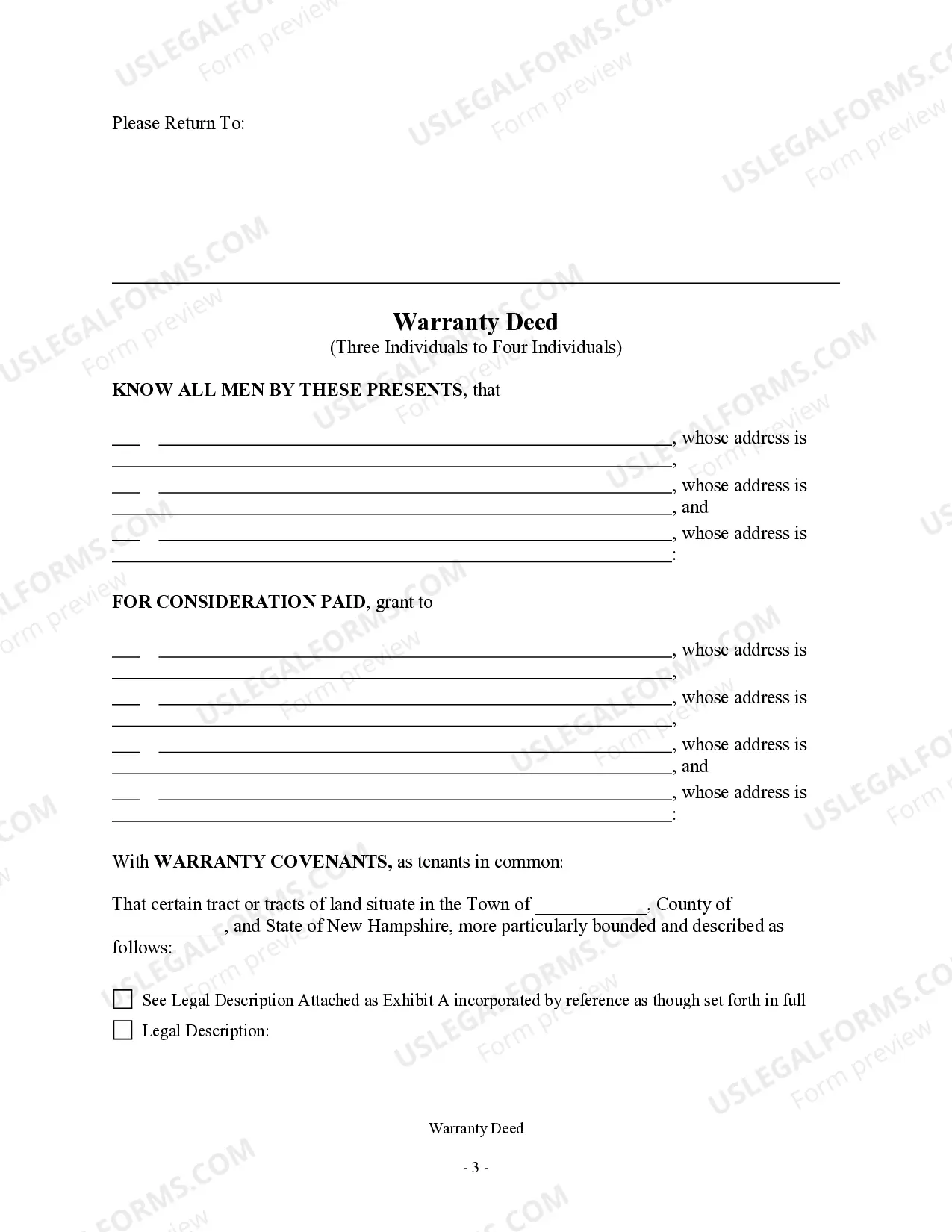
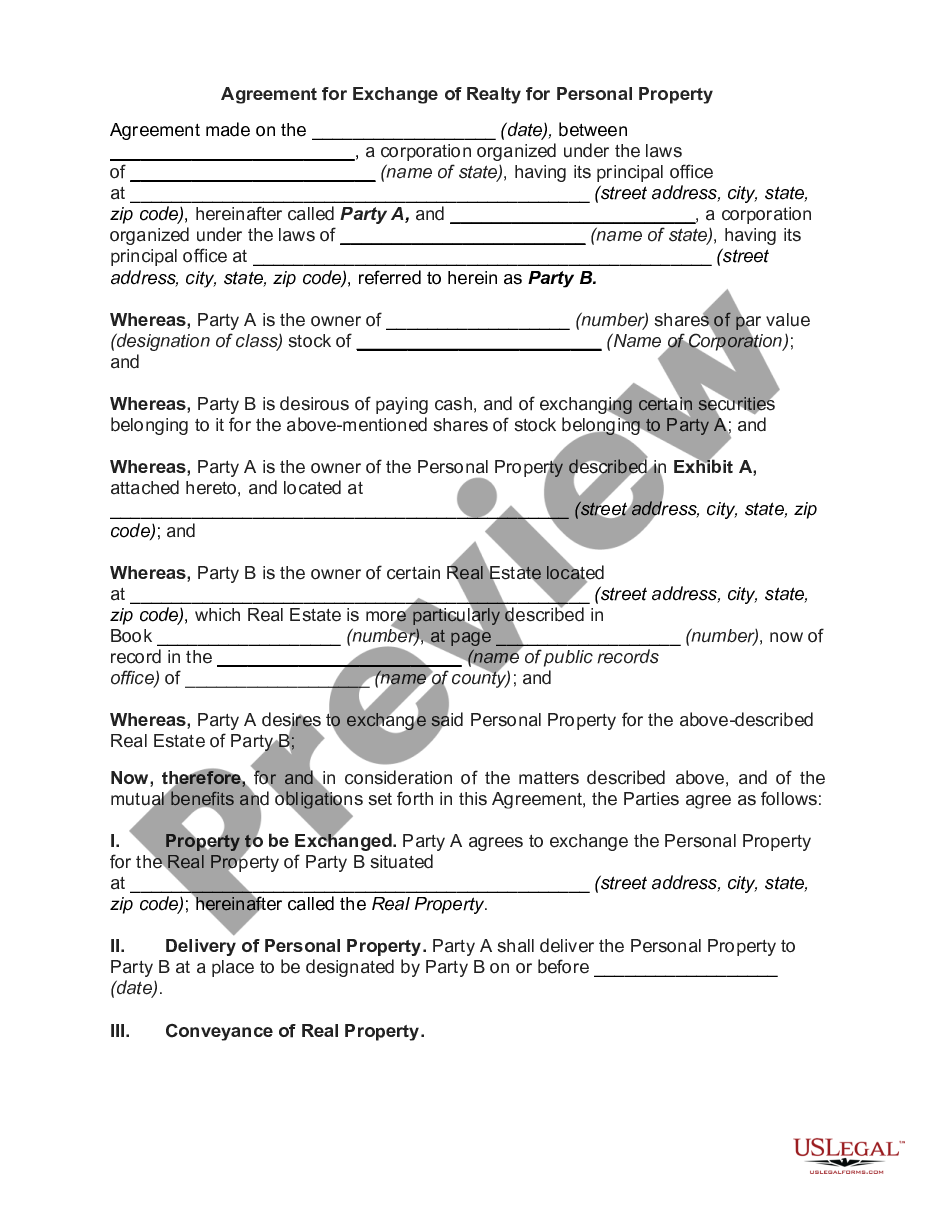
The Warranty Deed - Three Individuals to Four Individuals is a legal document used to transfer ownership of real property from three grantors (sellers) to four grantees (buyers). This deed includes warranties that guarantee the grantors have clear title to the property and the right to sell it. Unlike other types of deeds, such as quitclaim deeds, a warranty deed offers greater protection for the grantees, ensuring they are legally entitled to the property and minimizing potential disputes. This form allows the grantees to take ownership as either tenants in common or joint tenants with right of survivorship.
Key components of this form
- Identification of grantors and grantees with full legal names.
- Description of the property being transferred.
- Statement of granting clauses confirming transfer of ownership.
- Warranties provided by the grantors regarding the title.
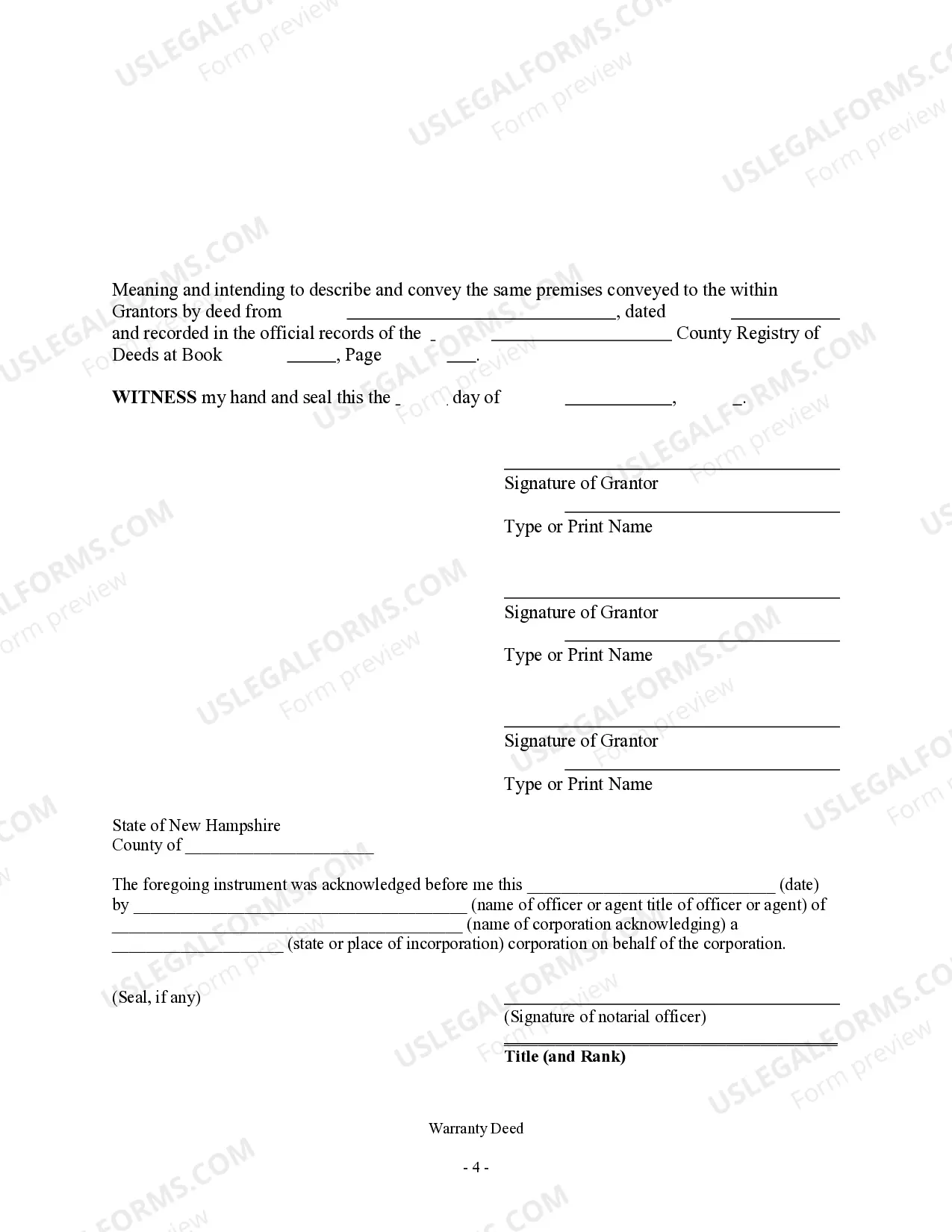
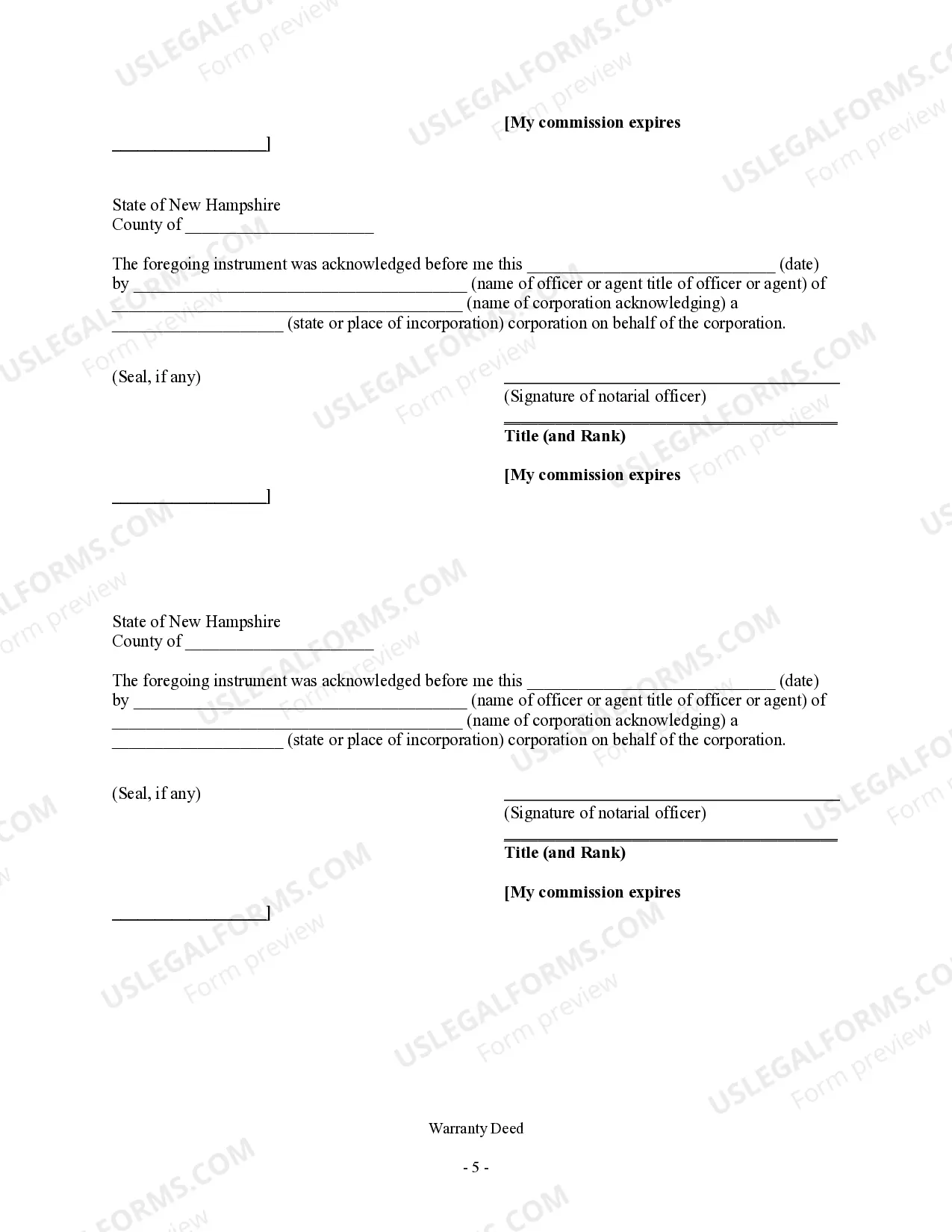
- Signature lines for grantors and a notary acknowledgment.



Common use cases
This form is necessary when three individuals wish to convey real estate to four individuals. It is especially useful in situations like a family property transfer, where multiple individuals share ownership. This deed may be used when the grantors want to ensure the property is legally conveyed with warranties in place, protecting the grantees from future claims on the title.
Intended users of this form
- Three individuals acting as grantors who are transferring property.
- Four individuals acting as grantees ready to take ownership of the property.
- Real estate professionals or attorneys seeking a legally sound transfer document.
How to prepare this document
- Identify and enter the full legal names of the grantors and grantees.
- Specify the legal description of the property being transferred.
- Complete the granting clauses with any warranties provided by the grantors.
- Ensure all parties sign the document in the presence of a notary public.
- Attach any required exhibits, such as maps or additional legal descriptions, to the document.
Is notarization required?
This form must be notarized to be legally valid. US Legal Forms provides secure online notarization powered by Notarize, allowing you to complete the process through a verified video call.
Get your form ready online
Our built-in tools help you complete, sign, share, and store your documents in one place.
Make edits, fill in missing information, and update formatting in US Legal Forms—just like you would in MS Word.
Download a copy, print it, send it by email, or mail it via USPS—whatever works best for your next step.
Sign and collect signatures with our SignNow integration. Send to multiple recipients, set reminders, and more. Go Premium to unlock E-Sign.
If this form requires notarization, complete it online through a secure video call—no need to meet a notary in person or wait for an appointment.
We protect your documents and personal data by following strict security and privacy standards.

Make edits, fill in missing information, and update formatting in US Legal Forms—just like you would in MS Word.

Download a copy, print it, send it by email, or mail it via USPS—whatever works best for your next step.

Sign and collect signatures with our SignNow integration. Send to multiple recipients, set reminders, and more. Go Premium to unlock E-Sign.

If this form requires notarization, complete it online through a secure video call—no need to meet a notary in person or wait for an appointment.

We protect your documents and personal data by following strict security and privacy standards.
Typical mistakes to avoid
- Failing to properly identify all grantors and grantees by their full legal names.
- Neglecting to include a complete legal description of the property.
- Not obtaining the appropriate signatures in front of a notary.
- Ignoring to attach necessary exhibits that support the transfer.
Advantages of online completion
- Easy access to professionally drafted legal documents.
- Convenience of filling out forms at your own pace.
- Editable fields that simplify entering information.
- Secure downloading options for personal records.
Looking for another form?
Form popularity
FAQ
Quitclaim deeds are most often used to transfer property between family members.Examples include when an owner gets married and wants to add a spouse's name to the title or deed, or when the owners divorce and one spouse's name is removed from the title or deed.
Find out if the property or land is registered. Pay £3 to download a copy of the title register. If the deeds are marked as 'filed' in the register then HM Land Registry has a scanned copy. Fill in the deeds request form using the property's title number from the title register.
Deeds can be obtained at the Strafford County Registry of Deeds. Their website is www.nhdeeds.com. They can also be contacted at Strafford County Registry of Deeds, 259 County Farm Road, Suite 202, Dover, NH 03820, (603) 742-1741. Most deeds are also available in the Assessing Office.
Signing - According to New Hampshire Law (§ 477:3) the Grantor must sign the quit claim deed in the presence of a Notary Public. Recording - Once notarized, the quit claim deed must be filed with the County Recorder's Office in the city or county where the property is located.
Once a quitclaim is signed and recorded, can the deed be challenged in court? Yes, it can. Recording your deed only provides notice of your ownership claim to the public. It does not guarantee ownership.
The drawback, quite simply, is that quitclaim deeds offer the grantee/recipient no protection or guarantees whatsoever about the property or their ownership of it. Maybe the grantor did not own the property at all, or maybe they only had partial ownership.
They are commonly used to add/remove someone to/from real estate title or deed (divorce, name changes, family and trust transfers). The quitclaim deed is a legal document (deed) used to transfer interest in real estate from one person or entity (grantor) to another (grantee).
Amherst. Antrim. Bedford. Bennington. Brookline. Deering. Francestown. Goffstown.
Fill out the quit claim deed form, which can be obtained online, or write your own using the form as a guide. The person giving up the interest in the property is the grantor, and the person receiving the interest is the grantee.
Expect to wait four to six weeks and don't expect to get the original deed because they keep that and send you a copy. On an even less romantic note, owners of new homes often only get an electronic copy.