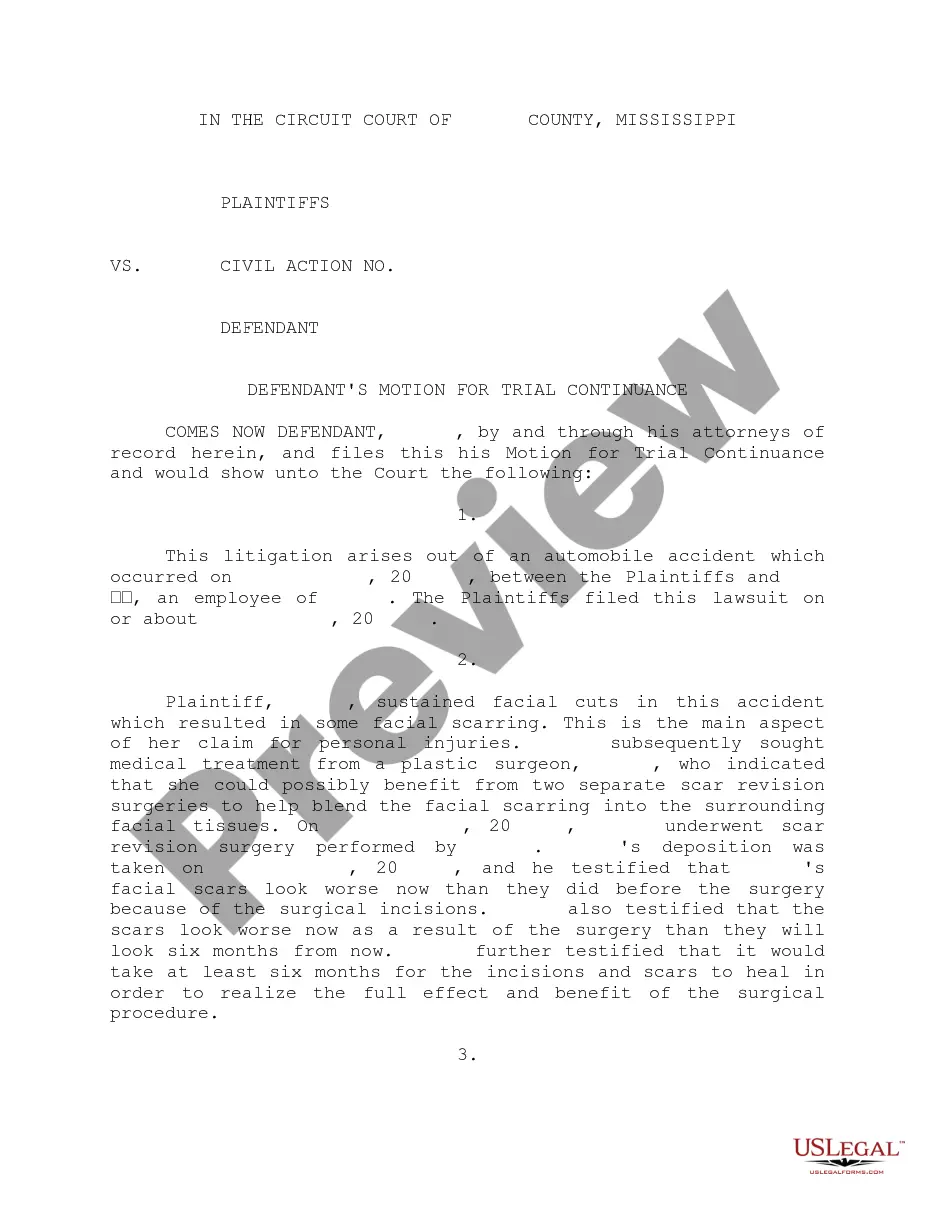
North Dakota Marital Domestic Separation and Property Settlement Agreement Minor Children no Joint Property or Debts where Divorce Action Filed
Overview of this form
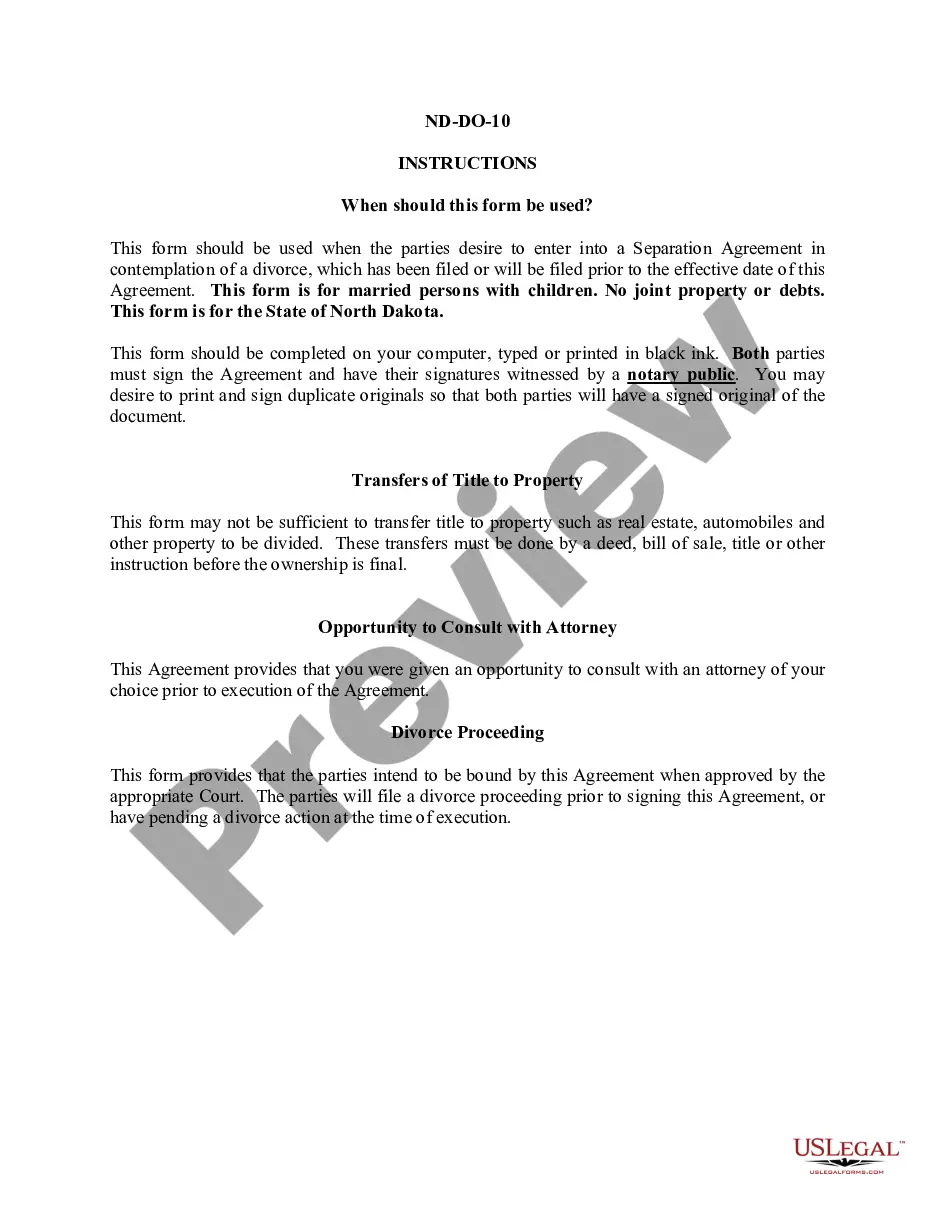
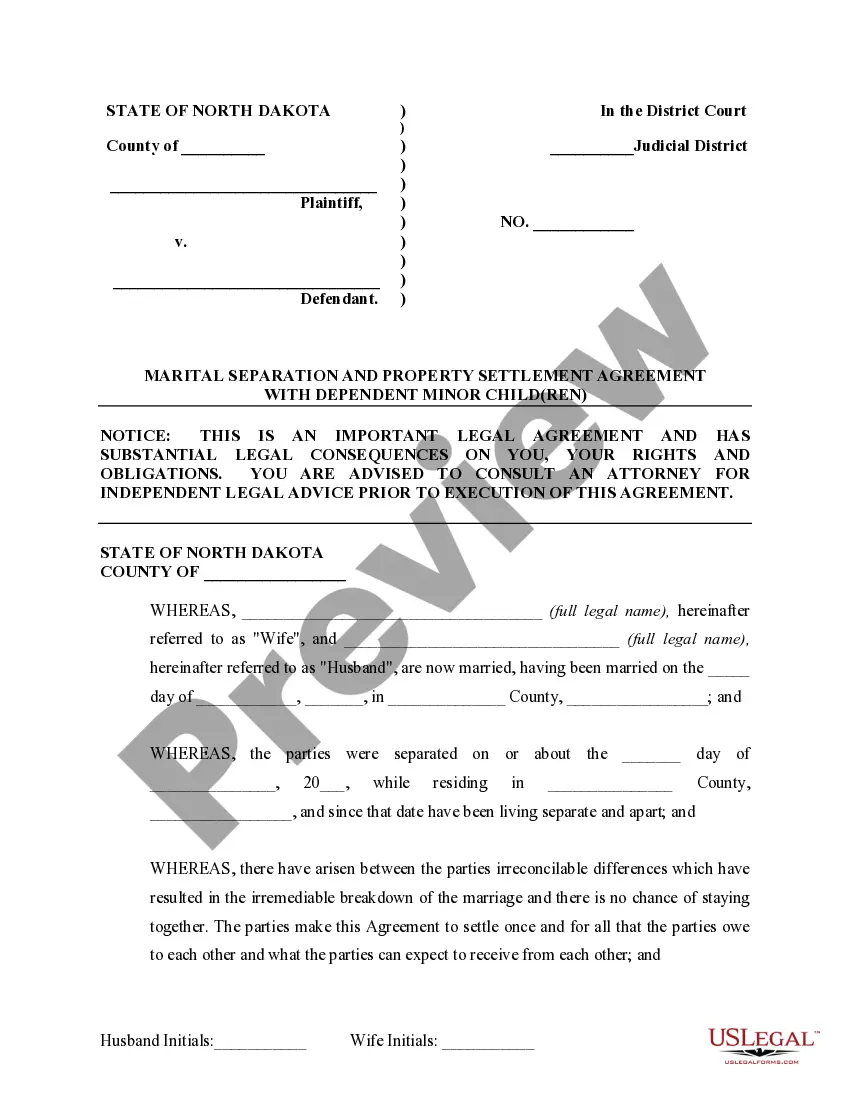
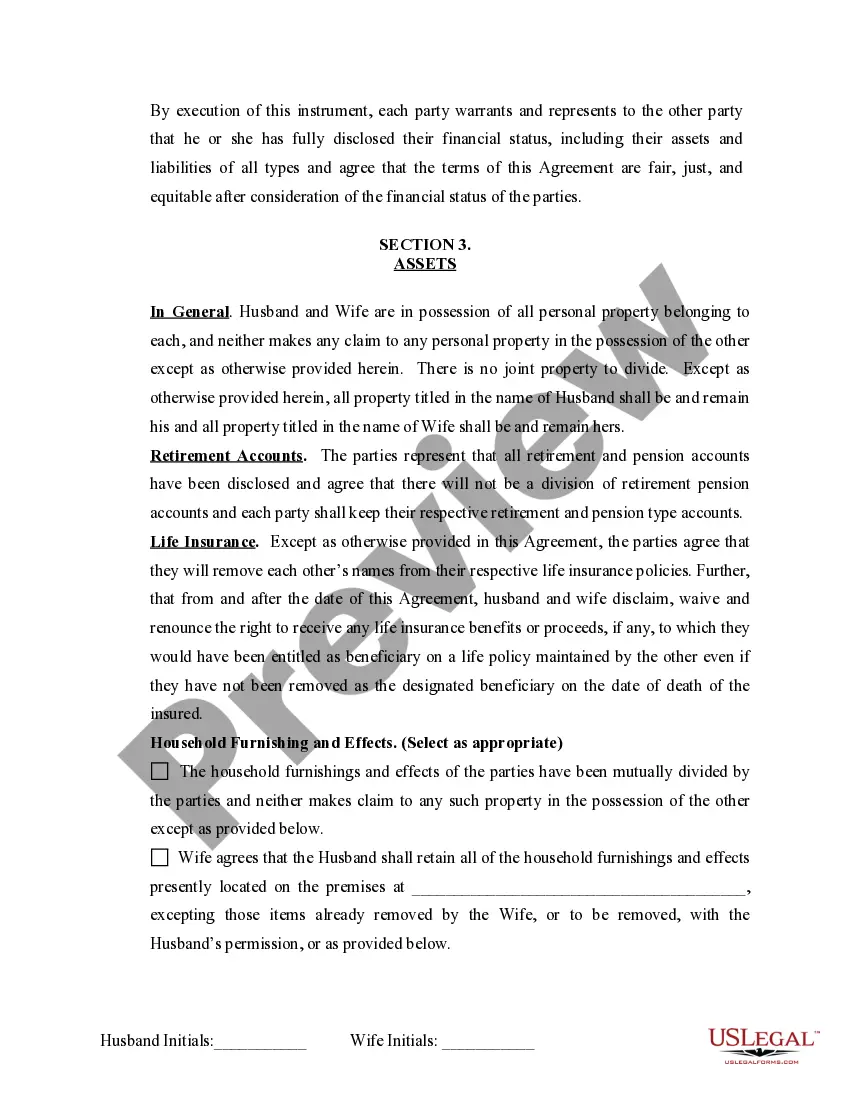
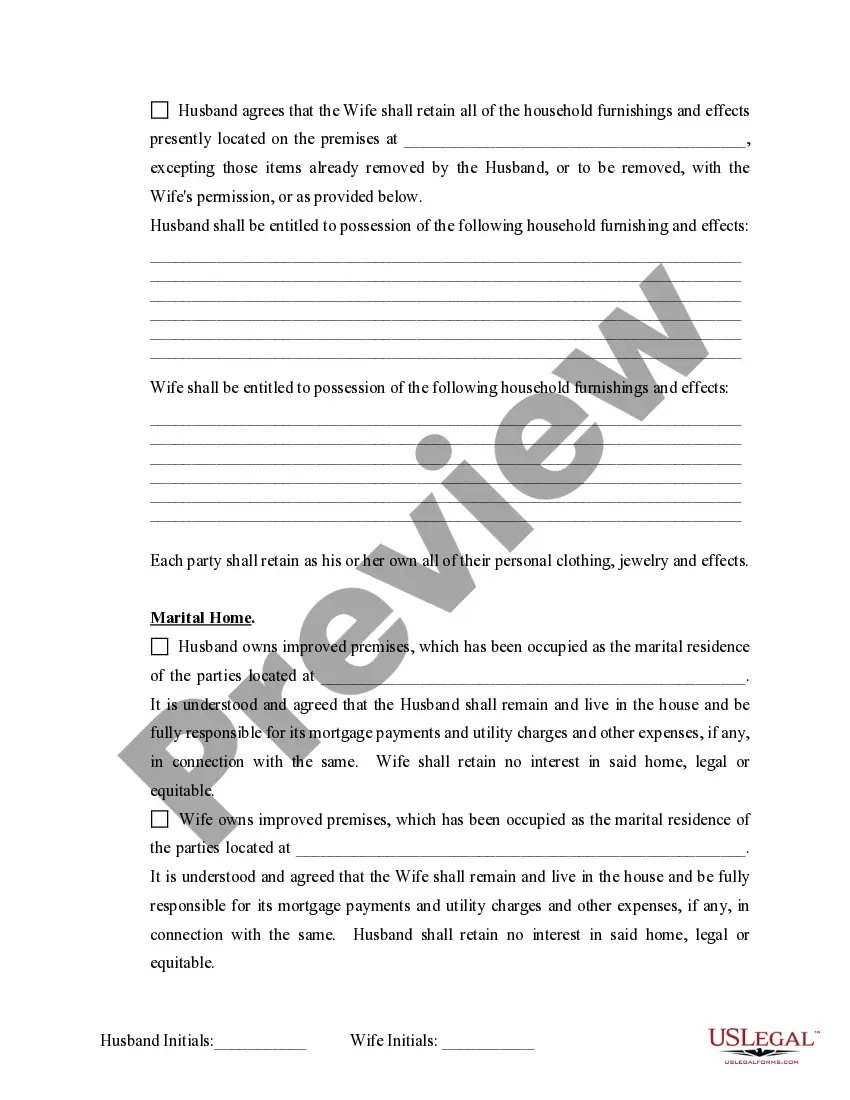
This Marital Domestic Separation and Property Settlement Agreement is designed for married couples with minor children who are contemplating divorce without joint property or debts. The purpose of this form is to facilitate an amicable separation by outlining custody, visitation, and child support arrangements while ensuring both parties understand their rights and obligations during the divorce process. This form differs from other separation agreements as it specifically addresses family matters involving children and excludes issues related to asset division due to the absence of joint property or debts.
What’s included in this form
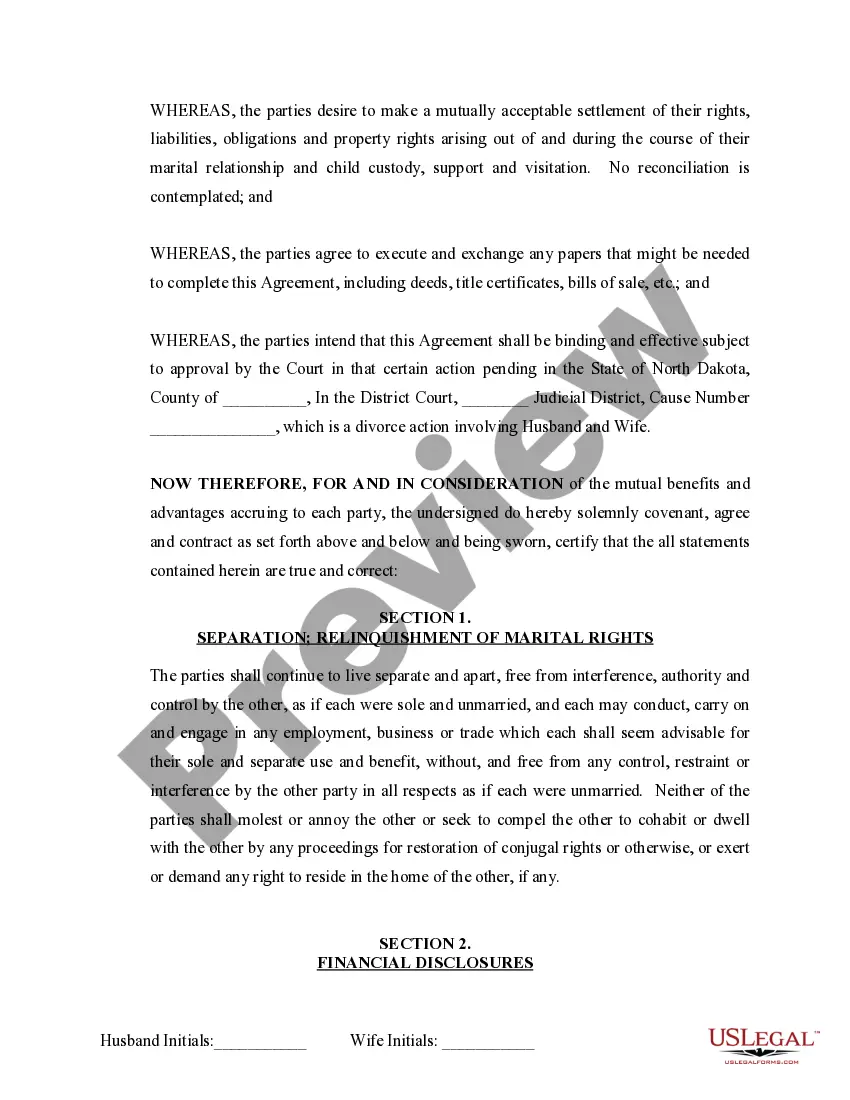
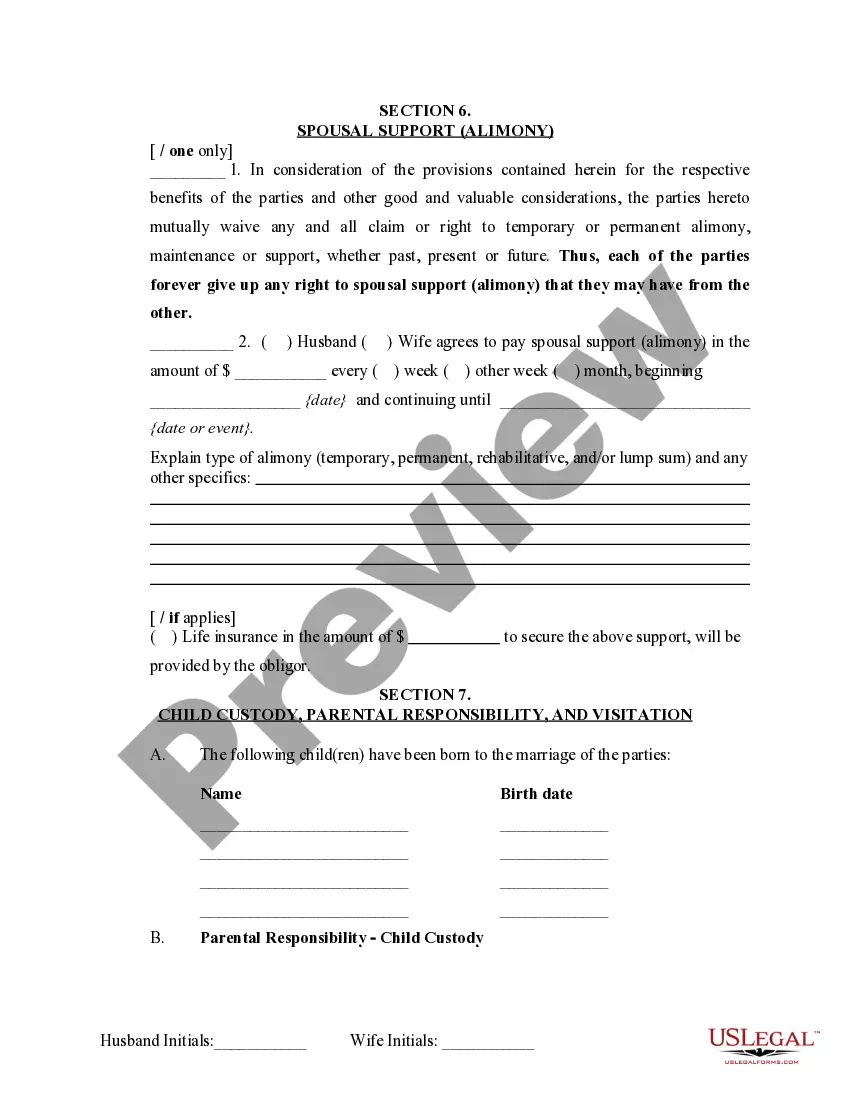
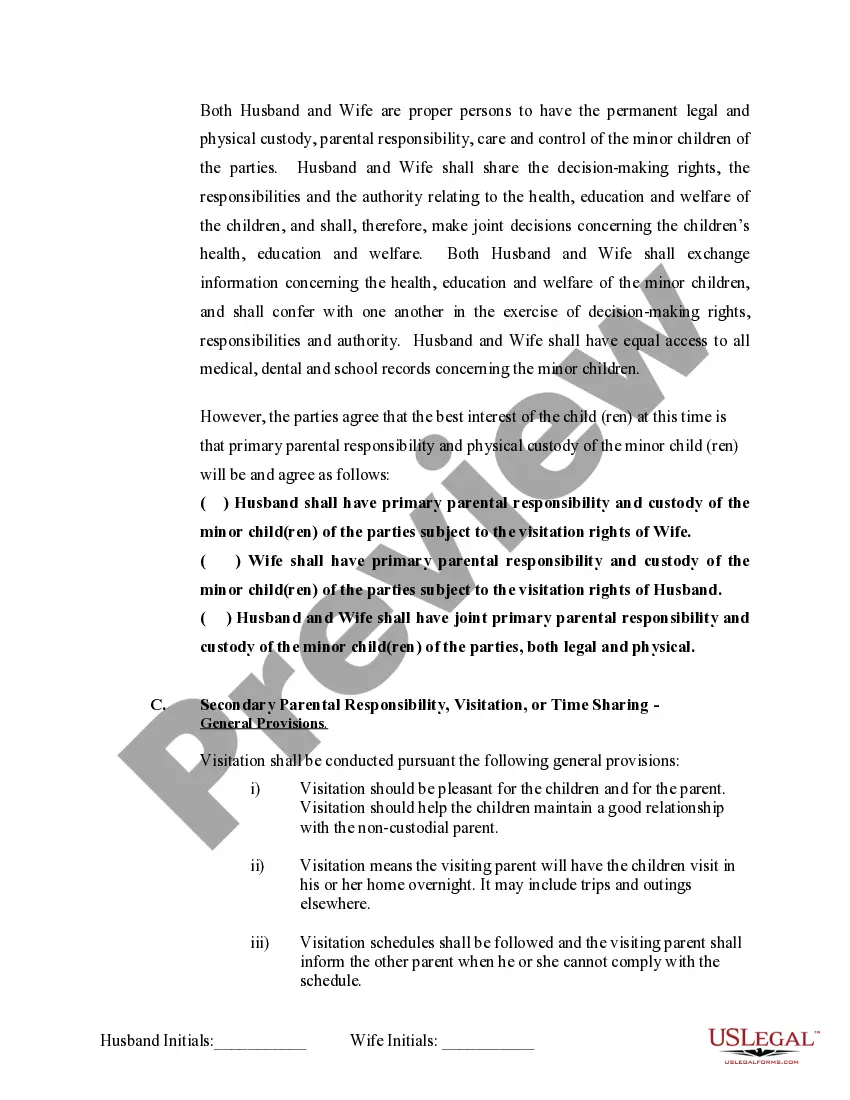
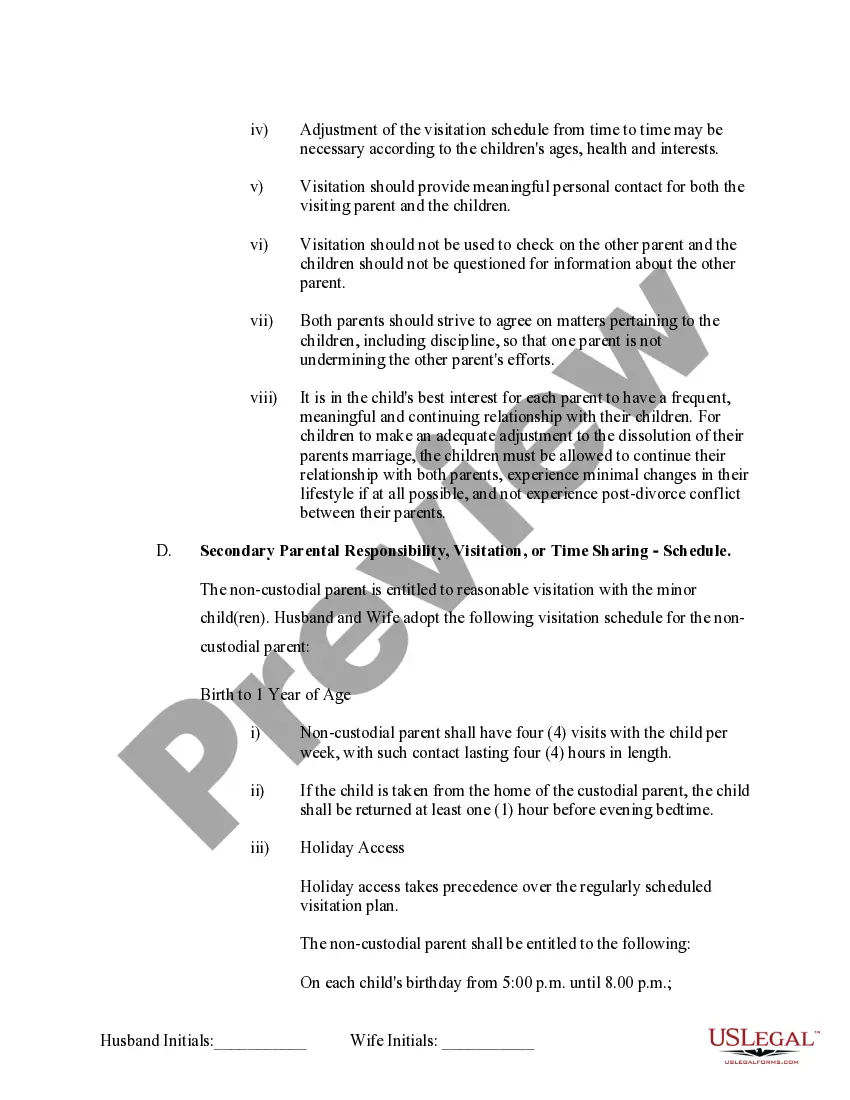
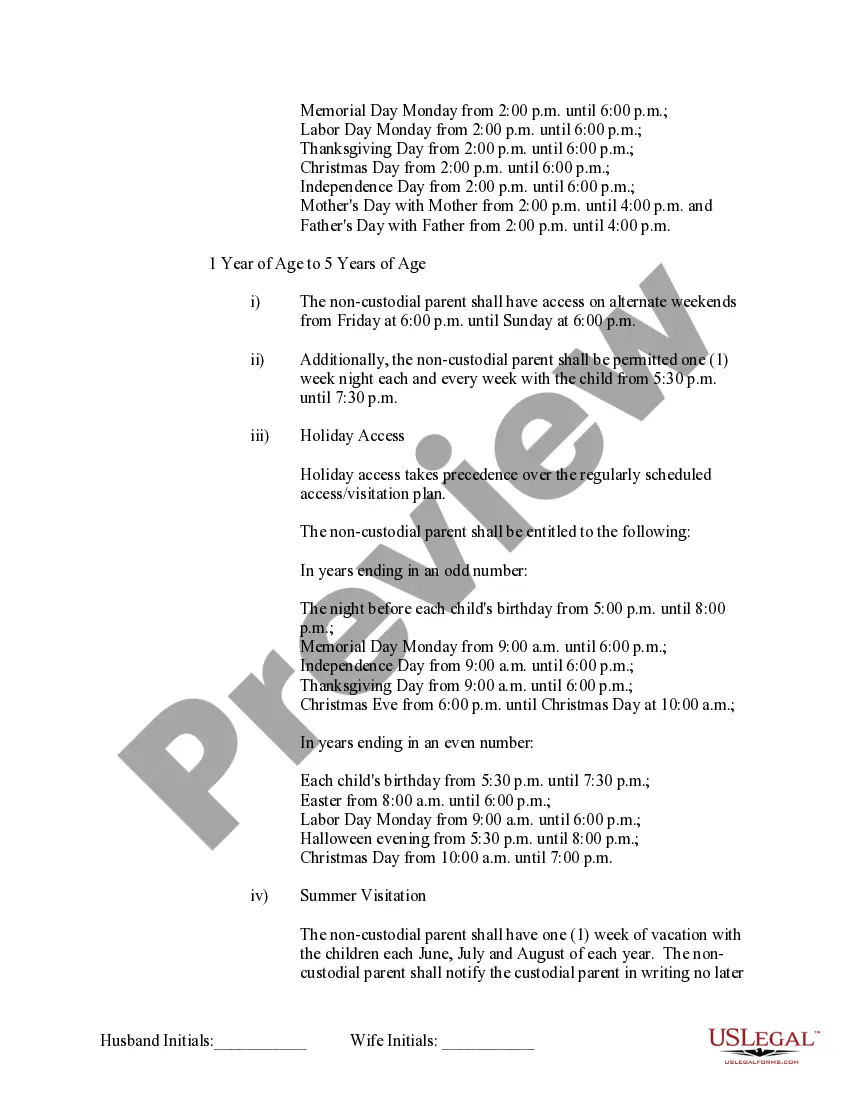
- Details about custody arrangements and visitation rights of both parents.
- Specifications regarding child support obligations and amounts.
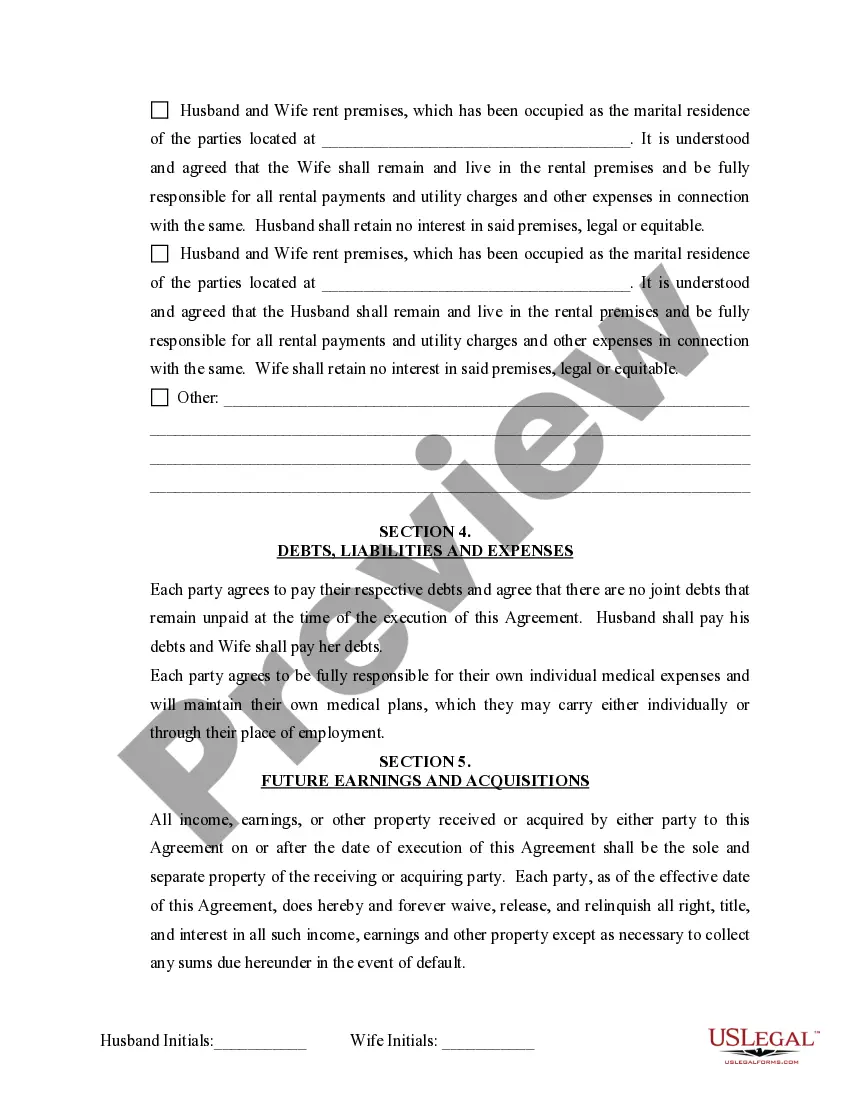
- Provisions for the relinquishment of marital rights and handling individual debts.
- Notary requirements for legal validity and appropriate signatures.
- Clauses relating to spousal support (alimony) and its terms.

When this form is needed
This form should be used when both spouses agree to separate and settle the terms of their marriage before finalizing a divorce. It is particularly appropriate when there are minor children involved, but no shared property or debts that need to be divided. If a divorce action is currently pending, this Agreement facilitates a clearer understanding of responsibilities relating to child custody and support while establishing clear terms around marital separation.
Who can use this document
- Married couples with minor children seeking separation before or during a divorce.
- Couples who do not have joint property or debts requiring division.
- Individuals looking to formalize child custody and support arrangements.
Instructions for completing this form
- Identify and enter the full legal names of both spouses and the required court information.
- Specify the custody arrangements, including visitation rights for each parent.
- Determine and write down the child support amounts, including who will pay and for how long.
- Each party should declare their respective debts and confirm there is no joint property.
- Both parties must sign the Agreement and have their signatures witnessed by a notary public for legal validation.
Notarization guidance
To make this form legally binding, it must be notarized. Our online notarization service, powered by Notarize, lets you verify and sign documents remotely through an encrypted video session.
Get your form ready online
Our built-in tools help you complete, sign, share, and store your documents in one place.
Make edits, fill in missing information, and update formatting in US Legal Forms—just like you would in MS Word.
Download a copy, print it, send it by email, or mail it via USPS—whatever works best for your next step.
Sign and collect signatures with our SignNow integration. Send to multiple recipients, set reminders, and more. Go Premium to unlock E-Sign.
If this form requires notarization, complete it online through a secure video call—no need to meet a notary in person or wait for an appointment.
We protect your documents and personal data by following strict security and privacy standards.

Make edits, fill in missing information, and update formatting in US Legal Forms—just like you would in MS Word.

Download a copy, print it, send it by email, or mail it via USPS—whatever works best for your next step.

Sign and collect signatures with our SignNow integration. Send to multiple recipients, set reminders, and more. Go Premium to unlock E-Sign.

If this form requires notarization, complete it online through a secure video call—no need to meet a notary in person or wait for an appointment.

We protect your documents and personal data by following strict security and privacy standards.
Avoid these common issues
- Failing to provide accurate names and court details, leading to potential enforceability issues.
- Omitting critical details regarding child custody or support terms.
- Neglecting to have the agreement notarized, which may invalidate the document.
- Not consulting with an attorney when unsure about legal rights and obligations.
Advantages of online completion
- Immediate access to a professionally drafted form that is compliant with North Dakota laws.
- Convenience of downloading, completing, and printing the form from home.
- Editability allows users to customize the agreement based on their specific situation.
Key takeaways
- This form is essential for married couples in North Dakota with minor children who are separating without shared property or debts.
- It establishes clear terms regarding child custody, visitation, and support obligations.
- Notarization is required for the agreement to be legally binding.
Looking for another form?
Form popularity
FAQ
A legal separation would mean one spouse may still be eligible for health insurance coverage from the other spouse's job, whereas a divorce would end this coverage. A legal separation also allows you and your spouse to continue filing taxes jointly, which can lead to some tax benefits.
The Plaintiff or Petitioner must have been a resident of North Dakota at least 6 months before starting the legal separation. Or, the Plaintiff or Petitioner must have been a resident of North Dakota for 6 months immediately before the District Court grants the judgment of legal separation.
What Rights do Spouses Have During Separation? In a legal separation proceeding, a court can decide matters such as child custody and support, alimony and property division. However, as stated above, the spouses will remain legally married and cannot remarry unless and until they get a divorce.
Yes, it is mandatory. Each party must obtain independent legal advice prior to signing a separation agreement. You also cannot use the same lawyer and should not use the same law firm. If you fail to obtain advice from a lawyer, the separation agreement will be unenforceable.
Separation agreement is a general term used to describe a written contract that spouses enter into to address some or all issues arising from their marital separation.Therefore, if a spouse refuses to sign a separation agreement, the other spouse cannot force the unwilling spouse to do so.
The Plaintiff or Petitioner must have been a resident of North Dakota at least 6 months before starting the legal separation. Or, the Plaintiff or Petitioner must have been a resident of North Dakota for 6 months immediately before the District Court grants the judgment of legal separation.
A separation agreement may be set aside and determined to be unenforceable if a party can show that the agreement was not signed voluntarily, that its terms are unconscionable, or that it was obtained as the result of fraud, duress, or undue influence.
People choose legal separation instead of divorce because of religious beliefs, a desire to keep the family together legally for the sake of children, the need for one spouse to keep the health insurance benefits that would be lost with a divorce, or simple aversion to divorcing despite the desire to live separate