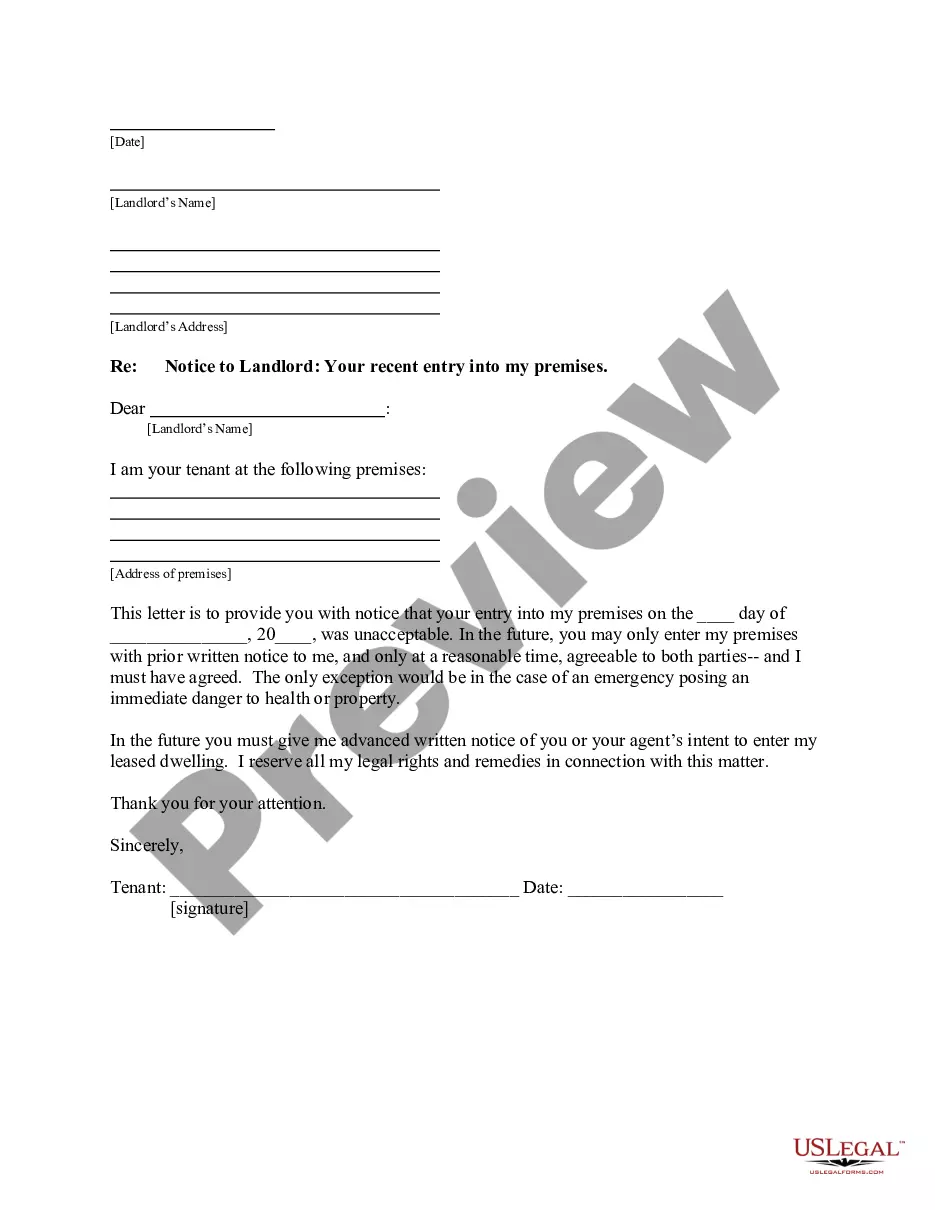
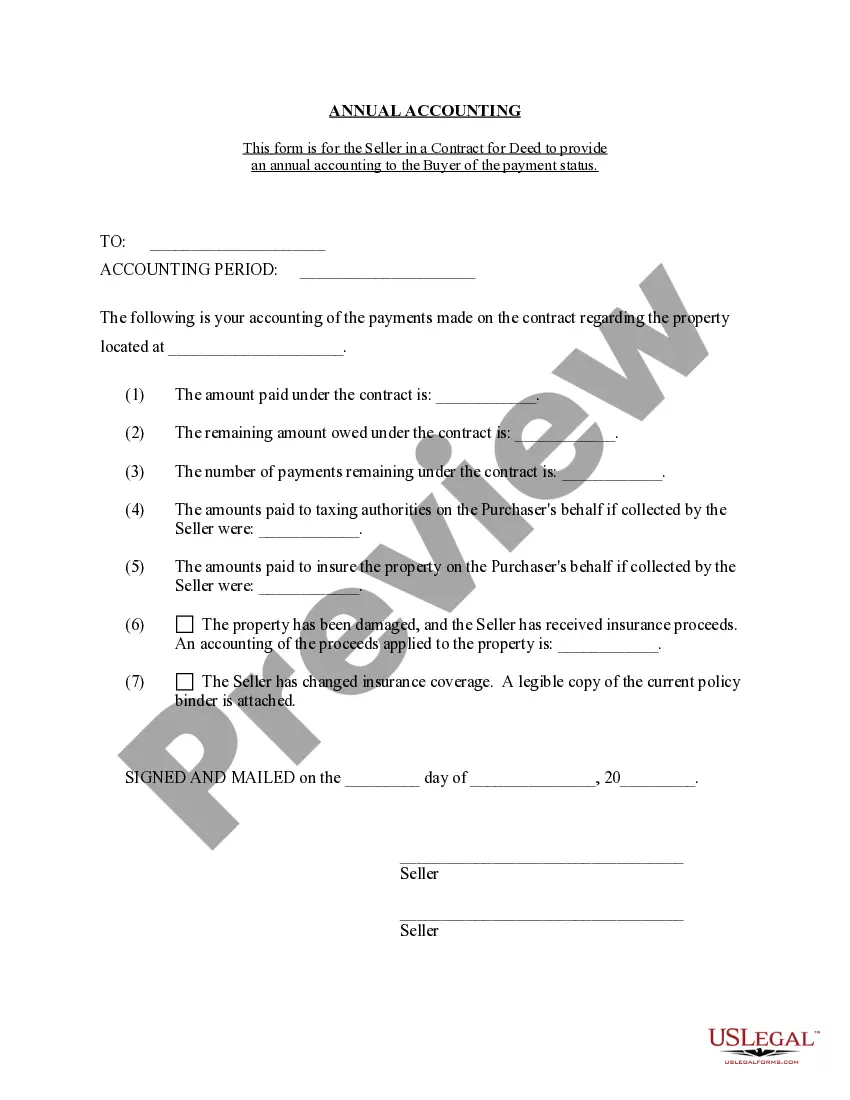
North Dakota Contract for Deed Seller's Annual Accounting Statement
Understanding this form
The Contract for Deed Seller's Annual Accounting Statement is a formal document that a seller provides to a purchaser on an annual basis. Its primary purpose is to inform the purchaser of the number and total amount of payments received toward the contract for deed's purchase price and interest. This form plays a crucial role in maintaining transparency and keeping accurate records of financial transactions between the seller and purchaser.
Key parts of this document
- Seller's identity and contact information.
- Purchaser's name and details.
- Date of the accounting statement.
- Number and amounts of payments received.
- Total outstanding balance of the purchase price and interest.

When this form is needed
This form is typically used annually by sellers who have entered into a contract for deed with a purchaser. It is essential to provide this statement to the purchaser as it keeps them informed about the payment progress and any outstanding balances. Use this form at the end of each year to fulfill your reporting obligations to the purchaser.
Who can use this document
- Sellers who have entered into a contract for deed agreement.
- Purchasers who need to track payments made toward the purchase of property.
- Real estate professionals involved in contract for deed transactions.
How to prepare this document
- Identify and enter your name and contact information as the seller.
- Include the purchaser's name and their contact information.
- Enter the date the accounting statement is prepared.
- Document the number of payments received and their total amounts.
- Specify any remaining balance on the purchase price and interest.
Notarization guidance
This form does not typically require notarization to be legally valid. However, some jurisdictions or document types may still require it. US Legal Forms provides secure online notarization powered by Notarize, available 24/7 for added convenience.
Get your form ready online
Our built-in tools help you complete, sign, share, and store your documents in one place.
Make edits, fill in missing information, and update formatting in US Legal Forms—just like you would in MS Word.
Download a copy, print it, send it by email, or mail it via USPS—whatever works best for your next step.
Sign and collect signatures with our SignNow integration. Send to multiple recipients, set reminders, and more. Go Premium to unlock E-Sign.
If this form requires notarization, complete it online through a secure video call—no need to meet a notary in person or wait for an appointment.
We protect your documents and personal data by following strict security and privacy standards.

Make edits, fill in missing information, and update formatting in US Legal Forms—just like you would in MS Word.

Download a copy, print it, send it by email, or mail it via USPS—whatever works best for your next step.

Sign and collect signatures with our SignNow integration. Send to multiple recipients, set reminders, and more. Go Premium to unlock E-Sign.

If this form requires notarization, complete it online through a secure video call—no need to meet a notary in person or wait for an appointment.

We protect your documents and personal data by following strict security and privacy standards.
Common mistakes
- Failing to include all payments received during the accounting period.
- Not updating the outstanding balance accurately.
- Omitting required signatures or dates.
- Using incorrect names or contact information for the seller or purchaser.
Advantages of online completion
- Convenient access to downloadable templates available anytime.
- Editable formats to customize according to your specific needs.
- Ensures reliability with professionally drafted legal content.
- Saves time by streamlining the process of preparing legal documents.
Main things to remember
- The Seller's Annual Accounting Statement provides a clear record of payment history between the Seller and Purchaser.
- Proper completion of this form is crucial for legal and financial accuracy regarding the Contract for Deed.
- Annual documentation helps prevent disputes and ensures transparency in property transactions.
Looking for another form?
Form popularity
FAQ
V. to transfer title (official ownership) to real property (or an interest in real property) from one (grantor) to another (grantee) by a written deed (or an equivalent document such as a judgment of distribution which conveys real property from an estate).
In NSW, for a deed to be enforceable, it must be in writing. The deed must also be signed, sealed and delivered to the counterparty for it to be binding. You will also need a witness who is not a party to the deed.
It involves a criminal stealing your identity and forging deed or title documents in order to "sell it" to unsuspecting buyers or borrow against it. However, these terms are somewhat of a misnomer - criminals can't actually "steal" your deed or your house for that matter.
It's a good idea to keep the original deeds though, as they can hold extra information, about legal boundaries or who the previous owner was, for example. If your property isn't on the register and you choose to apply for first registration, you'll need to submit the original deeds to us.
For real estate purposes, title refers to ownership of the property, meaning that you have the rights to use that property.Deeds, on the other hand, are actually the legal documents that transfer title from one person to another. It must be a written document, according to the Statute of Frauds.
Key Takeaways. A property deed is a legal document that transfers the ownership of real estate from a seller to a buyer. For a deed to be legal it must state the name of the buyer and the seller, describe the property that is being transferred, and include the signature of the party that is transferring the property.
When you own a home, you own both the deed and title for that property. In real estate, title means you have ownership and a right to use the property.The deed is the physical legal document that transfers ownership. It shows who you bought your house from, and when you sell it, it shows who you sold it to.
A deed is an official written document declaring a person's legal ownership of a property, while a title refers to the concept of ownership rights.
A deed is usually any written legal document that transfers, affirms, or confirms the interest, rights, property, etc. A valid deed requires that the grantor, the original owner of the land conveys his interest to the guarantee, the recipient of the title.