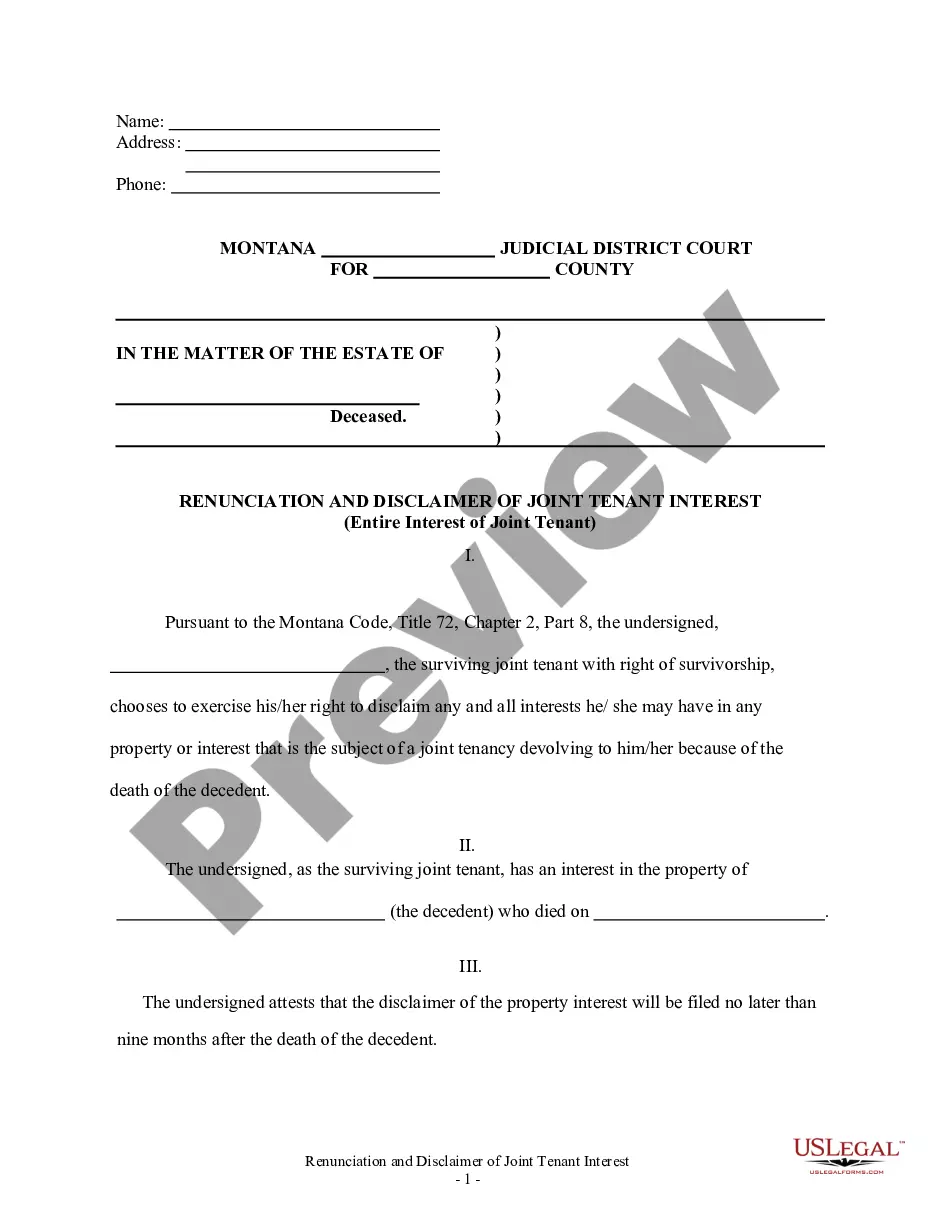
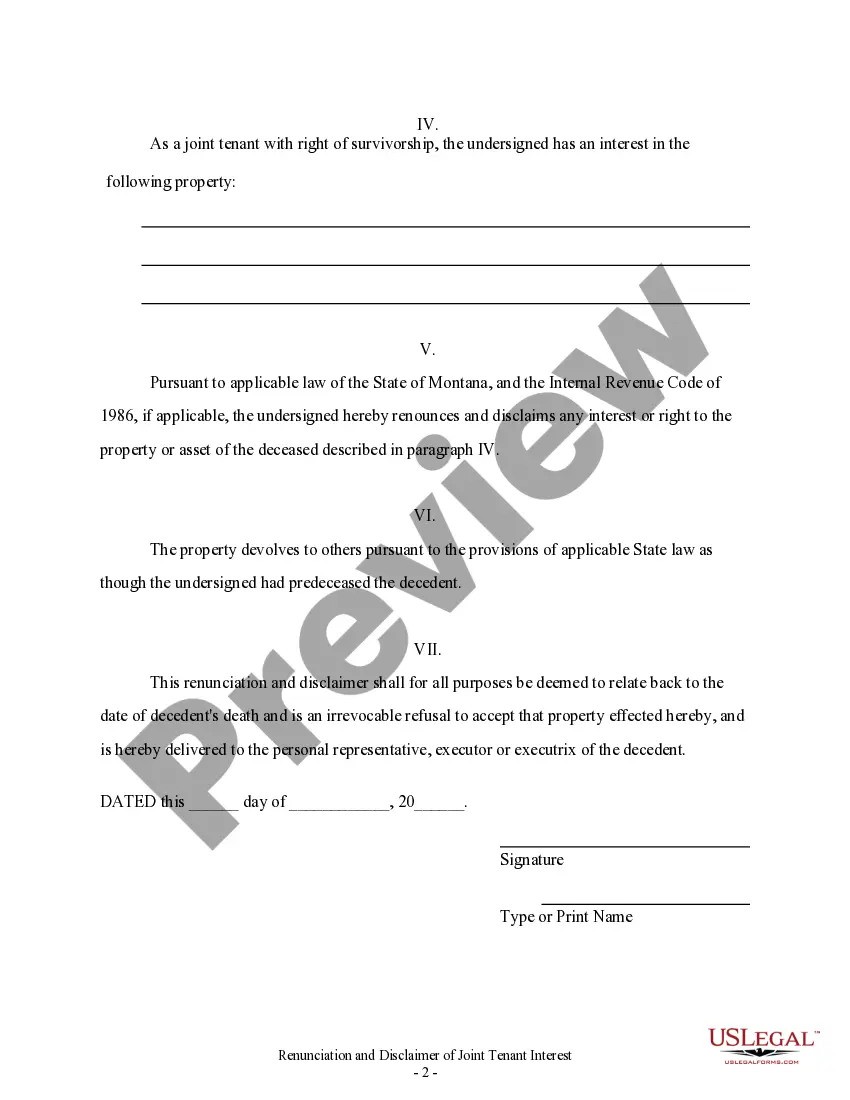
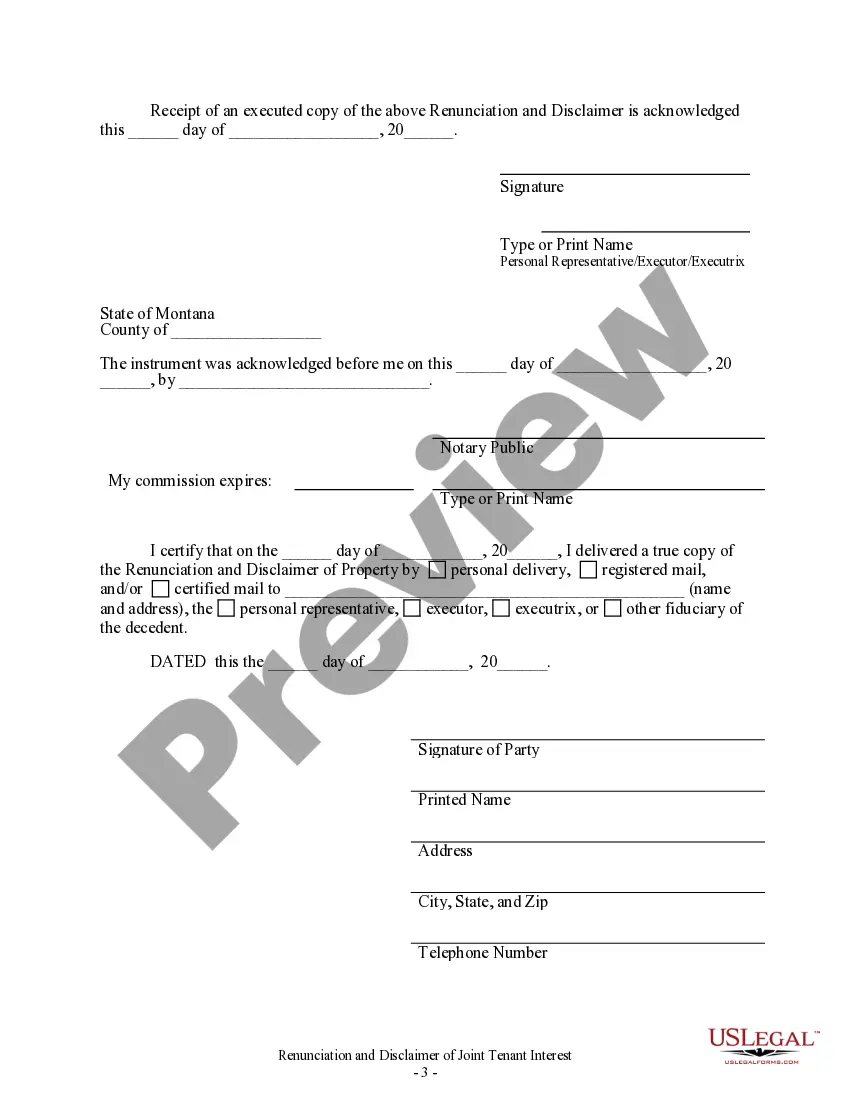
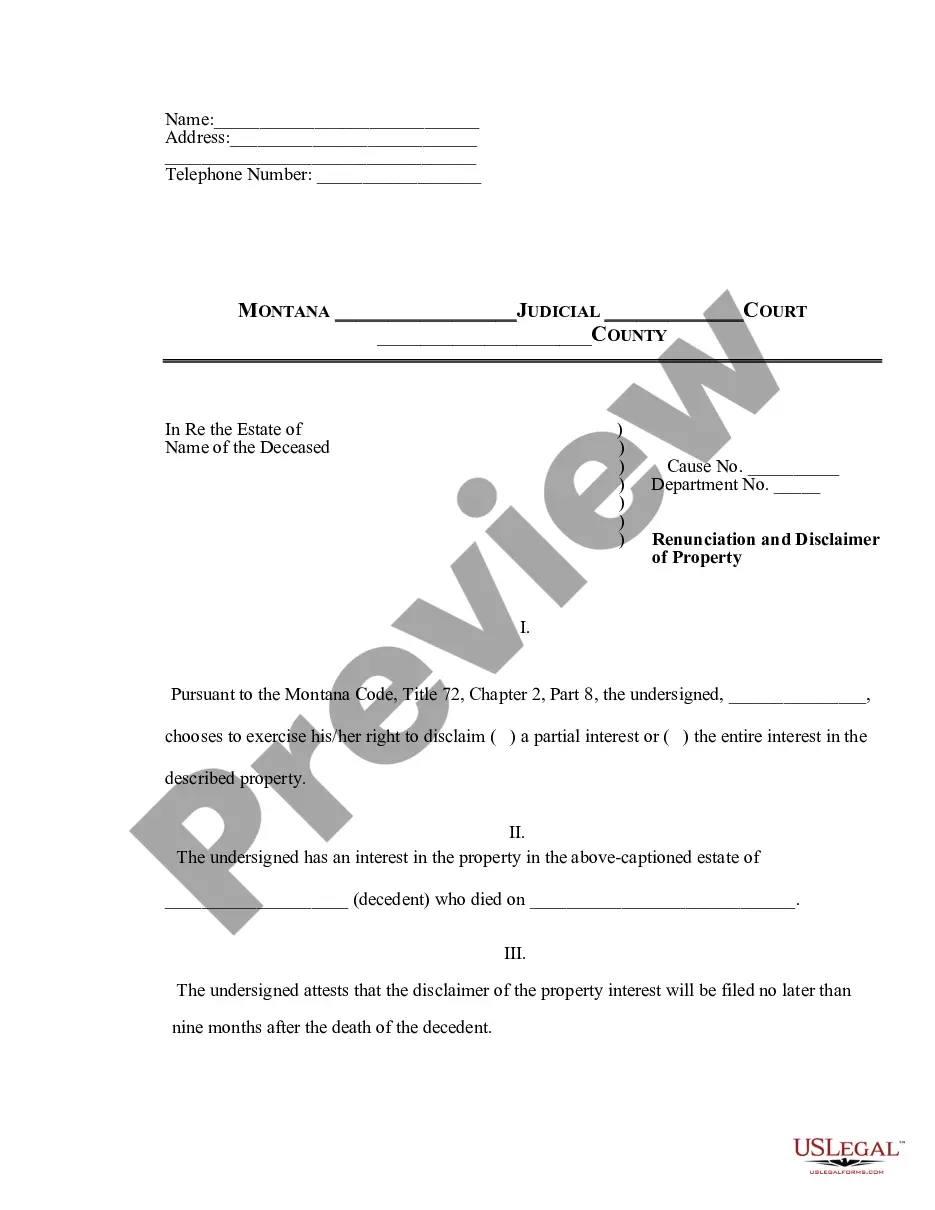
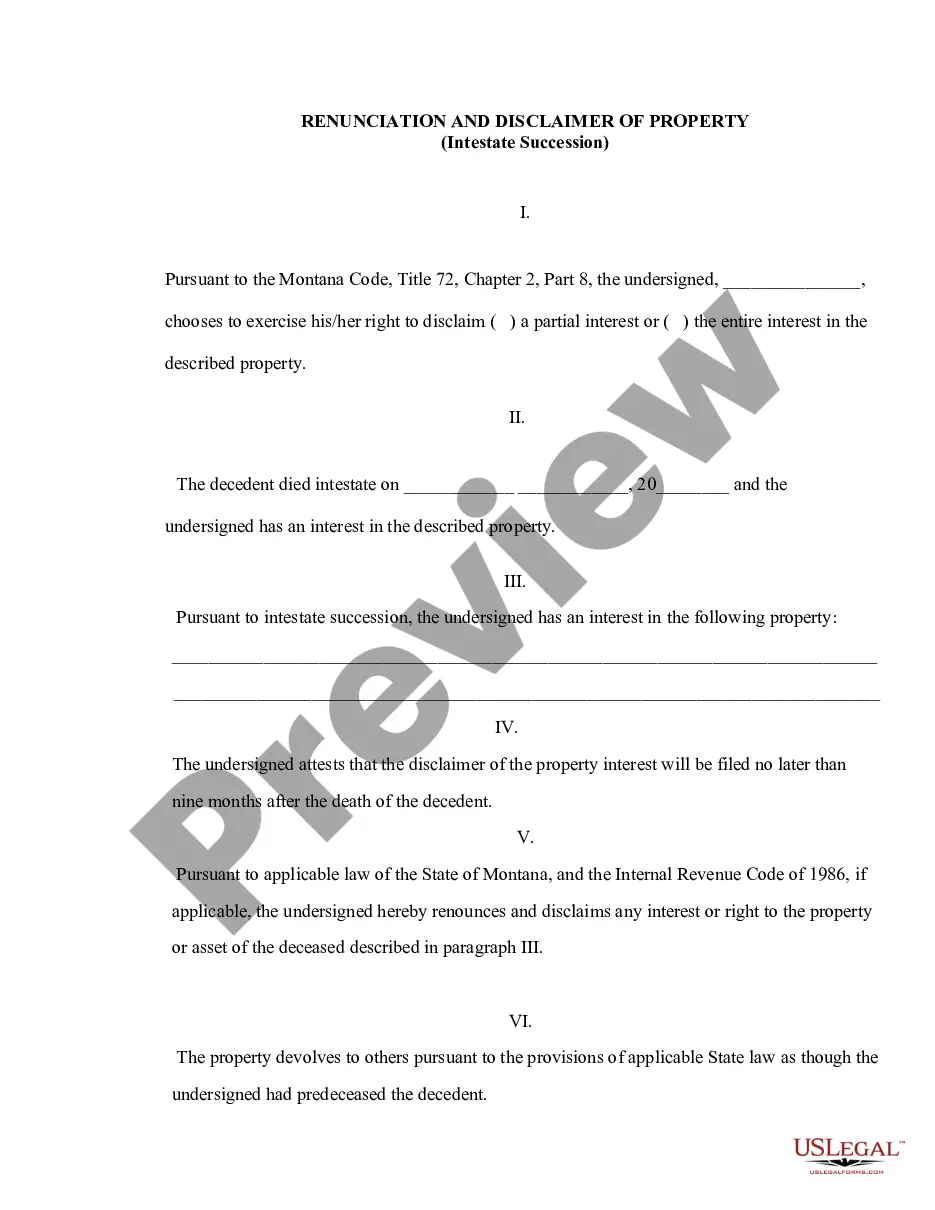
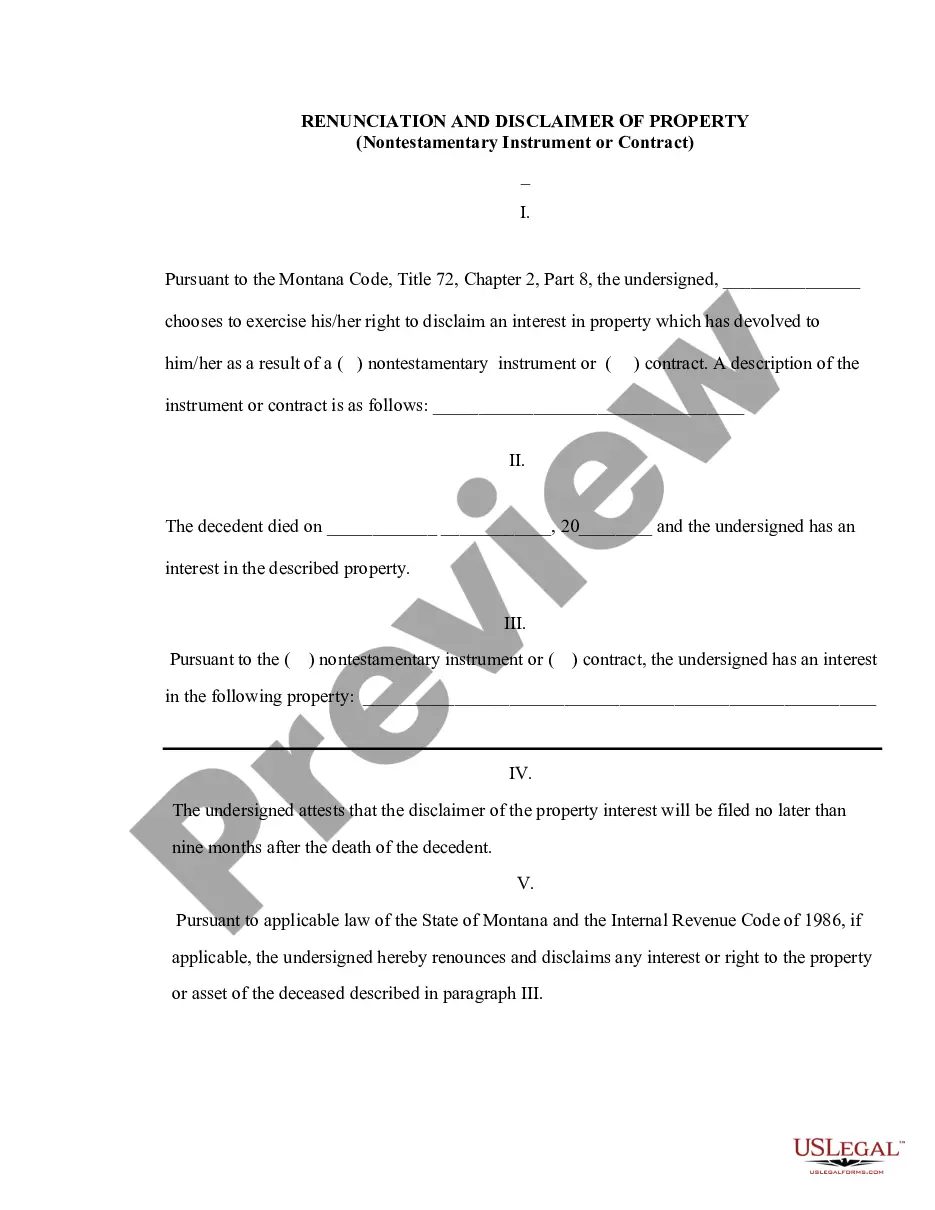
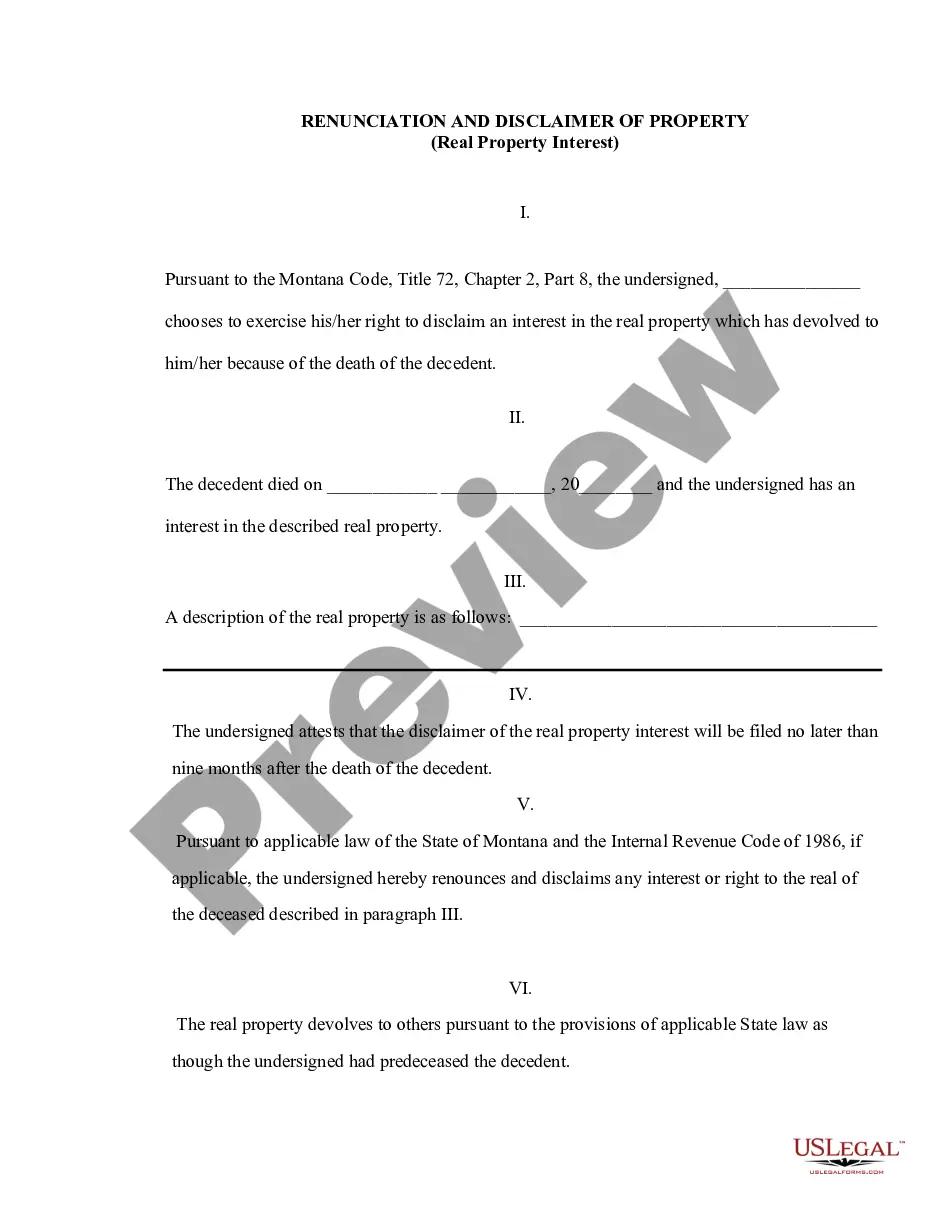
Montana Renunciation and Disclaimer of Joint Tenant or Tenancy Interest
Disclaimer of Property
Interest-Montana
Title 72 ESTATES, TRUSTS, AND FIDUCIARY RELATIONSHIPS
CHAPTER 2 UPC -- INTESTACY, WILLS, AND DONATIVE TRANSFERS
Part 8 General Provisions Concerning Probate and Nonprobate Transfers
Disclaimer of property interests.
(1) (a) A person or the representative of a person to whom
an interest in or with respect to property or an interest in the property
devolves by whatever means may disclaim it in whole or in part by delivering
or filing a written disclaimer under this section.
(c) For purposes of this subsection (1), the "representative of a person"
includes a personal representative of a decedent; a conservator of a disabled
person; a guardian of a minor or incapacitated person; a guardian ad litem
of a minor, an incapacitated person, an unborn person, an unascertained
person, or a person whose identity or address is unknown; and an agent
acting on behalf of the person within the authority of a power of attorney.
The representative of a person may rely on a general family benefit accruing
to the living members of the represented person's family as a basis for
making a disclaimer.
(a) If the property or interest has devolved to the disclaimant
under a testamentary instrument or by the laws of intestacy, the disclaimer
must be filed, if of a present interest, not later than 9 months after
the death of the deceased owner or deceased donee of a power of appointment
and, if of a future interest, not later than 9 months after the event determining
that the taker of the property or interest is finally ascertained and the
taker's interest is indefeasibly vested. The disclaimer must be filed in
the court of the county in which proceedings for the administration of
the estate of the deceased owner or deceased donee of the power have been
commenced. A copy of the disclaimer must be delivered in person or mailed
by certified mail, return receipt requested, to any personal representative
or other fiduciary of the decedent or donee of the power.
(b) If a property or interest has devolved to the disclaimant under
a nontestamentary instrument or contract, the disclaimer must be delivered
or filed, if of a present interest, not later than 9 months after the effective
date of the nontestamentary instrument or contract and, if of a future
interest, not later than 9 months after the event determining that the
taker of the property or interest is finally ascertained and the taker's
interest is indefeasibly vested. If the person entitled to disclaim does
not know of the existence of the interest, the disclaimer must be delivered
or filed not later than 9 months after the person learns of the existence
of the interest. The effective date of a revocable instrument or contract
is the date on which the maker no longer has power to revoke it or to transfer
to the maker or another the entire legal and equitable ownership of the
interest. The disclaimer or a copy of the disclaimer must be delivered
in person or mailed by certified mail, return receipt requested, to the
person who has legal title to or possession of the interest disclaimed.
(c) A surviving joint tenant may disclaim as a separate interest
any property or interest in property devolving to the surviving joint tenant
by right of survivorship within 9 months after the death of the deceased
joint owner, regardless of whether the surviving joint tenant contributed
to the purchase of jointly held property or benefited from the jointly
held property prior to the other joint tenant's death.
(a) If property or an interest in property devolves to
a disclaimant under a testamentary instrument, under a power of appointment
exercised by a testamentary instrument, or under the laws of intestacy
and the decedent has not provided for another disposition of that interest,
should it be disclaimed, or of disclaimed or failed interests in general,
the disclaimed interest devolves as if the disclaimant had predeceased
the decedent, but if by law or under the testamentary instrument the descendants
of the disclaimant would share in the disclaimed interest by representation
or otherwise were the disclaimant to predecease the decedent, then the
disclaimed interest passes by representation, or passes as directed by
the governing instrument, to the descendants of the disclaimant who survive
the decedent. A future interest that takes effect in possession or enjoyment
after the termination of the estate or interest disclaimed takes effect
as if the disclaimant had predeceased the decedent. A disclaimer relates
back for all purposes to the date of the death of the decedent.
(b) If property or an interest in property devolves to a disclaimant
under a nontestamentary instrument or contract and the instrument or contract
does not provide for another disposition of that interest, should it be
disclaimed, or of disclaimed or failed interests in general, the disclaimed
interest devolves as if the disclaimant had predeceased the effective date
of the instrument or contract, but if by law or under the nontestamentary
instrument or contract the descendants of the disclaimant would share in
the disclaimed interest by representation or otherwise were the disclaimant
to predecease the effective date of the instrument, then the disclaimed
interest passes by representation, or passes as directed by the governing
instrument, to the descendants of the disclaimant who survive the effective
date of the instrument. A disclaimer relates back for all purposes to that
date. A future interest that takes effect in possession or enjoyment at
or after the termination of the disclaimed interest takes effect as if
the disclaimant had died before the effective date of the instrument or
contract that transferred the disclaimed interest.
(a) an assignment, conveyance, encumbrance, pledge, or
transfer of the property or interest or a contract therefor;
(6) This section does not abridge the right of a person to waive, release,
disclaim, or renounce property or an interest in property under any other
statute.
(7) An interest in property that exists on October 1, 1993, as to
which, if a present interest, the time for filing a disclaimer under this
section has not expired or, if a future interest, the interest has not
become indefeasibly vested or the taker finally ascertained may be disclaimed
within 9 months after October 1, 1993.
History: En. 91A-2-801 by Sec. 1, Ch. 365, L. 1974; R.C.M. 1947, 91A-2-801;
amd. Sec. 1, Ch. 52, L. 1981; amd. Sec. 1, Ch. 511, L. 1983; amd. Sec.
5, Ch. 494, L. 1993; Sec. 72-2-101, MCA 1991; redes. 72-2-811 by Code Commissioner,
1993; amd. Sec. 20, Ch. 592, L. 1995; amd. Sec. 4, Ch. 290, L. 1999.
Official Comments: Purpose and Scope of Revisions.
This section brings into the Code the Uniform Disclaimer of Property Interests Act,
replacing the prior incorporation of the Uniform Disclaimer of Transfers
by Will, Intestacy or Appointment Act. The reason for incorporating the
broader Act is that the scope of Article II [Title 72, chapter 2] has now
been expanded to cover dispositive provisions not contained in wills.
Explanation of Revisions.
Only three revisions of the Uniform Disclaimer of Property Interests Act are adopted at this time, though the
Joint Editorial Board believes that this and the other Uniform Disclaimer
Acts are in need of revision in other respects.
Subsection (a) [72-2-811(1)]. Subsection (a) [72-2-811(1)] is revised
in two respects. First, the right to disclaim is extended to a decedent
through his or her personal representative. The Uniform Disclaimer of Property
Interests Act does not authorize disclaimers on behalf of a deceased person.
Second, the sentence authorizing a disclaimer despite a limitation or restriction
in the governing instrument is clarified to leave no doubt that an explicit
restriction or limitation on the right to disclaim in the governing instrument
is ineffective.
Subsection (d) [72-2-811(4)]. The third revision clarifies the effect
of a disclaimer. The Uniform Disclaimer of Property Interests Act states
that "it" shall devolve "as if the disclaimant had predeceased the decedent."
Literally interpreted, the word "it" refers to "the disclaimed interest,"
not to the estate as a whole. (One of the changes above is to make this
point unmistakable by replacing "it" with "the disclaimed interest.")
Unfortunately, even though the word "it" refers to the disclaimed
interest, not to the estate as a whole, there is still a plausible interpretation
of the phrase "the disclaimed interest devolves as if the disclaimant had
predeceased the decedent" that does not produce the desired result. The
desired result is to prevent an heir, for example, from using a disclaimer to effect a change in the division
of an intestate's estate. To illustrate this point, consider the following
example:
Under these facts, G's intestate estate is divided into
two equal parts: A takes half and B's child, Z, takes the other half. Suppose,
however, that A files a disclaimer. The desired effect of that disclaimer
is to prevent A from affecting the basic division of G's intestate estate
by this maneuver. If, however, the disclaimer statute merely provides that
the "disclaimed interest" devolves as though the disclaimant (A) had predeceased
the decedent, then A's one half interest would not pass only to X and Y,
but to X, Y, and Z. To prevent this possible interpretation of that language,
the "but if" phrase is added to (d)(1) [72-2-811(4)(a)] and (d)(2) [72-2-811(4)(b)].
This added phrase explicitly provides that A's disclaimed interest passes
to A's descendants, if A left any descendants.
Time Allowed for Filing Disclaimer.
It should be noted that there may be a discrepancy between the time allowed for filing a disclaimer
under this section (and under the freestanding Uniform Acts) and the time
allowed for filing a qualified disclaimer under the Internal Revenue Code
§ 2518. Lawyers are cautioned to check both the state and federal
disclaimer statutes before advising clients, especially with respect to
disclaimers of future interests.
Compiler's Comments:
1999 Amendment: Chapter 290 in (2)(c) near beginning after "devolving
to the" inserted "surviving" and inserted "within 9 months after the death
of the deceased joint owner, regardless of whether the surviving joint
tenant contributed to the purchase of jointly held property or benefited
from the jointly held property prior to the other joint tenant's death"
and at end deleted sentence that read: "A surviving joint tenant may disclaim
the entire interest in any property or interest in the property that is
the subject of a joint tenancy devolving to the joint tenant if the joint
tenancy was created by act of a deceased joint tenant, the survivor did
not join in creating the joint tenancy, and the survivor has not accepted
a benefit under it." Amendment effective April 9, 1999.
1995 Amendment: Chapter 592 in first sentence of (4)(a) and
(4)(b) substituted "share in the disclaimed interest by representation
or otherwise" for "take the disclaimant's share by representation" and
near end of both sentences, after "representation", inserted "or passes
as directed by the governing instrument"; and made minor changes in style.
1993 Amendment: Chapter 494 substituted current text concerning
disclaimer of property interests for former text that read:
"(1) A person or his personal representative or the representative
of an incapacitated or protected person who is an heir, devisee, person
succeeding to a renounced interest, donee, appointee, grantee, recipient,
or beneficiary under a trust or other nontestamentary instrument or under
a power of appointment exercised by a testamentary or nontestamentary instrument,
surviving joint owner or surviving joint tenant, or beneficiary or owner
of an insurance contract or any incident of ownership therein may renounce,
in whole or in part, the right of succession to any property or interest
therein, including a future interest, by filing a written renunciation
under this section. The instrument shall:
(2) The court may direct or permit a trustee under a testamentary or
nontestamentary instrument to renounce, modify, amend, or otherwise deviate
from any restriction on or power of administration, management, or allocation
of benefit upon finding that such restriction on the exercise of the power
may defeat or impair the accomplishment of the purposes of the trust, whether
by the imposition of tax, the allocation of beneficial interest inconsistent
with such purposes, or by other reason. Such authority shall be exercised,
after hearing and upon notice to all known persons beneficially interested
in such trust, in the manner directed by the court.
(3) The instrument of renunciation must be received by the transferor
of the interest, his legal representative, the personal representative
of a deceased transferor, the trustee of any trust in which the interest
being renounced exists, or the holder of the legal title to the property
to which the interest relates. To be effective for purposes of determining
inheritance and estate taxes, the instrument must be received not later
than the date which is 9 months after the later of the date on which the
transfer creating the interest in a person is made or the date on which
the person attains 18 years of age. If the circumstances that establish
the right of a person to renounce an interest arise as a result of the
death of an individual, the instrument must also be filed in the court
of the county where proceedings concerning the decedent's estate are pending
or where they would be pending if commenced. If real property or an interest
therein is renounced, a copy of the renunciation may be recorded in the
office of the county clerk and recorder of the county in which the real
estate is situated. No person entitled to a copy of the instrument is liable
for any proper distribution or disposition made without actual notice of
the renunciation, and no person making a proper distribution or disposition
in reliance upon the renunciation is liable for any such distribution or
disposition in the absence of actual notice that an action has been instituted
contesting the validity of the renunciation.
(4) Unless the transferor of the interest has otherwise provided,
the property or interest renounced devolves as though the person renouncing
had predeceased the decedent or, if the appointment was exercised by a
testamentary instrument, as though the person renouncing had predeceased
the donee of the power. A future interest that takes effect in possession
or enjoyment after the termination of the estate or interest renounced
takes effect as though the person renouncing had predeceased the decedent
or the donee of the power. A renunciation relates back for all purposes
to the date of the death of the decedent or the donee of the power.
(i) an assignment, conveyance, encumbrance, pledge, or
transfer of property or interest, or a contract therefor;
(6) This section does not abridge the right of a person to waive, release,
disclaim, or renounce property or an interest therein under any other statute.
(7) Within 30 days of receipt of a written instrument of renunciation
by the transferor of the interest, the renouncer, his legal representative,
the personal representative of the decedent, the trustee of any trust in
which the interest being renounced exists, or the holder of the legal title
to the property to which the interest relates, as the case may be, shall
attempt to notify in writing those persons who are known or ascertainable
with reasonable diligence who are recipients or potential recipients of
the renounced interest of the renunciation and the interest or potential
interest such recipient will receive as a result of the renunciation.
(8) Any interest in property which exists on July 1, 1983, may be
renounced after October 1, 1983, as provided in this section. An interest
that has arisen prior to July 1, 1983, in any person other than the person
renouncing is not destroyed or diminished by any action of the person renouncing
taken under this section."
Saving Clause: Section 136, Ch. 494, L. 1993, was
a saving clause.
1983 Amendment: In (1), after "renounced interest" substituted
"donee, appointee, grantee, recipient, or beneficiary under a . . . ownership
therein" (see 1983 Session Law for complete text) for "beneficiary under
a testamentary instrument, or appointee under a power of appointment exercised
by a testamentary instrument"; deleted former (2), which read:
"(a) An instrument renouncing a present interest shall
be filed within 9 months after the death of the decedent or the donee of
the power.
(b) An instrument renouncing a future interest may be filed not
later than 9 months after the event determining that the taker of the property
or interest is finally ascertained and his interest is indefeasibly vested.
(c) The renunciation must be filed in the court of the county in
which proceedings have been commenced for the administration of the estate
of the deceased owner or deceased donee of the power or, if they have not
been commenced, in which they could be commenced. A copy of the renunciation
shall be delivered in person or mailed by registered or certified mail
to any personal representative or other fiduciary of the decedent or donee
of the power. If real property or an interest therein is renounced, a copy
of the renunciation may be recorded in the office of the county clerk of
the county in which the real estate is situated."; inserted (2) allowing
trustee renunciation; inserted (3) relating to receipt of instrument of
renunciation and date of renunciation; in (4) near beginning of first sentence
substituted "transferor of the interest" for "decedent or donee of the
power"; deleted former (6), which read: "An interest in property which
exists on July 1, 1975, as to which, if a present interest, the time for
filing a renunciation under the Uniform Probate Code has not expired, or
if a future interest, the interest has not become indefeasibly vested or
the taker finally ascertained, may be renounced within 9 months after July
1, 1975."; inserted (7) concerning notice of renunciation; and inserted
(8) concerning renunciation of interest in property arising prior to and
existing on July 1, 1983.
Title 72, Chap. 2, Par 8, §72-2-811.