Missouri Warranty Deed from Individual to LLC
What is this form?
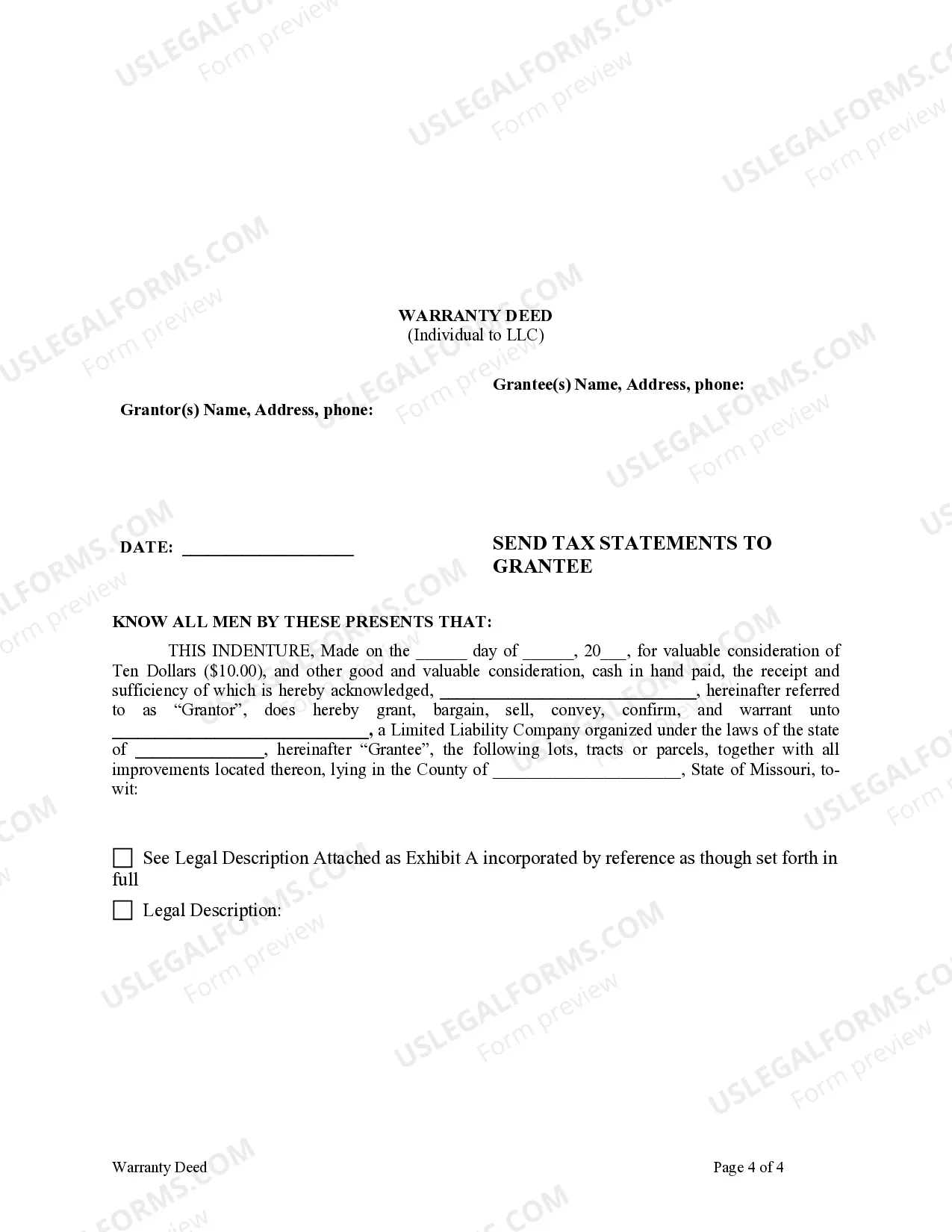
The Warranty Deed from Individual to LLC is a legal document used to transfer property ownership from an individual (the grantor) to a limited liability company (the grantee). This form ensures that the ownership is conveyed with warranties, meaning that the grantor guarantees clear title to the property being transferred. Unlike standard deeds, this specific form is tailored for transactions involving LLCs, making it essential for individuals wishing to transfer property into a business structure for liability protection or other business purposes.
Main sections of this form
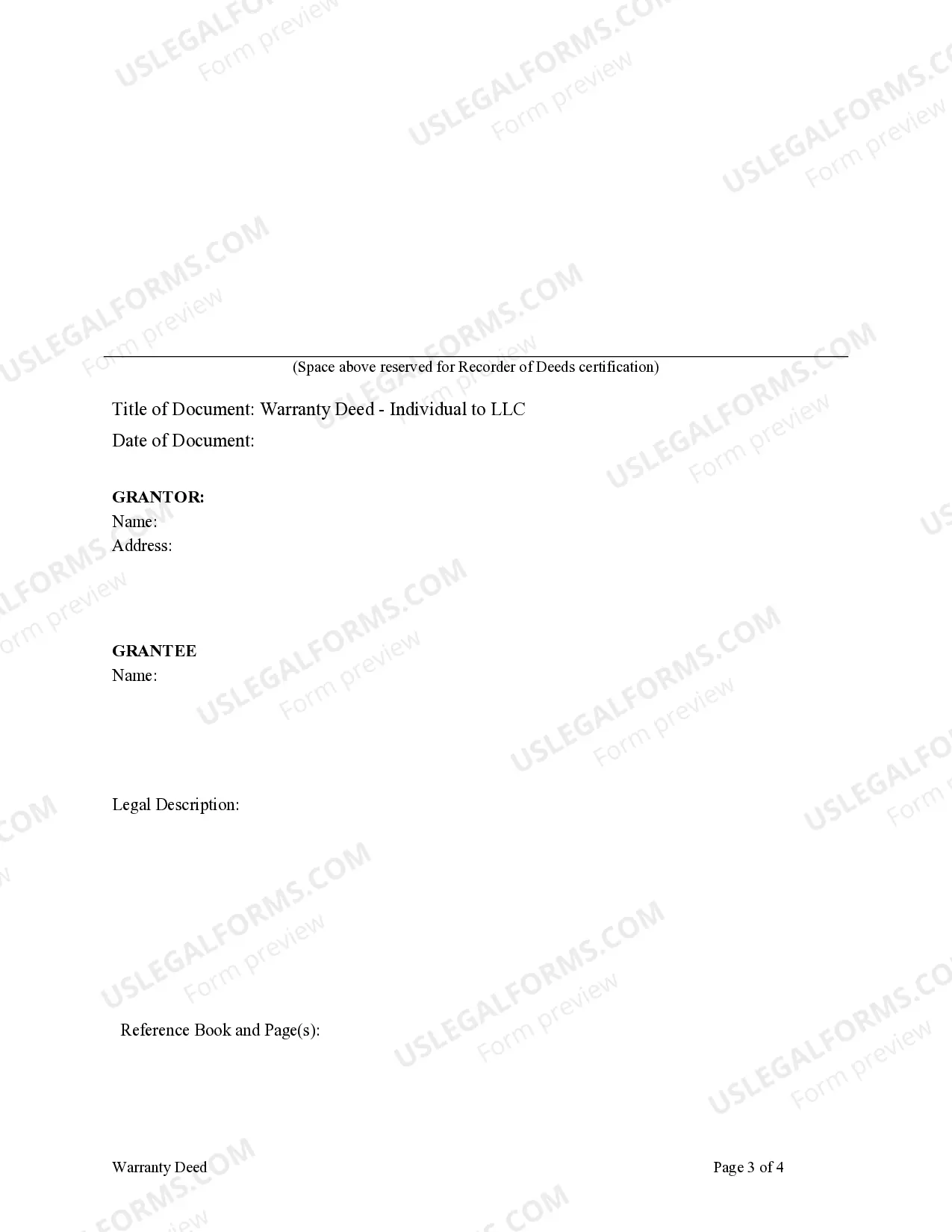
- Parties Involved: Identifies the grantor (individual) and the grantee (LLC), along with their contact information.
- Property Description: Requires a detailed legal description of the property being transferred.
- Consideration Clause: States that the transaction is for valuable consideration, typically a nominal amount of ten dollars.
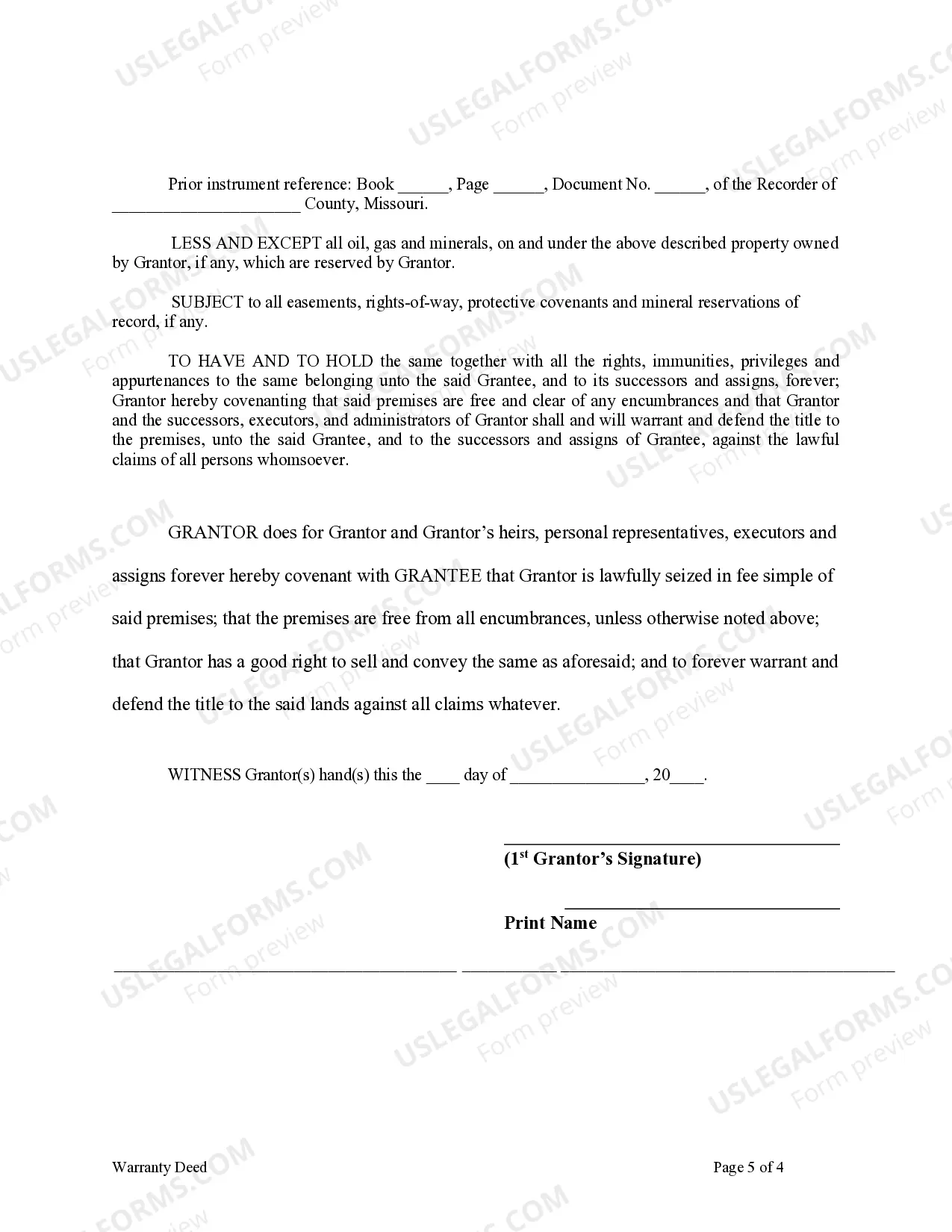
- Covenants: Includes warranties provided by the grantor regarding the title and encumbrances on the property.
- Signatures: Requires the signatures of the grantor to validate the deed transfer.





Situations where this form applies
This form should be used when an individual wishes to transfer real estate ownership to an LLC. Typical scenarios include transferring property for business purposes, asset protection, or to facilitate partnership investments. It is also relevant when converting personal property into business assets or when seeking to limit personal liability through a corporate structure.
Who this form is for
- Individuals who own real estate and want to transfer it to an LLC.
- Business owners looking to secure property under their LLC for liability benefits.
- Real estate investors interested in protecting assets through corporate structures.
How to complete this form
- Identify the parties: Enter the names and addresses of the grantor and grantee.
- Specify the property: Provide the exact legal description of the property being conveyed.
- Enter the date: Fill in the date of the transaction.
- Complete the consideration clause: State the amount of money or value exchanged.
- Sign the document: Ensure the grantor signs the deed in the specified area.
Notarization guidance
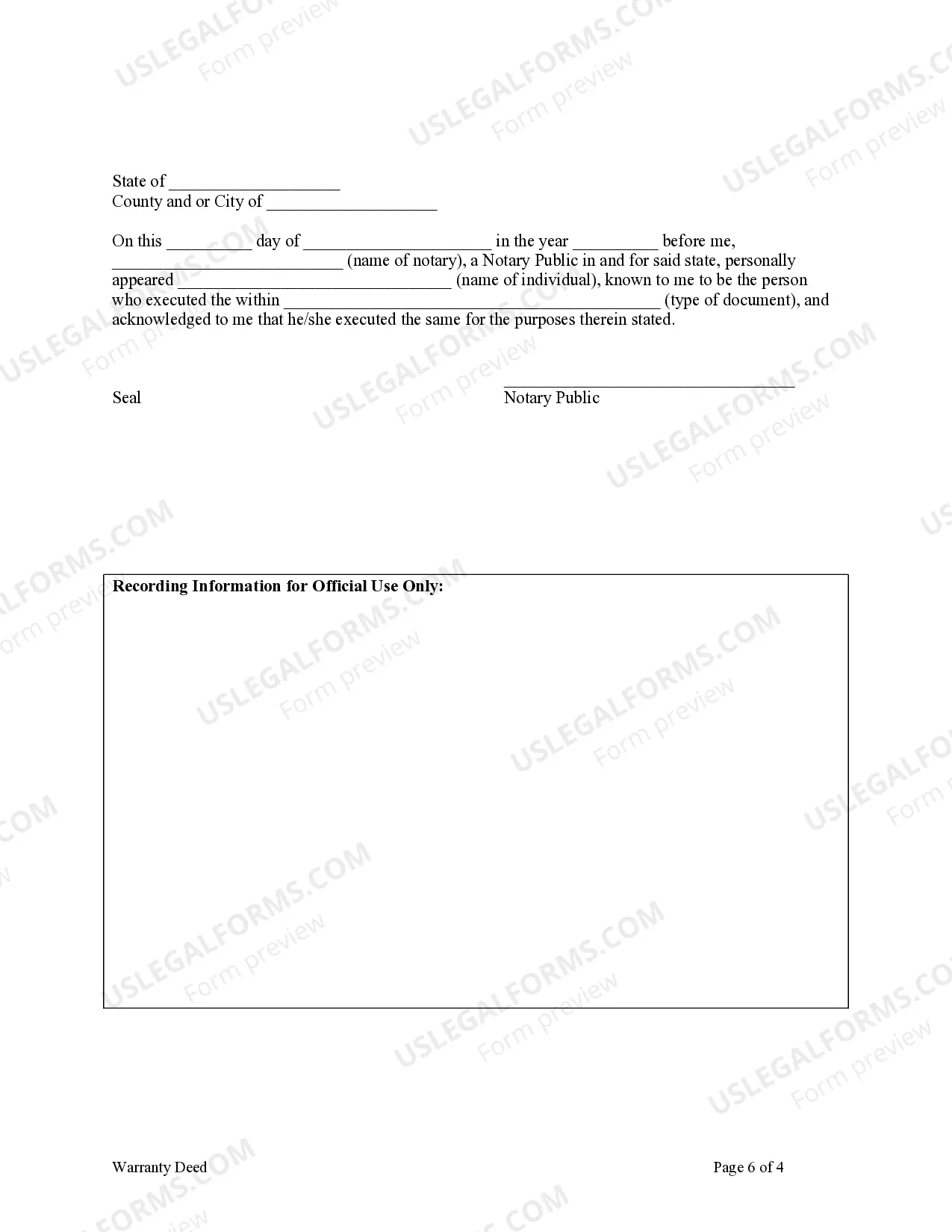
To make this form legally binding, it must be notarized. Our online notarization service, powered by Notarize, lets you verify and sign documents remotely through an encrypted video session.
Get your form ready online
Our built-in tools help you complete, sign, share, and store your documents in one place.
Make edits, fill in missing information, and update formatting in US Legal Forms—just like you would in MS Word.
Download a copy, print it, send it by email, or mail it via USPS—whatever works best for your next step.
Sign and collect signatures with our SignNow integration. Send to multiple recipients, set reminders, and more. Go Premium to unlock E-Sign.
If this form requires notarization, complete it online through a secure video call—no need to meet a notary in person or wait for an appointment.
We protect your documents and personal data by following strict security and privacy standards.

Make edits, fill in missing information, and update formatting in US Legal Forms—just like you would in MS Word.

Download a copy, print it, send it by email, or mail it via USPS—whatever works best for your next step.

Sign and collect signatures with our SignNow integration. Send to multiple recipients, set reminders, and more. Go Premium to unlock E-Sign.

If this form requires notarization, complete it online through a secure video call—no need to meet a notary in person or wait for an appointment.

We protect your documents and personal data by following strict security and privacy standards.
Common mistakes to avoid
- Failure to include a complete legal description of the property.
- Not providing all required signatures on the form.
- Incorrectly stating the consideration amount, which could lead to disputes.
- Missing the date of execution, which could affect the validity of the deed.
Benefits of completing this form online
- Access to professionally drafted legal documents tailored to your needs.
- Editable forms that can be completed quickly and easily from your computer.
- Instant downloads that save time and can be printed for immediate use.
- Guidance available throughout the process to ensure proper completion.
Looking for another form?

Form popularity
FAQ
To put your home in your LLC, start by drafting a Missouri Warranty Deed from Individual to LLC that reflects the property transfer. This document should include details about the property and the LLC. After completing the deed, file it with the county recorder’s office to make the transfer official. Using platforms like US Legal Forms can simplify this process, guiding you through the necessary steps and ensuring compliance.
To transfer ownership of an LLC in Missouri, you need to follow a few steps. First, consult your LLC's operating agreement to understand the required process for transferring membership interests. Then, prepare a Missouri Warranty Deed from Individual to LLC, which officially documents the transfer. Finally, file any necessary paperwork with the Missouri Secretary of State to update your LLC’s records.
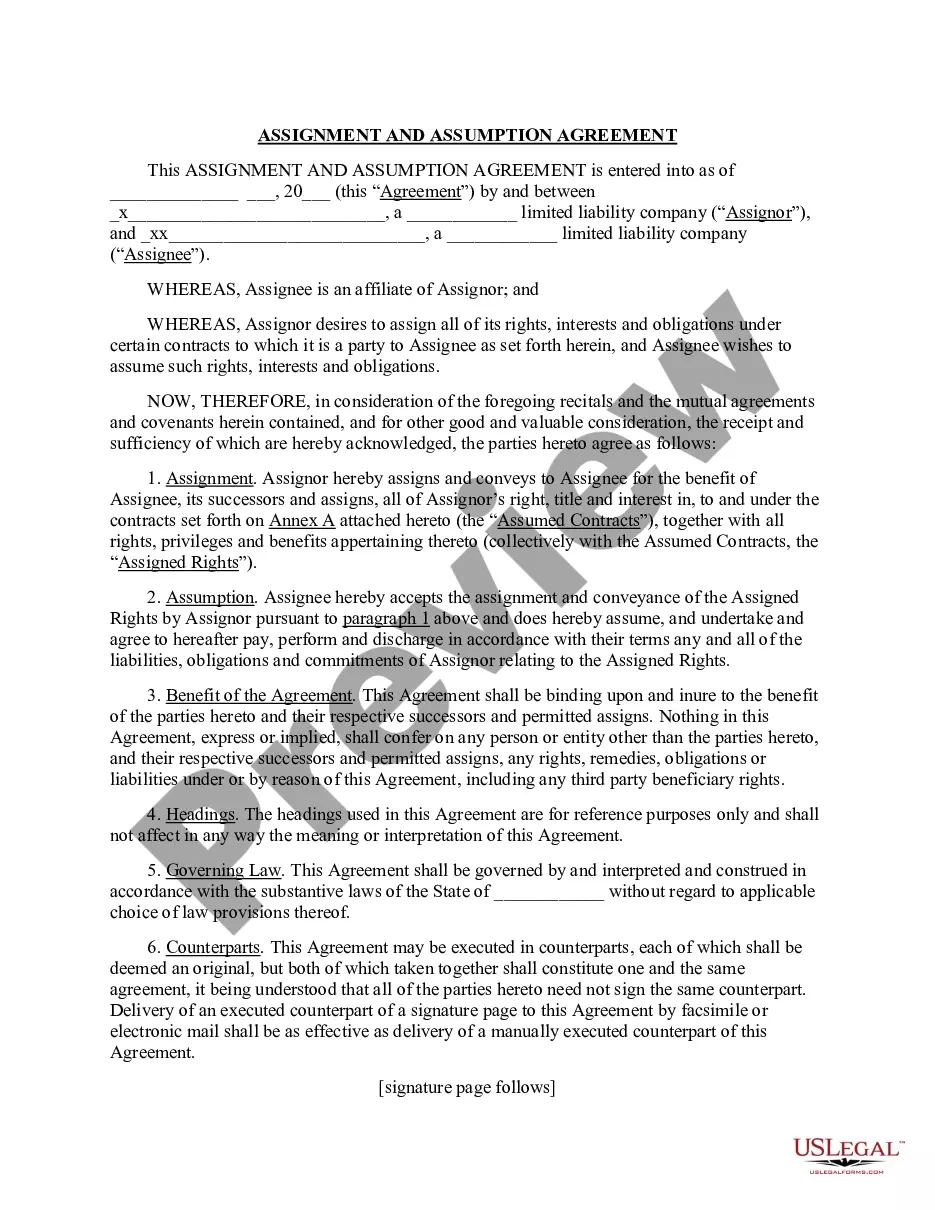
To transfer personal assets to an LLC, begin by identifying the assets you wish to transfer and prepare the necessary documentation, such as a Missouri Warranty Deed from Individual to LLC for real estate. Ensure all paperwork accurately reflects the transfer of ownership and is signed by all relevant parties. You can use resources from USLegalForms to streamline this process and ensure compliance with state requirements.
Transferring property from personal ownership to an LLC involves executing a Missouri Warranty Deed from Individual to LLC. First, you need to create the deed, which outlines the transfer of ownership. After signing the deed before a notary, you should record it at your local county office to ensure the transfer is legally recognized and documented.
To obtain a Missouri Warranty Deed from Individual to LLC, start by drafting the deed, including the necessary details such as the names of both parties and a description of the property. You can find templates and resources on platforms like USLegalForms, which can simplify the process. Once you have completed the deed, sign it in the presence of a notary public, and then file it with the county recorder’s office where the property is located.
Locate the Prior Deed to the Property. The prior deed includes important information that is needed to prepare the new deed. Get a New Deed to the Property. Sign and Notarize the New Deed. Record the New Deed in the Land Records.
Typically, the lender will provide you with a copy of the deed of trust after the closing. The original warranty deeds are often mailed to the grantee after they are recorded. These are your original copies and should be kept in a safe place, such as a fireproof lockbox or a safe deposit box at a financial institution.
It's important to note that a warranty deed does not actually prove the grantor has ownership (a title search is the best way to prove that), but it is a promise by the grantor that they are transferring ownership and if it turns out they don't actually own the property, the grantor will be responsible for compensating
Used to transfer property rights from a deceased person's estate. Involves Probate Court. Like a Quit Claim deed, there are no warranties. Generally, the Personal Representative is unwilling to warrant or promise anything relating to property that he/she has never personally owned.
The original deed is returned to the owner of the property from the office of the recorder after proper entry. The office of the Recorder of Deeds maintains a set of indexes about each deed recorded, for an easy search. Almost all states have a grantor-grantee index including a reference to all documents recorded.