Michigan Warranty Deed for a Time Share from an Individual to a Trust
Overview of this form
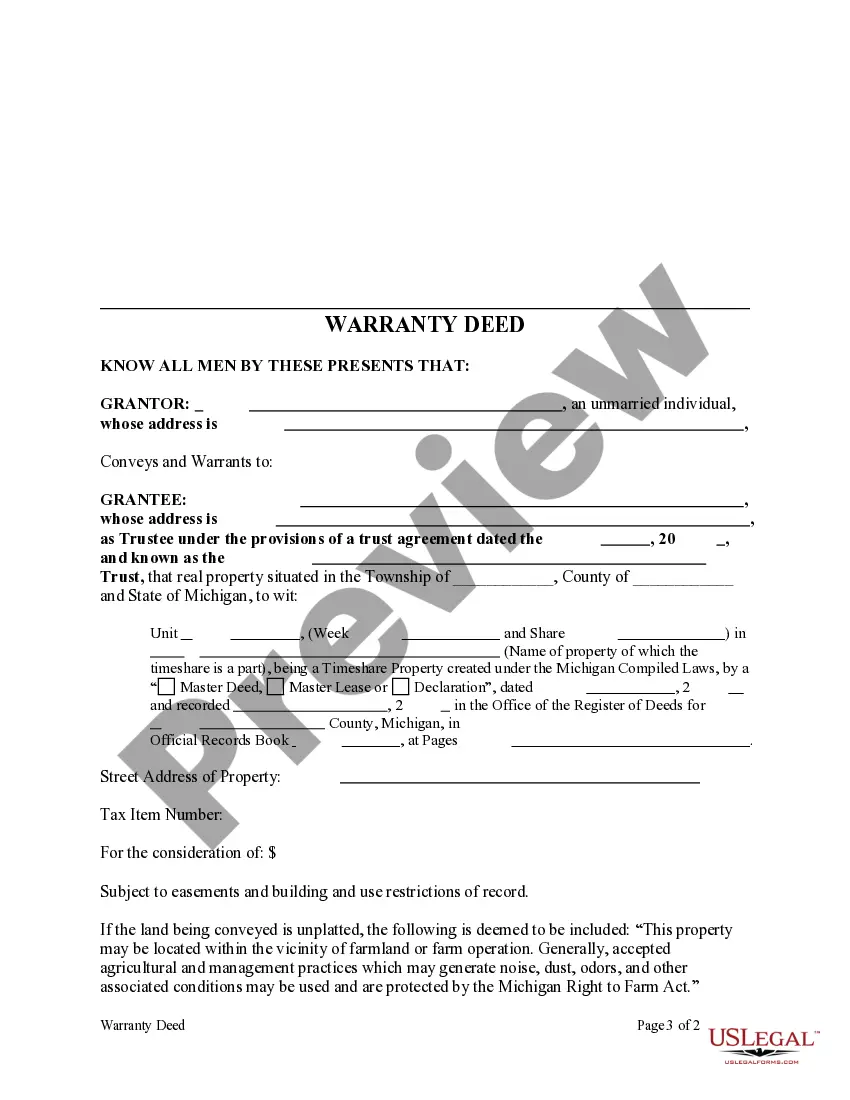
This form is a Warranty Deed for a Time Share where the Grantor, an individual, conveys and warrants the described property to a Trust as the Grantee. This legal document is essential for transferring ownership of a time share to a trust, ensuring that the trust holds legal title to the property. Unlike other forms of deeds, this warranty deed provides guarantees about the title, making it suitable for transferring interests in time shares specifically.
Key parts of this document
- Identification of the Grantor (individual) and Grantee (Trust).
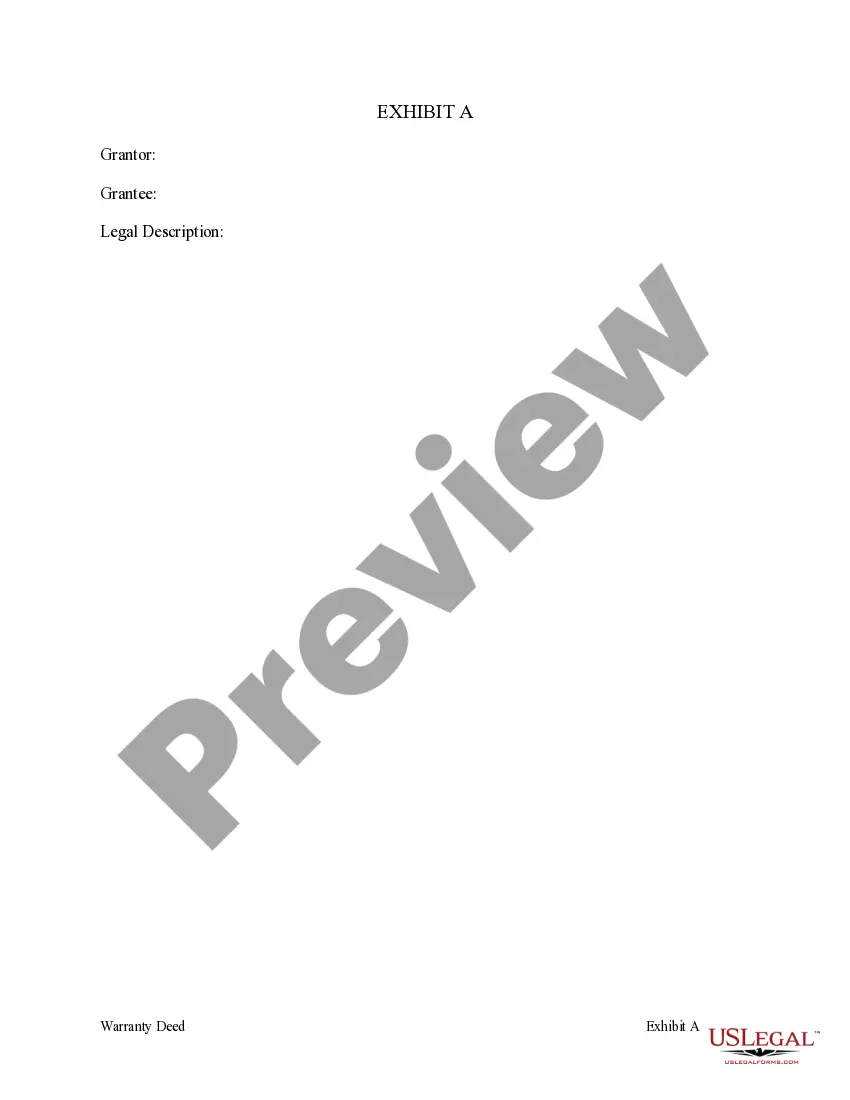
- Legal description of the time share property being transferred.
- Warranties made by the Grantor regarding the title of the property.
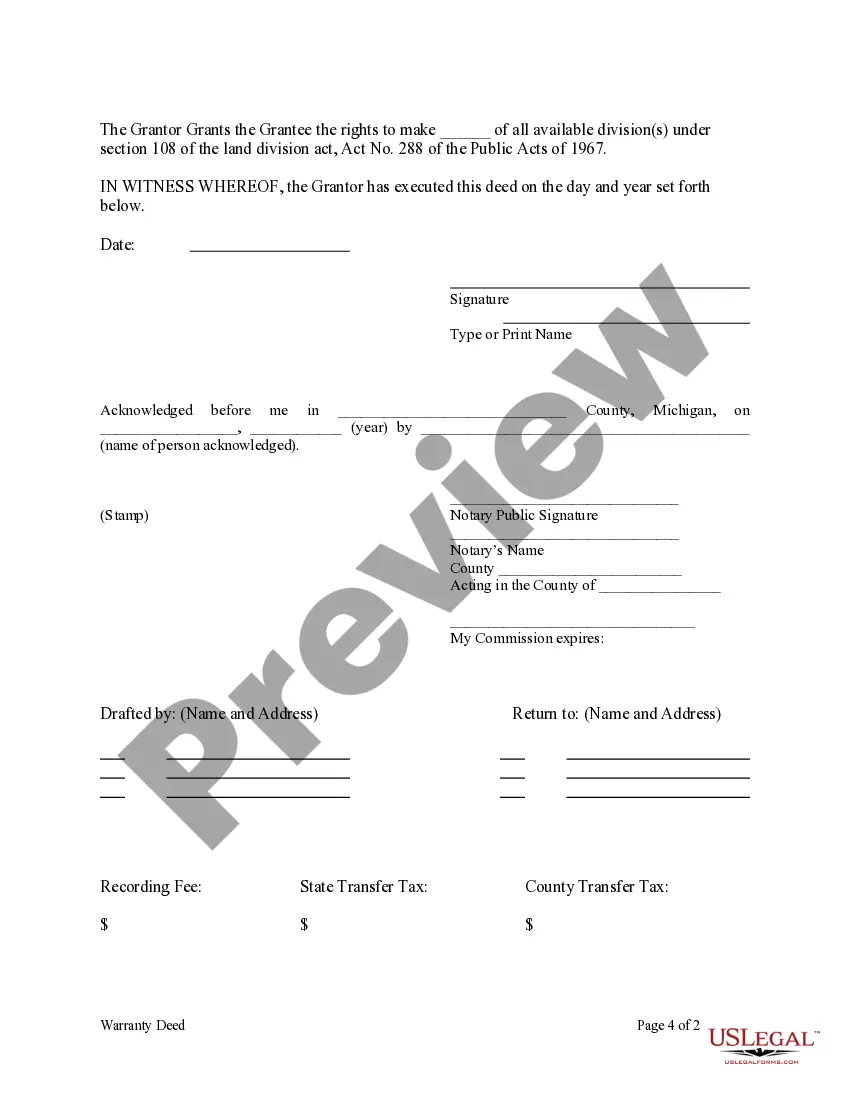
- Signature lines for the Grantor and any required witnesses.
- Notarization section, if applicable, to validate the document.




Common use cases
This Warranty Deed is typically used when an individual wants to transfer ownership of a time share to a trust for estate planning purposes. It is essential when setting up a trust to manage the time share property and ensure it is handled according to the Grantor's wishes. This deed may also be used in situations where the Grantor is looking to protect their assets or facilitate smoother management of the time share for beneficiaries.
Who should use this form
- Individuals transferring their time share ownership to a trust.
- Trustees or trust beneficiaries managing time share properties.
- Estate planners seeking to organize time share assets within a trust structure.
How to prepare this document
- Identify the parties involved by entering the full legal names of the Grantor and the Grantee Trust.
- Specify the time share property by providing its legal description, including address and unit number if applicable.
- Complete the warranty clauses, stipulating any warranties offered by the Grantor regarding the property title.
- Sign and date the form where indicated, ensuring that the Grantor's signature is notarized if necessary.
- Retain copies for both the Grantor's records and the Grantee Trust after the completion of the deed.
Notarization guidance
Yes, this form must be notarized to be legally valid. Notarization serves as a verification method that the signatures provided on the document are authentic. US Legal Forms offers integrated online notarization, allowing for a secure video call with a notary public anytime, ensuring your document is valid without the need for travel.
Get your form ready online
Our built-in tools help you complete, sign, share, and store your documents in one place.
Make edits, fill in missing information, and update formatting in US Legal Forms—just like you would in MS Word.
Download a copy, print it, send it by email, or mail it via USPS—whatever works best for your next step.
Sign and collect signatures with our SignNow integration. Send to multiple recipients, set reminders, and more. Go Premium to unlock E-Sign.
If this form requires notarization, complete it online through a secure video call—no need to meet a notary in person or wait for an appointment.
We protect your documents and personal data by following strict security and privacy standards.

Make edits, fill in missing information, and update formatting in US Legal Forms—just like you would in MS Word.

Download a copy, print it, send it by email, or mail it via USPS—whatever works best for your next step.

Sign and collect signatures with our SignNow integration. Send to multiple recipients, set reminders, and more. Go Premium to unlock E-Sign.

If this form requires notarization, complete it online through a secure video call—no need to meet a notary in person or wait for an appointment.

We protect your documents and personal data by following strict security and privacy standards.
Typical mistakes to avoid
- Failing to include the full legal name of the Grantor or Grantee.
- Not providing a complete legal description of the time share property.
- Omitting necessary signatures or failing to have the signature notarized when required.
- Completing the form without consulting state-specific regulations affecting time share transfers.
Benefits of completing this form online
- Convenience of downloading and completing the form at your own pace from any device.
- Editability allows you to fill out the form digitally before printing.
- Access to forms drafted by licensed attorneys ensures compliance with legal standards.
- Reduced time in obtaining the necessary documents as they are instantly available for download.
Legal use & context
- This Warranty Deed provides a legal basis for the transfer of title of a time share from an individual to a trust.
- It is enforceable in a court of law, provided it is executed correctly and complies with state laws.
- Limitations or additional requirements may exist based on local legislation or specific trust provisions.
Quick recap
- A Warranty Deed for a Time Share is crucial for transferring ownership from an individual to a trust.
- Accuracy in completing and executing the form is essential to avoid legal complications.
- Utilizing online resources streamlines the process of obtaining and managing legal documents.
Looking for another form?

Form popularity
FAQ
The name and address of the seller (called the grantor) The name and address of the buyer (called the grantee) A legal description of the property (found on the previous deed) A statement that the grantor is transferring the property to the grantee.
The act of transferring a property that is owned by an individual into a trust, will see the trust liable to pay stamp duty on acquisition of the asset. Additionally, the individual who is transferring ownership to the trust, will be liable to pay capital gains tax on the disposal of the asset.
The law doesn't forbid adding people to a deed on a home with an outstanding mortgage. Mortgage lenders are familiar and frequently work with deed changes and transfers.When you "deed" your home to someone, you've effectively transferred part ownership, which could activate the "due-on-sale" clause.
When you purchase property, the previous owner will transfer the warranty deed to you. However, if you're paying for your home with a mortgage, as most people do, the warranty deed is not free and clear.You must deal with your mortgage appropriately if you move to sell your home.
How To Establish A Trust. You will need to retain an estate attorney to draft and execute your trust document. For a simple revocable or irrevocable trust, it may cost anywhere from $2,000 $5,000.
If the property is to be transferred to a beneficiary the Executor or Administrator will need to submit a document called an 'Assent' to the Land Registry, with a copy of the Grant of Representation. The Land Registry will then transfer the property into the name of the new owner.
Locate your current deed. Use the proper deed. Check with your title insurance company and lender. Prepare a new deed. Sign in the presence of a notary. Record the deed in the county clerk's office. Locate the deed that's in trust. Use the proper deed.
No. And unless the deed identifies the trust as an owner, then father is the owner of an interest. It is a common mistake to set up a trust and then fail to deed property into the trust. However, you cannot force him to make the changes you are...
Retrieve your original deed. Get the appropriate deed form. Draft the deed. Sign the deed before a notary. Record the deed with the county recorder. Obtain the new original deed.