Maryland Living Trust Property Record
Understanding this form
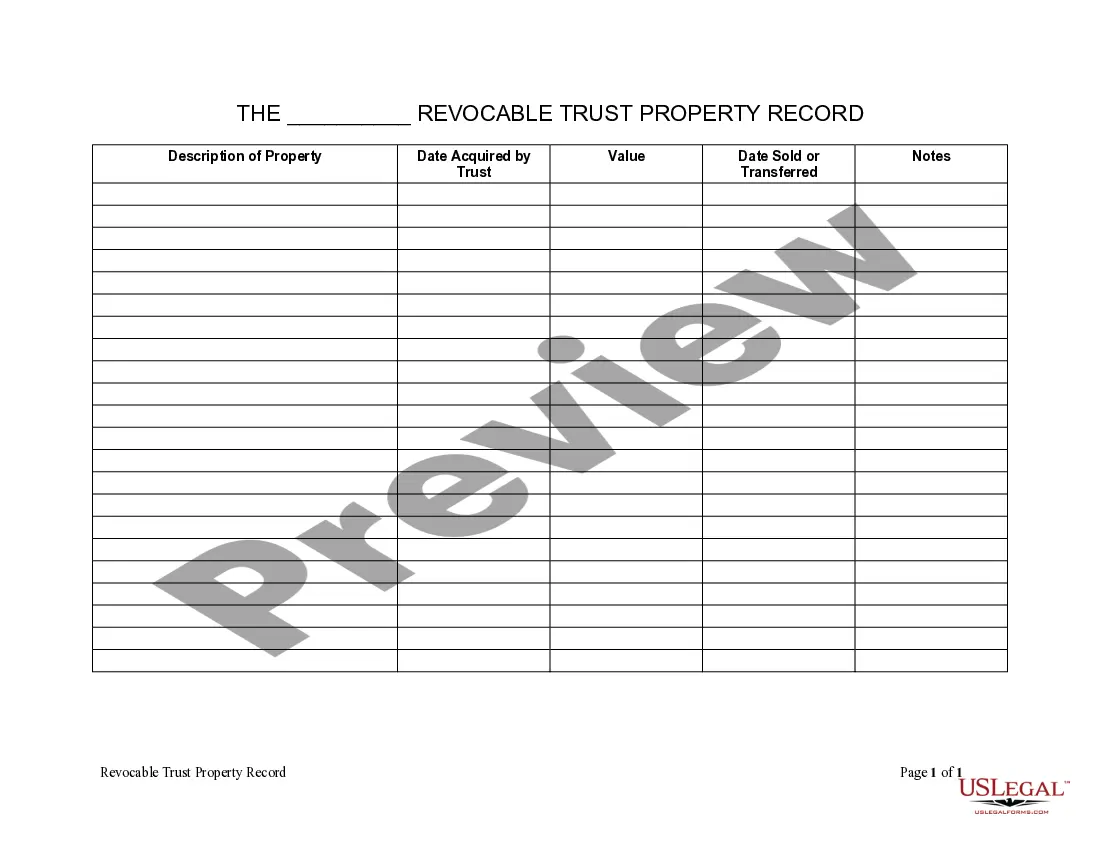
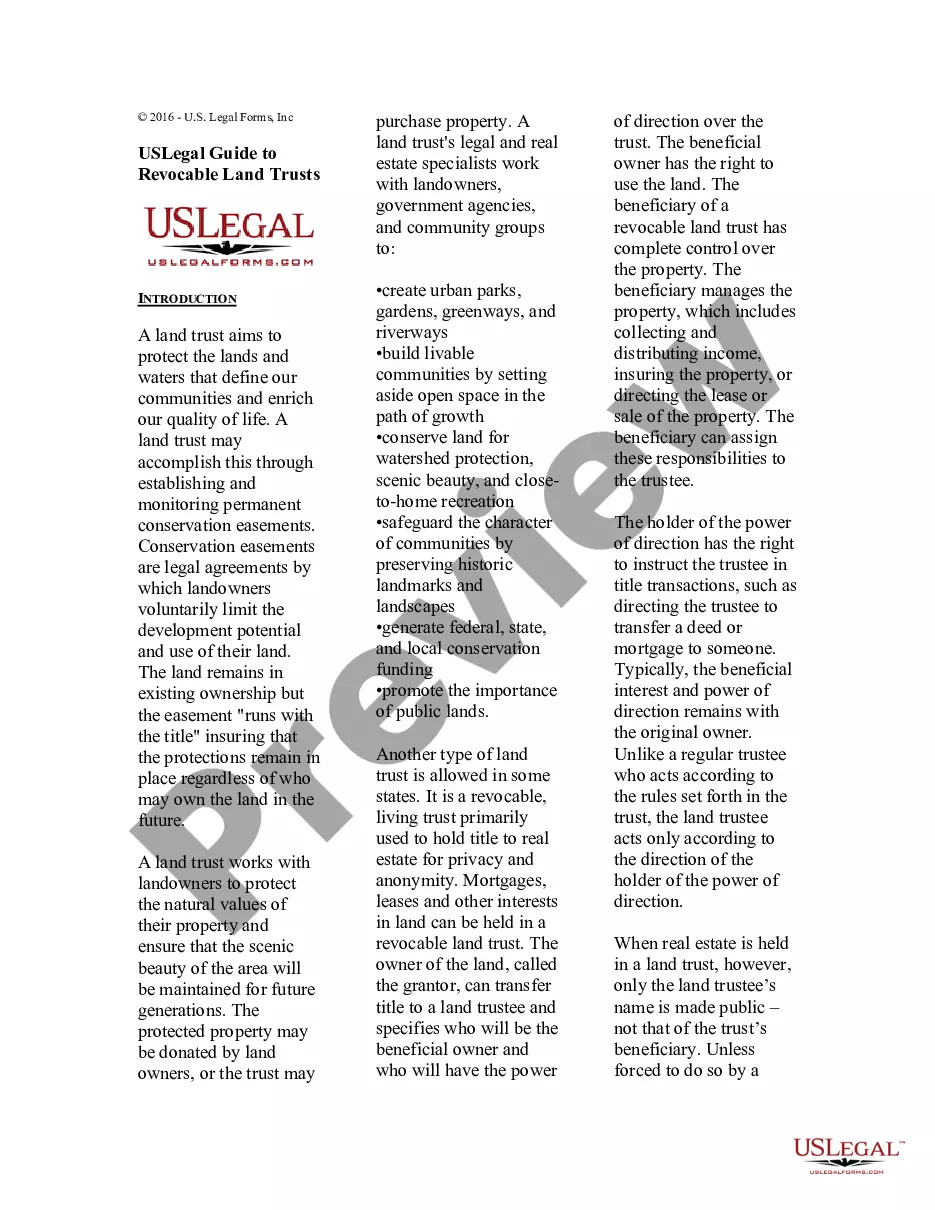
The Living Trust Property Record is a specialized inventory form used to document assets placed in a living trust. A living trust is established during an individual's lifetime to manage assets and facilitate estate planning. This form enables the trustee to record crucial details about each property included in the trust, such as its description, the date acquired, its value, and any date sold or transferred. By maintaining an accurate property inventory, this form helps ensure that all assets within the trust are accounted for, providing clarity and organization compared to other property management forms.
Key components of this form
- Description of property: Space to detail the specific assets included in the trust.
- Date acquired by trust: The date on which each asset was transferred into the trust.
- Value: The monetary value assigned to each asset at the time it was added to the trust.
- Date sold or transferred: The date when an asset is sold or moved out of the trust, if applicable.

When to use this form
This form is essential for individuals who have established a living trust and wish to keep comprehensive records of the property held within. It is particularly useful during estate planning, ensuring that beneficiaries and trustees have a clear understanding of the trust's contents. It can also be beneficial when updating the trust as new properties are acquired or existing assets are sold or transferred.
Intended users of this form
This form is intended for:
- Individuals creating or managing a living trust.
- Trustees responsible for overseeing the trust's assets and ensuring their accurate documentation.
- Estate planners who want to maintain organized records of trust property.
Instructions for completing this form
- Start by identifying each asset that is part of the living trust.
- For each asset, provide a detailed description in the corresponding section.
- Enter the date when each asset was acquired by the trust.
- Assign a fair market value for each asset at the time of acquisition.
- If an asset is sold or transferred, record the date in the appropriate field.
Notarization guidance
Notarization is generally not required for this form. However, certain states or situations might demand it. You can complete notarization online through US Legal Forms, powered by Notarize, using a verified video call available anytime.
Get your form ready online
Our built-in tools help you complete, sign, share, and store your documents in one place.
Make edits, fill in missing information, and update formatting in US Legal Forms—just like you would in MS Word.
Download a copy, print it, send it by email, or mail it via USPS—whatever works best for your next step.
Sign and collect signatures with our SignNow integration. Send to multiple recipients, set reminders, and more. Go Premium to unlock E-Sign.
If this form requires notarization, complete it online through a secure video call—no need to meet a notary in person or wait for an appointment.
We protect your documents and personal data by following strict security and privacy standards.

Make edits, fill in missing information, and update formatting in US Legal Forms—just like you would in MS Word.

Download a copy, print it, send it by email, or mail it via USPS—whatever works best for your next step.

Sign and collect signatures with our SignNow integration. Send to multiple recipients, set reminders, and more. Go Premium to unlock E-Sign.

If this form requires notarization, complete it online through a secure video call—no need to meet a notary in person or wait for an appointment.

We protect your documents and personal data by following strict security and privacy standards.
Typical mistakes to avoid
- Failing to update the inventory when assets are added or removed.
- Not providing complete descriptions of assets, which may lead to confusion later.
- Neglecting to assign a current value, which can impact estate distribution.
Advantages of online completion
- Access to professionally drafted templates that are easy to download and edit.
- Convenience of completing the form at your own pace, without needing an appointment.
- Assurance that the form meets legal standards, reducing the risk of errors.
Looking for another form?


Form popularity
FAQ
If you can't find original living trust documents, you can contact the California Bar Association for assistance. Trusts aren't recorded anywhere, so you can't go to the County Recorder's office in the courthouse to ask to see a copy of the trust.
A living trust does not protect your assets from a lawsuit. Living trusts are revocable, meaning you remain in control of the assets and you are the legal owner until your death.
Trusts aren't public record, so they're not usually recorded anywhere. Instead, the trust attorney determines who is entitled to receive a copy of the document, even if state law doesn't require it.
With a revocable trust, your assets will not be protected from creditors looking to sue. That's because you maintain ownership of the trust while you're alive. Therefore if you lose a lawsuit and a judgment is awarded to the creditor, the trust may have to be closed and the money handed over.
Irrevocable trusts safeguard assets from creditors.Creditors can't claim assets in an irrevocable trust. The reason being that you don't control the assets, can't revoke the Trust, and therefore can't be considered the owner of the assets.
If you can't find original living trust documents, you can contact the California Bar Association for assistance. Trusts aren't recorded anywhere, so you can't go to the County Recorder's office in the courthouse to ask to see a copy of the trust.
Trusts may be revocable or irrevocable. Each trust is different, and the creator of each trust generally determines whether the trust is revocable.Therefore, if a judgment debtor is also the creator of a revocable trust, the judgment creditor can generally garnish the money or property held by that trust.
Legally your Trust now owns all of your assets, but you manage all of the assets as the Trustee. This is the essential step that allows you to avoid Probate Court because there is nothing for the courts to control when you die or become incapacitated.
With an irrevocable trust, the assets that fund the trust become the property of the trust, and the terms of the trust direct that the trustor no longer controls the assets.Because the assets within the trust are no longer the property of the trustor, a creditor cannot come after them to satisfy debts of the trustor.