Maryland Quitclaim Deed from Individual to LLC
What is this form?
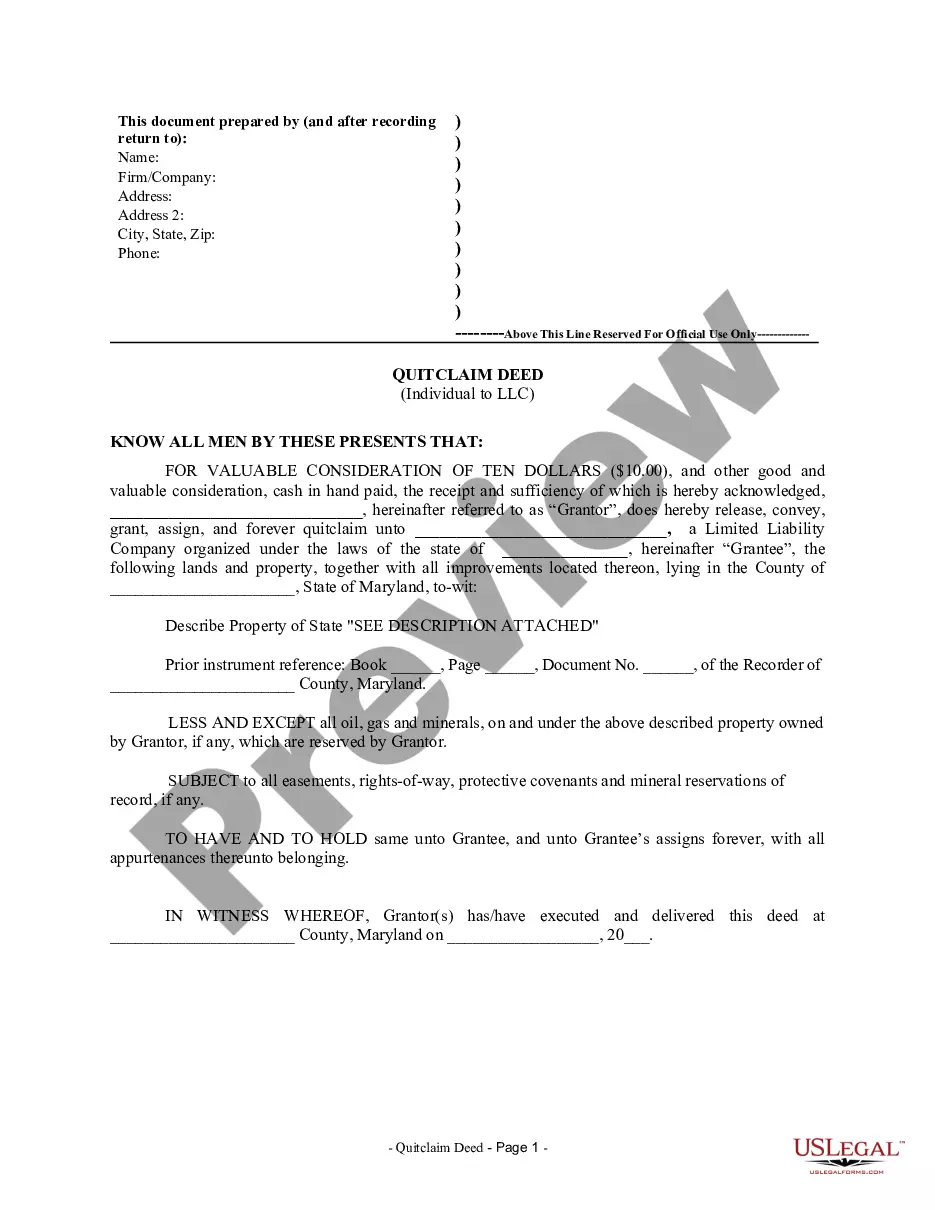
The Quitclaim Deed from Individual to LLC is a legal document used when a property owner (grantor) transfers ownership of real estate to a limited liability company (grantee). This type of deed conveys any interest the grantor has in the property without guaranteeing that the title is free of claims or encumbrances. Unlike warranty deeds, quitclaim deeds do not provide warranties regarding the quality of the title, making them commonly used among family members or in transactions that do not require extensive due diligence.
Key parts of this document
- Description of the property being transferred.
- Reference to prior instrument recording details.
- Clauses reserving oil, gas, and minerals owned by the grantor.
- Statements regarding easements and rights-of-way affecting the property.
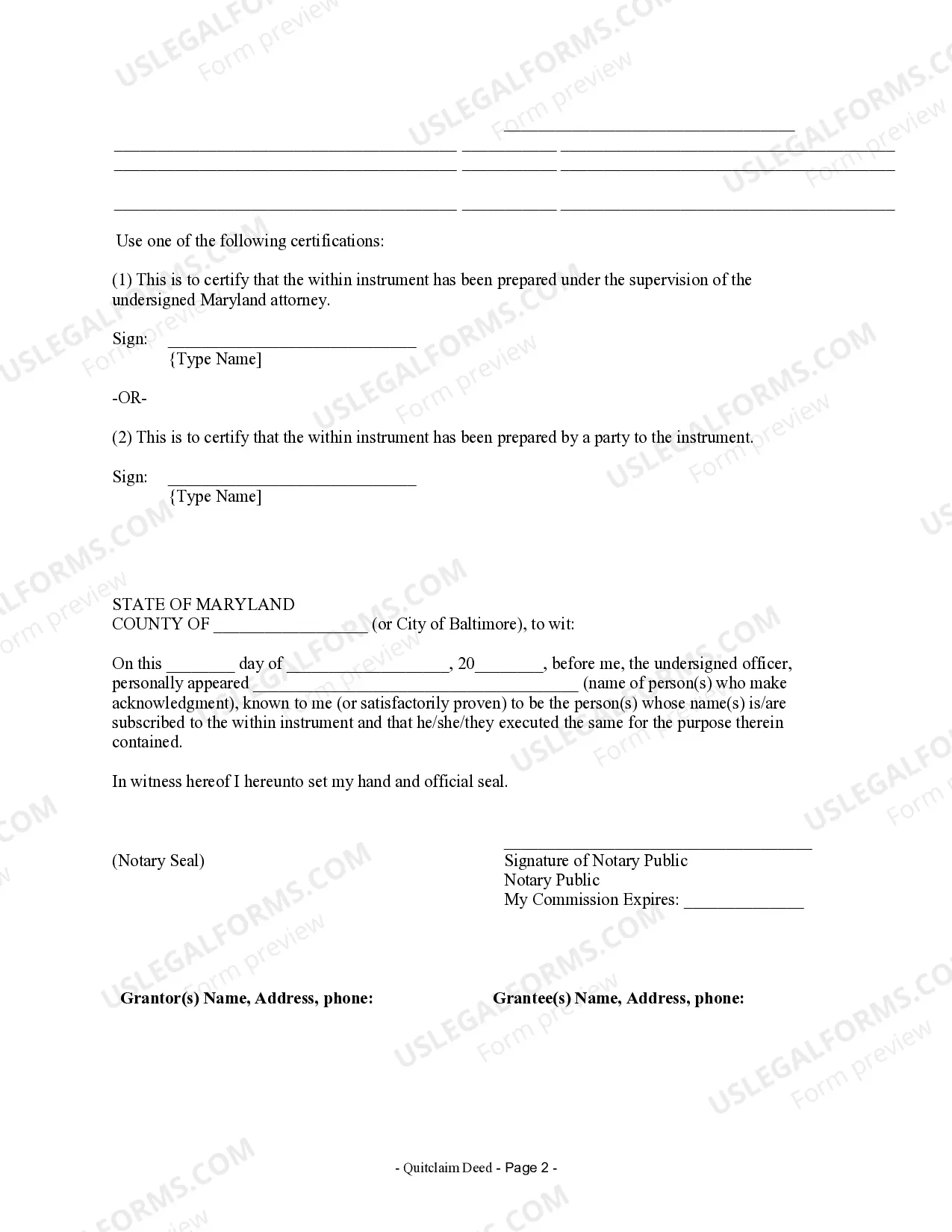
- Signature lines for the grantor and witnesses, along with notary acknowledgment.





When to use this document
This quitclaim deed should be used when an individual wishes to transfer property to an LLC, often for purposes such as business operations, investment, or estate planning. It is especially suitable when the grantor is certain of their ownership rights but does not need the protections offered by a warranty deed. It is commonly used in property transfers where there is a relationship of trust between the parties involved.
Who should use this form
- Individuals transferring their property to their own limited liability company.
- Property owners looking to simplify the ownership structure for investment purposes.
- Individuals involved in estate planning who wish to manage their real estate holdings through an LLC.
Completing this form step by step
- Identify the parties involved: the grantor (individual) and the grantee (LLC).
- Specify the property being transferred by including a detailed description.
- Refer to the prior instrument by entering the book, page, and document number as applicable.
- Indicate the date of the transfer and ensure all parties sign the document.
- Arrange for notarization by a qualified notary public to finalize the deed.
Does this document require notarization?
To make this form legally binding, it must be notarized. Our online notarization service, powered by Notarize, lets you verify and sign documents remotely through an encrypted video session.
Get your form ready online
Our built-in tools help you complete, sign, share, and store your documents in one place.
Make edits, fill in missing information, and update formatting in US Legal Forms—just like you would in MS Word.
Download a copy, print it, send it by email, or mail it via USPS—whatever works best for your next step.
Sign and collect signatures with our SignNow integration. Send to multiple recipients, set reminders, and more. Go Premium to unlock E-Sign.
If this form requires notarization, complete it online through a secure video call—no need to meet a notary in person or wait for an appointment.
We protect your documents and personal data by following strict security and privacy standards.

Make edits, fill in missing information, and update formatting in US Legal Forms—just like you would in MS Word.

Download a copy, print it, send it by email, or mail it via USPS—whatever works best for your next step.

Sign and collect signatures with our SignNow integration. Send to multiple recipients, set reminders, and more. Go Premium to unlock E-Sign.

If this form requires notarization, complete it online through a secure video call—no need to meet a notary in person or wait for an appointment.

We protect your documents and personal data by following strict security and privacy standards.
Mistakes to watch out for
- Failing to include a clear and accurate description of the property.
- Not obtaining the necessary notarization, which may render the deed invalid.
- Overlooking to reserve oil, gas, and minerals if applicable, leading to potential future disputes.
Advantages of online completion
- Convenient access to legally vetted templates that save time.
- Editability allows users to customize the document to their specific needs.
- Reliability through professional drafting by licensed attorneys, ensuring legal compliance.
Looking for another form?
Form popularity
FAQ
They are commonly used to add/remove someone to/from real estate title or deed (divorce, name changes, family and trust transfers). The quitclaim deed is a legal document (deed) used to transfer interest in real estate from one person or entity (grantor) to another (grantee).
When done properly, a deed is recorded anywhere from two weeks to three months after closing. However, there are many instances where deeds are not properly recorded. Title agents commit errors, lose deeds, and even go out of business. Even county offices sometimes fail to record deeds that were properly submitted.
Instead of transferring assets as a capital contribution, you can also sell assets directly to your LLC. The most significant difference between a contribution and a sale is that the sale creates no equity in the company.
However, there are substantial downsides associated with transferring your primary home into an LLC.If you are using your personal residence for estate planning purposes, a qualified personal residence trust (QPRT) may be more effective than transferring your property to a limited liability company.
Does LLC ownership count as time used as a primary residence? For a single-member LLC, the answer is typically yes. For example, if the house is owned by an LLC. The Treasury Regulations allow for the capital gains exclusion when title is held by a single-member disregarded entity.
But you might be wondering if an owner can transfer a deed to another person without a real estate lawyer. The answer is yes. Parties to a transaction are always free to prepare their own deeds.A quitclaim deed, for example, is far simpler than a warranty deed.
Documents: To submit the quitclaim deed to the Clerk of the Circuit Court, you must have a Land Intake Sheet with the deed. Filing: Quitclaim deeds in Maryland are filed with the Clerk of the Circuit Court in the county where the property is located. Each county has its own filing fee.
A Quitclaim Deed must be notarized by a notary public or attorney in order to be valid.Consideration in a Quitclaim Deed is what the Grantee will pay to the Grantor for the interest in the property.