Maryland Warranty Deed from Individual to Husband and Wife
What is this form?
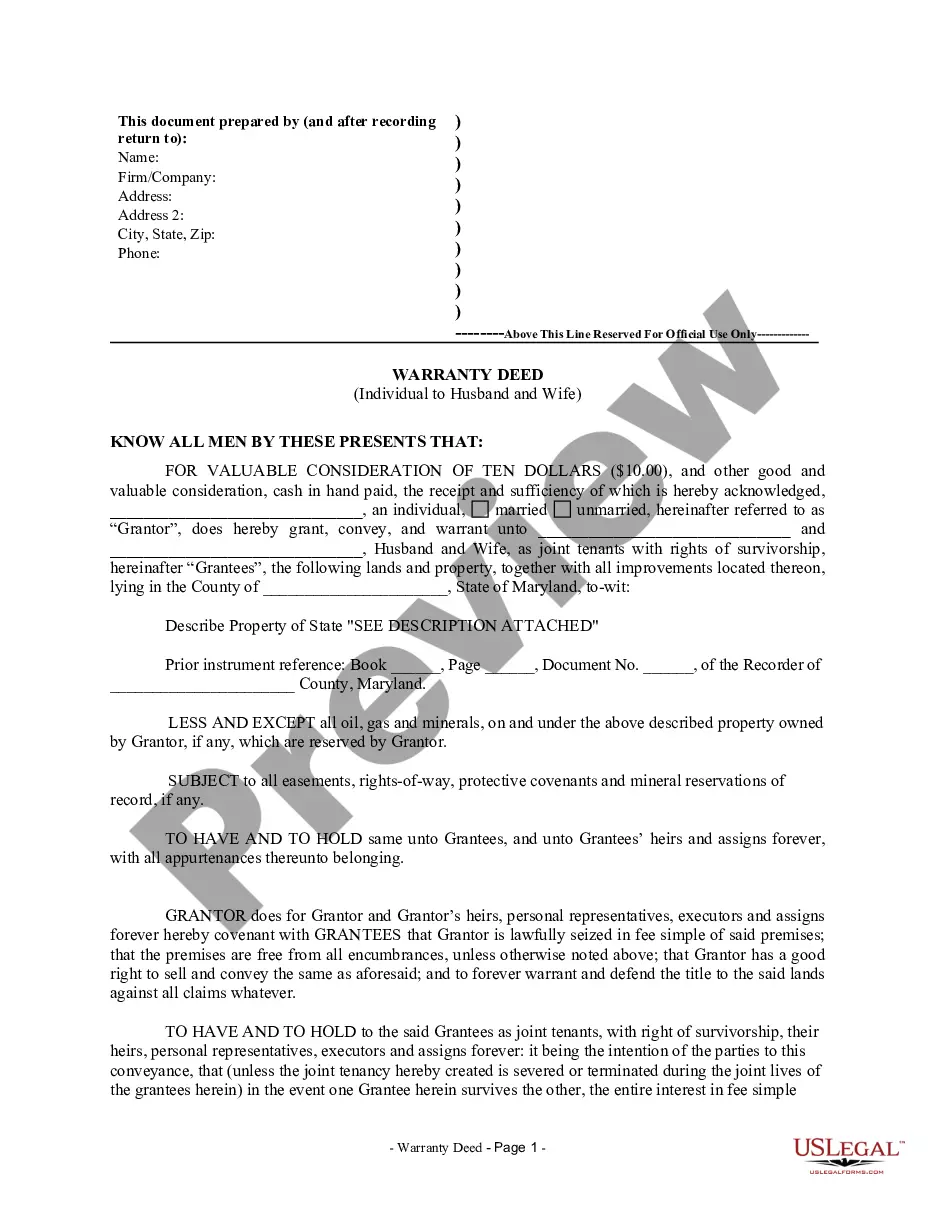
This Warranty Deed from Individual to Husband and Wife form is a legal document used to transfer property ownership from an individual (the Grantor) to a couple (the Grantees). It guarantees that the Grantor has the legal right to sell the property and that the property is free from any encumbrances, except as stated. This warranty deed is particularly significant as it establishes joint tenancy with right of survivorship for the couple, ensuring that in the event of one spouse's death, the surviving spouse automatically inherits the entire property.
Key components of this form
- Identification of the Grantor (seller) and Grantees (husband and wife).
- Description of the property being transferred.
- Reservation of rights for oil, gas, and minerals under the property.
- Warranties and covenants regarding the title to the property.
- Joint tenancy clause, including right of survivorship provisions.
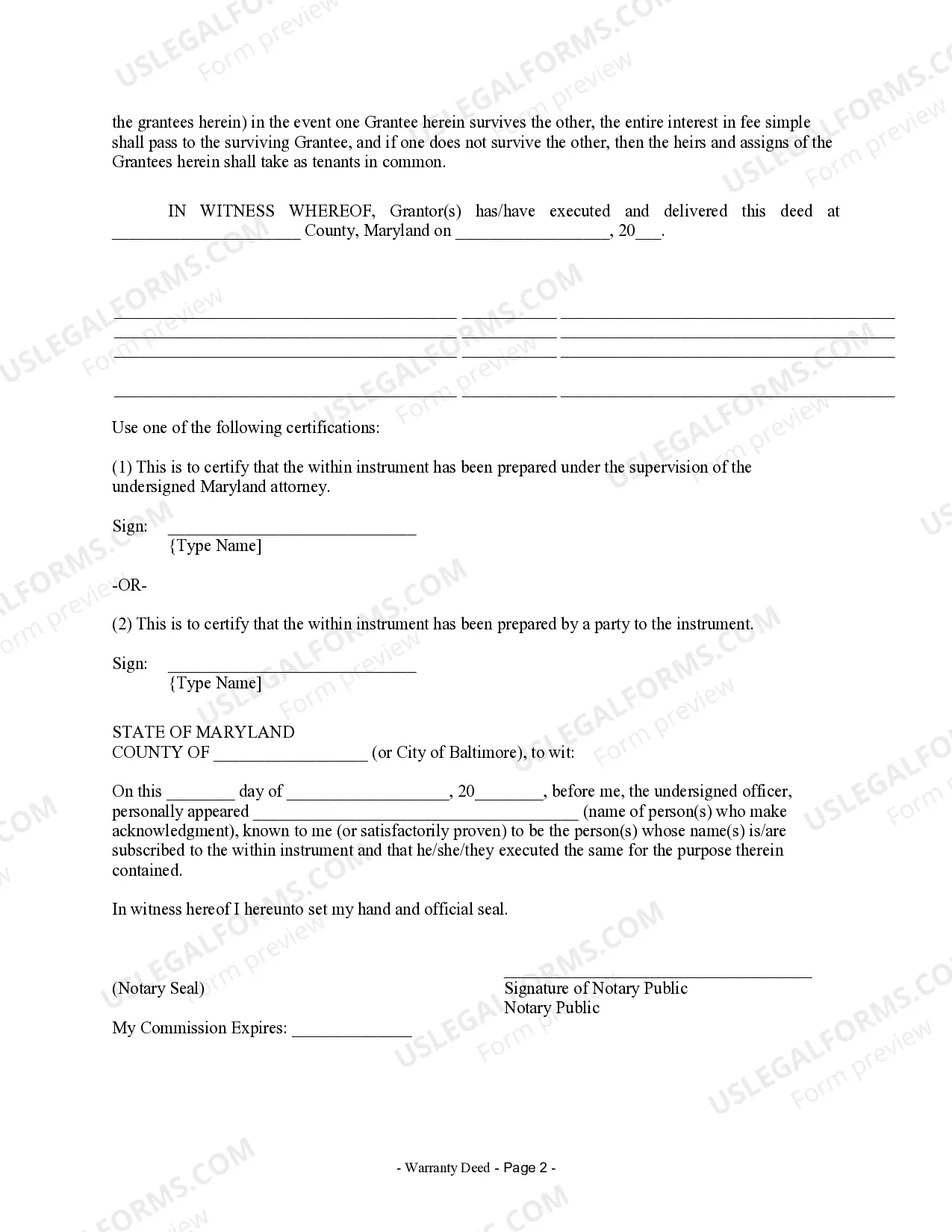
- Notary acknowledgment space for certification of the document.





When to use this document
This form should be used when an individual wishes to transfer ownership of real estate to a married couple. It is applicable in scenarios such as gifting property, consolidating ownership within a family, or when a spouse is adding their partner to the property title. This warranty deed provides legal protection by confirming the transfer of ownership is effective and upfront about any limitations on the property being transferred.
Who should use this form
- Individuals looking to formally transfer property to a spouse and another party as joint owners.
- Couples who want to establish joint tenancy in real estate for estate planning purposes.
- Property owners seeking to ensure their title is conveyed without encumbrances.
Steps to complete this form
- Identify the Grantor and Grantees by entering their full names.
- Provide a detailed description of the property being transferred.
- Specify any exceptions, such as reserved rights for minerals under the property.
- Include the notary acknowledgment section to verify the identities of the parties signing the deed.
- Sign and date the form in the presence of a notary public.
Is notarization required?
To make this form legally binding, it must be notarized. Our online notarization service, powered by Notarize, lets you verify and sign documents remotely through an encrypted video session.
Get your form ready online
Our built-in tools help you complete, sign, share, and store your documents in one place.
Make edits, fill in missing information, and update formatting in US Legal Forms—just like you would in MS Word.
Download a copy, print it, send it by email, or mail it via USPS—whatever works best for your next step.
Sign and collect signatures with our SignNow integration. Send to multiple recipients, set reminders, and more. Go Premium to unlock E-Sign.
If this form requires notarization, complete it online through a secure video call—no need to meet a notary in person or wait for an appointment.
We protect your documents and personal data by following strict security and privacy standards.

Make edits, fill in missing information, and update formatting in US Legal Forms—just like you would in MS Word.

Download a copy, print it, send it by email, or mail it via USPS—whatever works best for your next step.

Sign and collect signatures with our SignNow integration. Send to multiple recipients, set reminders, and more. Go Premium to unlock E-Sign.

If this form requires notarization, complete it online through a secure video call—no need to meet a notary in person or wait for an appointment.

We protect your documents and personal data by following strict security and privacy standards.
Common mistakes
- Failing to include a complete and accurate description of the property.
- Not specifying any reserved interests, such as mineral rights.
- Neglecting to sign the deed in front of a notary public.
- Overlooking the need to properly record the deed with the local county office.
Why complete this form online
- Easy access to legally compliant templates drafted by licensed attorneys.
- Convenience of downloading and printing the form at your convenience.
- Editable electronic format allows for easy customization to fit specific needs.
- Reduced time and cost compared to hiring legal assistance for simple property transfers.
Quick recap
- The Warranty Deed from Individual to Husband and Wife facilitates property transfer to a married couple.
- It includes joint tenancy rights, enhancing estate planning for couples.
- Always ensure the form is notarized for legal enforceability.
Looking for another form?
Form popularity
FAQ
Yes you can. This is called a transfer of equity but you will need the permission of your lender. If you are not married or in a civil partnership you may wish to consider creating a deed of trust and a living together agreement which we can explain to you.
To change the names on a real estate deed, you will need to file a new deed with the Division of Land Records in the Circuit Court for the county where the property is located. The clerk will record the new deed.
Typically, the lender will provide you with a copy of the deed of trust after the closing. The original warranty deeds are often mailed to the grantee after they are recorded. These are your original copies and should be kept in a safe place, such as a fireproof lockbox or a safe deposit box at a financial institution.
It's important to note that a warranty deed does not actually prove the grantor has ownership (a title search is the best way to prove that), but it is a promise by the grantor that they are transferring ownership and if it turns out they don't actually own the property, the grantor will be responsible for compensating
Let's start with the definition of a deed: DEED: A written instrument by which one party, the Grantor, conveys the title of ownership in property to another party, the Grantee. A Warranty Deed contains promises, called covenants, that the Grantor makes to the Grantee.
Title the deed and list the amount given for the transfer. If it is a quitclaim deed, title the deed Quitclaim Deed; for warranty deeds, title the deed Warranty Deed. Write In consideration of dollar amount to list the amount given for the transfer. List the names of the parties involved.
Two of the most common ways to transfer property in a divorce are through an interspousal transfer deed or quitclaim deed. When spouses own property together, but then one spouse executes an interspousal transfer or a quitclaim deed, this is known as transmutation.
In order to make the Warranty Deed legally binding, the Seller needs to sign it front of a notary public. Then signed and notarized deed must be filed at the city or county office for recording property documents. Before filing with this office all previously billed property taxes must be paid in full.
A warranty deed guarantees that: The grantor is the rightful owner of the property and has the legal right to transfer the title.The title would withstand third-party claims to ownership of the property. The grantor will do anything to ensure the grantee's title to the property.