Maryland Notice of Default for Past Due Payments in connection with Contract for Deed
About this form
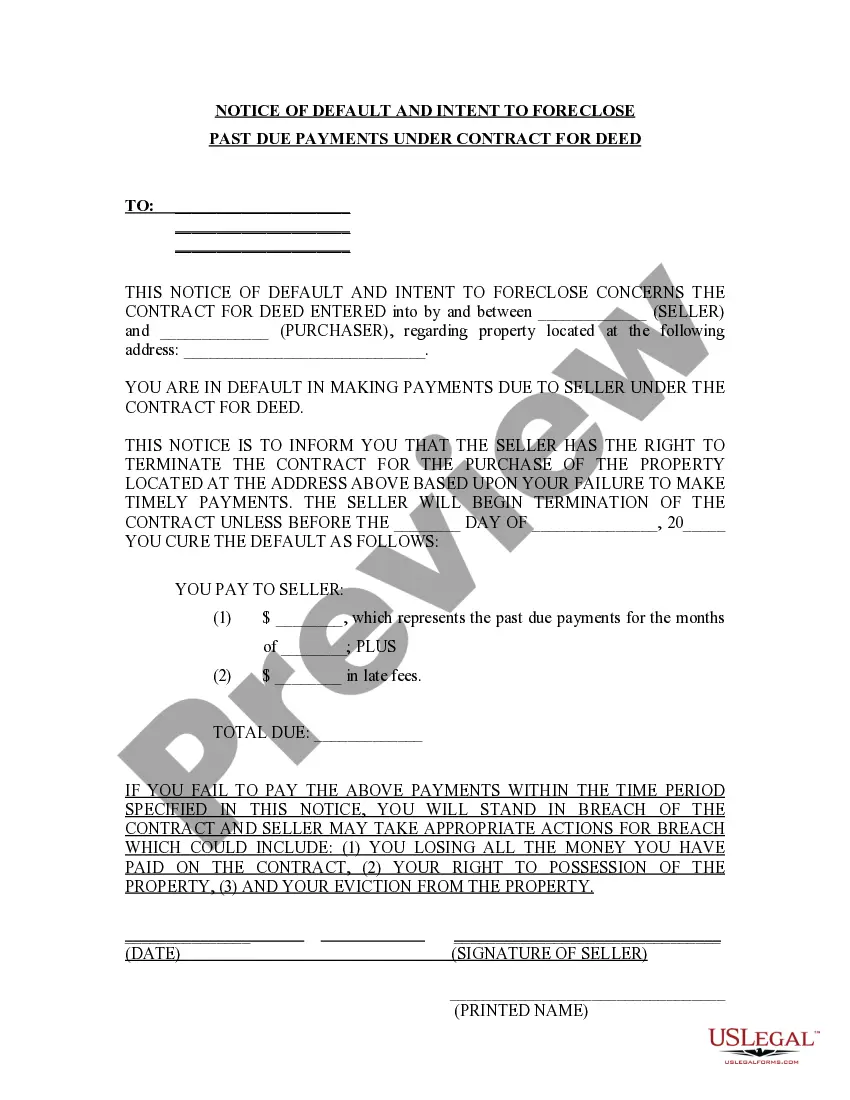
The Notice of Default for Past Due Payments in connection with Contract for Deed is a formal document served by a seller to notify a purchaser that their payment obligations under the contract for deed have not been met. This document is crucial as it serves as the seller's first notification regarding late payments, outlining the need for compliance to avoid defaulting on the contract. By addressing non-payment promptly, sellers can initiate necessary actions to protect their interests in the property.
Main sections of this form
- Seller Information: Details of the seller including name and contact information.
- Purchaser Information: Name and address of the purchaser receiving the notice.
- Contract Details: Identification of the contract for deed related to the late payment.
- Payment Terms: Specific payment obligations and the amount overdue.
- Default Notice: Clear statement highlighting the default status due to non-payment.
- Consequences of Non-compliance: Information about potential consequences if payment is not made.

Common use cases
This form should be used when a seller has not received a payment from the purchaser under a contract for deed agreement. It typically arises in situations where the payment due date has passed, and the seller is required to notify the purchaser of their default. This form is essential for starting formal communication regarding payment issues and can help in resolving the matter promptly.
Who this form is for
This form is intended for:
- Property sellers engaged in a contract for deed who are experiencing non-payment issues.
- Purchasers of properties under a contract for deed when they need to understand their obligations.
- Legal professionals representing either party in a contract for deed transaction.
How to complete this form
Follow these steps to complete the Notice of Default form:
- Identify the parties involved by filling in the seller's and purchaser's names and addresses.
- Specify the details of the contract for deed, including any identifying numbers or dates.
- Clearly state the amount that is past due and the specific payment terms that were not met.
- Include a statement outlining the default status and the necessary actions the purchaser must take.
- Sign and date the notice to finalize it before sending it to the purchaser.
Does this document require notarization?
This form does not typically require notarization unless specified by local law. However, having a notarized document can provide additional legal assurance and verification of the parties' identities.
Get your form ready online
Our built-in tools help you complete, sign, share, and store your documents in one place.
Make edits, fill in missing information, and update formatting in US Legal Forms—just like you would in MS Word.
Download a copy, print it, send it by email, or mail it via USPS—whatever works best for your next step.
Sign and collect signatures with our SignNow integration. Send to multiple recipients, set reminders, and more. Go Premium to unlock E-Sign.
If this form requires notarization, complete it online through a secure video call—no need to meet a notary in person or wait for an appointment.
We protect your documents and personal data by following strict security and privacy standards.

Make edits, fill in missing information, and update formatting in US Legal Forms—just like you would in MS Word.

Download a copy, print it, send it by email, or mail it via USPS—whatever works best for your next step.

Sign and collect signatures with our SignNow integration. Send to multiple recipients, set reminders, and more. Go Premium to unlock E-Sign.

If this form requires notarization, complete it online through a secure video call—no need to meet a notary in person or wait for an appointment.

We protect your documents and personal data by following strict security and privacy standards.
Avoid these common issues
- Failing to complete all required fields on the form.
- Not sending the notice within the timeframe specified in the contract for deed.
- Using incorrect or outdated contact information for the purchaser.
- Omitting important details regarding the payment terms or amounts due.
Benefits of completing this form online
- Convenient access to legal forms tailored for your specific needs.
- Editable templates allow you to customize the document before downloading.
- Reliability of forms created by licensed attorneys to ensure compliance with legal standards.
Legal use & context
- This form acts as an essential preliminary step in enforcing payment obligations under a contract for deed.
- Proper use of this form can help prevent further legal complications or foreclosure proceedings.
Looking for another form?
Form popularity
FAQ
The notice of default doesn't affect your credit file, but when the account defaults this will be recorded.If the debt is regulated by the Consumer Credit Act, you must be sent a default notice warning letter and have time to act on it before the default is recorded on your credit file.
While you can't redeem your home after the foreclosure sale in Maryland, you do get what is called an "equitable right of redemption" before the sale is finalized.Ratification typically takes place 30 to 45 days after the sale, though this varies from county to county.
A notice of default is the first step to a bank or mortgage lender's foreclosure process.If the mortgage is not paid up to date, the lender will seize the home. A notice of default is also known as a reinstatement period, notice of public auction, or notice of foreclosure.
Write to the agency making the claim. Present evidence of why the NOD was improperly issued or why you legitimately cannot make payments. Ask the agency in the letter if they will take a lower monthly payment, total settlement or a payment plan. Send a copy of your letter by certified mail.
The foreclosure process is defined by California civil code 2924 and begins with the filing of a Notice of Default (NOD) with the county recorder. Once a borrower is at least 90 days behind in making mortgage payments, the lender will file a Notice of Default with the court of the county where the property is located.
After the lender files the Notice of Default, you get 90 days to bring your past-due bill current. After the 90 days pass, the lender files a Notice of Sale with the clerk. The Notice of Sale displays the location, date and time of the sale. It lists the trustee's name and contact information.
Typically, it takes about 90 days to foreclose on a Maryland property if the borrower does not object to the foreclosure. If a lender pursues a judicial foreclosure in Maryland then the time frame for foreclosure will vary depending on the court's schedule and orders.
A notice of default is the first step to a bank or mortgage lender's foreclosure process.If the mortgage is not paid up to date, the lender will seize the home. A notice of default is also known as a reinstatement period, notice of public auction, or notice of foreclosure.