Kansas Quitclaim Deed from Individual to Two Individuals in Joint Tenancy
What this document covers
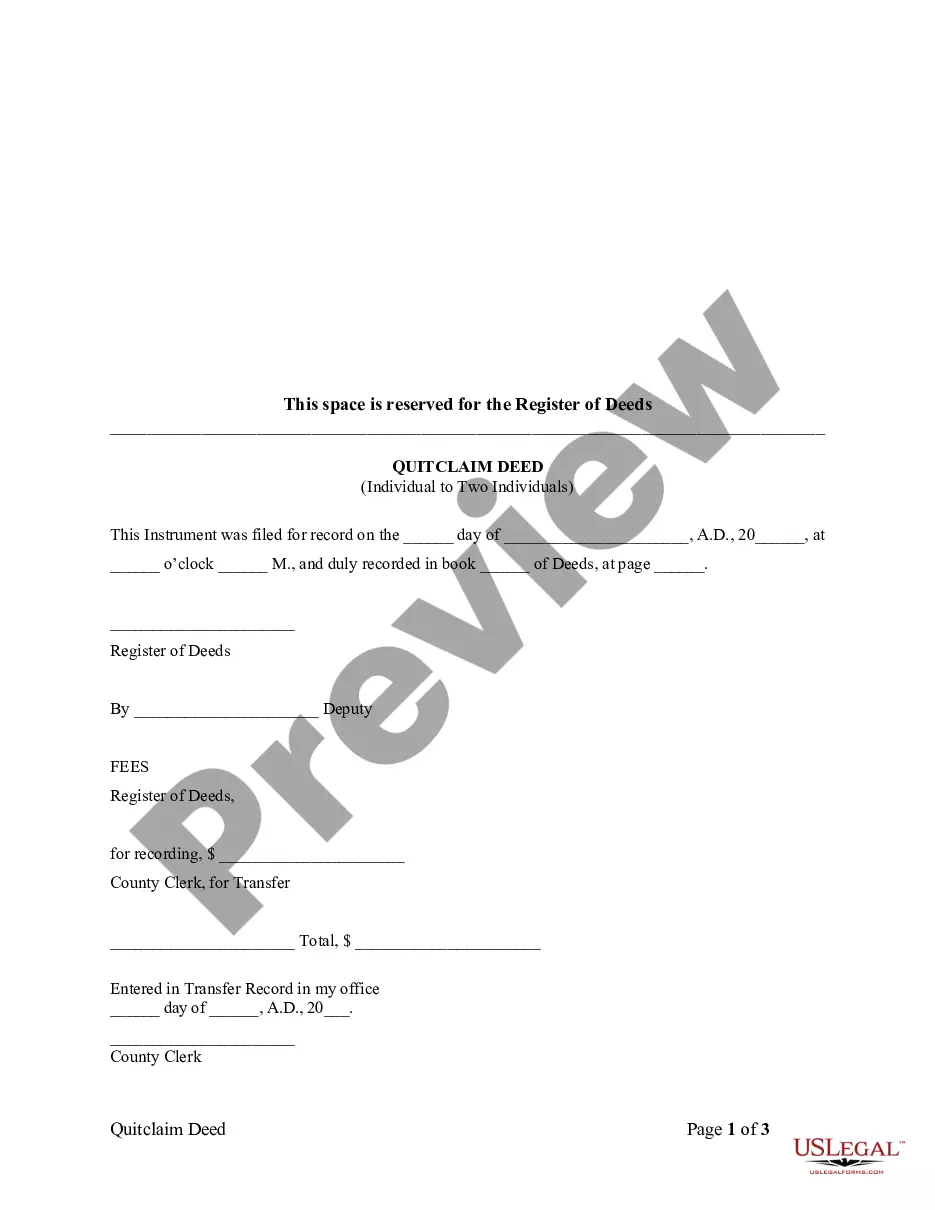
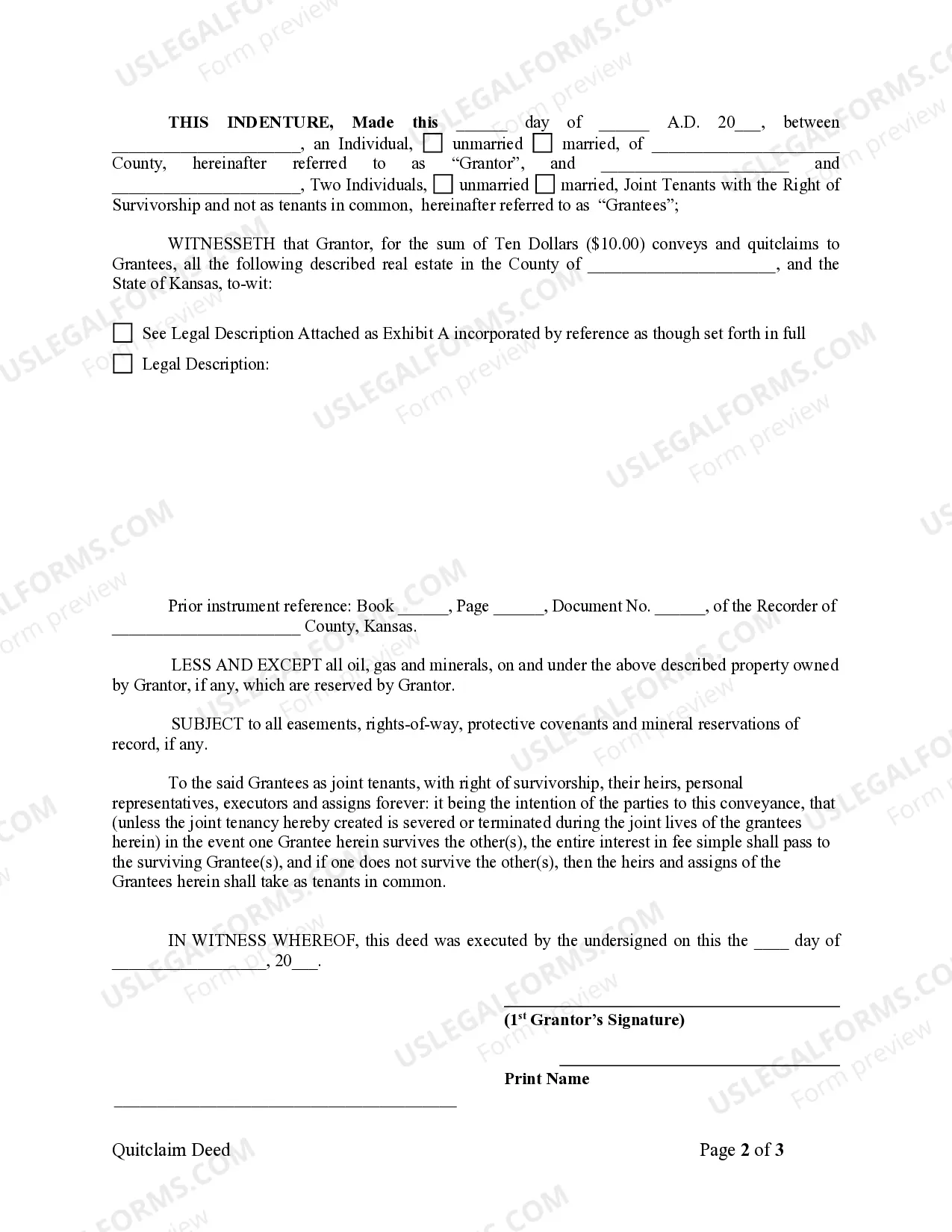
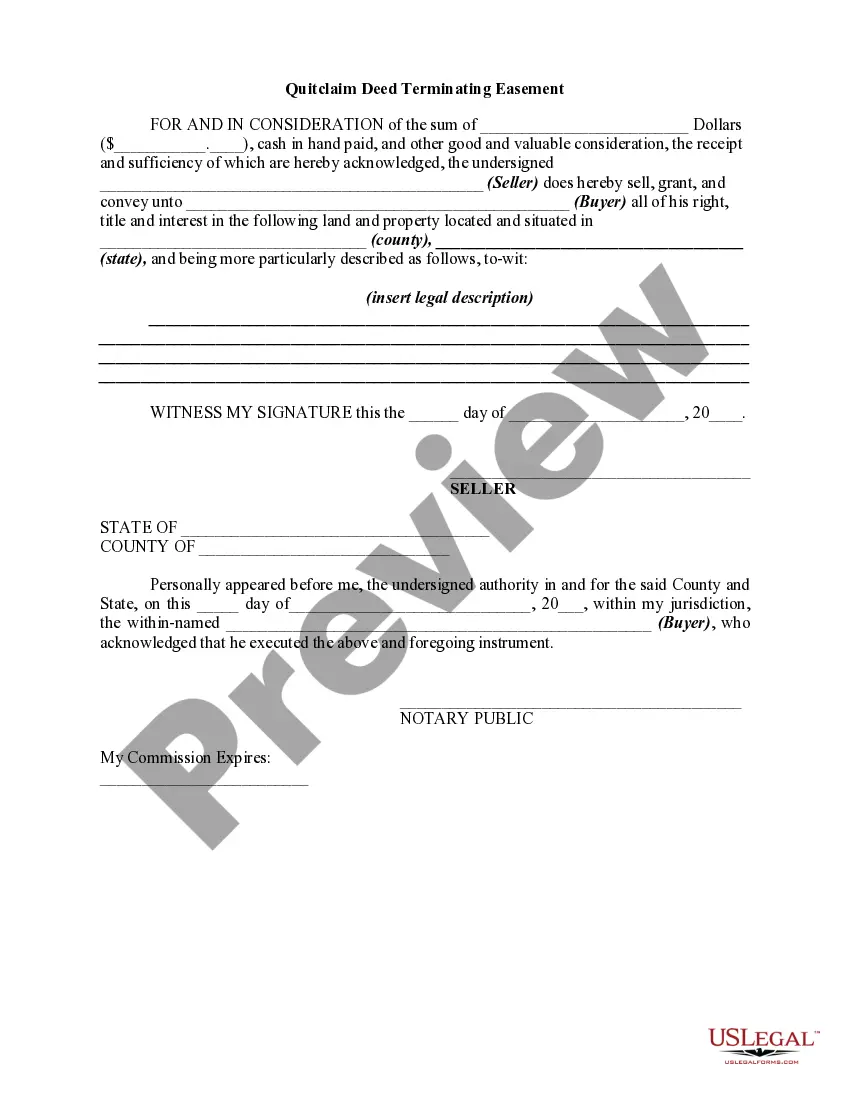
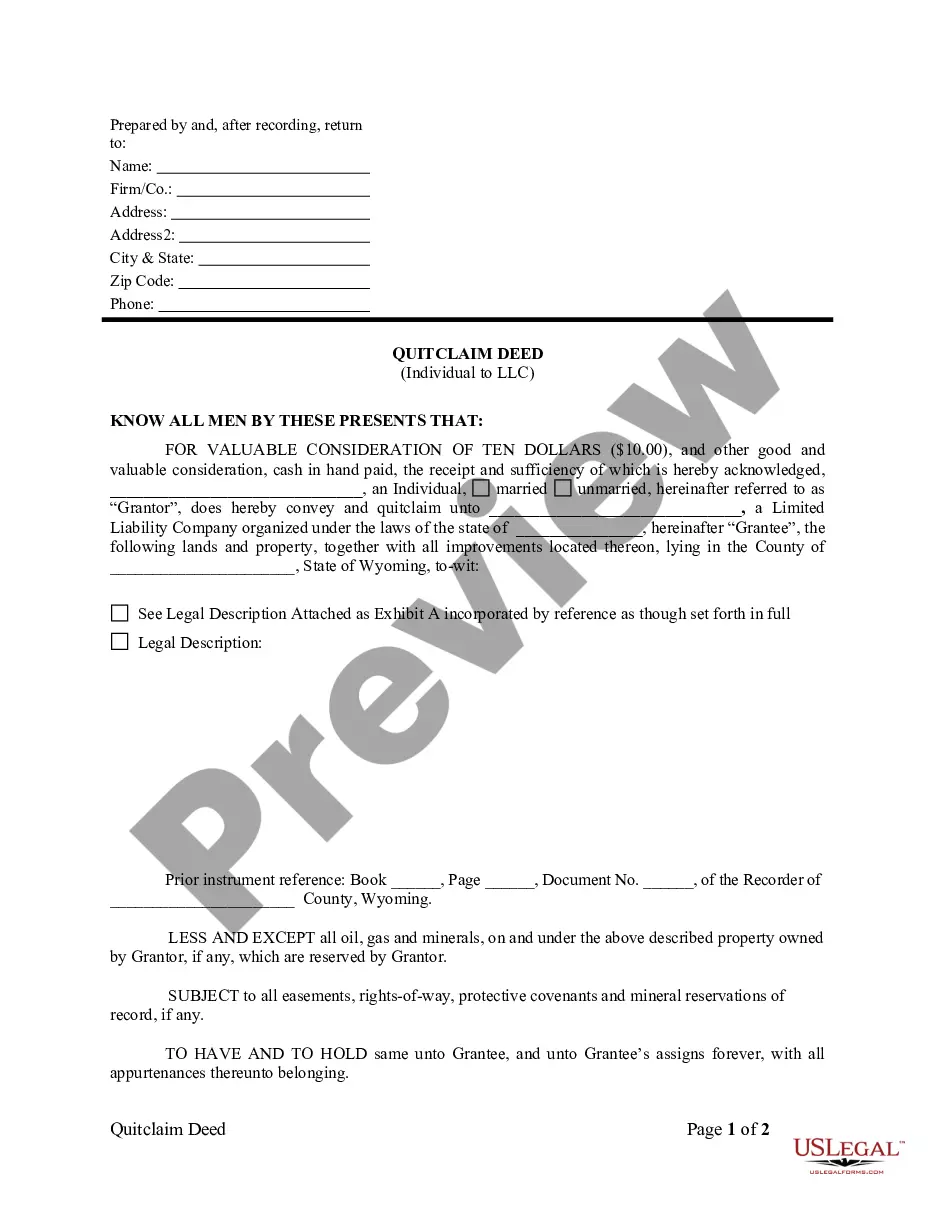
The Quitclaim Deed from Individual to Two Individuals in Joint Tenancy is a legal document that allows one individual (the Grantor) to transfer their ownership interest in a property to two individuals (the Grantees) as joint tenants. This type of deed conveys the property without any warranties regarding its title, and it includes a provision that allows for the right of survivorship, meaning that if one Grantee passes away, their share automatically transfers to the surviving Grantee. It differs from other deeds, such as warranty deeds, because it does not guarantee clear ownership, making it a straightforward option for transferring property interests.
Main sections of this form
- Identification of the Grantor and Grantees, including their marital status.
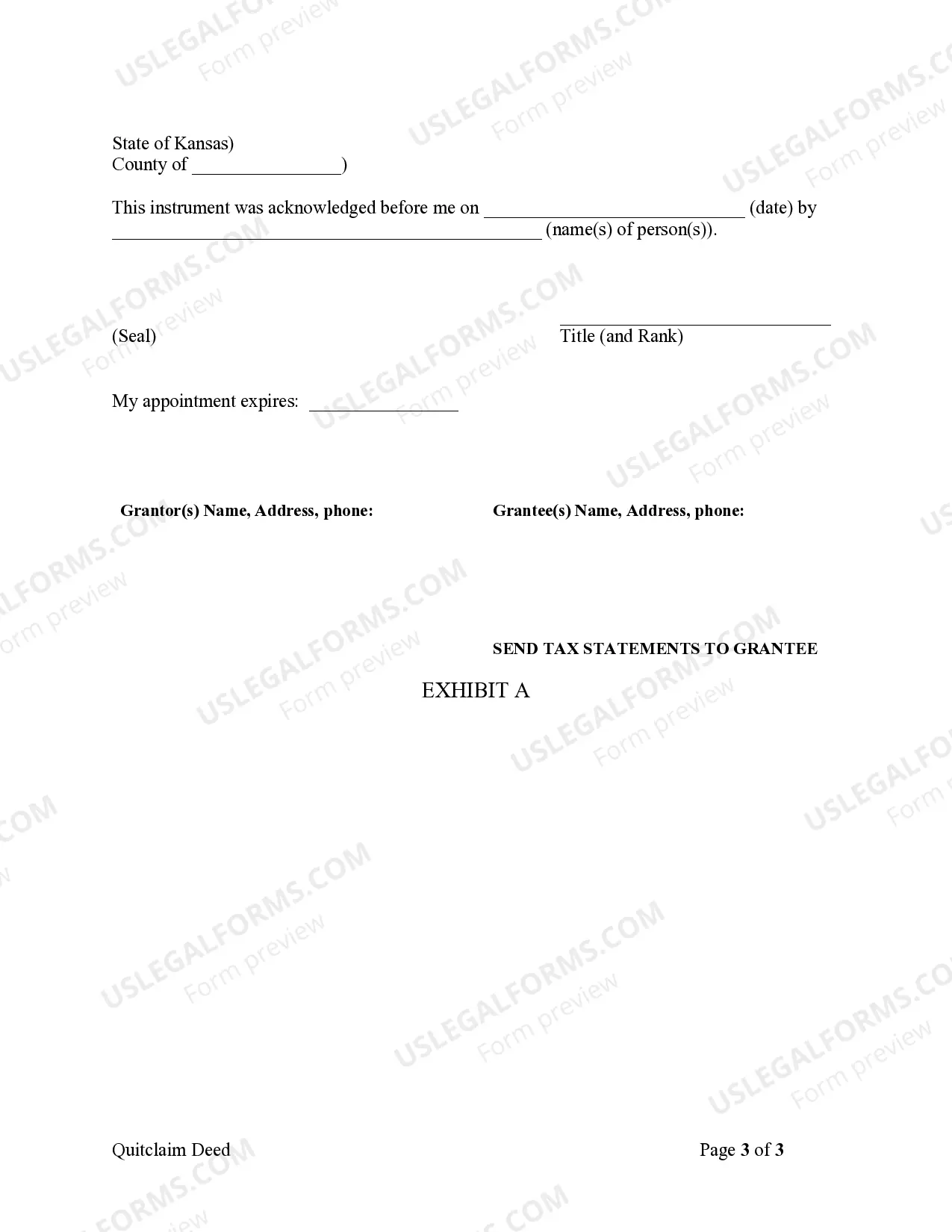
- Legal description of the property being conveyed, included as an exhibit.
- Specification of the joint tenancy arrangement with right of survivorship.
- Statement regarding the exclusion of oil, gas, and mineral rights from the conveyance.
- Signature and date fields for the Grantor and a notary public for validation.




When to use this form
This form is useful when an individual wishes to transfer property ownership to two other individuals while establishing joint tenancy. Common scenarios include situations where family members want to share ownership of a property, or when a person wants to grant their property to friends or partners with the intent that the surviving party retains full ownership upon the others' death. It's also suitable for simplifying estate planning by ensuring a direct transfer of property interest to survivors without going through probate.
Who this form is for
- Individuals looking to transfer property ownership to two other individuals.
- Owners of real estate who want to establish a right of survivorship among recipients.
- Those who prefer a straightforward conveyance without the need for extensive legal descriptions or guarantees.
Completing this form step by step
- Identify the Grantor by entering their full name and marital status.
- List the names of the two Grantees, specifying their marital status.
- Attach the legal description of the property as an exhibit.
- Enter the date of execution and ensure the Grantor signs the document.
- Acquire notarization by having a notary public sign and seal the document.
Does this form need to be notarized?
This form must be notarized to be legally valid. US Legal Forms provides secure online notarization powered by Notarize, allowing you to complete the process through a verified video call.
Get your form ready online
Our built-in tools help you complete, sign, share, and store your documents in one place.
Make edits, fill in missing information, and update formatting in US Legal Forms—just like you would in MS Word.
Download a copy, print it, send it by email, or mail it via USPS—whatever works best for your next step.
Sign and collect signatures with our SignNow integration. Send to multiple recipients, set reminders, and more. Go Premium to unlock E-Sign.
If this form requires notarization, complete it online through a secure video call—no need to meet a notary in person or wait for an appointment.
We protect your documents and personal data by following strict security and privacy standards.

Make edits, fill in missing information, and update formatting in US Legal Forms—just like you would in MS Word.

Download a copy, print it, send it by email, or mail it via USPS—whatever works best for your next step.

Sign and collect signatures with our SignNow integration. Send to multiple recipients, set reminders, and more. Go Premium to unlock E-Sign.

If this form requires notarization, complete it online through a secure video call—no need to meet a notary in person or wait for an appointment.

We protect your documents and personal data by following strict security and privacy standards.
Common mistakes
- Failing to include a complete legal description of the property.
- Not specifying the marital status of the Grantor and Grantees correctly.
- Omitting the necessary notary signature and seal.
- Using incorrect terminology when describing ownership interests.
Advantages of online completion
- Easy access to customizable templates that can be downloaded instantly.
- Ability to complete the form at your own pace without legal fees for simple transfers.
- Assurance that the form meets all state-specific legal requirements.
Looking for another form?

Form popularity
FAQ
Recording A quitclaim deed must be filed with the County Recorder's Office where the real estate is located. Go to your County Website to locate the office nearest you. Signing (§ 58-2205) A quitclaim deed is required to be authorized with a notary public present.
A quitclaim deed affects ownership and the name on the deed, not the mortgage. Because quitclaim deeds expose the grantee to certain risks, they are most often used between family members and where there is no exchange of money.Quitclaim deeds transfer title but do not affect mortgages.
A person who signs a quitclaim deed to transfer property they do not own results in no title at all being transferred since there is no actual ownership interest. The quitclaim deed only transfers the type of title you own.
They are commonly used to add/remove someone to/from real estate title or deed (divorce, name changes, family and trust transfers). The quitclaim deed is a legal document (deed) used to transfer interest in real estate from one person or entity (grantor) to another (grantee).
It's usually a very straightforward transaction, but it's possible for a quitclaim deed to be challenged. If a quitclaim deed is challenged in court, the issue becomes whether the property was legally transferred and if the grantor had the legal right to transfer the property.
A Quitclaim Deed must be notarized by a notary public or attorney in order to be valid.Consideration in a Quitclaim Deed is what the Grantee will pay to the Grantor for the interest in the property.
Since the joint tenants have equal interest, the property cannot be sold without all parties' consent. Instead of selling, a joint tenant can choose to transfer their interest to another party.Therefore, the property cannot be passed down to the heirs of the joint tenants.
But you might be wondering if an owner can transfer a deed to another person without a real estate lawyer. The answer is yes. Parties to a transaction are always free to prepare their own deeds.A quitclaim deed, for example, is far simpler than a warranty deed.