Indiana Quitclaim Deed for Individual to Two Individuals as Joint Tenants
About this form
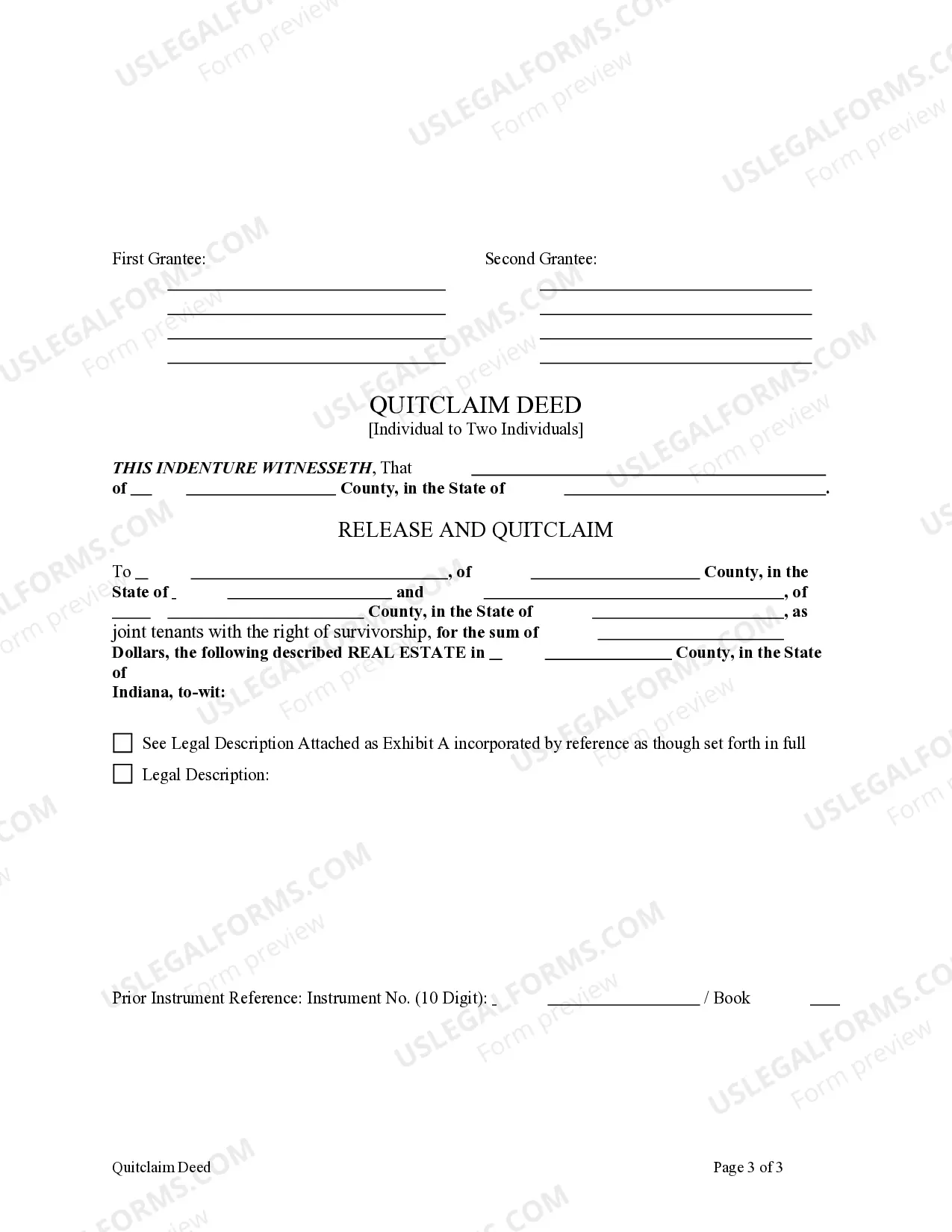
This Quitclaim Deed is a legal document used to transfer ownership of real property from one individual to two individuals as joint tenants. Unlike a warranty deed, it does not guarantee that the grantor holds clear title to the property, but it effectively allows the transfer of rights. This form is essential in situations where an individual wishes to share property ownership with others while maintaining equal ownership rights.
Key parts of this document
- Information about the grantor (the individual transferring the property).
- Details of the grantees (the two individuals receiving the property as joint tenants).
- Description of the property being transferred, including address and legal description.
- Statement of intent to transfer property rights without warranties.
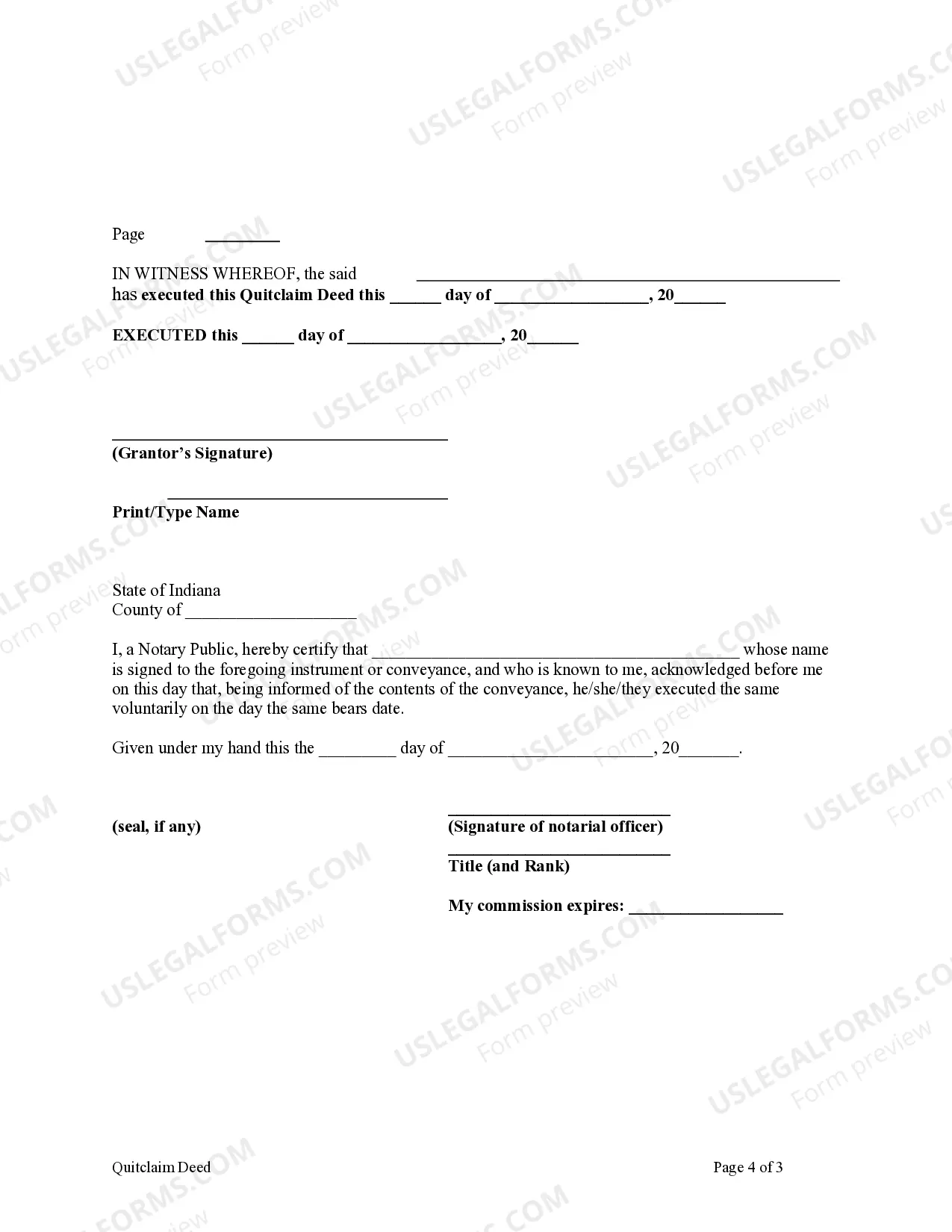
- Signature fields for the grantor and any required witnesses.




When to use this document
This form is commonly used when an individual wants to transfer property ownership to two other individuals who will share ownership as joint tenants. This might occur in various scenarios, such as family property transfers, estate planning, or when friends or partners decide to co-own real estate. Using this deed helps clarify ownership rights and intentions among co-owners.
Intended users of this form
This Quitclaim Deed is suitable for:
- Individuals who are the current owners of a property and wish to transfer it to two other co-owners.
- Families or friends looking to formalize joint ownership of property.
- Anyone engaged in estate planning that involves the transfer of property to beneficiaries.
Instructions for completing this form
- Identify and enter the names of the grantor and the grantees.
- Provide a full legal description of the property being transferred, including the address.
- Clearly state the intent to transfer property rights through the quitclaim deed.
- Sign and date the document in the designated area for the grantor.
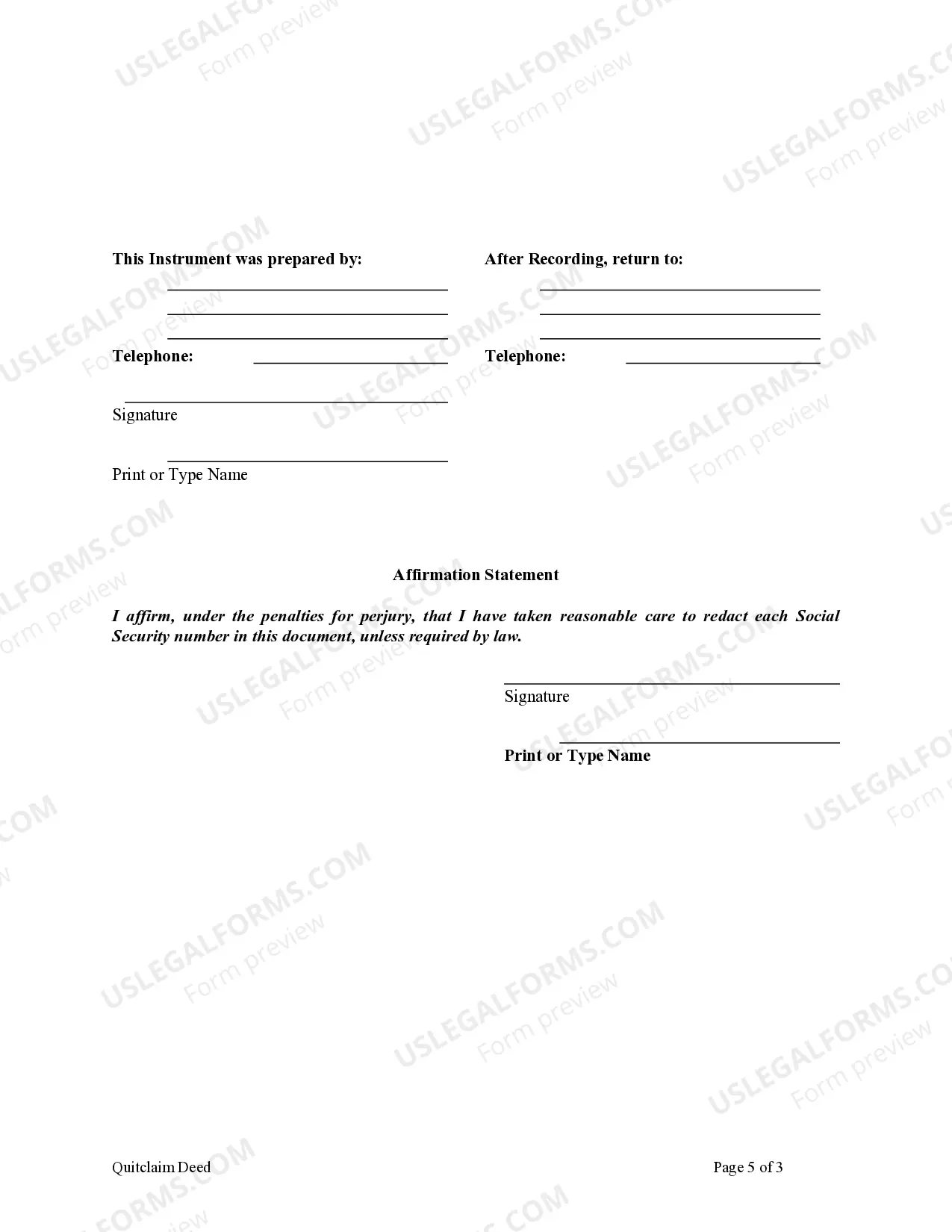
- If required, obtain signatures from witnesses or a notary public, as needed.
Notarization requirements for this form
Notarization is required for this form to take effect. Our online notarization service, powered by Notarize, lets you verify and sign documents remotely through an encrypted video session, available 24/7.
Get your form ready online
Our built-in tools help you complete, sign, share, and store your documents in one place.
Make edits, fill in missing information, and update formatting in US Legal Forms—just like you would in MS Word.
Download a copy, print it, send it by email, or mail it via USPS—whatever works best for your next step.
Sign and collect signatures with our SignNow integration. Send to multiple recipients, set reminders, and more. Go Premium to unlock E-Sign.
If this form requires notarization, complete it online through a secure video call—no need to meet a notary in person or wait for an appointment.
We protect your documents and personal data by following strict security and privacy standards.

Make edits, fill in missing information, and update formatting in US Legal Forms—just like you would in MS Word.

Download a copy, print it, send it by email, or mail it via USPS—whatever works best for your next step.

Sign and collect signatures with our SignNow integration. Send to multiple recipients, set reminders, and more. Go Premium to unlock E-Sign.

If this form requires notarization, complete it online through a secure video call—no need to meet a notary in person or wait for an appointment.

We protect your documents and personal data by following strict security and privacy standards.
Common mistakes
- Failing to accurately describe the property in question.
- Not including all grantees' names, which may lead to complications in ownership rights.
- Omitting required signatures or failing to have the form notarized if required by state law.
Benefits of completing this form online
- Convenience of completing the form anytime, without the need for in-person appointments.
- Editability allows users to customize the form to their specific needs before printing.
- Access to legally sound templates created by licensed attorneys, ensuring reliability.
Main things to remember
- The Quitclaim Deed allows for the transfer of property without warranties.
- It is essential to clearly identify all parties and provide a complete property description.
- Maintaining accurate documentation is crucial to prevent future disputes.
Looking for another form?
Form popularity
FAQ
The grant deed is the most common instrument of conveyance in California. It may be written or typed, but is valid as long as it lists a grantor and a grantee, a description of the property being transferred and a statement transferring an ownership interest from the grantor to the grantee.
Adding someone to your house deed requires the filing of a legal form known as a quitclaim deed. When executed and notarized, the quitclaim deed legally overrides the current deed to your home. By filing the quitclaim deed, you can add someone to the title of your home, in effect transferring a share of ownership.
The Quit Claim Deed form uses the terms of Grantor (Seller or Owner of said property) and Grantee (Buyer of said property) for the two parties involved. First, the parties must fill in the date. Then, write in the name of the county and state in which the property is located.
Write the Deed Fill out the quit claim deed form, which can be obtained online, or write your own using the form as a guide. The person giving up the interest in the property is the grantor, and the person receiving the interest is the grantee.
A person who signs a quitclaim deed to transfer property they do not own results in no title at all being transferred since there is no actual ownership interest. The quitclaim deed only transfers the type of title you own.
Documents must be notarized. Documents executed or acknowledged in Indiana must include a statement that includes: The names of all those signing or serving as a witness on the document must be identical throughout the document and must be printed or typewritten under each signature.
Step 1: Find your IN quitclaim deed form. Step 2: Gather the information you need. Step 3: Enter the information about the parties. Step 4: Enter the legal description of the property. Step 5: Have the grantor sign the document in the presence of a Notary Public.