Indiana Boarding Stable Agreement - Horse Equine Forms
About this form
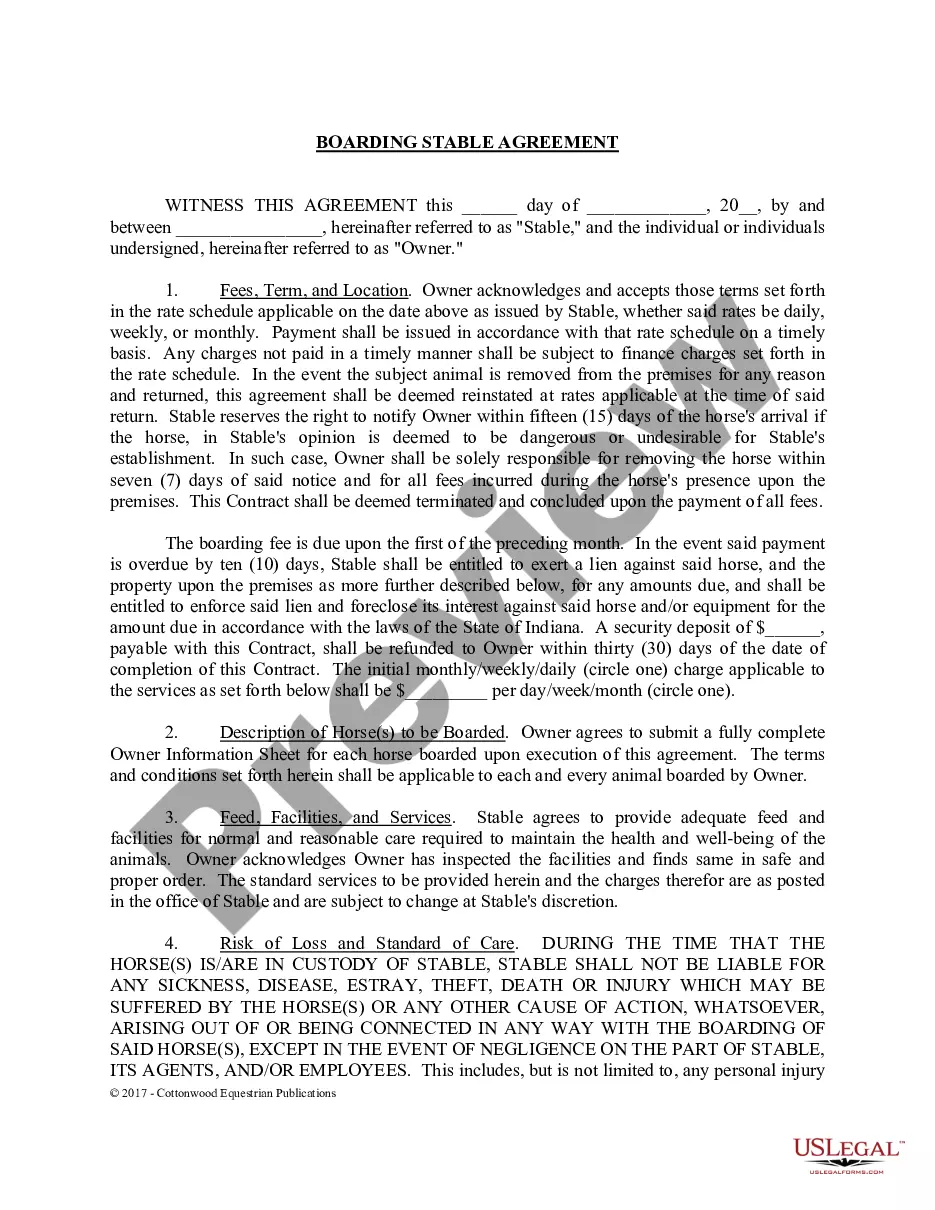
The Boarding Stable Agreement is a legal document between the owner of a stable and the horse owner, outlining the terms of care and services provided for boarding horses. This agreement is essential in defining the responsibilities of both parties, including financial obligations, care standards, and liability. It ensures that both the stable and horse owner are clear about their rights and duties, making it a crucial element for anyone engaging in horse boarding arrangements.
Main sections of this form
- Details of fees, payment schedules, and security deposits.
- Identification and description of the horse(s) to be boarded.
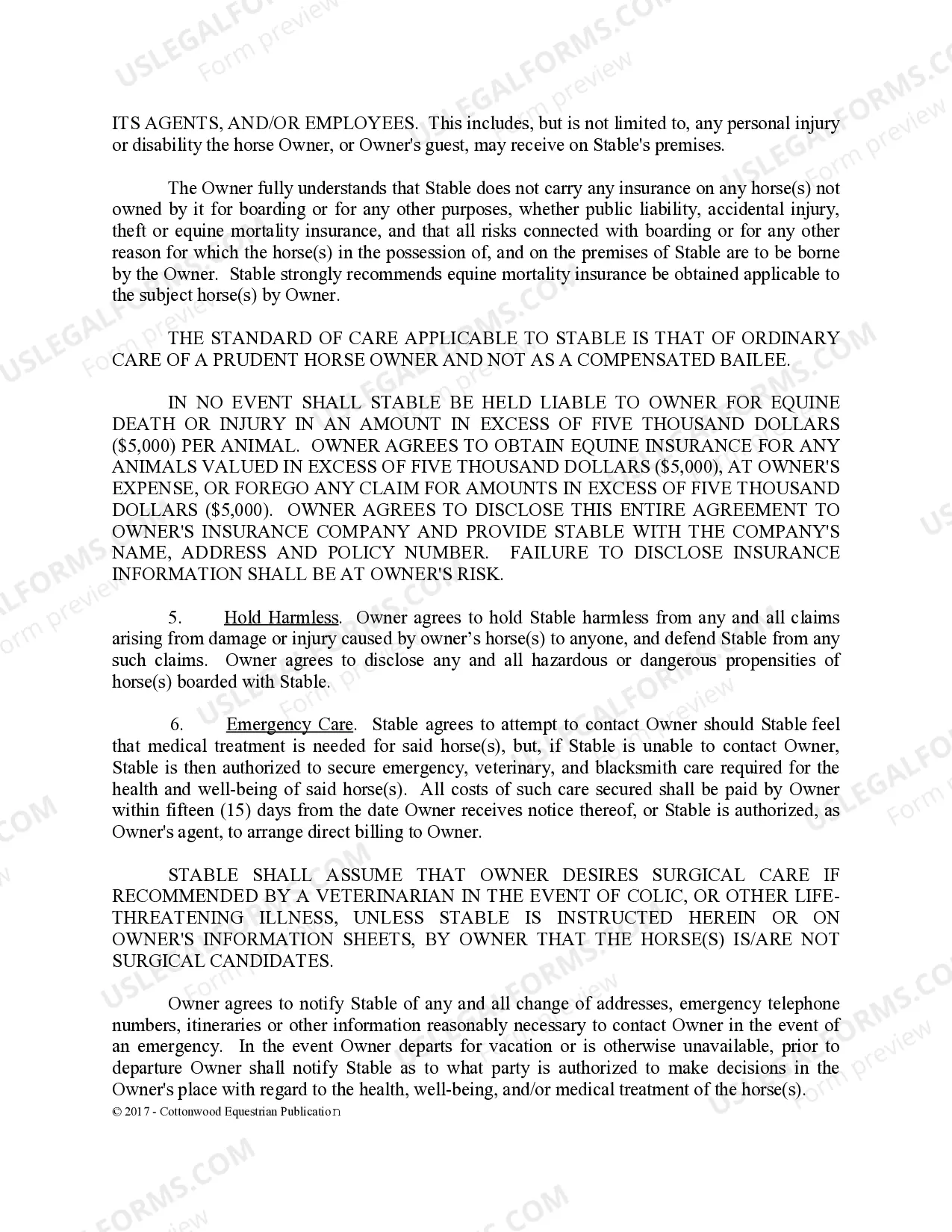
- Standard of care and risk of loss provisions.
- Emergency care protocols and liabilities.
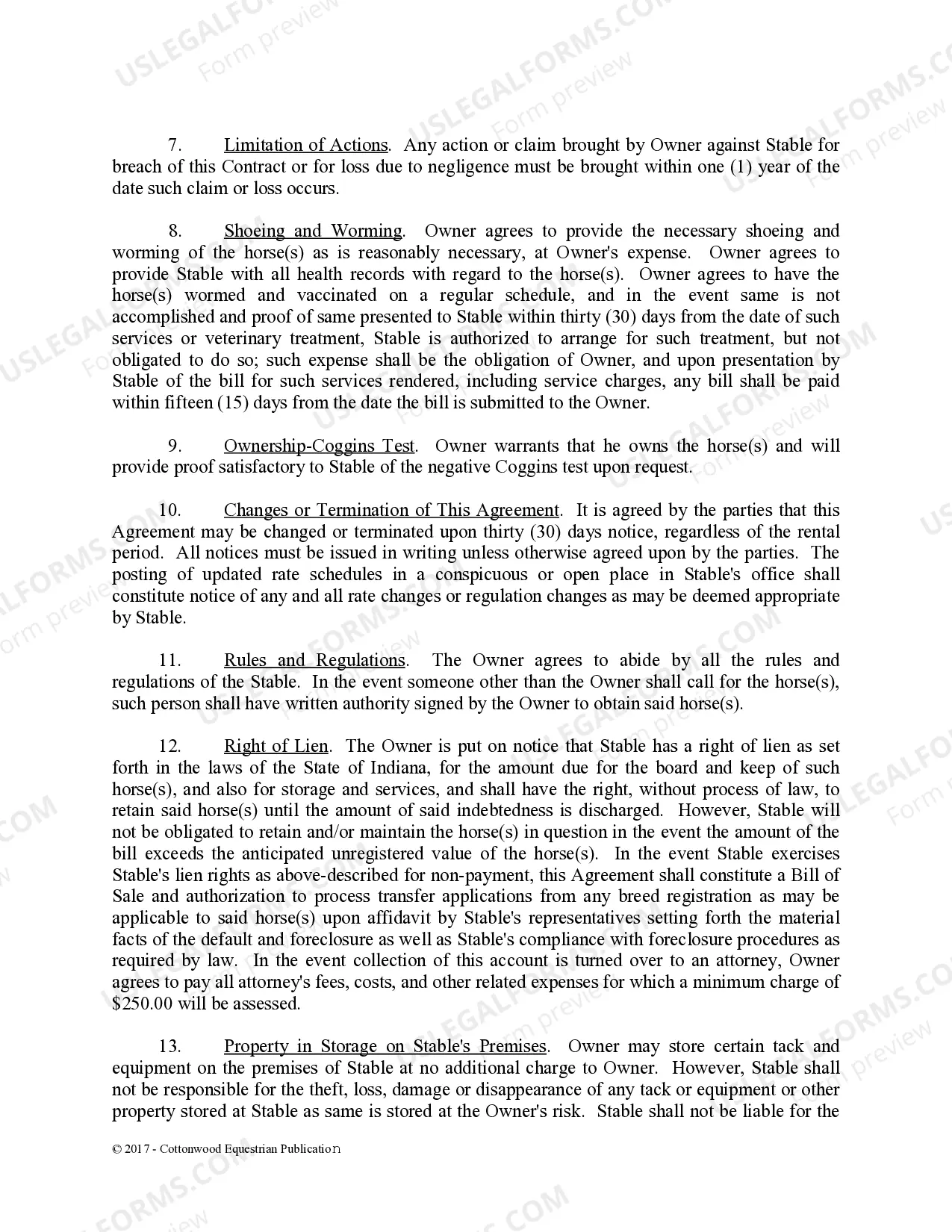
- Owner's responsibilities, including insurance requirements and health record submissions.
- Termination and notice provisions related to the agreement.


When to use this document
This Boarding Stable Agreement should be utilized when a horse owner is seeking to board their horse at a stable. It is ideal in scenarios where the owner needs to ensure the safe and secure care of their horse, while also clarifying responsibilities regarding payment, care standards, insurance, and emergency situations. This agreement helps prevent misunderstandings and disputes between the horse owner and stable operator.
Who this form is for
- Horse owners looking for boarding services for their animals.
- Stable owners seeking to formalize agreements with horse owners.
- Individuals or entities involved in equine activities requiring defined care and liability standards.
Steps to complete this form
- Identify the parties involved by entering the stable's name and the owner's name.
- Specify the fees and payment terms, including the security deposit.
- Provide a complete description of the horses to be boarded.
- Review and sign the agreement, ensuring all parties understand their obligations.
- Keep a copy of the signed agreement for your records and future reference.
Does this document require notarization?
Notarization is generally not required for this form. However, certain states or situations might demand it. You can complete notarization online through US Legal Forms, powered by Notarize, using a verified video call available anytime.
Get your form ready online
Our built-in tools help you complete, sign, share, and store your documents in one place.
Make edits, fill in missing information, and update formatting in US Legal Forms—just like you would in MS Word.
Download a copy, print it, send it by email, or mail it via USPS—whatever works best for your next step.
Sign and collect signatures with our SignNow integration. Send to multiple recipients, set reminders, and more. Go Premium to unlock E-Sign.
If this form requires notarization, complete it online through a secure video call—no need to meet a notary in person or wait for an appointment.
We protect your documents and personal data by following strict security and privacy standards.

Make edits, fill in missing information, and update formatting in US Legal Forms—just like you would in MS Word.

Download a copy, print it, send it by email, or mail it via USPS—whatever works best for your next step.

Sign and collect signatures with our SignNow integration. Send to multiple recipients, set reminders, and more. Go Premium to unlock E-Sign.

If this form requires notarization, complete it online through a secure video call—no need to meet a notary in person or wait for an appointment.

We protect your documents and personal data by following strict security and privacy standards.
Common mistakes to avoid
- Failing to provide complete information about the horses being boarded.
- Not discussing or understanding the terms of liability and risk of loss.
- Neglecting to submit valid insurance details, if applicable.
- Overlooking signatures from all necessary parties.
Benefits of completing this form online
- Easy access and convenience of downloading the form anytime.
- Editable fields allow customization to fit specific needs.
- Guidance provided within the form ensures clarity of terms.
- Provides a professional standard agreement drafted by legal experts.
Looking for another form?
Form popularity
FAQ
The cost of boarding averages $400 to $500 per month but can go as high as $1,200 to $2,500 in metropolitan areas. Services such as mucking out stalls, feeding and turning out your horse to pasture may not be included in the price. For those lucky enough to own sufficient land, there are still costs to consider.
AS an instructor, you obviously need insurance cover to protect you in the course of your commercial activities. Anyone involved in business-related equestrian activities should have public liability insurance.
Numbers Game. The reality is that boarding facilities operate on slim profit margins. By the time costs are considered for hay, grain, bedding, labor for feeding, cleaning stalls, doing turnout, etc., the board fees typically do not leave a lot left over, Sherrick-von Schiller said.Labor costs are also significant.
Equine/Stable Liability will be required; Care, Custody, Control to provide coverage for the non-owned boarded horses; General Liability and Property insurance.
Self-care stall board usually costs between $200 and $1,000 monthly depending on the factors described above and self-care pasture board can cost between $100 and $600 monthly.
Scope out legalities. Consider zoning, business permits and your state's lien laws. Evaluate your facilities. Investigate the cost of liability insurance. Research your market. Crunch the numbers. Draw up a legal boarding contract.
The horse owner and stable manager can decide on what works best, but usually partial board or semi board includes a stall, pasture, hay, bedding, and grain. The horse owner would need to complete the daily care of the horse to include feeding and stall cleaning.
Scope out legalities. Consider zoning, business permits and your state's lien laws. Evaluate your facilities. Investigate the cost of liability insurance. Research your market. Crunch the numbers. Draw up a legal boarding contract.