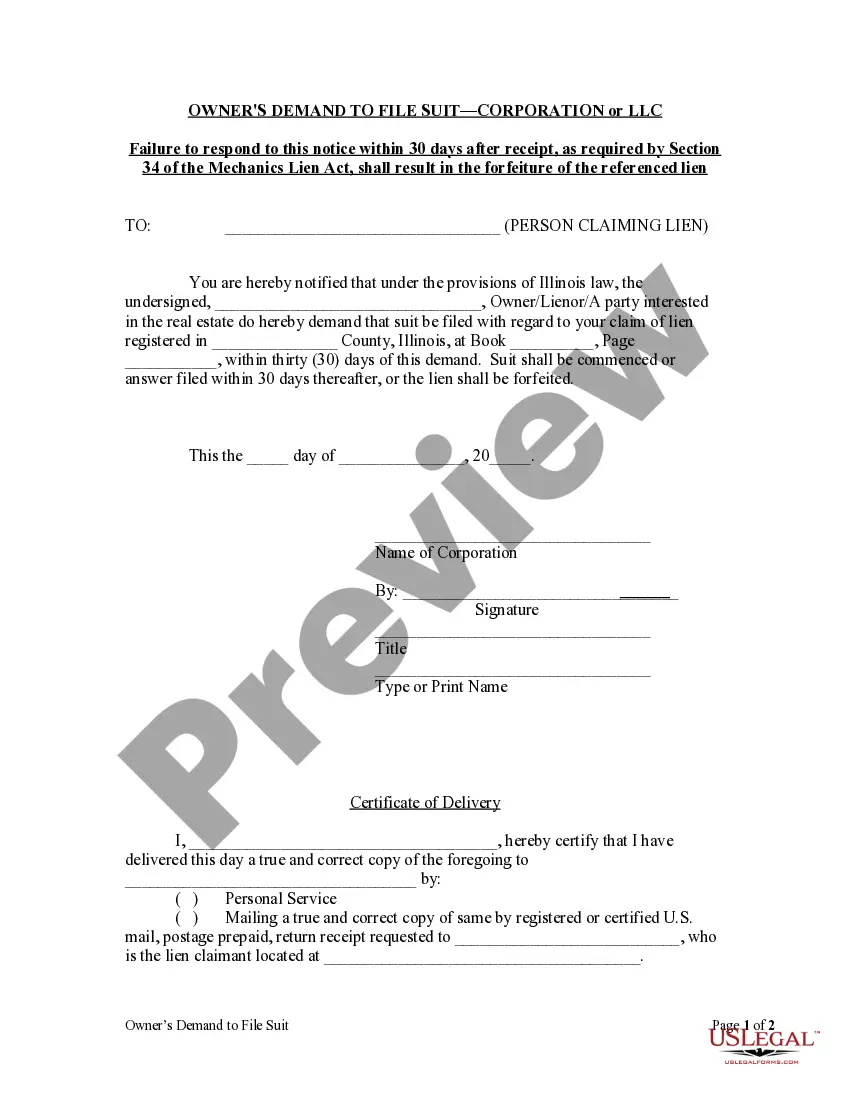
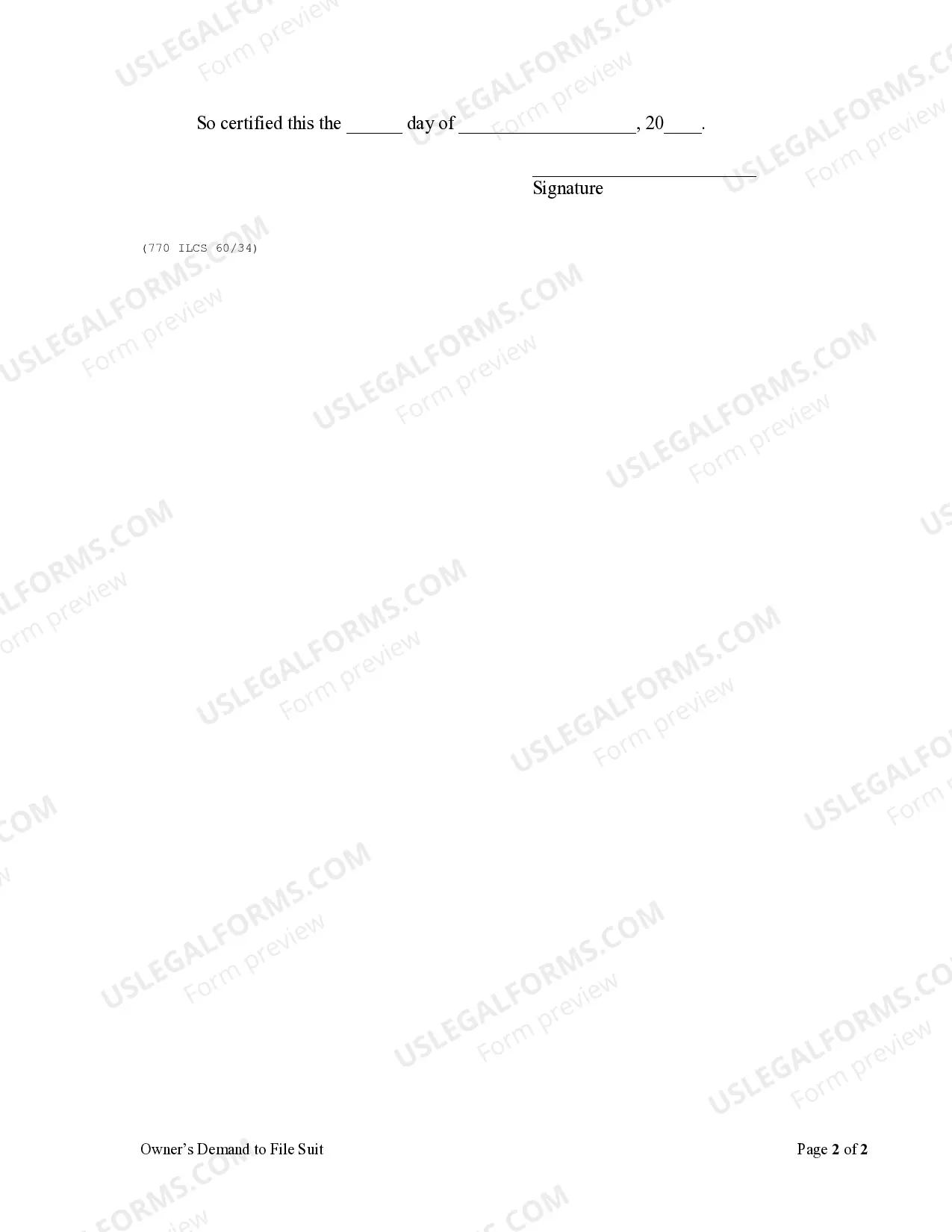
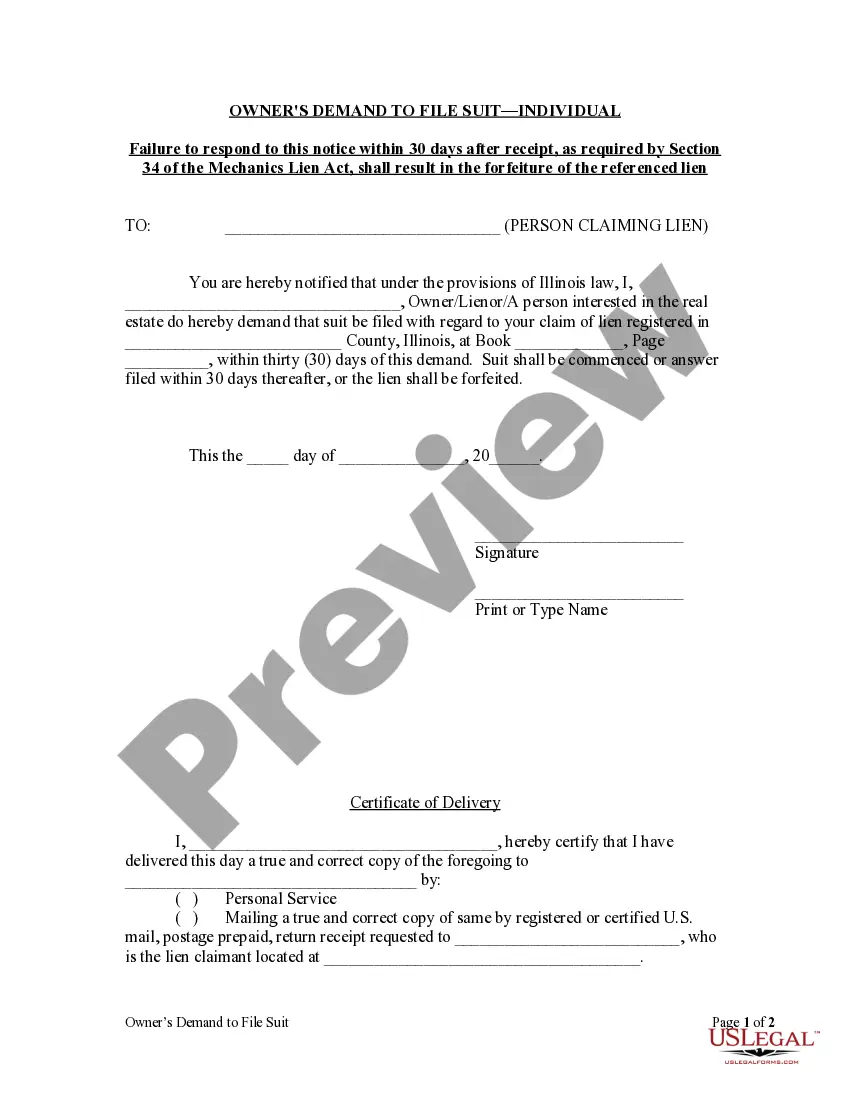
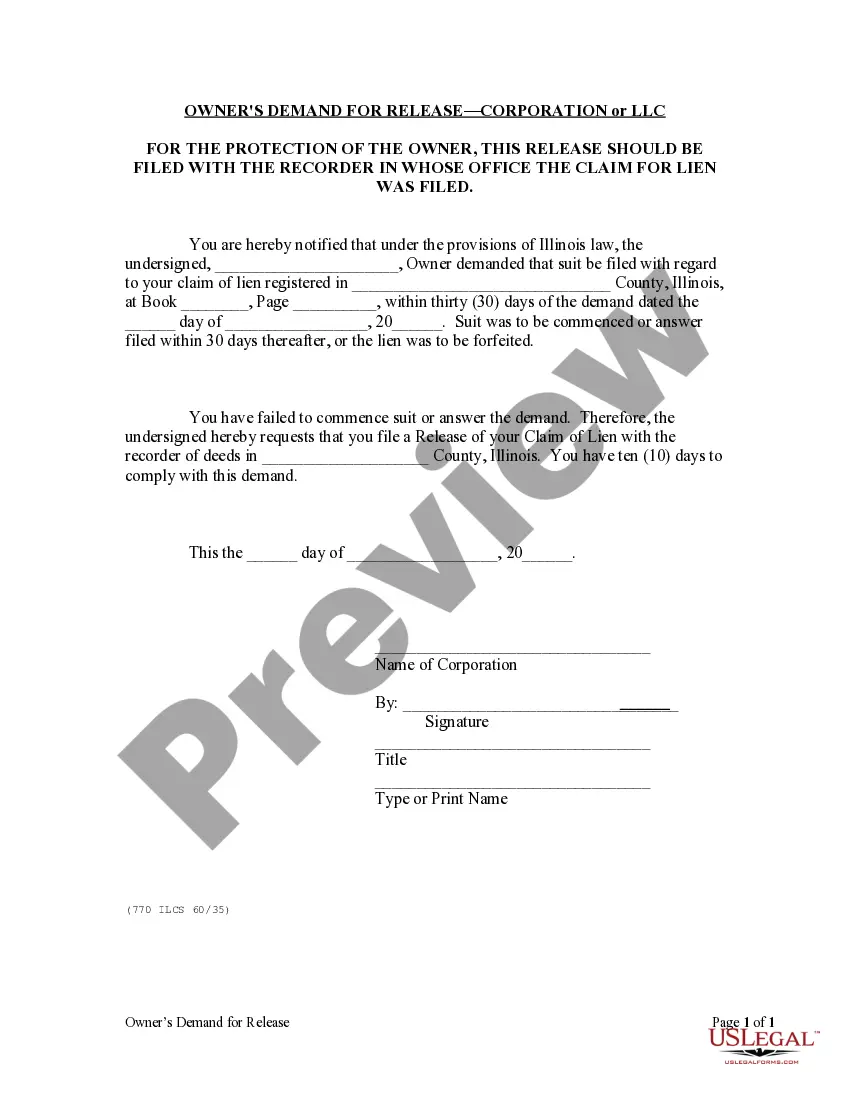
Pursuant to 770 ILCS 60/34, this form may be used by a corporate or LLC owner to demand that a person who has a lien claim either commence a suit or file an answer in a pending suit within thirty (30) days of service.
Illinois Owner's Demand to File Suit - Mechanics Liens - Corporation or LLC
Category:
State:
Illinois
Control #:
IL-08A-09
Format:
Word;
Rich Text
Instant download
Description
Free preview




How to fill out Illinois Owner's Demand To File Suit - Mechanics Liens - Corporation Or LLC?
Searching for Illinois Owner's Demand to Initiate Lawsuit - Mechanics Liens - Corporation or LLC paperwork and completing them could pose a challenge.
To conserve time, expenses, and effort, utilize US Legal Forms and locate the appropriate template specifically for your jurisdiction in just a few clicks.
Our legal professionals prepare all documents, so you only need to fill them out. It's really that straightforward.
Select your plan on the pricing page and set up your account. Choose whether you prefer to pay with a card or via PayPal. Download the document in your desired format. You can print the Illinois Owner's Demand to Initiate Lawsuit - Mechanics Liens - Corporation or LLC template or complete it using any online editor. Don’t worry about making mistakes since your template can be used, submitted, and printed as many times as you wish. Explore US Legal Forms and gain access to about 85,000 state-specific legal and tax documents.
- Log in to your account and revisit the form's webpage to download the example.
- All of your saved templates are stored in My documents and are available at any time for future use.
- If you haven’t yet signed up, it's advisable to register.
- Refer to our comprehensive guidelines on how to obtain your Illinois Owner's Demand to Initiate Lawsuit - Mechanics Liens - Corporation or LLC example in just a few minutes.
- To acquire a qualified example, verify its applicability for your jurisdiction.
- Examine the form using the Preview feature (if available).
- If there's a description, read it to understand the crucial elements.
- Click on the Buy Now button if you discover what you're looking for.
Form popularity
FAQ
Formalize a defense for disputing the amount of the lien. Gather supporting documentation for your rebuttal, depending on the type of lien. Contact the agent representing the creditor to dispute the amount of the claim. Negotiate a payment settlement with the creditor if you cannot pay the amount you owe in full.
Negotiate with the contractor who placed the lien (the "lienor" to remove it. Obtain a lien bond to discharge the lien, or. File a lawsuit to vacate the lien.
The deadline for contractors and subcontractors to file their statement of mechanic's lien is four months (not 120 days) from the last date of work (exclusive of warranty work or other work performed free of charge), or from the last date that materials were supplied to the project.
In order to enforce a lien, the contractor, subcontractor or supplier must file a lawsuit. The deadline to file a lawsuit is two years from the last date work was performed or materials were supplied. A recorded lien is valid for these two years, but a failure to sue within that time frame voids the lien.
The deadline for contractors and subcontractors to file their statement of mechanic's lien is four months (not 120 days) from the last date of work (exclusive of warranty work or other work performed free of charge), or from the last date that materials were supplied to the project.
Step 1: Determine if you have lien rightsIllinois is relatively liberal about who has the right to file a lien. Most parties who provide any labor or services, including architects and engineers, are entitled to file a mechanics lien.
The process of bonding off a mechanics lien starts after a claimant has filed a mechanics lien. After the claim is made, a general contractor or a property owner can contact a surety bond company to purchase a surety bond that replaces the value of the lien that was filed against the property.
If a license is required for the work performed, an unlicensed contractor NOT ONLY cannot file a valid mechanics lien, but s/he also cannot file suit to recover, either. In California, unlicensed contractors are not entitled to be paid period for anything, and will be thrown out of court if they sue to get paid.
The people who can file mechanic's liens are identified by state law. A subcontractor or supplier to a subcontractor may not be able to file a lien. Also, unlicensed contractors are often barred from filing a mechanic's lien.