Illinois Quitclaim Deed from Husband and Wife to Corporation
Understanding this form
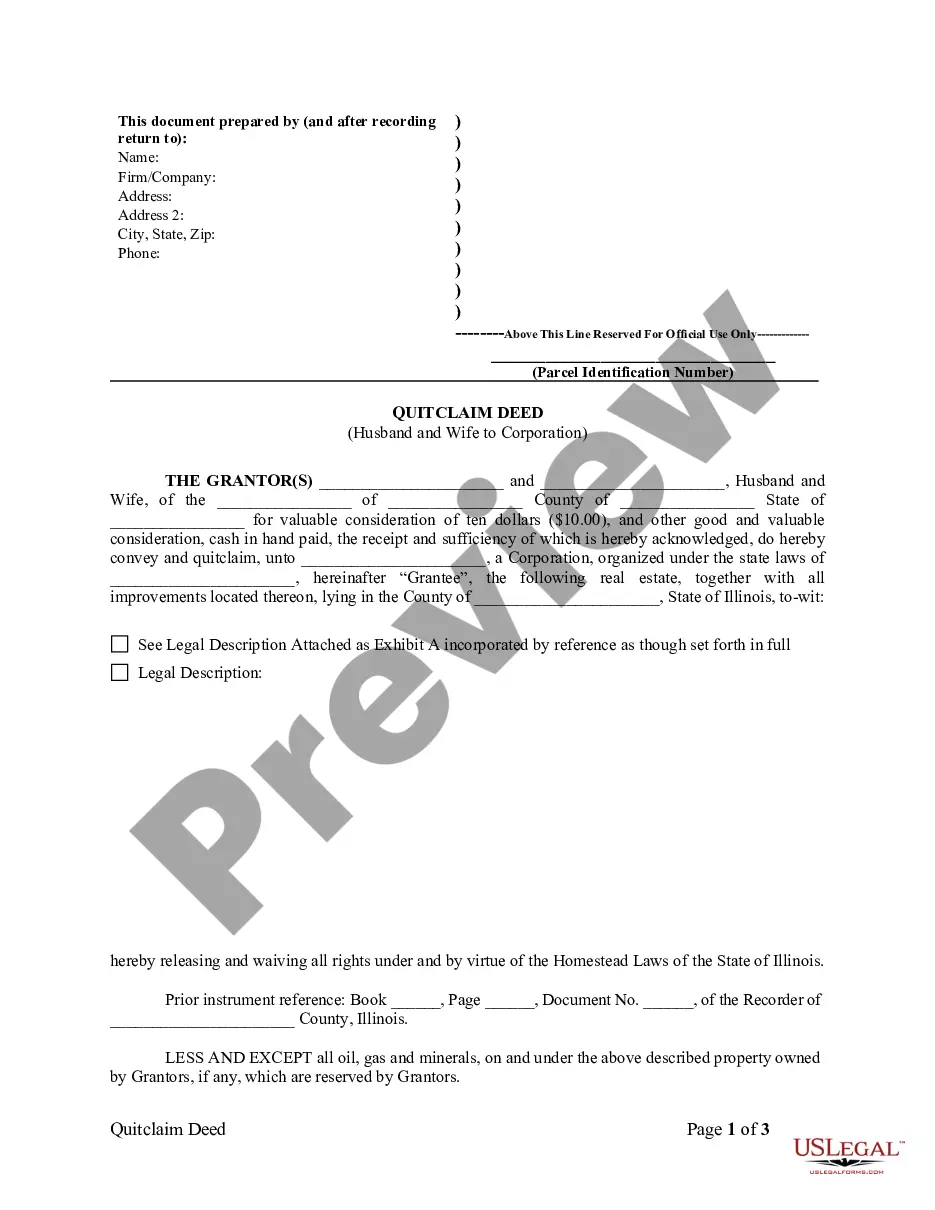
This Quitclaim Deed from Husband and Wife to Corporation is a legal document that allows a married couple to transfer ownership of a property to a corporation. Unlike a warranty deed, a quitclaim deed does not guarantee the title, making it important for situations where the grantors want to relinquish any claim to the property without offering warranties. This form is essential in real estate transactions when husbands and wives wish to convey property to a corporation, freeing them from any interest without dispute or assumption of liability.
What’s included in this form
- Identification of the grantors (husband and wife) and the grantee (corporation).
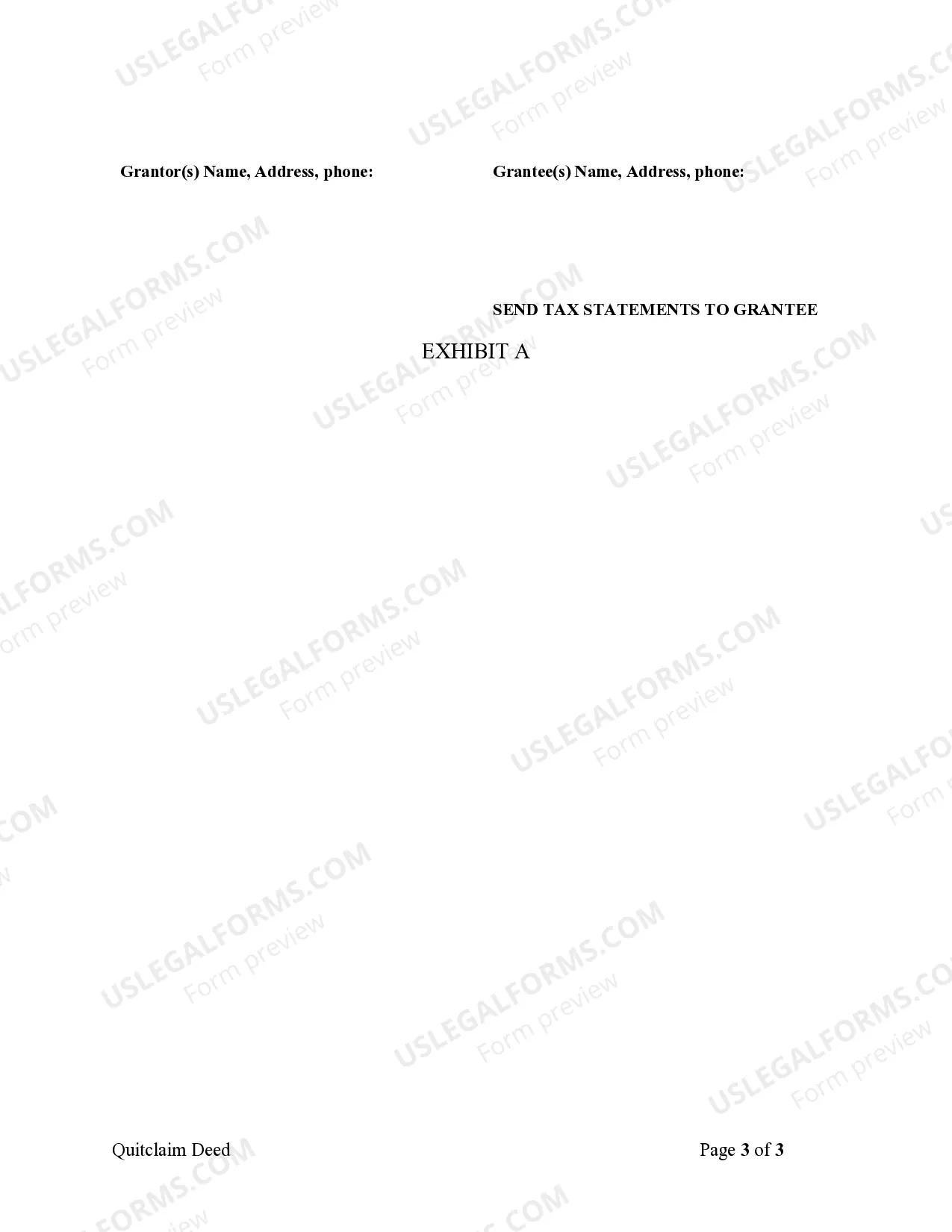
- Legal description of the property being transferred, including attachments.
- Reservation of rights concerning oil, gas, and mineral interests in the property.
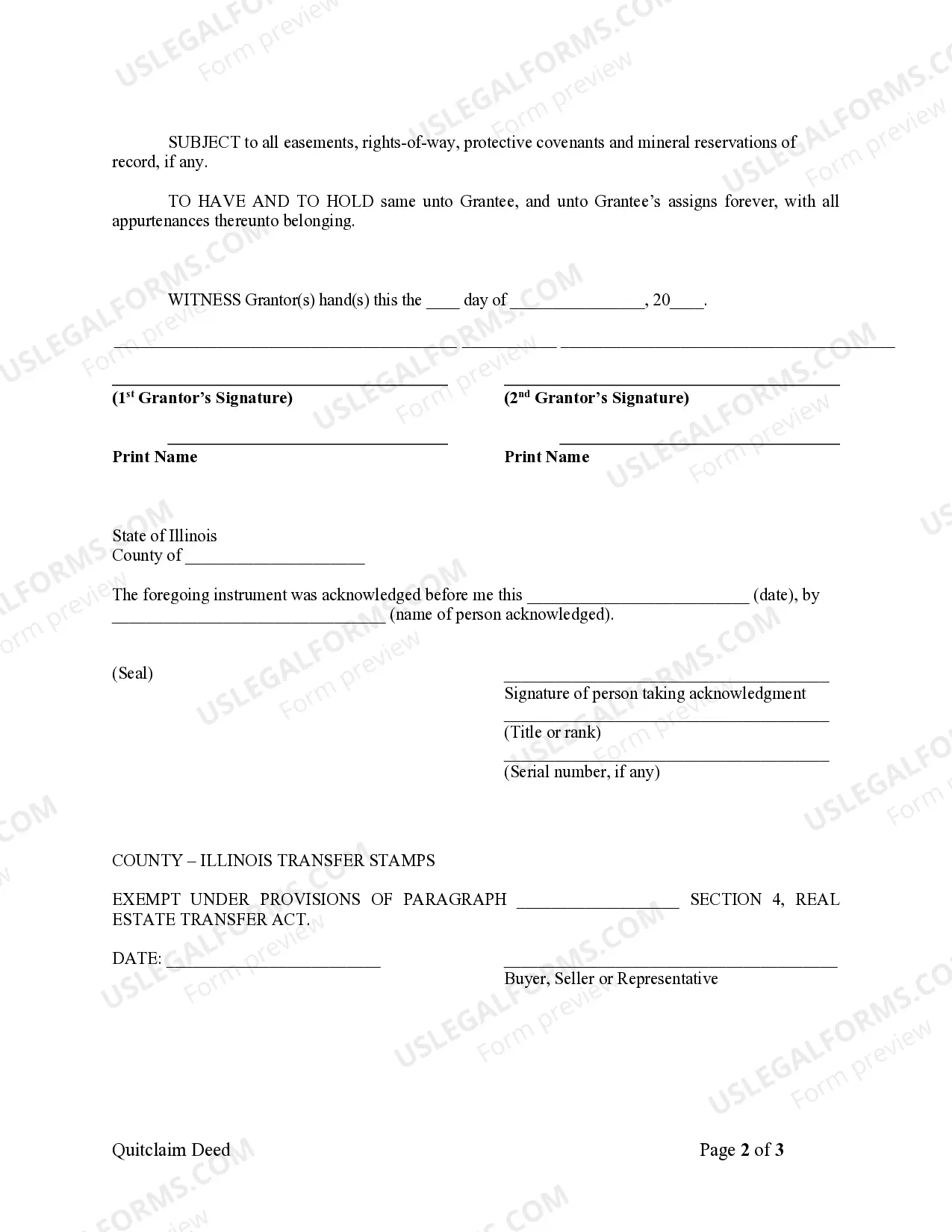
- Statement regarding easements, rights-of-way, and other recorded interests that may affect the property.
- Date of signing and notarial acknowledgment for validation.




When to use this document
This form is useful when a husband and wife want to transfer real property they own to a corporation, such as in estate planning or business structuring scenarios. It is particularly applicable when the couple desires to resolve any claims to the property while avoiding the complexities associated with warranties or guarantees on the title, especially in transactions involving family businesses or corporate ownership structures.
Who needs this form
This form is intended for:
- Husbands and wives who jointly own property and wish to transfer it to a corporation.
- Corporate entities receiving property as part of a business transaction.
- Individuals managing estate planning who need to shift ownership of assets efficiently.
How to prepare this document
- Identify the parties by including the names of the husband and wife as grantors and the corporation as the grantee.
- Specify the legal description of the property, referring to any attachments or exhibits needed.
- Indicate the reservation of any rights related to oil, gas, and minerals on the property.
- Fill in the date of execution at the appropriate section of the form.
- Have the document signed in the presence of a notary public to ensure its validity.
Is notarization required?
This document requires notarization to meet legal standards. US Legal Forms provides secure online notarization powered by Notarize, allowing you to complete the process through a verified video call, available 24/7.
Get your form ready online
Our built-in tools help you complete, sign, share, and store your documents in one place.
Make edits, fill in missing information, and update formatting in US Legal Forms—just like you would in MS Word.
Download a copy, print it, send it by email, or mail it via USPS—whatever works best for your next step.
Sign and collect signatures with our SignNow integration. Send to multiple recipients, set reminders, and more. Go Premium to unlock E-Sign.
If this form requires notarization, complete it online through a secure video call—no need to meet a notary in person or wait for an appointment.
We protect your documents and personal data by following strict security and privacy standards.

Make edits, fill in missing information, and update formatting in US Legal Forms—just like you would in MS Word.

Download a copy, print it, send it by email, or mail it via USPS—whatever works best for your next step.

Sign and collect signatures with our SignNow integration. Send to multiple recipients, set reminders, and more. Go Premium to unlock E-Sign.

If this form requires notarization, complete it online through a secure video call—no need to meet a notary in person or wait for an appointment.

We protect your documents and personal data by following strict security and privacy standards.
Avoid these common issues
- Failing to include the full legal description of the property.
- Not reserving rights for oil, gas, and minerals when applicable.
- Neglecting to sign the document in front of a notary public.
- Omitting to check for existing easements or covenants that could affect ownership rights.
Benefits of using this form online
- Immediate access to a legally drafted template created by licensed attorneys.
- Easy download and printing capabilities for convenience.
- Editability to customize the document according to specific needs without any hassle.
- Secure and efficient process compared to traditional methods of obtaining legal forms.
Looking for another form?
Form popularity
FAQ
If the quitclaim deed requires the signature of all co-owners, the deed is invalid unless all co-owners have signed it and the deed is then delivered to the grantee.If one individual owns real estate and desires to add a co-owner such as a spouse, a quitclaim deed might be used.
A quitclaim deed in Illinois is often used to transfer property between close family members or trusted friends.A quitclaim deed requires trust on the part of the person receiving the deed, because the person transferring it, also known as the grantor, isn't guaranteeing they actually own the property.
But you might be wondering if an owner can transfer a deed to another person without a real estate lawyer. The answer is yes. Parties to a transaction are always free to prepare their own deeds.A quitclaim deed, for example, is far simpler than a warranty deed.
A quitclaim deed is quick and easy because it transfers all of one person's interest in the property to another.The deed transfers all claims the seller has to the property, if any. If the seller has no interest in the real estate, no interest is transferred.
A quitclaim deed transfers title but makes no promises at all about the owner's title.A person who signs a quitclaim deed to transfer property they do not own results in no title at all being transferred since there is no actual ownership interest. The quitclaim deed only transfers the type of title you own.
A quitclaim deed affects ownership and the name on the deed, not the mortgage. Because quitclaim deeds expose the grantee to certain risks, they are most often used between family members and where there is no exchange of money.Quitclaim deeds transfer title but do not affect mortgages.
The drawback, quite simply, is that quitclaim deeds offer the grantee/recipient no protection or guarantees whatsoever about the property or their ownership of it. Maybe the grantor did not own the property at all, or maybe they only had partial ownership.
A quitclaim deed is a deed (proof of ownership) that is passed from a grantor (the existing property owner) to a grantee (the new property owner) that does not have a warranty.A quitclaim deed has no guarantees for the grantor or grantee.