Illinois Owner's Demand to File Suit - Mechanics Liens - Individual
About this form
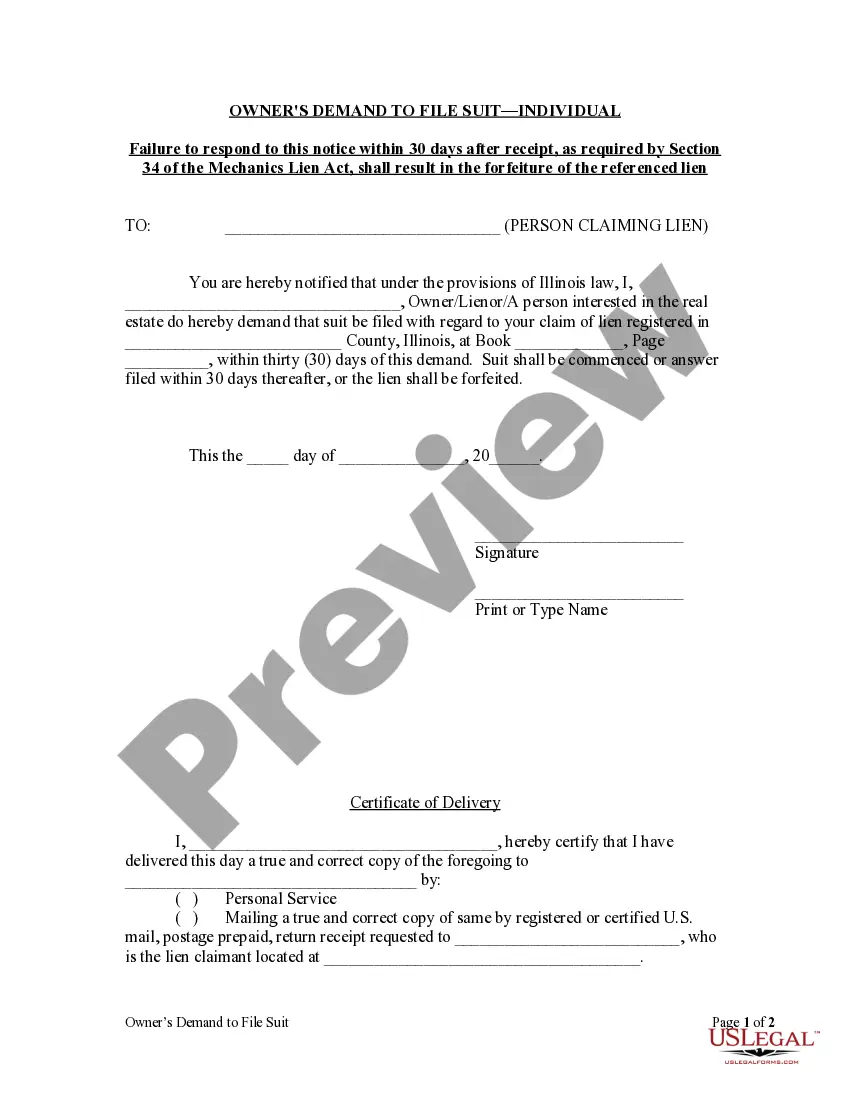
The Owner's Demand to File Suit - Mechanics Liens - Individual form is a legal document that allows an individual owner to formally demand that a lien claimant take action regarding their lien claim. Specifically, this form requires the claimant to file a suit or respond to an existing suit within thirty days. It is crucial for enforcing the owner's rights and preventing the forfeit of the lien, and it serves as an important step in the mechanics lien process in Illinois.
Form components explained
- Identification of the parties involved, including the owner and the lien claimant.
- Details regarding the lien claim, including the county and book/page number where the lien is registered.
- A clear demand for the lien claimant to commence suit or file an answer within thirty days.
- A signature line for verification and acknowledgement by the owner.
- Certification of delivery, detailing how and when the demand was served to the lien claimant.
When this form is needed
This form should be used when an individual property owner receives a lien claim from a contractor, subcontractor, or supplier and wants to compel the claimant to take legal action. If the claimant does not respond within the specified timeframe, the lien could be forfeited, providing the owner with the opportunity to clear their property title.
Who needs this form
- Individual property owners facing a mechanics lien on their property.
- Individuals who have received a lien claim and wish to prompt legal action from the claimant.
- Homeowners or landlords involved in construction projects where lien claims may arise.
How to prepare this document
- Identify the lien claimant by entering their full name where indicated.
- Fill in your name as the owner or lienor in the appropriate section.
- Specify the county and the book/page number where the lien is recorded.
- Date the form appropriately before signing it.
- Sign the form and print your name clearly beneath the signature line.
- Complete the certificate of delivery by indicating how the demand was served to the lien claimant.
Is notarization required?
Notarization is not commonly needed for this form. However, certain documents or local rules may make it necessary. Our notarization service, powered by Notarize, allows you to finalize it securely online anytime, day or night.
Get your form ready online
Our built-in tools help you complete, sign, share, and store your documents in one place.
Make edits, fill in missing information, and update formatting in US Legal Forms—just like you would in MS Word.
Download a copy, print it, send it by email, or mail it via USPS—whatever works best for your next step.
Sign and collect signatures with our SignNow integration. Send to multiple recipients, set reminders, and more. Go Premium to unlock E-Sign.
If this form requires notarization, complete it online through a secure video call—no need to meet a notary in person or wait for an appointment.
We protect your documents and personal data by following strict security and privacy standards.

Make edits, fill in missing information, and update formatting in US Legal Forms—just like you would in MS Word.

Download a copy, print it, send it by email, or mail it via USPS—whatever works best for your next step.

Sign and collect signatures with our SignNow integration. Send to multiple recipients, set reminders, and more. Go Premium to unlock E-Sign.

If this form requires notarization, complete it online through a secure video call—no need to meet a notary in person or wait for an appointment.

We protect your documents and personal data by following strict security and privacy standards.
Common mistakes to avoid
- Failing to include the correct book and page number of the lien.
- Not serving the document correctly, which can invalidate the demand.
- Omitting the date or signature, making the document incomplete.
- Not adhering to the thirty-day requirement for the claimant's response.
Benefits of completing this form online
- Convenience of immediate download without the need to visit a lawyer.
- Editability allows you to customize the document to fit your specific situation.
- Reliability, as the forms are drafted by licensed attorneys to ensure legal compliance.
- Easy access to guidance while completing the form.
Legal use & context
- This form is legally binding under Illinois law when properly filled out and delivered.
- The demand must be issued within the prescribed thirty-day period to avoid forfeiture of the lien.
- Failure to comply with the demand can result in the forfeiture of the lien claim.
What to keep in mind
- The form facilitates the enforcement of legal rights for property owners facing lien claims.
- Completion and timely submission are crucial to prevent forfeiture of the lien.
- Using this form helps clarify legal obligations and encourages prompt action from lien claimants.
Looking for another form?

Form popularity
FAQ
Step 1: Determine if you have lien rightsIllinois is relatively liberal about who has the right to file a lien. Most parties who provide any labor or services, including architects and engineers, are entitled to file a mechanics lien.
The process of bonding off a mechanics lien starts after a claimant has filed a mechanics lien. After the claim is made, a general contractor or a property owner can contact a surety bond company to purchase a surety bond that replaces the value of the lien that was filed against the property.
The simplest way to prevent liens and ensure that subcontractors and suppliers are paid is to pay with joint checks. This is when both parties endorse the check. Compare the contractor's materials or labor bill to the schedule of payments in your contract and the Preliminary Notices.
California Mechanics' Lien law provides special protection to contractors, subcontractors, laborers and suppliers who furnish labor or materials to repair, remodel or build your home.The mechanics' lien is a right that California gives to workers and suppliers to record a lien to ensure payment.
To enforce the lien, the contractor must file a lawsuit within 90 days from the date of recording the lien. If this deadline is passed, the contractor may not be able to enforce the lien and may be required to remove the lien.
Even though these states may permit project participants to secure lien rights and claim a mechanics lien even without a written contract, it is generally best practice to have a signed written contract for work provided.
Posting a Bond Asselta says to expect to pay 110 percent of the lien amount. Submit the bond to the court. The lien will then transfer to the bond and clear the property's title. Wait for the contractor claimant to foreclose on the lien in the allotted period to dispute the lien in court.
In order to enforce a lien, the contractor, subcontractor or supplier must file a lawsuit. The deadline to file a lawsuit is two years from the last date work was performed or materials were supplied. A recorded lien is valid for these two years, but a failure to sue within that time frame voids the lien.