Illinois Renunciation and Disclaimer of Real Property Interest
About this form
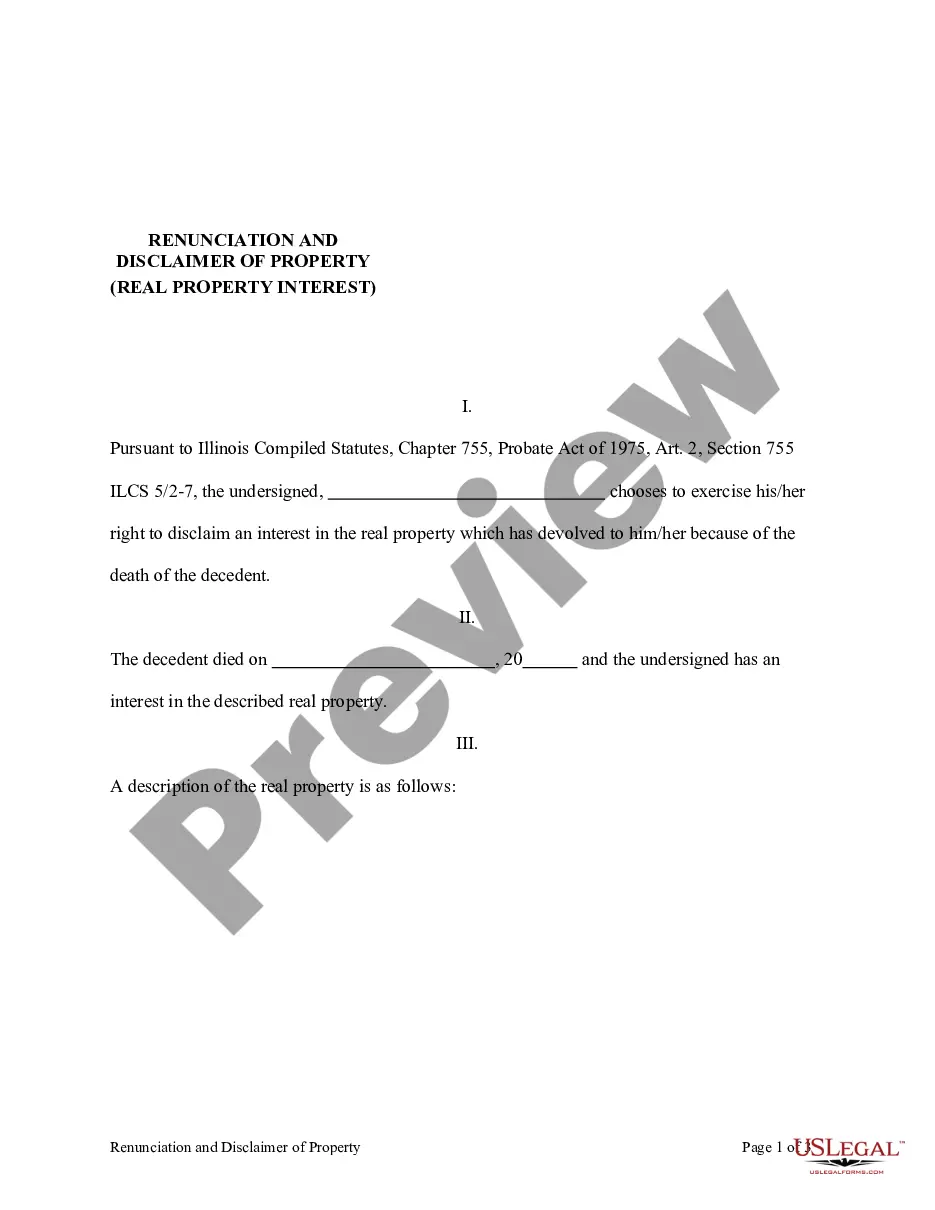
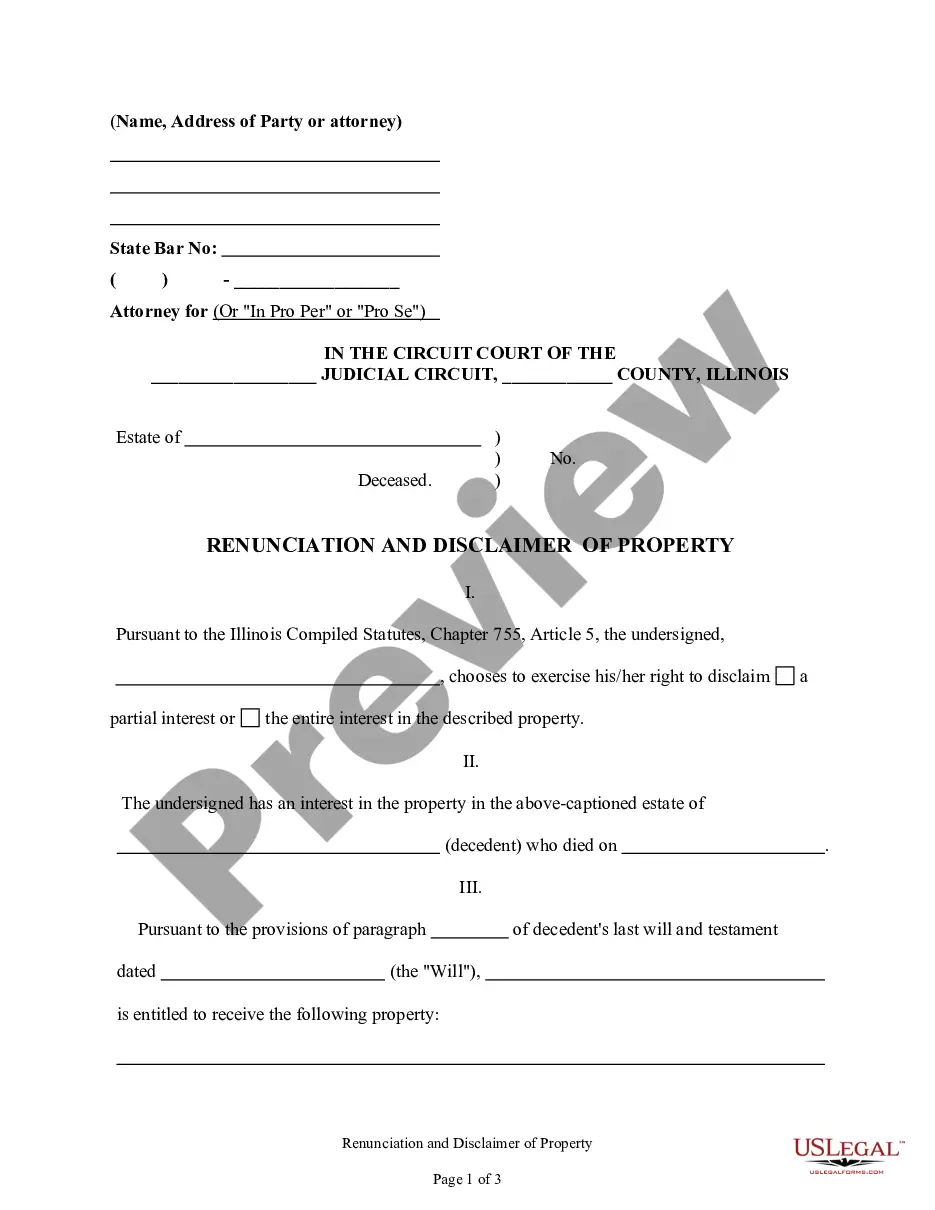
The Illinois Renunciation and Disclaimer of Real Property Interest is a legal document allowing a beneficiary to formally renounce their interest in real property received through inheritance. This form is crucial for beneficiaries who do not wish to accept their inherited property, enabling the asset to pass on to other heirs as if the beneficiary had predeceased the decedent. This form is specifically designed for use under Illinois law and is essential for ensuring that the beneficiary's intentions are clearly documented and recognized by authorities.
Key components of this form
- Identification of the beneficiary renouncing the property interest.
- Description of the real property involved.
- Legal acknowledgment of the beneficiary's choice to disclaim the interest.
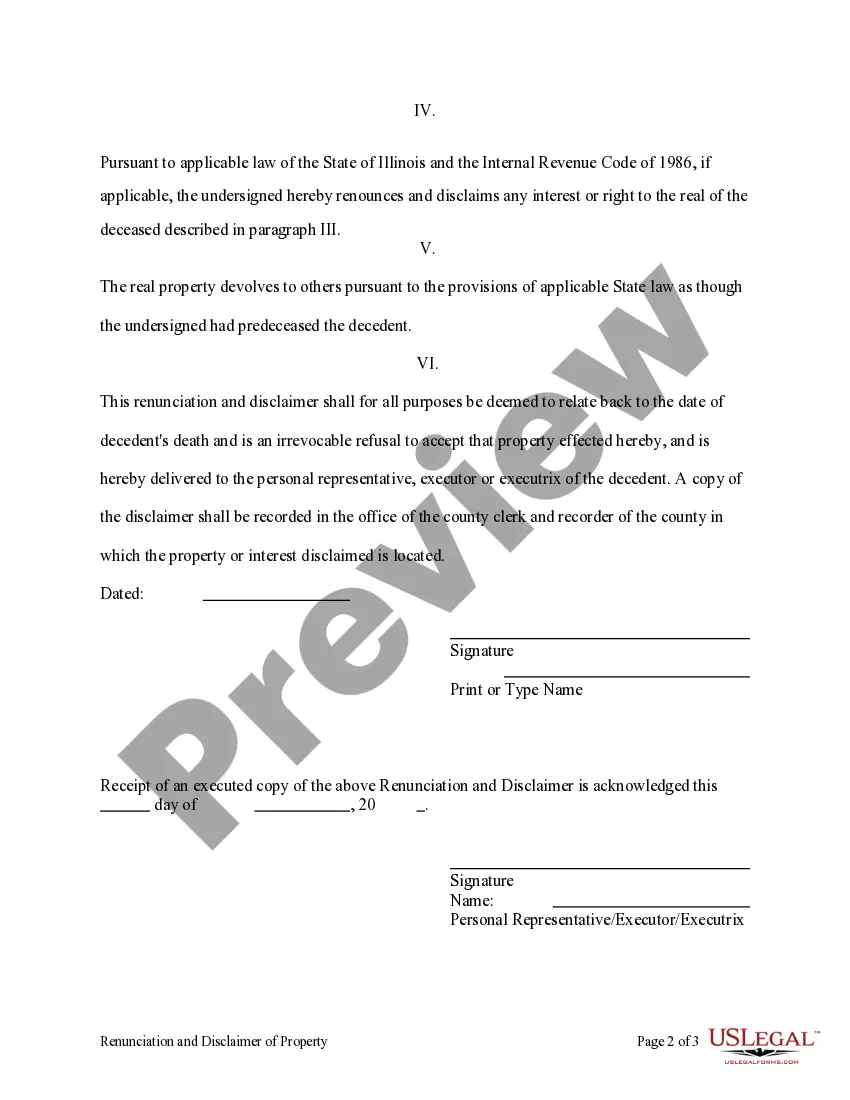
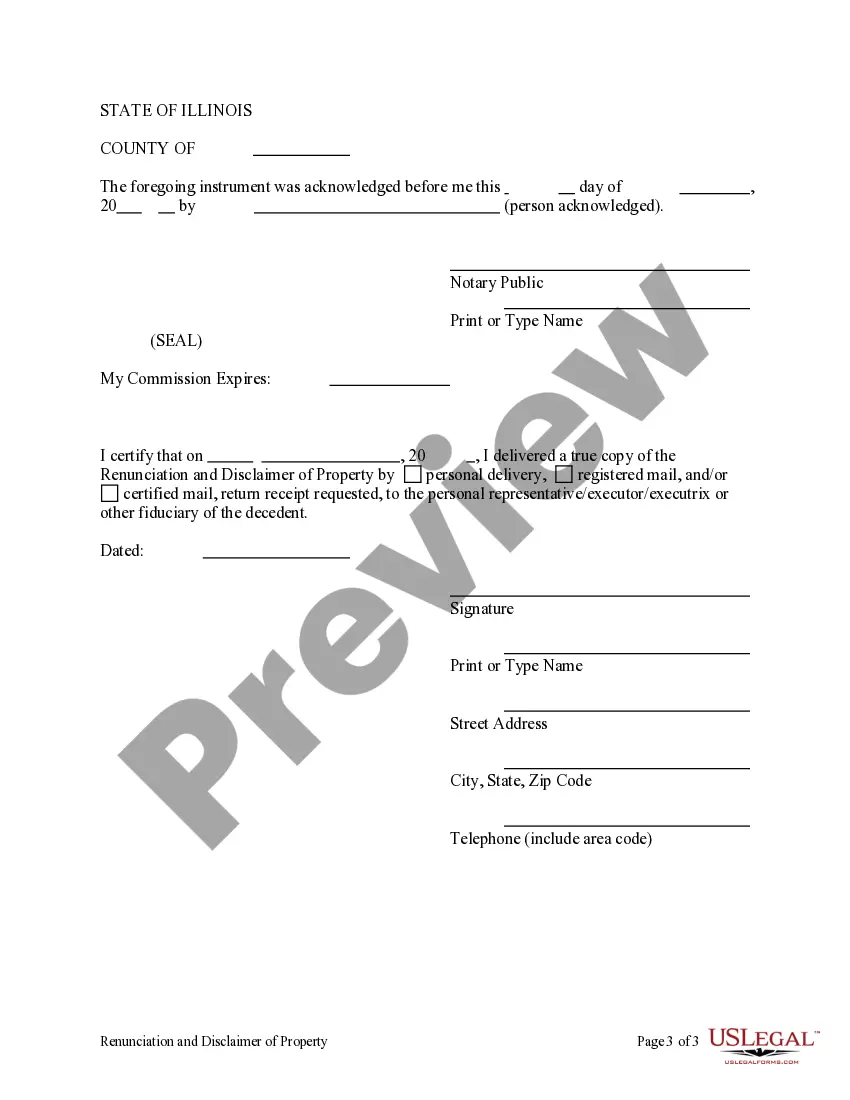
- Certification of delivery to relevant parties.
- Provision that the property will devolve according to state laws.

When this form is needed
This form should be used when an individual inherits real property but decides not to accept the interest for any reason. Situations may include financial considerations, tax implications, or personal preference. Completing this renunciation allows the property to be distributed to alternative beneficiaries as if the disclaiming party had not inherited it.
Who needs this form
This form is intended for:
- Beneficiaries who have inherited real property from a decedent.
- Individuals who wish to legally renounce their interest in the property.
- Those seeking to ensure that property passes to other heirs in accordance with Illinois law.
Completing this form step by step
- Identify the beneficiary's full name and contact information.
- Provide a detailed description of the real property being renounced.
- Clearly state the intention to disclaim the property interest.
- Sign and date the form in the presence of an appropriate witness if required.
- Submit the completed form to the relevant parties, ensuring it is delivered correctly.
Notarization guidance
This form does not typically require notarization unless specified by local law. Itâs important to check state-specific regulations to confirm any requirements related to notarization.
Get your form ready online
Our built-in tools help you complete, sign, share, and store your documents in one place.
Make edits, fill in missing information, and update formatting in US Legal Forms—just like you would in MS Word.
Download a copy, print it, send it by email, or mail it via USPS—whatever works best for your next step.
Sign and collect signatures with our SignNow integration. Send to multiple recipients, set reminders, and more. Go Premium to unlock E-Sign.
If this form requires notarization, complete it online through a secure video call—no need to meet a notary in person or wait for an appointment.
We protect your documents and personal data by following strict security and privacy standards.

Make edits, fill in missing information, and update formatting in US Legal Forms—just like you would in MS Word.

Download a copy, print it, send it by email, or mail it via USPS—whatever works best for your next step.

Sign and collect signatures with our SignNow integration. Send to multiple recipients, set reminders, and more. Go Premium to unlock E-Sign.

If this form requires notarization, complete it online through a secure video call—no need to meet a notary in person or wait for an appointment.

We protect your documents and personal data by following strict security and privacy standards.
Avoid these common issues
- Failing to include all necessary identifying information about the beneficiary.
- Not providing a clear description of the property being renounced.
- Omitting signatures or dates, which can render the form invalid.
- Not understanding the implications of renouncing the property.
Why use this form online
- Immediate access to professionally drafted forms ensures accuracy and reliability.
- Easy editing options allow users to customize the form to their specific needs.
- Secure download means users can save and print the form conveniently.
- Quick guidance and resources enhance understanding and completion of the form.
Legal use & context
- Renunciation of property interests can affect tax liabilities and inheritance rights.
- Form must comply with Illinois law to ensure enforceability in property transfers.
- Proper completion and delivery of the form are essential for legal validity.
Key takeaways
- The Illinois Renunciation and Disclaimer of Real Property Interest allows a beneficiary to decline inherited property.
- This process can help simplify estate transitions and avoid tax burdens.
- Complete all sections accurately to ensure the renunciation is legally valid.
Looking for another form?
Form popularity
FAQ
Property owned in joint tenancy automatically passes, without probate, to the surviving owner(s) when one owner dies. Setting up a joint tenancy is easy, and it doesn't cost a penny.
In law, a disclaimer is a statement denying responsibility intended to prevent civil liability arising for particular acts or omissions. Disclaimers are frequently made to escape the effects of the torts of negligence and of occupiers' liability towards visitors.
Any disclaimer of an interest in a trust by a trust beneficiary must be made to the trustee of that trust. For a disclaimer to be valid, it must be supported by some evidence that the beneficiary is disclaiming their interest. Silence or otherwise passive behaviour will not suffice.
Disclaim, in a legal sense, refers to the renunciation of an interest in, or an acceptance of, inherited assets, such as property, by way of a legal instrument. A person disclaiming an interest, right, or obligation is known as a disclaimant.
Disclaimer of interest, in the law of inheritance, wills and trusts, is a term that describes an attempt by a person to renounce their legal right to benefit from an inheritance (either under a will or through intestacy) or through a trust. A disclaimer of interest is irrevocable.
The disclaimer must be in writing: A signed letter by the person doing the disclaiming, identifying the decedent, describing the asset to be disclaimed, and the extent and amount, percentage or dollar amount, to be disclaimed, must be delivered to the person in control of the estate or asset, such as an executor,
Jointly owned property is treated as consisting of a both present and a future interest in the jointly owned property. Thus, a surviving spouse may disclaim the future interest in jointly owned property on the death of their spouse, including assets that were held by the spouses as tenants by the entirety.
What is a Deed of Disclaimer? A Deed of Disclaimer is a document that you can execute if you wish to Disclaim an inheritance due via the Rules of Intestacy and you are not applying for probate. A typical example of this is if a spouse of a deceased would prefer the estate passes to the children.
1a : a denial or disavowal of legal claim : relinquishment of or formal refusal to accept an interest or estate. b : a writing that embodies a legal disclaimer. 2a : denial, disavowal. b : repudiation.