Delaware Letter from Landlord to Tenant for Failure of to dispose all ashes, rubbish, garbage or other waste in a clean and safe manner in compliance with community rules
About this form
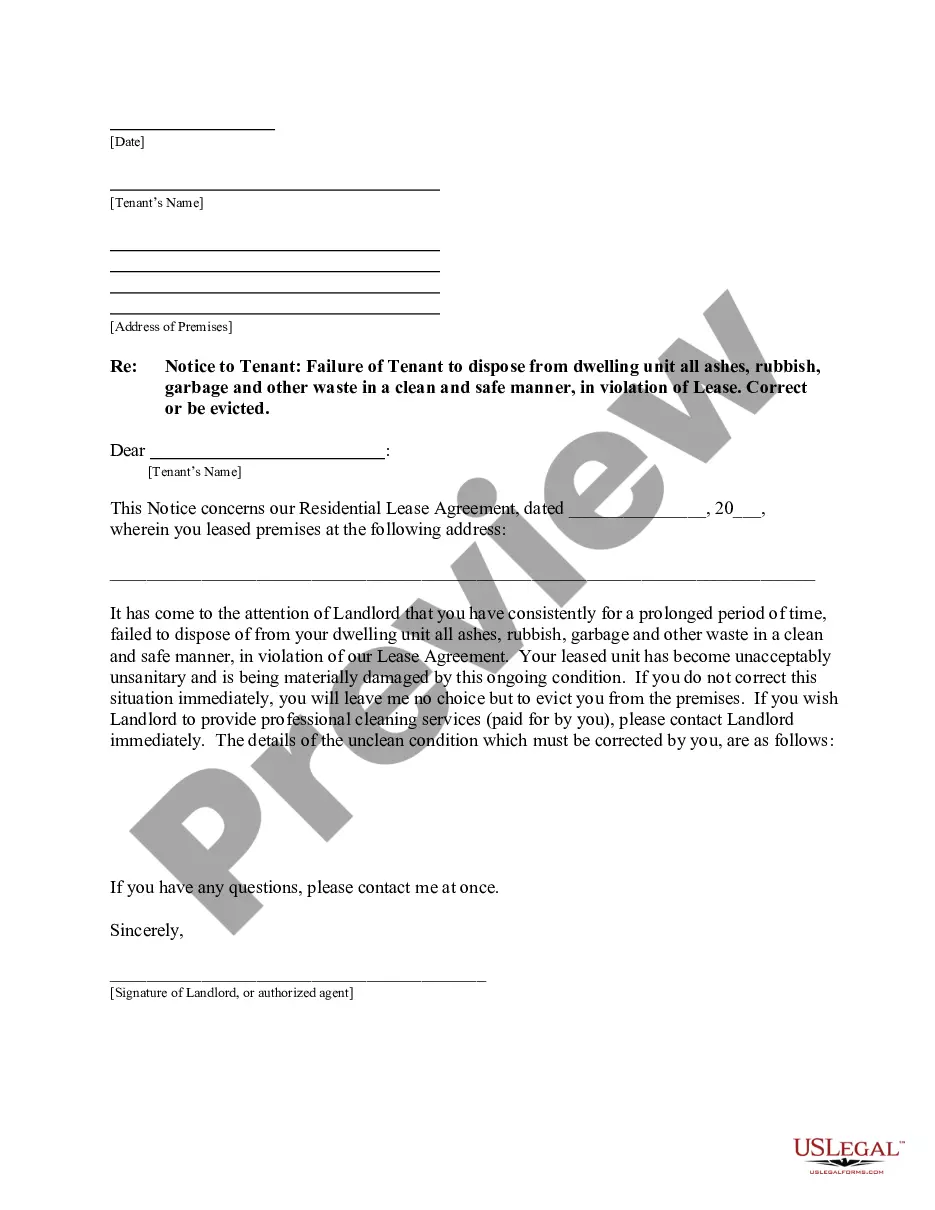
This form is a Letter from Landlord to Tenant focusing on the failure to dispose of ashes, rubbish, garbage, or other waste properly. It serves as a formal notice demanding the tenant correct unsanitary conditions that violate community rules. If the tenant does not comply, the landlord may initiate eviction proceedings. This form is essential for landlords looking to ensure the cleanliness and upkeep of their rental properties in accordance with lease agreements.
Main sections of this form
- Identification of the landlord and tenant involved.
- Details regarding the unsanitary condition and community rule violations.
- A statement of the actions required by the tenant.
- Consequences of non-compliance, including potential eviction.
- Option for the tenant to request professional cleaning services at their expense.


When to use this form
This form should be used when a landlord observes that a tenant is not disposing of waste in a clean and safe manner, leading to unsanitary living conditions. It is applicable when tenants frequently violate community rules regarding waste disposal, giving the landlord a formal record of communication before taking further action like eviction.
Who this form is for
- Landlords seeking to enforce lease agreements regarding property maintenance.
- Property managers responsible for maintaining community standards.
- Tenants who have received notice regarding their waste disposal practices.
Instructions for completing this form
- Identify the landlord and tenant by entering their names and addresses at the top of the letter.
- Document the specific unclean conditions that need addressing, providing clear examples.
- State the corrective actions required of the tenant to comply with community rules.
- Include a deadline for compliance to provide urgency to the notice.
- Sign and date the letter to formalize it as an official notice.
Is notarization required?
Notarization is not commonly needed for this form. However, certain documents or local rules may make it necessary. Our notarization service, powered by Notarize, allows you to finalize it securely online anytime, day or night.
Get your form ready online
Our built-in tools help you complete, sign, share, and store your documents in one place.
Make edits, fill in missing information, and update formatting in US Legal Forms—just like you would in MS Word.
Download a copy, print it, send it by email, or mail it via USPS—whatever works best for your next step.
Sign and collect signatures with our SignNow integration. Send to multiple recipients, set reminders, and more. Go Premium to unlock E-Sign.
If this form requires notarization, complete it online through a secure video call—no need to meet a notary in person or wait for an appointment.
We protect your documents and personal data by following strict security and privacy standards.

Make edits, fill in missing information, and update formatting in US Legal Forms—just like you would in MS Word.

Download a copy, print it, send it by email, or mail it via USPS—whatever works best for your next step.

Sign and collect signatures with our SignNow integration. Send to multiple recipients, set reminders, and more. Go Premium to unlock E-Sign.

If this form requires notarization, complete it online through a secure video call—no need to meet a notary in person or wait for an appointment.

We protect your documents and personal data by following strict security and privacy standards.
Common mistakes to avoid
- Failing to clearly specify the violations leading to the notice.
- Not providing a reasonable deadline for correction.
- Neglecting to keep a copy of the notice for personal records.
Advantages of online completion
- Convenience of accessing and downloading the form at any time.
- Editability to tailor the notice to specific situations easily.
- Reliability of using attorney-drafted templates to ensure legal compliance.
Legal use & context
This letter serves as an initial step for landlords to formally address breach of lease terms. It establishes a record of the landlord's concerns and efforts to communicate with the tenant, which may be necessary for any future legal proceedings.
Key takeaways
- This form acts as a critical communication tool between landlords and tenants regarding waste disposal issues.
- Landlords should document unsanitary conditions comprehensively to support any future eviction attempts.
- Providing tenants with a chance to correct the situation fosters better tenant-landlord relationships.
Looking for another form?
Form popularity
FAQ
Section 5513 of the Delaware Landlord-Tenant Code deals with a landlord's responsibilities regarding the property’s overall condition and habitability. It establishes expectations for landlords to maintain the premises, ensuring safety and compliance with local laws. This section inspires landlords to communicate clearly about tenant responsibilities, particularly in issues concerning waste disposal. A well-crafted Delaware Letter from Landlord to Tenant for Failure of to dispose all ashes, rubbish, garbage or other waste in a clean and safe manner reinforces these lawful obligations, ensuring a harmonious living environment.
In Delaware, landlords must return a tenant's security deposit within 20 days after the lease ends and the tenant has vacated the property. This return period ensures tenants receive any unspent portion of their deposit promptly. If the landlord withholds any amount for damages or unpaid rent, they must provide an itemized list. Knowing this timeframe can prevent disputes and unnecessary issues, including unwanted communication such as a Delaware Letter from Landlord to Tenant for Failure of to dispose all ashes, rubbish, garbage or other waste in a clean and safe manner.
Section 5314 of the Delaware Residential Landlord-Tenant Code outlines the obligations of tenants regarding the maintenance of their rental property. It specifically mandates that tenants keep their living space safe and sanitary. This section also highlights the importance of following community rules, which includes the proper disposal of ashes, rubbish, garbage, or other waste. Understanding this requirement helps tenants avoid receiving a Delaware Letter from Landlord to Tenant for Failure of to dispose all ashes, rubbish, garbage or other waste in a clean and safe manner.
There is no set rule for how often a landlord must replace carpet in Delaware. The requirement typically depends on the lease agreement and the overall condition of the property. It’s important to review your lease and maintain open communication. If issues arise regarding cleanliness and maintenance, a Delaware Letter from Landlord to Tenant for Failure to dispose all ashes, rubbish, garbage, or other waste in a clean and safe manner in compliance with community rules can serve as a formal reminder of responsibilities.
In Delaware, there is no state law that outlines a specific maximum rent increase. However, landlords must provide tenants with proper notice before implementing any increase. To navigate potential disputes, it is beneficial for tenants to refer to a Delaware Letter from Landlord to Tenant for Failure to dispose all ashes, rubbish, garbage, or other waste in a clean and safe manner in compliance with community rules. This document can help clarify obligations and foster communication regarding rental terms.
To file a complaint against your landlord in Delaware, begin by noting down all instances of their neglect or misconduct. Once you have the necessary information, contact the Delaware Department of Consumer Protection to file your complaint. If your landlord has issued a Delaware Letter from Landlord to Tenant for Failure of to dispose all ashes, rubbish, garbage or other waste in a clean and safe manner, you can include this in your complaint for a stronger case.
To report a terrible landlord in Delaware, gather all relevant documentation, such as lease agreements and any communication regarding your complaints. You can then reach out to the Delaware Department of Consumer Protection or local housing authorities. Additionally, using platforms like uslegalforms can facilitate the process of creating necessary legal documents to address your concerns effectively.
In Delaware, landlords are required to make repairs within a reasonable time frame, typically defined as a few days to a couple of weeks depending on the severity of the issue. If a repair is urgent, such as plumbing or heating issues, landlords should act immediately. If they fail to address these repairs, you may need to consider sending a formal notice or a Delaware Letter from Landlord to Tenant regarding your concerns.
As a tenant in Delaware, you have several rights aimed at protecting your living conditions. Your landlord must provide a safe, clean, and habitable space and cannot retaliate against you for reporting violations. Knowing your rights can empower you to respond appropriately if you receive a Delaware Letter from Landlord to Tenant for Failure of to dispose all ashes, rubbish, garbage or other waste in a clean and safe manner in compliance with community rules.
Section 5314 of the Delaware Residential Landlord Tenant Code addresses the responsibilities of landlords regarding tenant safety and habitability. It establishes that landlords must maintain rental properties, ensuring they are clean and safe. If you receive a Delaware Letter from Landlord to Tenant for Failure of to dispose all ashes, rubbish, garbage or other waste in a clean and safe manner, this section supports your rights as a tenant.