District of Columbia Warning of Default on Residential Lease
About this form
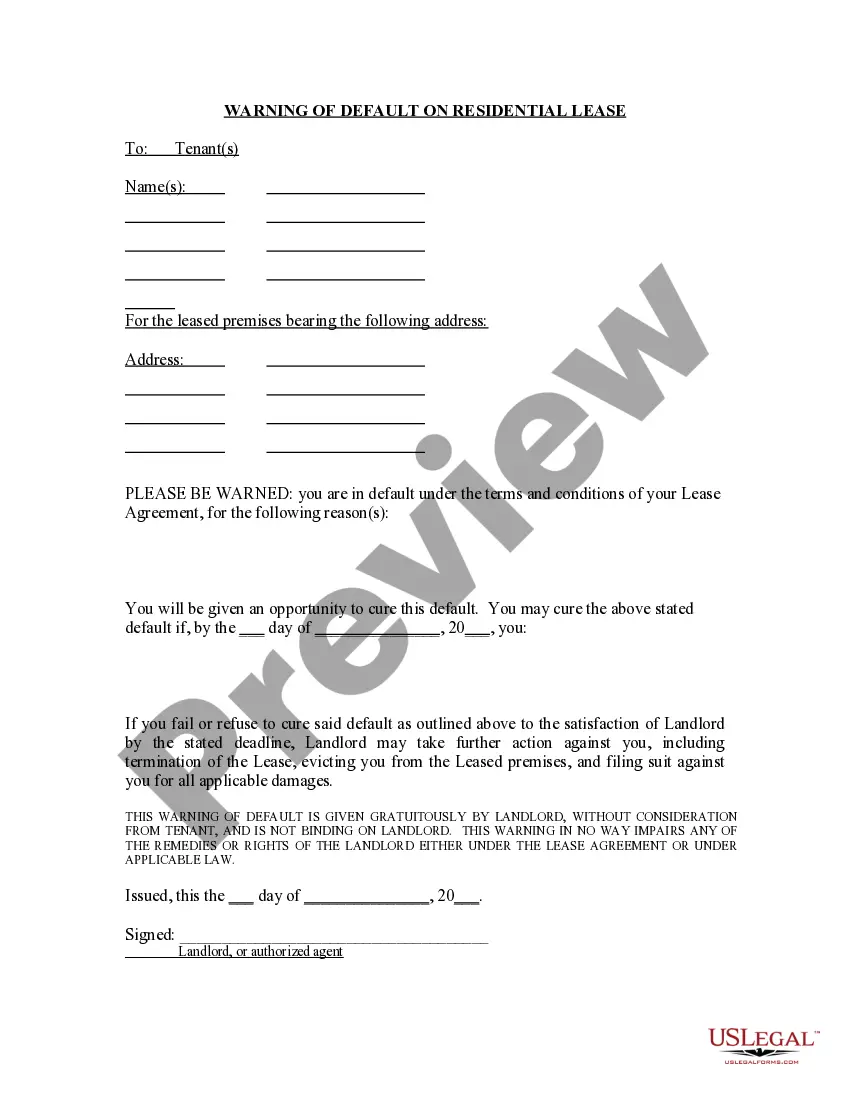
The Warning of Default on Residential Lease is a formal communication from a landlord to a tenant. Its primary purpose is to inform the tenant that certain conditions, if not resolved, could result in a default under the lease agreement. This form serves as an important step in the lease enforcement process, distinct from other notices such as eviction notices or lease termination notices, as it specifically addresses concerns about compliance with lease terms.
What’s included in this form
- Date of issuance to establish the timeline of the warning.
- Identification of the landlord or authorized agent providing the warning.
- Explicit statement that the warning is given gratuitously and is not binding.
- Notification that this warning does not impair the landlord's rights under the lease or applicable law.
- Space for tenant identification, if needed, to clarify whom the warning addresses.



Common use cases
This form is used when a landlord needs to formally notify a tenant of potential default regarding their lease terms. Common scenarios include situations where rent has not been paid on time, the tenant is violating lease provisions, or there are concerns regarding property maintenance. It is a proactive measure to inform tenants of their obligations and the need for corrective action.
Who can use this document
- Landlords who wish to formally address lease violations with their tenants.
- Property management companies acting on behalf of landlords.
- Legal professionals assisting landlords in managing lease agreements.
- Tenants who want to understand potential risks of default notices.
Completing this form step by step
- Identify the date of issuance to keep track of timelines.
- Clearly write the landlord's name or the name of the authorized agent.
- Specify the tenant's details if relevant to clarify the warning's recipient.
- Review the terms of the lease agreement to accurately state any violations.
- Sign the form to validate it as an official warning.
Notarization requirements for this form
This form does not typically require notarization unless specified by local law. However, landlords should check specific state requirements to ensure compliance.
Get your form ready online
Our built-in tools help you complete, sign, share, and store your documents in one place.
Make edits, fill in missing information, and update formatting in US Legal Forms—just like you would in MS Word.
Download a copy, print it, send it by email, or mail it via USPS—whatever works best for your next step.
Sign and collect signatures with our SignNow integration. Send to multiple recipients, set reminders, and more. Go Premium to unlock E-Sign.
If this form requires notarization, complete it online through a secure video call—no need to meet a notary in person or wait for an appointment.
We protect your documents and personal data by following strict security and privacy standards.

Make edits, fill in missing information, and update formatting in US Legal Forms—just like you would in MS Word.

Download a copy, print it, send it by email, or mail it via USPS—whatever works best for your next step.

Sign and collect signatures with our SignNow integration. Send to multiple recipients, set reminders, and more. Go Premium to unlock E-Sign.

If this form requires notarization, complete it online through a secure video call—no need to meet a notary in person or wait for an appointment.

We protect your documents and personal data by following strict security and privacy standards.
Avoid these common issues
- Failing to include the date of issuance, which is crucial for timelines.
- Not clearly identifying the tenant, leading to potential confusion.
- Inaccurately stating lease violations, which could weaken the warning.
- Omitting the landlord's signature, making the document ineffective.
Why use this form online
- Convenient access to legal forms that can be filled out at any time.
- Edit the form easily to fit specific situations or needs.
- Reliability of templates drafted by licensed attorneys, ensuring legal accuracy.
Legal use & context
- This warning serves as a formal record of the landlord's intent to address lease violations.
- Understanding the implications of a default notice can aid both landlords and tenants in resolving issues amicably.
Summary of main points
- The Warning of Default on Residential Lease serves as an essential alert for lease compliance.
- It is important for landlords to use this form to inform tenants of potential lease violations.
- Completion of this form requires attention to detail to avoid common mistakes.
Looking for another form?
Form popularity
FAQ
If you default on a lease in the District of Columbia, you may face serious consequences, including eviction or legal action from your landlord. The landlord is required to provide a formal notification, often referred to as a District of Columbia Warning of Default on Residential Lease. It's critical to address any defaults promptly and seek assistance, such as from USLegalForms, to understand your options and rights in these situations.
A landlord event of default refers to specific situations where a landlord fails to uphold their obligations under the lease agreement. Common issues include failing to make necessary repairs or not providing habitable living conditions. When landlords default, tenants may invoke their rights under the District of Columbia Warning of Default on Residential Lease. It’s crucial to document any defaults to protect your interests as a tenant.
In the District of Columbia, when your lease comes to an end, you must either vacate the property or negotiate a renewal with your landlord. It's essential to review the terms of your lease to understand your options. If neither party takes action, the lease may convert to a month-to-month agreement. Always be aware of the District of Columbia Warning of Default on Residential Lease, as it provides insight into your rights and responsibilities.
If you find yourself needing to report a landlord in the District of Columbia, you can start by contacting the Department of Consumer and Regulatory Affairs (DCRA). They handle property complaints and can guide you in resolving issues related to the District of Columbia Warning of Default on Residential Lease. Furthermore, using platforms like USLegalForms can help you understand your rights and provide the necessary documentation for reporting your landlord effectively. It's essential to address these concerns promptly for a healthier rental experience.
In the District of Columbia, landlords must provide at least 24 hours' notice before entering a rental unit to conduct repairs. This is crucial as it respects the tenant's right to privacy while allowing necessary maintenance to occur. If you have concerns that your landlord is not following the District of Columbia Warning of Default on Residential Lease guidelines, you may want to document any issues for future reference. This can help protect your rights as a tenant.
DC Code 42 3202 pertains to the District of Columbia Warning of Default on Residential Lease. This code outlines the legal obligations landlords must follow regarding notices of default. It ensures that tenants receive adequate notice about any lease violations, thus providing them an opportunity to rectify issues before further actions are taken. Understanding this code can help tenants and landlords navigate disputes more effectively.
If you default on your lease, the landlord may take action to protect their property and investment. This could include filing an eviction notice or pursuing legal action to recover unpaid rent. A District of Columbia Warning of Default on Residential Lease serves as a formal notice to help resolve the issue before further steps are taken. Addressing this situation promptly can lead to better outcomes for both you and your landlord.
As a tenant in the District of Columbia, you have several rights designed to protect you. These rights include the right to a safe and habitable living space, the right to privacy, and the right to receive proper notice before eviction actions, which may involve a District of Columbia Warning of Default on Residential Lease. It is essential to know and assert these rights to ensure a fair rental experience.
In the District of Columbia, a tenant may remain on the property after the lease expires if the landlord does not take action to reclaim the unit. This is known as holdover tenancy. However, it is important to remember that the landlord can issue a District of Columbia Warning of Default on Residential Lease if they seek to evict a tenant for remaining beyond the lease term. Tenants should always understand their rights before extending their stay.