Colorado Quitclaim Deed - Trust to an Individual
What is this form?
The Quitclaim Deed - Trust to an Individual is a legal document that allows a trustee to transfer property ownership from a trust to a single individual. This form is distinct from other types of deeds because it does not guarantee that the property has clear title, which means the grantee receives whatever interest the grantor, in this case the trustee, has in the property. It is primarily used when no money changes hands for the property or during an informal transfer of ownership between parties.
Key components of this form
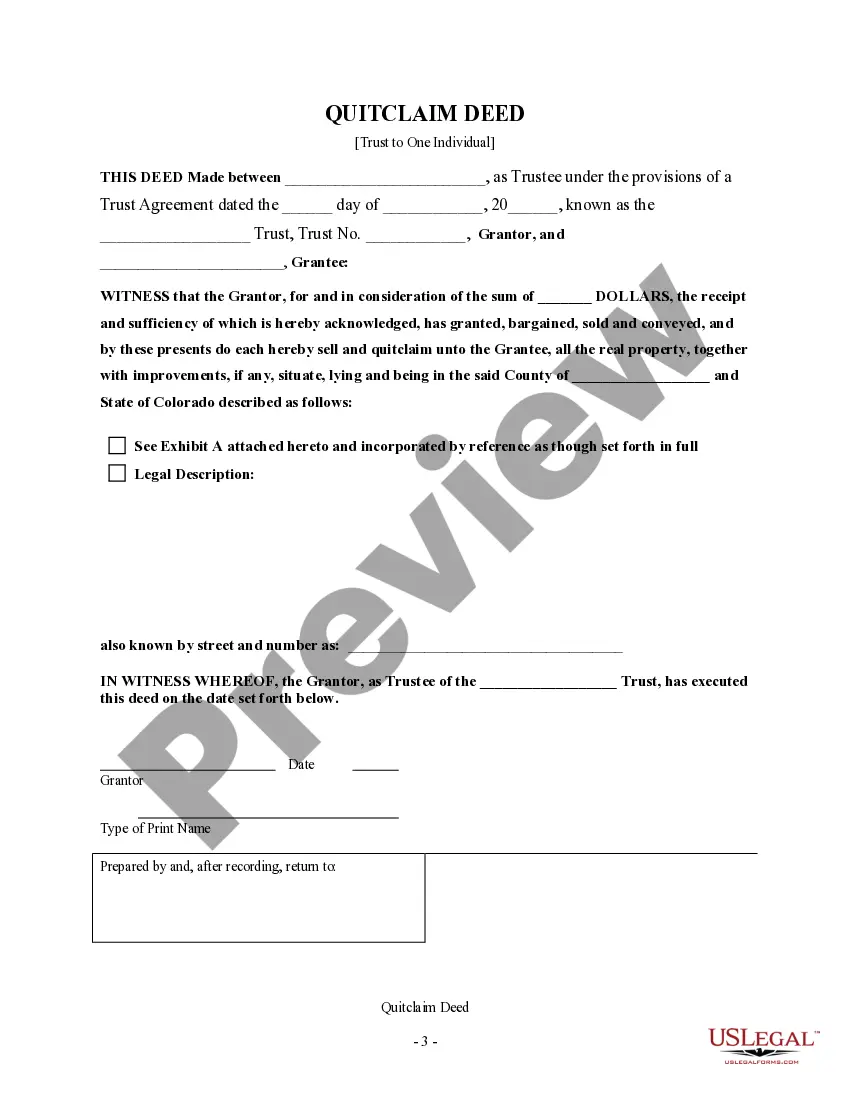
- Identification of the grantor (trustee) and grantee (individual receiving the property).
- Legal description of the property being transferred.
- Consideration: the amount or acknowledgment of value for the property transfer.
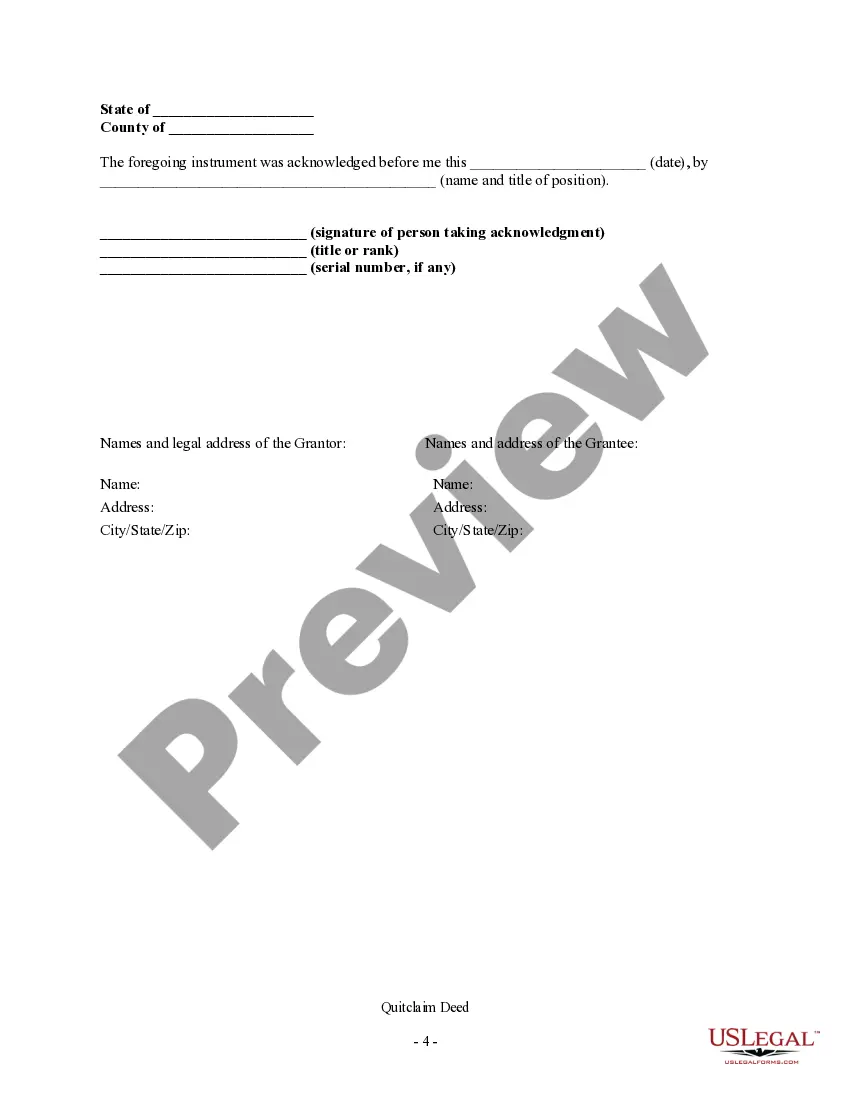
- Space for signatures and acknowledgment, including the notary section.






Common use cases
This form is used when the trustee of a trust wishes to transfer property from the trust to an individual. This may occur in situations such as the following: - Distributing assets to beneficiaries at the termination of the trust. - Facilitating informal property transfers among family members. - Simplifying the transfer process in estate planning scenarios.
Intended users of this form
This form is intended for:
- Trustees wanting to transfer property to an individual.
- Individuals receiving property from a trust.
- Estate planners and attorneys facilitating property transfers.
How to complete this form
- Identify the grantor, noting their role as trustee and providing the name of the trust.
- Identify the grantee, the individual who will receive the property.
- Specify the property by including its legal description in the provided section.
- Enter the consideration amount that acknowledges the value of the property transfer.
- Have the grantor sign the document in the appropriate space and obtain notarization to validate the deed.
Does this form need to be notarized?
To make this form legally binding, it must be notarized. Our online notarization service, powered by Notarize, lets you verify and sign documents remotely through an encrypted video session.
Get your form ready online
Our built-in tools help you complete, sign, share, and store your documents in one place.
Make edits, fill in missing information, and update formatting in US Legal Forms—just like you would in MS Word.
Download a copy, print it, send it by email, or mail it via USPS—whatever works best for your next step.
Sign and collect signatures with our SignNow integration. Send to multiple recipients, set reminders, and more. Go Premium to unlock E-Sign.
If this form requires notarization, complete it online through a secure video call—no need to meet a notary in person or wait for an appointment.
We protect your documents and personal data by following strict security and privacy standards.

Make edits, fill in missing information, and update formatting in US Legal Forms—just like you would in MS Word.

Download a copy, print it, send it by email, or mail it via USPS—whatever works best for your next step.

Sign and collect signatures with our SignNow integration. Send to multiple recipients, set reminders, and more. Go Premium to unlock E-Sign.

If this form requires notarization, complete it online through a secure video call—no need to meet a notary in person or wait for an appointment.

We protect your documents and personal data by following strict security and privacy standards.
Common mistakes to avoid
- Failing to provide a complete legal description of the property.
- Not obtaining the necessary signatures from the trustee and grantee.
- Overlooking notarization requirements if applicable in your jurisdiction.
Advantages of online completion
- Convenience: Downloadable forms can be completed from home at your convenience.
- Editability: Forms in digital format can be easily filled out and modified as needed.
- Reliability: The forms are created by licensed attorneys to ensure compliance with legal standards.
Legal use & context
- Quitclaim deeds offer a straightforward means of transferring property but do not guarantee clear title.
- This form is enforceable in court as long as it is properly executed, including signatures and legal descriptions.
Main things to remember
- The Quitclaim Deed - Trust to an Individual allows for property transfer without warranty of title.
- This form is ideal for trustees distributing trust property to individuals.
- Understanding local laws is crucial to ensure the deed is enforceable.
Looking for another form?


Form popularity
FAQ
In Colorado, a quitclaim deed operates by allowing an individual to transfer their property interest to another without asserting any title warranty. This deed simply conveys what interest the grantor has, if any, in the property. When you utilize a Colorado Quitclaim Deed - Trust to an Individual, it's crucial to prepare the deed properly and file it with the county clerk and recorder. This process ensures that the deed is recognized and the ownership is updated in public records.
Transferring property to a family member in Colorado can be accomplished effectively through a quitclaim deed. This method simplifies the process, as it requires minimal documentation and can be done without extensive legal procedures. To execute a Colorado Quitclaim Deed - Trust to an Individual, ensure you provide the necessary details of the property and both parties, and consider using platforms like uslegalforms for the paperwork. This ensures everything is precisely documented for a smooth transfer.
While the Colorado Quitclaim Deed - Trust to an Individual is an efficient way to transfer ownership, it does come with significant risks. The primary disadvantage is that it does not guarantee a clear title, potentially leaving the grantee vulnerable to claims or liens. Additionally, if the grantor has any financial obligations related to the property, those may not be resolved upon transfer. Thus, careful consideration is needed before proceeding.
Yes, a quitclaim deed transfers ownership of property in Colorado. This legal document allows one party to convey their interest in a property to another party without making any guarantees about the title. In the context of a Colorado Quitclaim Deed - Trust to an Individual, it’s essential to understand that this transfer is straightforward but may not provide the same security as other types of deeds. Always ensure proper documentation to confirm the transfer's validity.
To fill out a Colorado Quitclaim Deed - Trust to an Individual correctly, start by including the names of the grantor and grantee at the top. Next, describe the property in detail, including its address and legal description. Don’t forget to state that you are transferring ownership and have both parties sign the document in front of a notary. Using uslegalforms can provide you with templates and guidelines that simplify this process and ensure accuracy.
Yes, you can complete a Colorado Quitclaim Deed - Trust to an Individual on your own, but it requires careful attention to detail. It's crucial to ensure that the deed is properly filled out, signed, and notarized to be legally valid. Many people find it helpful to consult resources or legal platforms like uslegalforms to guide them through the process. By doing so, you can avoid common mistakes and ensure your deed meets all requirements.
One significant disadvantage of a Colorado Quitclaim Deed - Trust to an Individual is that it does not provide any warranty on the property title. This means the recipient may inherit existing liens or claims against the property, which can lead to complications later. Additionally, because this deed does not require a title search, it can expose both parties to risks. As a result, it's essential to fully understand the implications before using this option.
The Colorado Quitclaim Deed - Trust to an Individual primarily benefits individuals transferring property to family members or friends. This tool allows for a quick and straightforward transfer without the need for extensive legal processes. It can also serve those seeking to clarify ownership after a divorce or partnership dissolution. Ultimately, anyone needing to change property ownership in a simple manner can find value in using a quitclaim deed.
To transfer a property title to a family member in Colorado, you can utilize a Colorado Quitclaim Deed - Trust to an Individual. This deed allows you to convey your interest in the property swiftly and without complication. Ensure the deed is properly executed and filed, and consider involving uslegalforms for guidance in adhering to all requirements.
Filing a quitclaim deed in Colorado involves several important steps. Begin by filling out the Colorado Quitclaim Deed - Trust to an Individual form accurately. Next, you must sign the deed before a notary public, followed by filing it with the county clerk and recorder's office. Always check for local regulations to ensure compliance.