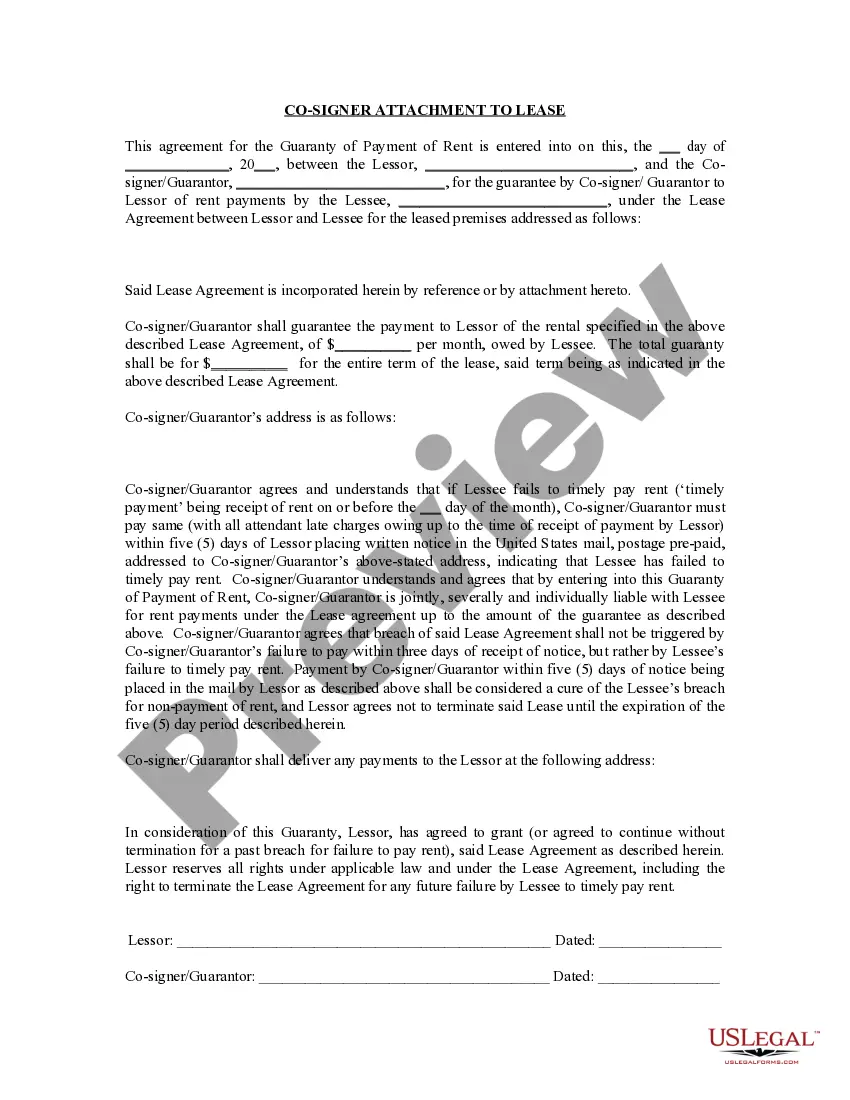
Arizona Guaranty Attachment to Lease for Guarantor or Cosigner
Overview of this form
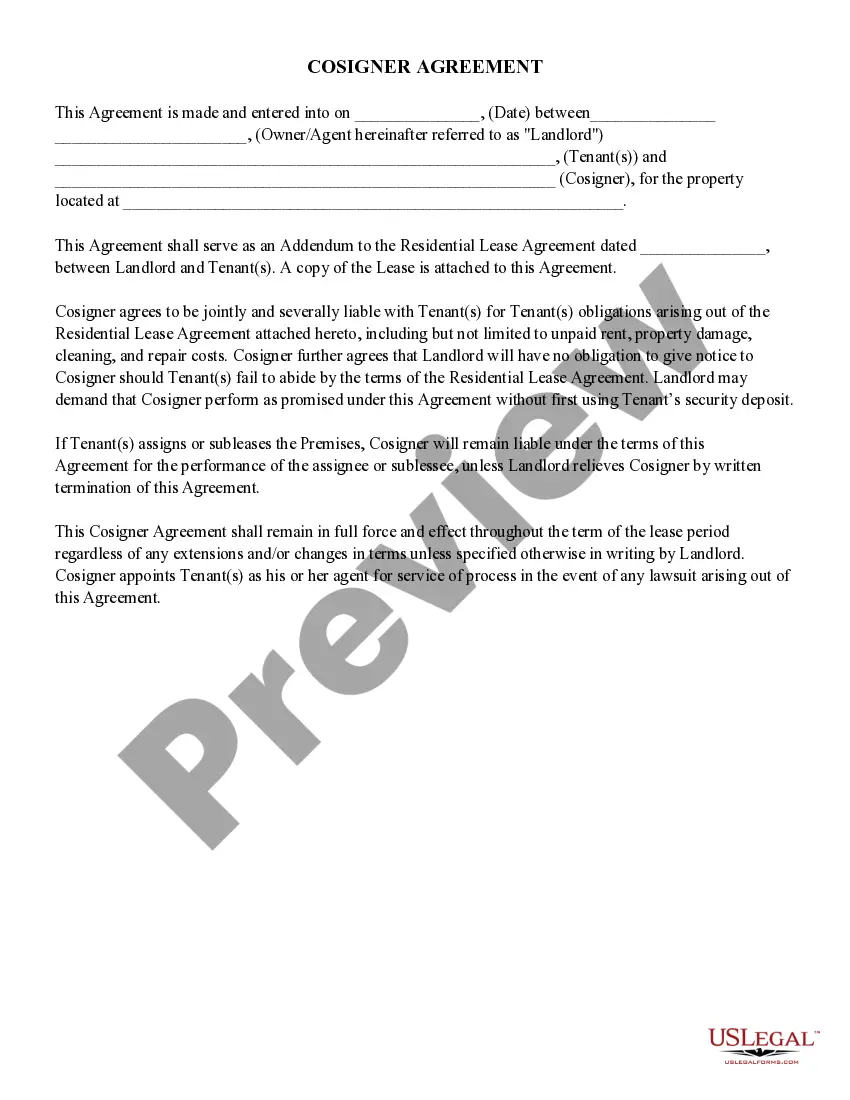
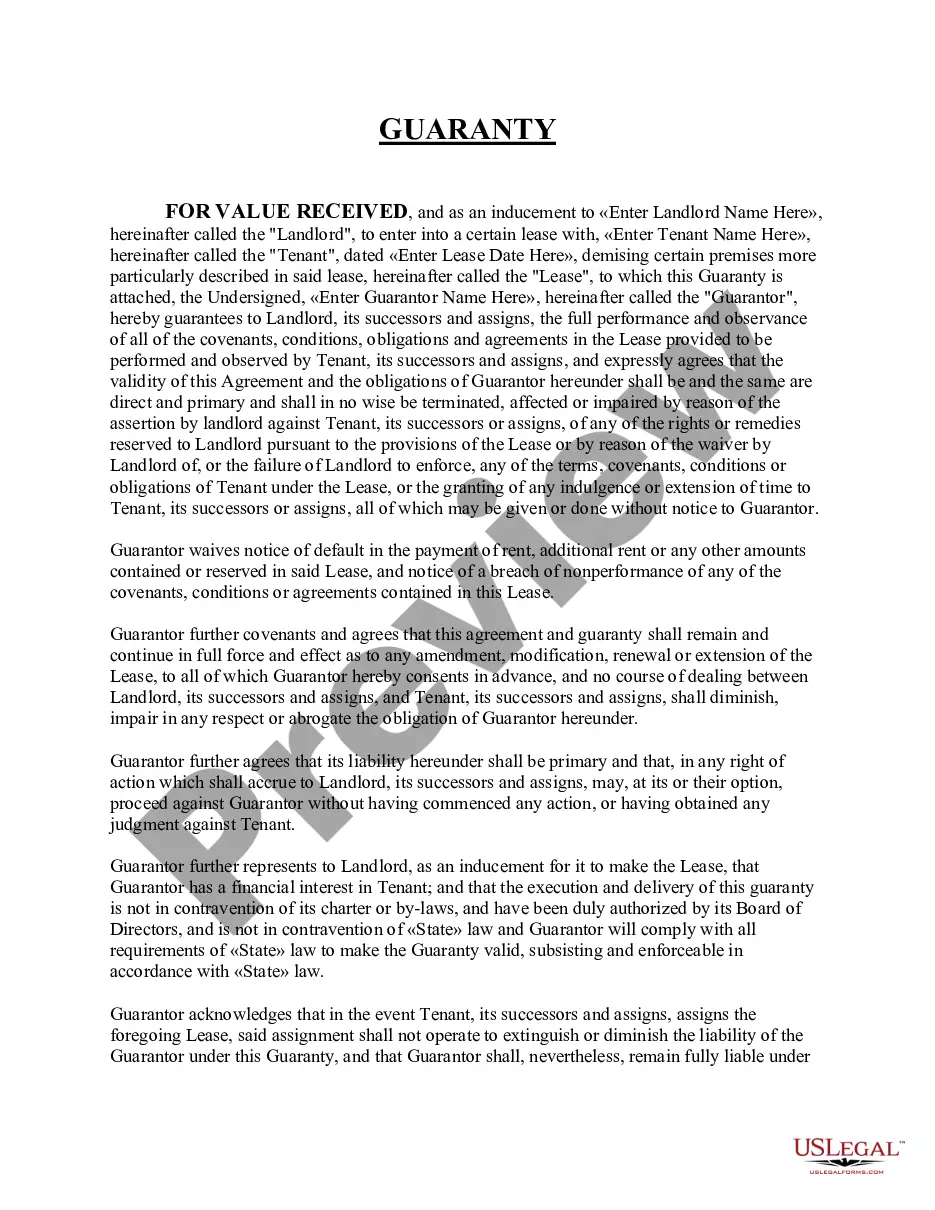
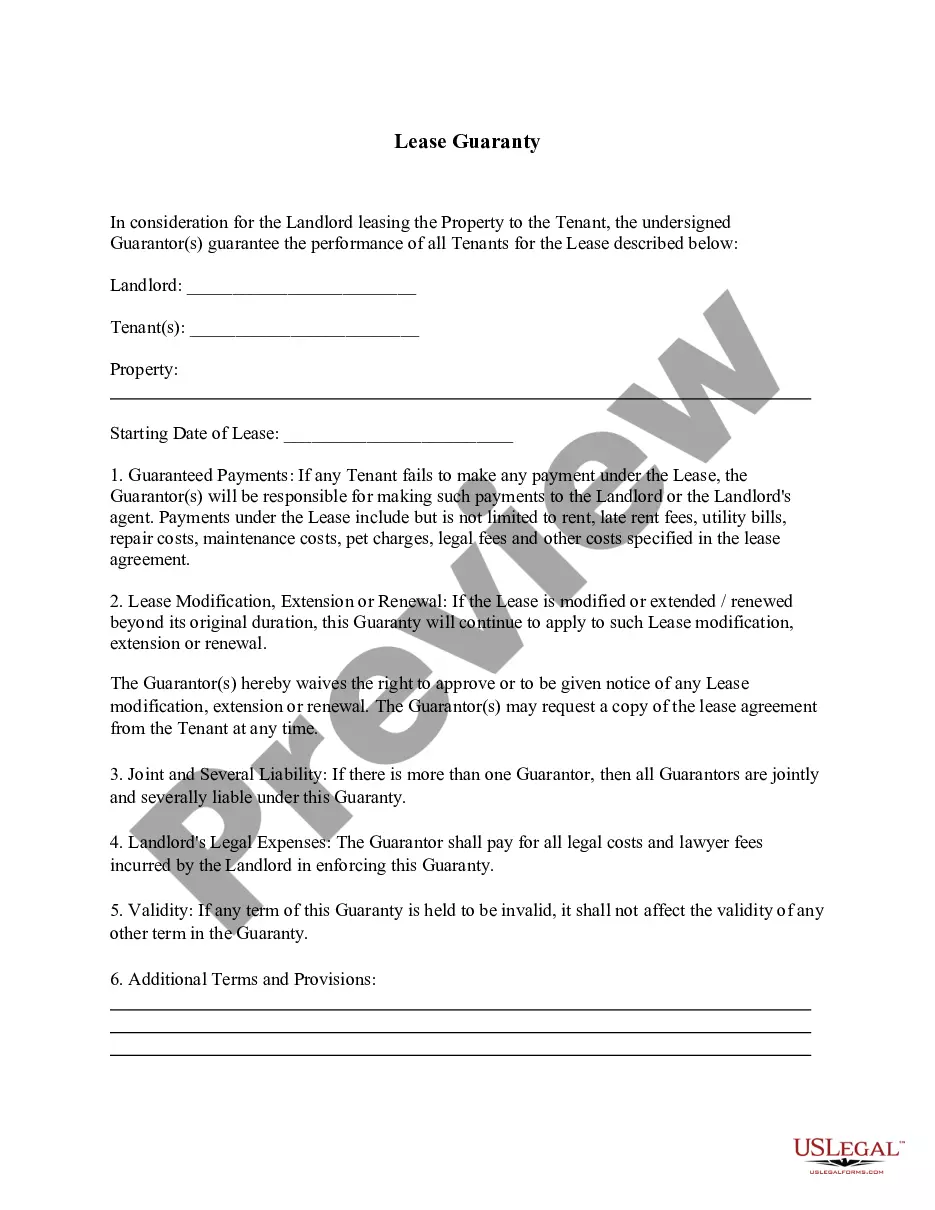
The Guaranty Attachment to Lease for Guarantor or Cosigner is a legal document that allows a third party to co-sign a lease agreement. This third party, known as the guarantor, agrees to cover the rent payments in case the tenant fails to do so. This form is essential for landlords seeking additional security when renting out property, differing from a regular lease agreement as it adds an extra layer of financial assurance from the guarantor.
What’s included in this form
- Co-signer/Guarantor's address: Provides the contact information of the guarantor.
- Lessor information: Identifies the landlord or property owner involved in the agreement.
- Signature lines: Space for the signatures of the co-signer/guarantor and the lessor to validate the agreement.
- Dates: Required to indicate when the agreement was signed.
When to use this document
This form is typically used when a landlord wants to ensure that rent will be paid, especially if the tenant may not have a strong credit history or sufficient income. It is common in rental situations involving students, first-time renters, or individuals with a limited rental history. If a tenant cannot fulfill their rent obligations, the guarantor will be legally responsible for compensating the landlord.
Who this form is for
This form is suitable for:
- Landlords seeking security from tenants with questionable rent payment histories.
- Tenants who may not qualify for a lease independently seeking a cosigner.
- Parents or guardians wanting to help their children secure rental accommodations.
- Individuals looking to establish a rental agreement with added financial backing.
Completing this form step by step
- Identify the parties: Fill out the names and addresses of both the tenant and the guarantor.
- Specify the property: Include details regarding the rental property covered by the lease.
- Enter dates and signatures: Sign and date the document in the designated fields to validate it.
- Keep copies: Ensure that both the guarantor and the landlord retain copies of the signed form.
Does this form need to be notarized?
This form does not typically require notarization unless specified by local law. However, check your jurisdiction's requirements to ensure compliance.
Get your form ready online
Our built-in tools help you complete, sign, share, and store your documents in one place.
Make edits, fill in missing information, and update formatting in US Legal Forms—just like you would in MS Word.
Download a copy, print it, send it by email, or mail it via USPS—whatever works best for your next step.
Sign and collect signatures with our SignNow integration. Send to multiple recipients, set reminders, and more. Go Premium to unlock E-Sign.
If this form requires notarization, complete it online through a secure video call—no need to meet a notary in person or wait for an appointment.
We protect your documents and personal data by following strict security and privacy standards.

Make edits, fill in missing information, and update formatting in US Legal Forms—just like you would in MS Word.

Download a copy, print it, send it by email, or mail it via USPS—whatever works best for your next step.

Sign and collect signatures with our SignNow integration. Send to multiple recipients, set reminders, and more. Go Premium to unlock E-Sign.

If this form requires notarization, complete it online through a secure video call—no need to meet a notary in person or wait for an appointment.

We protect your documents and personal data by following strict security and privacy standards.
Typical mistakes to avoid
- Failing to provide accurate contact information for the guarantor.
- Not signing or dating the document, which can render it invalid.
- Missing details about the rental property being guaranteed.
- Assuming the form does not need to be notarized when required by local law.
Why use this form online
- Convenience: Download and fill out the form from home without needing to visit a lawyer.
- Editability: Customize the form as per your specific needs using our templates.
- Reliability: Access forms drafted by licensed attorneys to ensure compliance with legal standards.
Legal use & context
- The Guaranty Attachment is a legally binding contract once signed by both parties.
- It is enforceable in a court of law, providing security to landlords while outlining the obligations of the guarantor.
- Understanding the potential liabilities involved is crucial for both the tenant and the guarantor.
Summary of main points
- This form provides security for landlords by having a guarantor assume financial obligations.
- Clearly outline the responsibilities of both the tenant and the guarantor in the lease agreement.
- Complete and sign the form accurately to ensure its enforceability.
Looking for another form?

Form popularity
FAQ
The Arizona Guaranty Attachment to Lease for Guarantor or Cosigner is a document that lets a third party co-sign a lease and agree to cover the tenant’s rent if the tenant defaults. It attaches to the lease to provide an extra layer of financial security for the landlord and is used when a guarantor is required or desired.
Not always. This form provides a mechanism for a guarantor to assume the tenant’s rent obligations, but whether a guarantor is required depends on the landlord’s policy and the tenant’s qualifications. The attachment is used to add that guarantor to the lease, along with the guarantor’s address, lessor information, and signed dates.
This form targets landlords seeking security from tenants with questionable rent histories or limited income, tenants who may not qualify on their own, and guardians or parents wanting to back a dependent. It applies to individuals who want added financial backing and reassurance that rent will be paid.
Yes. The Arizona Guaranty Attachment to Lease for Guarantor or Cosigner is designed to be attached to an existing lease to add a guarantor, with spaces for the guarantor’s address, lessor information, and the necessary signature lines and dates to finalize the agreement.
The form includes the co-signer/guarantor’s address, lessor information, signature lines for both the guarantor and the lessor, and dates. These elements identify who is guaranteeing the lease and confirm the agreement is properly executed and dated.
This form is specifically designed as an attachment to a lease, binding the guarantor to the lease terms and obligations through the attached document, with dedicated spaces for guarantor and lessor signatures and dates. A standalone guaranty is a separate contract not tied to the lease.