Donation Pursuant to the Arkansas Revised Uniform Anatomical Gift Act
What this document covers
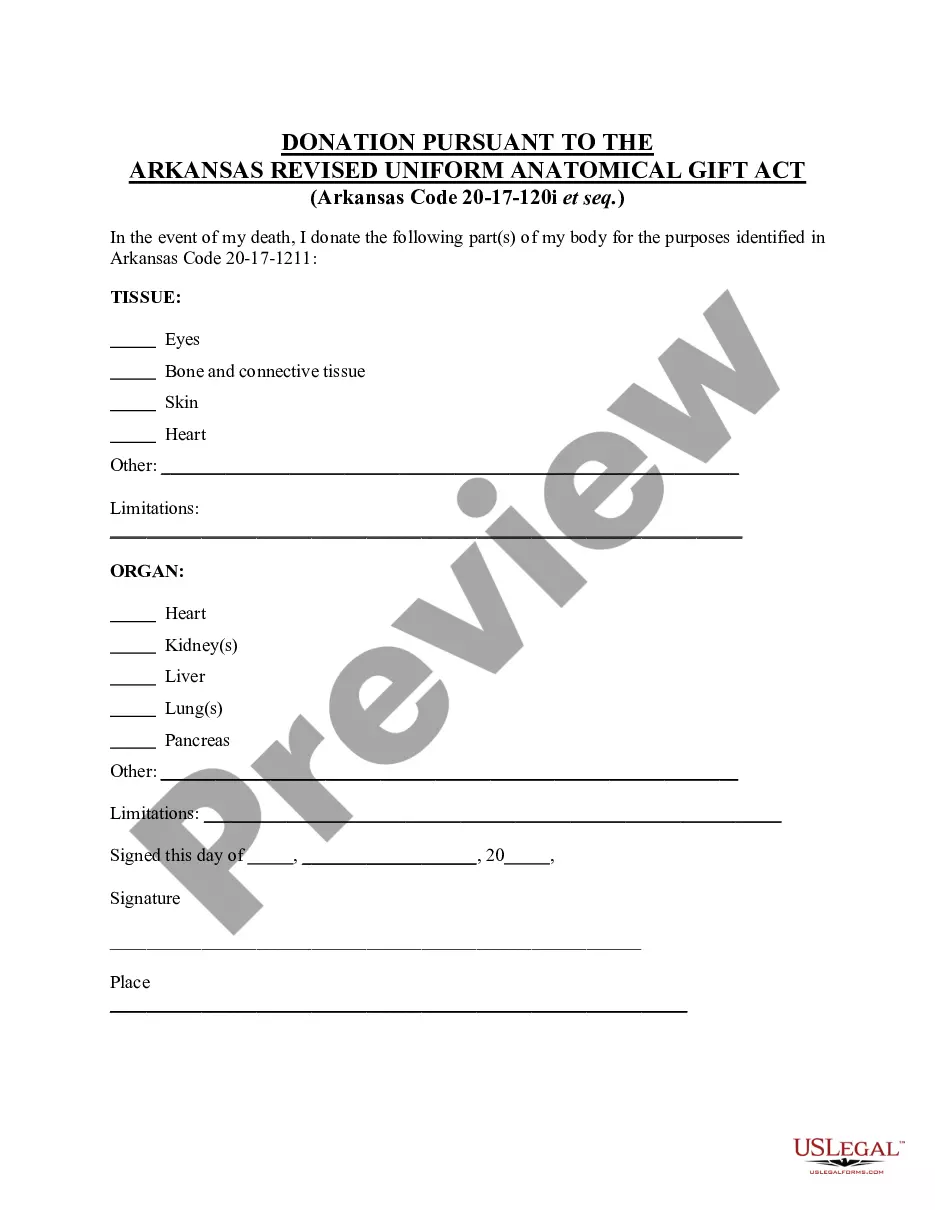
The Donation Pursuant to the Arkansas Revised Uniform Anatomical Gift Act is a legal document that allows individuals to specify which body parts or organs they wish to donate upon their death. This form differs from general wills or other legal documents as it is specifically designed for anatomical gifts and must adhere to Arkansas state law regarding such donations.
Key parts of this document
- Section for indicating which body parts or organs are being donated.
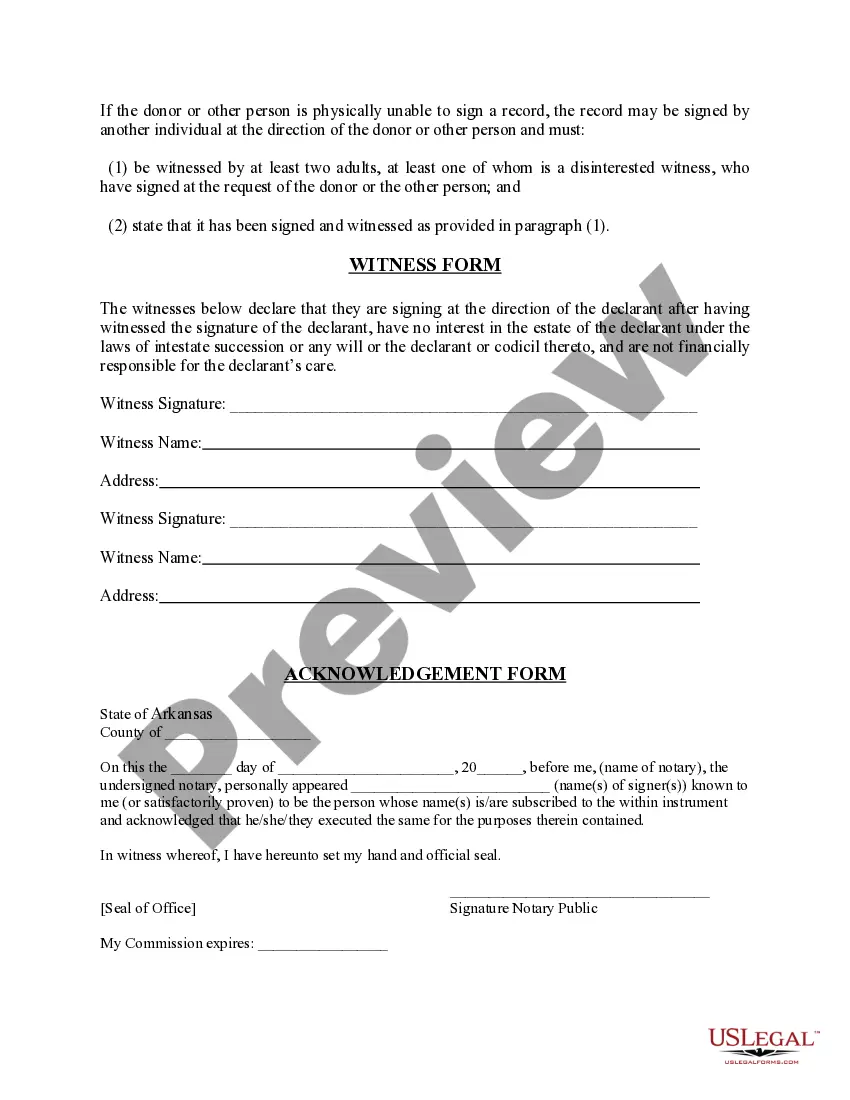
- Requirements for signatures, including the need for two witnesses, one of whom must be disinterested.
- Provisions for donors who are minors or unable to sign the document themselves.


Common use cases
This form should be used when an individual wishes to formally document their intent to donate specific body parts or organs after their death. It is particularly important for those who have strong feelings about anatomical donations, as well as for medical professionals and families who may need to confirm a loved one's wishes in such circumstances.
Who this form is for
- Adults wishing to make anatomical gifts.
- Emancipated minors or minors aged sixteen and older who are authorized under state law.
- Agents designated by the donor, provided they are permitted to act on the donor's behalf under applicable power of attorney documents.
- Parents of unemancipated minors who wish to donate on behalf of their child.
- Guardians of individuals unable to make decisions regarding their own anatomical gifts.
How to complete this form
- Identify the specific body parts or organs you wish to donate on the designated line.
- Ensure that the form is signed in the presence of two adult witnesses, one of whom must not have an interest in your estate.
- If the donor is unable to sign, arrange for another individual to sign on their behalf and witness the event.
- Notarize the completed form to ensure legal validity.
- Keep a copy of the signed and notarized form for your records and share with your family and healthcare providers.
Notarization requirements for this form
Yes, this form must be notarized to be legally valid. US Legal Forms offers integrated online notarization, available 24/7, ensuring your documents can be completed securely through a video call, making the process simple and efficient.
Get your form ready online
Our built-in tools help you complete, sign, share, and store your documents in one place.
Make edits, fill in missing information, and update formatting in US Legal Forms—just like you would in MS Word.
Download a copy, print it, send it by email, or mail it via USPS—whatever works best for your next step.
Sign and collect signatures with our SignNow integration. Send to multiple recipients, set reminders, and more. Go Premium to unlock E-Sign.
If this form requires notarization, complete it online through a secure video call—no need to meet a notary in person or wait for an appointment.
We protect your documents and personal data by following strict security and privacy standards.

Make edits, fill in missing information, and update formatting in US Legal Forms—just like you would in MS Word.

Download a copy, print it, send it by email, or mail it via USPS—whatever works best for your next step.

Sign and collect signatures with our SignNow integration. Send to multiple recipients, set reminders, and more. Go Premium to unlock E-Sign.

If this form requires notarization, complete it online through a secure video call—no need to meet a notary in person or wait for an appointment.

We protect your documents and personal data by following strict security and privacy standards.
Typical mistakes to avoid
- Failing to have the form signed by the required number of witnesses.
- Not including specific information about the body parts or organs intended for donation.
- Forgetting to notarize the document, which is essential for it to be legally binding.
Benefits of completing this form online
- Convenience of immediate access to the form, allowing you to complete it at your own pace.
- Editable fields make it easy to customize according to your specific preferences regarding donations.
- Reliable resources and instructions provided to ensure that you complete the form correctly.
Key takeaways
- This form allows individuals to document their wishes regarding organ donation in Arkansas.
- Proper witnessing and notarization are required for the form to be valid.
- Various parties, including agents and parents of minors, may complete this form.
- Clearly specifying which organs or body parts are to be donated is essential.
Looking for another form?
Form popularity
FAQ
The Donation Pursuant to the Arkansas Revised Uniform Anatomical Gift Act is a form that lets eligible individuals designate which organs or body parts they wish to donate after death, in accordance with Arkansas law. It documents a specific anatomical gift and includes a section listing the parts donated, signing requirements with two witnesses (one disinterested), and provisions for minors or those unable to sign.
To execute the form, the donor must sign it and have two witnesses attest, with at least one witness disinterested. If the donor is a minor or unable to sign, the form provides alternate provisions to document the donor's wishes.
The form includes provisions for donors who are minors or unable to sign, ensuring their wishes can be documented even if they cannot sign themselves. For Arkansas, emancipated minors or those aged sixteen and older may sign under state law, and the form provides processes if signing must be done by a guardian or authorized agent.
The form includes a dedicated section for listing the body parts or organs to be donated, so the donor’s exact anatomical gifts are clearly documented.
The form is intended for adults wishing to make anatomical gifts, as well as emancipated minors or minors aged sixteen or older under state law. It also contemplates situations where an agent under a power of attorney, a parent of an unemancipated minor, or a guardian acts on the donor’s behalf.
This form is Arkansas-specific, aligned with the Arkansas Revised Uniform Anatomical Gift Act. It includes state-specific signing and witnessing requirements (two witnesses with one disinterested) and explicit provisions for minors or those unable to sign, setting it apart from more general, multi-state forms.