Alabama Owner's Information Sheet - Horse Equine Forms
Overview of this form
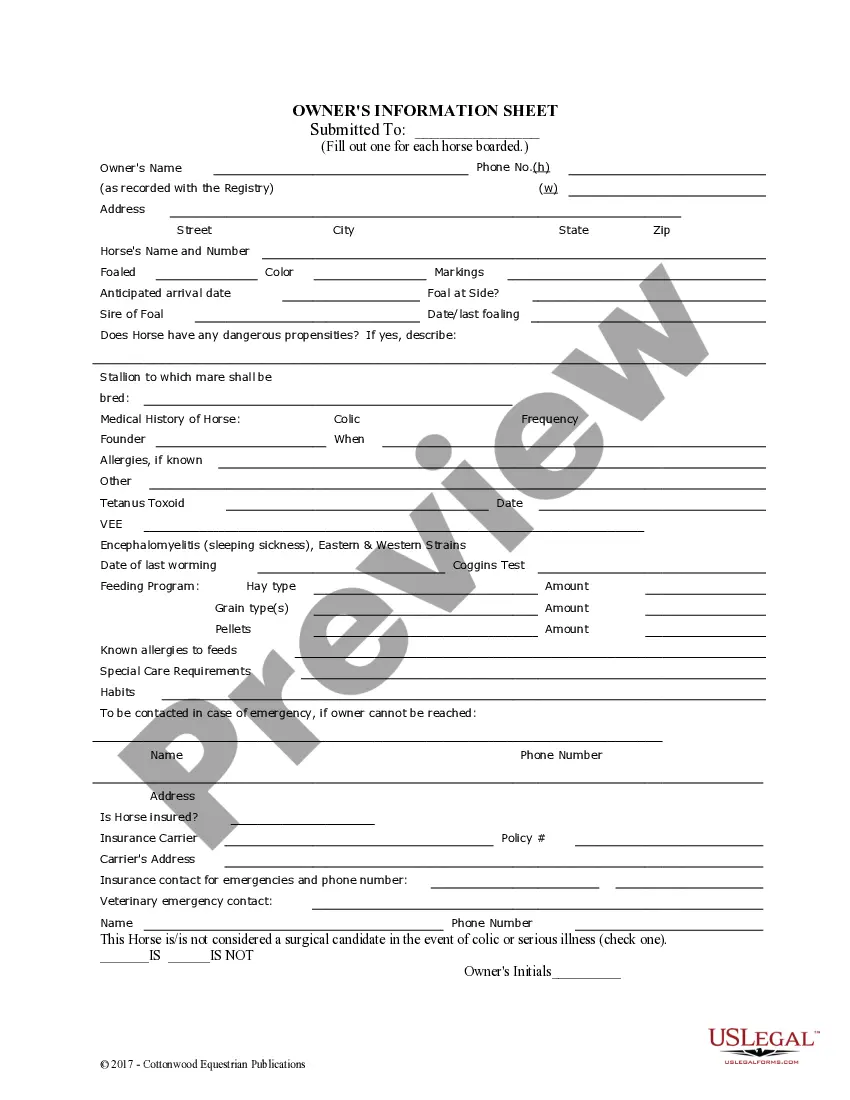
The Owner's Information Sheet is an essential document for horse owners. This form is designed to gather important details about each horse being boarded or receiving services. It provides a comprehensive overview of your horse's medical history, feeding requirements, and emergency contacts, ensuring that caretakers have the necessary information to provide optimal care. Unlike other equine forms, the Owner's Information Sheet focuses specifically on the needs and details of each individual horse, making it a vital resource in equine management.
Main sections of this form
- Owner's contact information, including name and phone numbers.
- Details about the horse, such as name, number, date foaled, color, and markings.
- Medical history, including any dangerous propensities and past medical issues.
- Feeding program specifications, including types and amounts of food.
- Emergency contact details for the horse's care.
- Insurance information, including policy coverage details.

When to use this form
This form should be completed whenever a horse is boarded at a facility or when veterinary services are required. It is necessary to provide caregivers with the information essential for the horse's well-being. This form is particularly useful during the intake process at boarding facilities, veterinary clinics, or when scheduling equine services.
Intended users of this form
- Horse owners looking to board their horses.
- Veterinary practices requiring detailed medical history for treatment.
- Equestrian facilities needing to maintain records of the horses in their care.
- Services related to the breeding of horses requiring accurate information about the mare and foal.
Completing this form step by step
- Write the owner's name and contact information at the top of the form.
- Fill in the horse's details, including name, number foaled, color, and any distinctive markings.
- Document the horse's medical history, including any known allergies or dangerous behaviors.
- Specify the feeding program, including types of hay and grain along with their amounts.
- Provide emergency contact details for reaching someone in case of urgent situations.
Is notarization required?
This form does not typically require notarization unless specified by local law.
Get your form ready online
Our built-in tools help you complete, sign, share, and store your documents in one place.
Make edits, fill in missing information, and update formatting in US Legal Forms—just like you would in MS Word.
Download a copy, print it, send it by email, or mail it via USPS—whatever works best for your next step.
Sign and collect signatures with our SignNow integration. Send to multiple recipients, set reminders, and more. Go Premium to unlock E-Sign.
If this form requires notarization, complete it online through a secure video call—no need to meet a notary in person or wait for an appointment.
We protect your documents and personal data by following strict security and privacy standards.

Make edits, fill in missing information, and update formatting in US Legal Forms—just like you would in MS Word.

Download a copy, print it, send it by email, or mail it via USPS—whatever works best for your next step.

Sign and collect signatures with our SignNow integration. Send to multiple recipients, set reminders, and more. Go Premium to unlock E-Sign.

If this form requires notarization, complete it online through a secure video call—no need to meet a notary in person or wait for an appointment.

We protect your documents and personal data by following strict security and privacy standards.
Common mistakes to avoid
- Neglecting to update the medical history if new conditions arise.
- Omitting contact details for emergency contacts.
- Failing to provide complete information about the horse's feeding program.
Advantages of online completion
- Convenient access to the form anytime, allowing for quick completion.
- Editable templates that let you customize specific sections easily.
- Reliability in ensuring all necessary details are gathered for each horse.
Main things to remember
- The Owner's Information Sheet is essential for managing horse care during boarding.
- Accurate and complete information helps ensure the safety and health of the horse.
- The form can be used across multiple states without specific legal modifications.
Looking for another form?
Form popularity
FAQ
In general horses are divided into three main types, namely heavy horses, light horses, and ponies.
Horses are ungulates mammals with hooves. They also have long tails, short hair, muscular torsos, long thick necks and elongated heads. Due to domestication, they are found all over the world. Horses have lived on Earth for more than 50 million years, according the American Museum of Natural History.
Horses are mammals through and through. They have backbones which makes them vertebrates. Female horses also nurse their foals with milk they produce using their own mammary glands. Horses also have coats comprised of hair that comes in a variety of beautiful colors and unique patterns.
Equus is a genus of mammals in the family Equidae, which includes horses, donkeys, and zebras. Within the Equidae, Equus is the only recognized extant genus, comprising seven living species.
Horses are ungulates mammals with hooves. They also have long tails, short hair, muscular torsos, long thick necks and elongated heads. Due to domestication, they are found all over the world. Horses have lived on Earth for more than 50 million years, according the American Museum of Natural History.
Horses are mammals, and as such are warm-blooded, or endothermic creatures, as opposed to cold-blooded, or poikilothermic animals. However, these words have developed a separate meaning in the context of equine terminology, used to describe temperament, not body temperature.
It is alternately called a team, a harras, a rag (for colts), a stud (a group kept primarily for breeding), or a string (a group belonging to or used by one individual).
Horses can sleep both lying down and standing up. Horses can run shortly after birth. Domestic horses have a lifespan of around 25 years. A 19th century horse named 'Old Billy' is said to have lived 62 years. Horses have around 205 bones in their skeleton. Horses have been domesticated for over 5000 years.
Horses are special creatures. They are majestic, strong and can display a broad range of emotions. Whether they're around humans or other horses, they are amazingly communicative and thrive in social settings. These qualities are part of the reason why horses can develop such a strong bond with humans.