Alabama Renunciation and Disclaimer of Joint Tenant or Tenancy Interest
Understanding this form
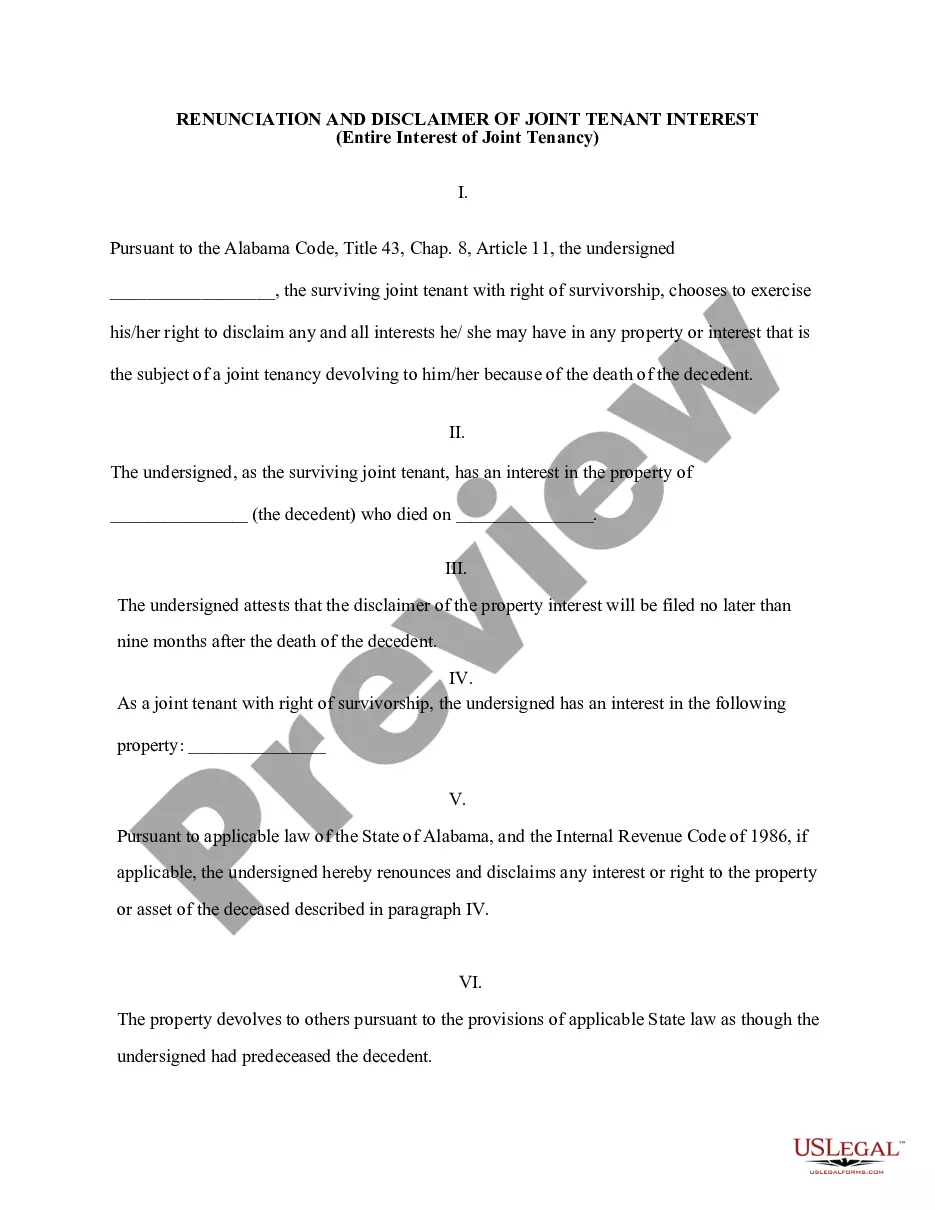
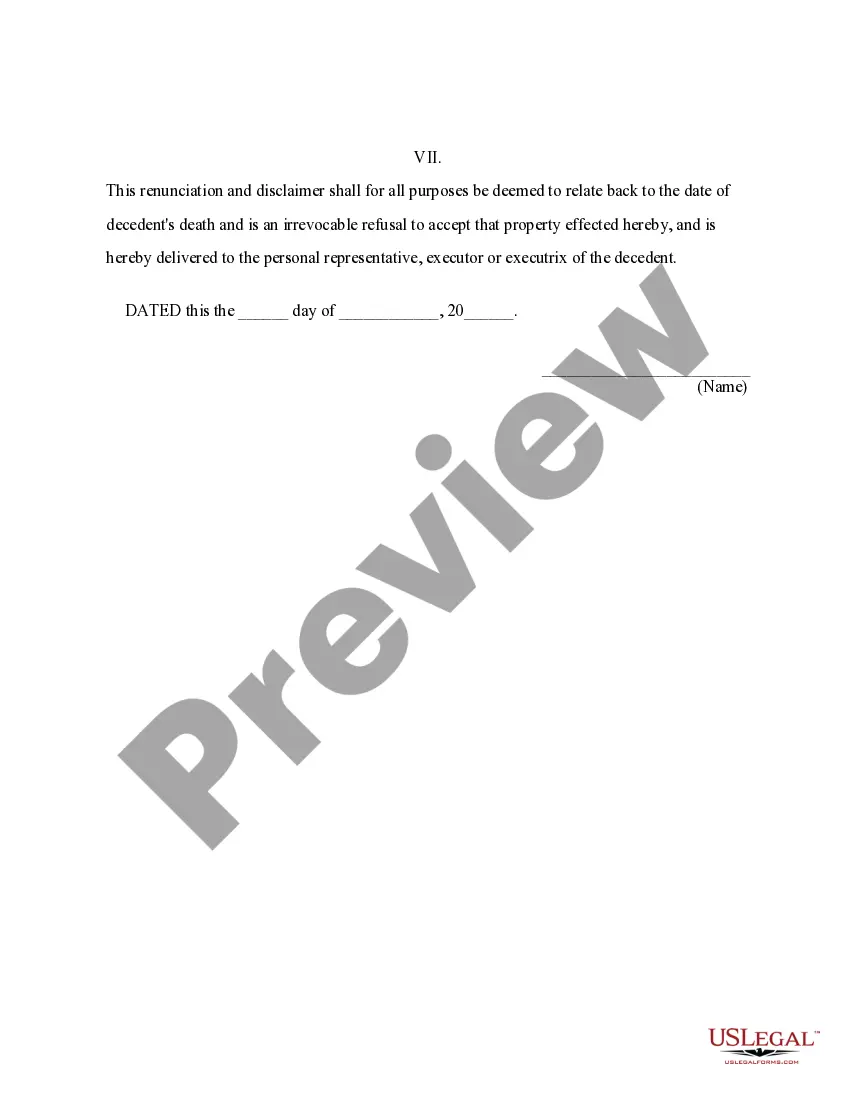
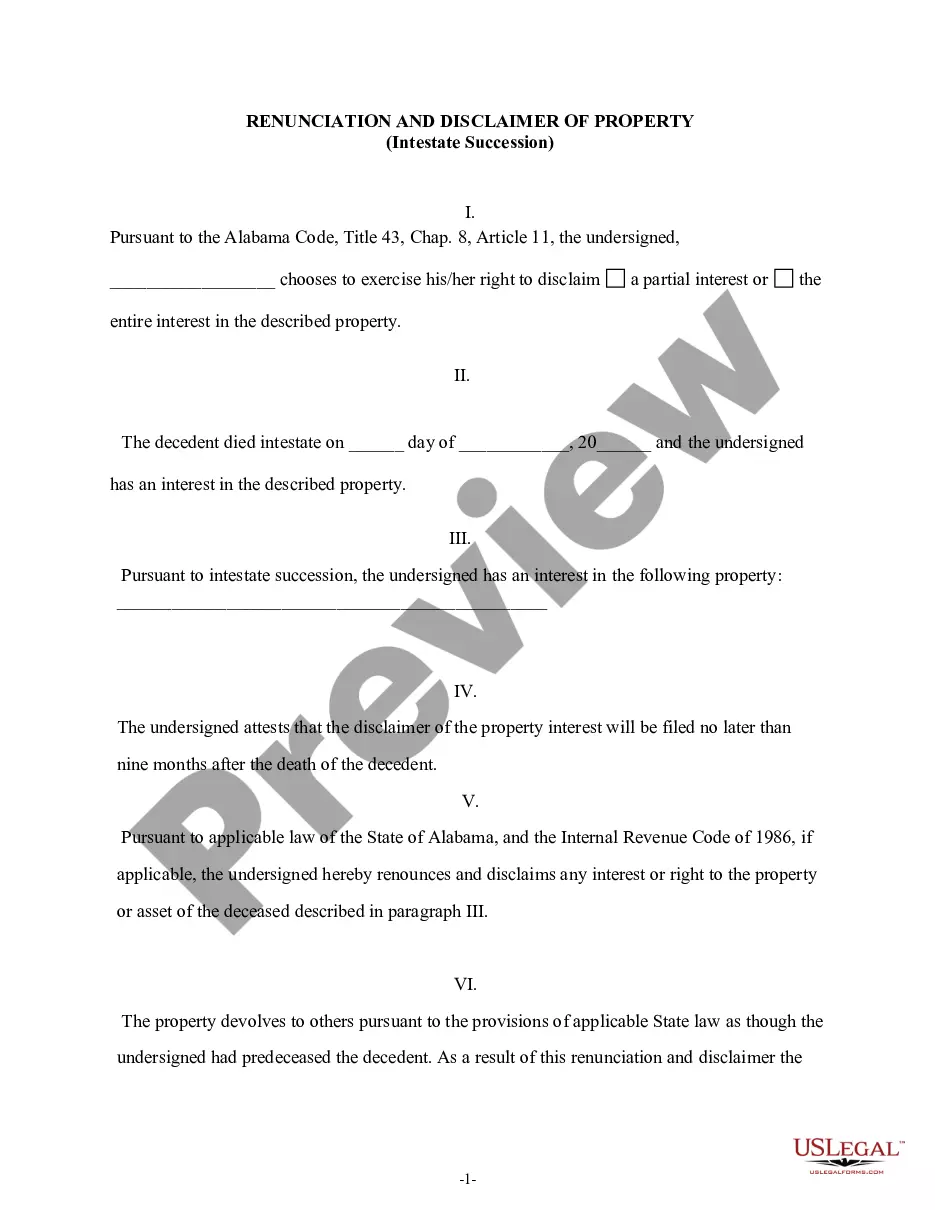
The Alabama Renunciation and Disclaimer of Joint Tenant or Tenancy Interest is a legal document used by a surviving joint tenant who wishes to forgo their interests in property acquired through joint tenancy after the death of the co-owner. This form allows the beneficiary to formally renounce their interest, ensuring that the property devolves according to state law as if they predeceased the decedent. By utilizing this form, individuals can clarify their intentions and prevent any future disputes over property rights, distinguishing it from other estate planning documents.
What’s included in this form
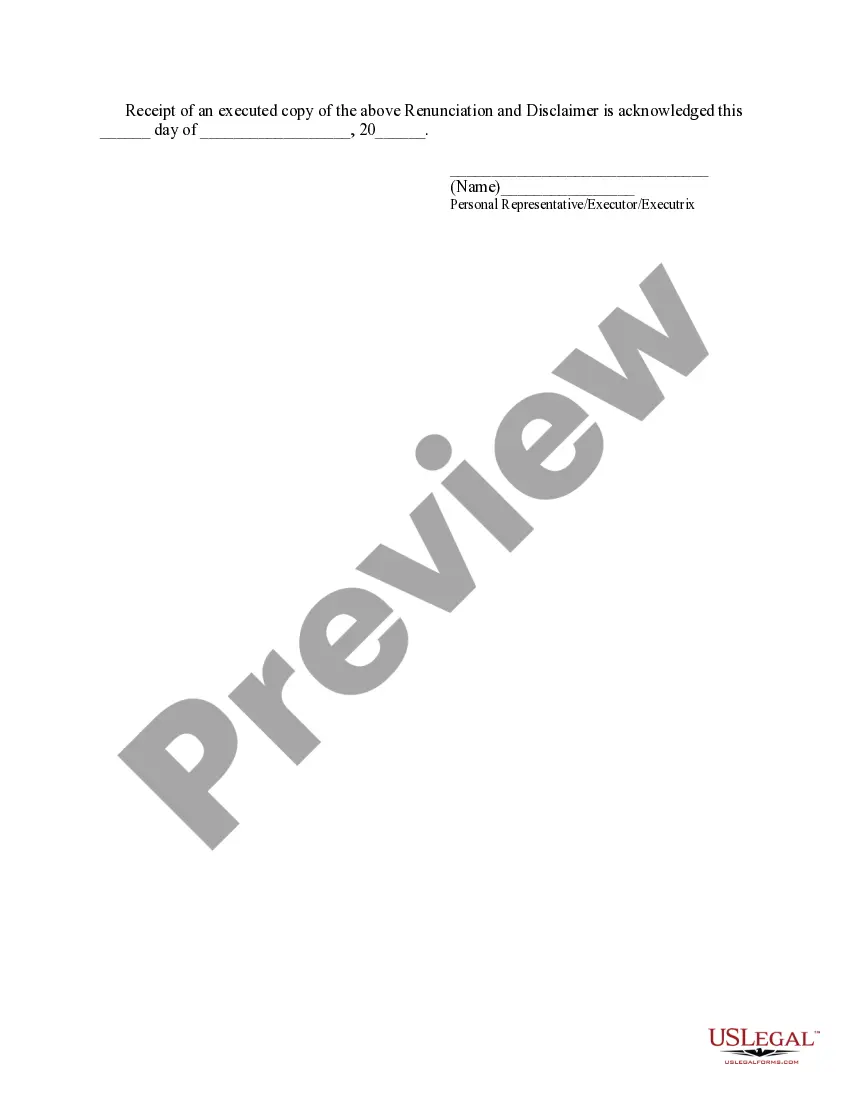
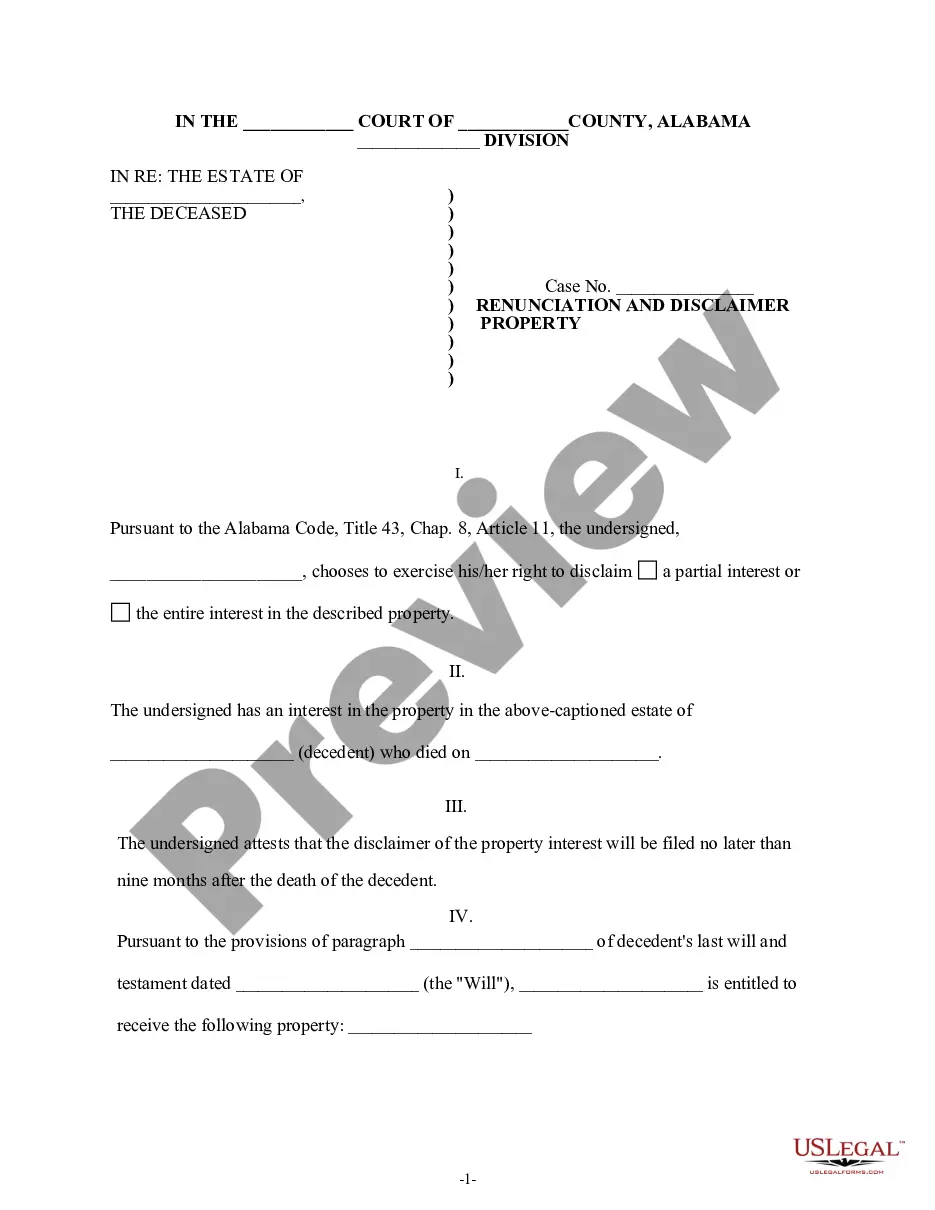
- Identification of the surviving joint tenant and the deceased co-owner.
- Declaration of the property interests being disclaimed.
- Affirmation that the form will be filed within nine months of the decedent's death.
- Legal acknowledgment of the irrevocable nature of the disclaimer.
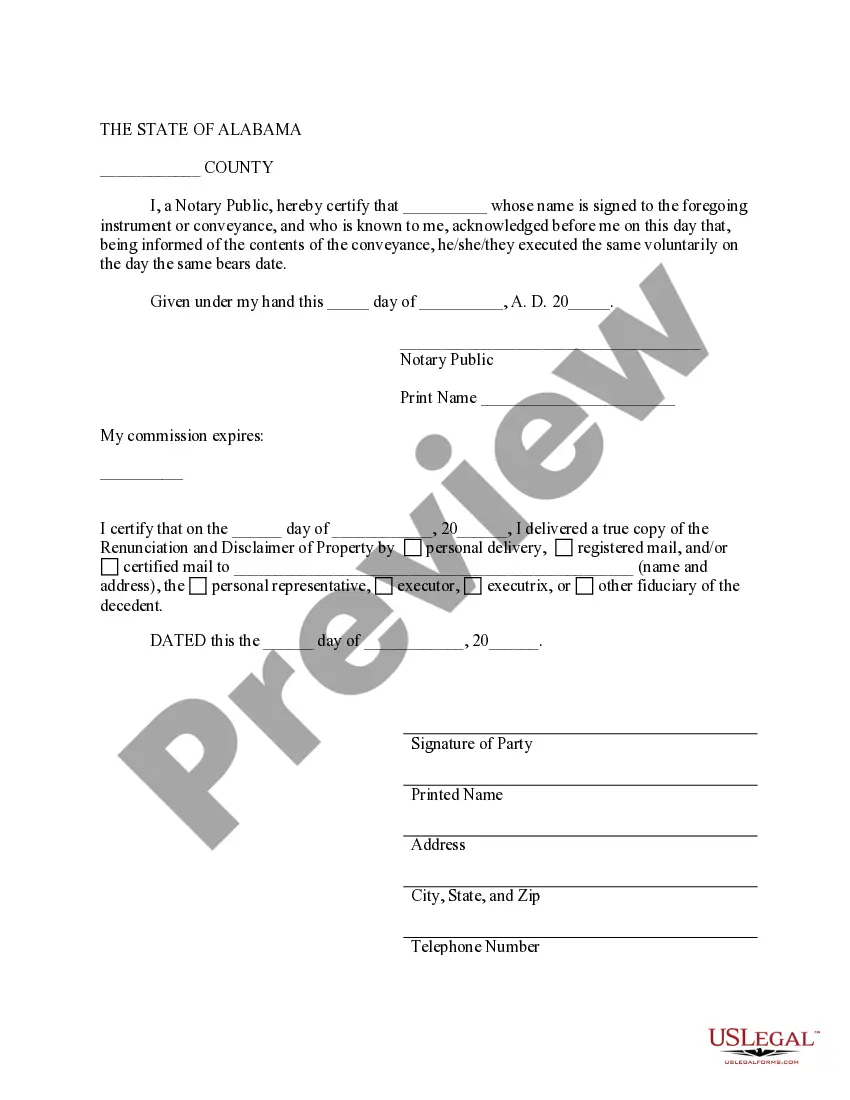
- Notary public certification, ensuring the validity of the document.

When this form is needed
This form should be used when a surviving joint tenant decides to renounce their interest in property following the death of a co-owner. This scenario may arise if the surviving tenant does not wish to inherit the property, perhaps due to personal reasons or financial obligations. Completing this form is crucial within nine months of the decedent's death to meet legal requirements, ensuring a clear transfer of property rights.
Who should use this form
- Surviving joint tenants who want to disclaim their property interests.
- Beneficiaries who wish to ensure the property passes to other heirs or beneficiaries.
- Individuals seeking to avoid inheritance disputes regarding the jointly held property.
How to complete this form
- Identify the surviving joint tenant and the deceased individual.
- Enter the date of the decedent's death.
- Specify the property interest that is being renounced.
- Ensure the disclaimer is filed within the required nine-month period.
- Sign the document in the presence of a notary public for verification.
Notarization guidance
To make this form legally binding, it must be notarized. Our online notarization service, powered by Notarize, lets you verify and sign documents remotely through an encrypted video session.
Get your form ready online
Our built-in tools help you complete, sign, share, and store your documents in one place.
Make edits, fill in missing information, and update formatting in US Legal Forms—just like you would in MS Word.
Download a copy, print it, send it by email, or mail it via USPS—whatever works best for your next step.
Sign and collect signatures with our SignNow integration. Send to multiple recipients, set reminders, and more. Go Premium to unlock E-Sign.
If this form requires notarization, complete it online through a secure video call—no need to meet a notary in person or wait for an appointment.
We protect your documents and personal data by following strict security and privacy standards.

Make edits, fill in missing information, and update formatting in US Legal Forms—just like you would in MS Word.

Download a copy, print it, send it by email, or mail it via USPS—whatever works best for your next step.

Sign and collect signatures with our SignNow integration. Send to multiple recipients, set reminders, and more. Go Premium to unlock E-Sign.

If this form requires notarization, complete it online through a secure video call—no need to meet a notary in person or wait for an appointment.

We protect your documents and personal data by following strict security and privacy standards.
Common mistakes to avoid
- Failing to file the disclaimer within the nine-month deadline.
- Not providing complete and accurate property descriptions.
- Overlooking the need for notarization, which can invalidate the document.
- Not ensuring the form is delivered to the appropriate parties.
Advantages of online completion
- Convenience of downloading and completing the form at your own pace.
- Editability allows for adjustments to be made easily before finalizing.
- Access to reliable legal templates drafted by licensed attorneys.
- Instant availability, enabling prompt action to meet important deadlines.
Quick recap
- The Alabama Renunciation and Disclaimer of Joint Tenant or Tenancy Interest form allows a surviving tenant to refuse inherited property.
- Submission must occur within nine months of the decedent's death for validity.
- Notarization is required for this form to be legally effective.
- Using this form online simplifies the process and ensures compliance with state laws.
Looking for another form?
Form popularity
FAQ
Alabama does not recognize oral (nuncupative) wills. Also, unlike some other states, Alabama does not permit handwritten and unwitnessed (holographic) wills, based on the legal requirement that all wills in Alabama be signed and witnessed by two people to be a valid will.
While T&C's contain general liability waivers, Disclaimers address specific issues with your product or service. Disclaimers may cover medical or health risks, professional liability and earnings claims. If your website or app creates a risk of user error or misuse, a disclaimer will do more to help you than hurt you.
Signature: The will must be signed by the testator or by another person in the testator's name, under his direction and in his presence. Witnesses: At least two witnesses must sign an Alabama Last Will in order for it to be valid. Writing: An Alabama will must be written in order to be valid.
For example, California requires that all sections of the will necessary to make the will valid must be written entirely by hand and that the person writing the will must sign it. If these state rules aren't followed, the holographic will won't be valid.
Disclaimer of interest, in the law of inheritance, wills and trusts, is a term that describes an attempt by a person to renounce their legal right to benefit from an inheritance (either under a will or through intestacy) or through a trust. A disclaimer of interest is irrevocable.
A last will and testament in Alabama must be in writing and signed by the testator (the person writing the will), or at the testator's direction and in his or her presence. The will also has to be witnessed and signed by at least two people.
A Last Will and Testament is a legal document that provides for the distribution of a person's assets at death. Assuming that probate is necessary and that no alternatives to probate are available, all wills must be admitted to probate before they are considered to be effective.
In law, a disclaimer is a statement denying responsibility intended to prevent civil liability arising for particular acts or omissions.A disclaimer may take effect as a term of the contract between the person making the disclaimer and the person who is thereby prevented from suing.
It may be filed by the person named as executor in the will or anyone named in the will or who has a financial interest in the estate. The will must be filed in the county where the person lived at the time of their death. If they lived out of state, it must be filed in the county where they owned property or assets.