Real Estate Seller
Description
Get your form ready online
Our built-in tools help you complete, sign, share, and store your documents in one place.
Make edits, fill in missing information, and update formatting in US Legal Forms—just like you would in MS Word.
Download a copy, print it, send it by email, or mail it via USPS—whatever works best for your next step.
Sign and collect signatures with our SignNow integration. Send to multiple recipients, set reminders, and more. Go Premium to unlock E-Sign.
If this form requires notarization, complete it online through a secure video call—no need to meet a notary in person or wait for an appointment.
We protect your documents and personal data by following strict security and privacy standards.

Make edits, fill in missing information, and update formatting in US Legal Forms—just like you would in MS Word.

Download a copy, print it, send it by email, or mail it via USPS—whatever works best for your next step.

Sign and collect signatures with our SignNow integration. Send to multiple recipients, set reminders, and more. Go Premium to unlock E-Sign.

If this form requires notarization, complete it online through a secure video call—no need to meet a notary in person or wait for an appointment.

We protect your documents and personal data by following strict security and privacy standards.
Looking for another form?


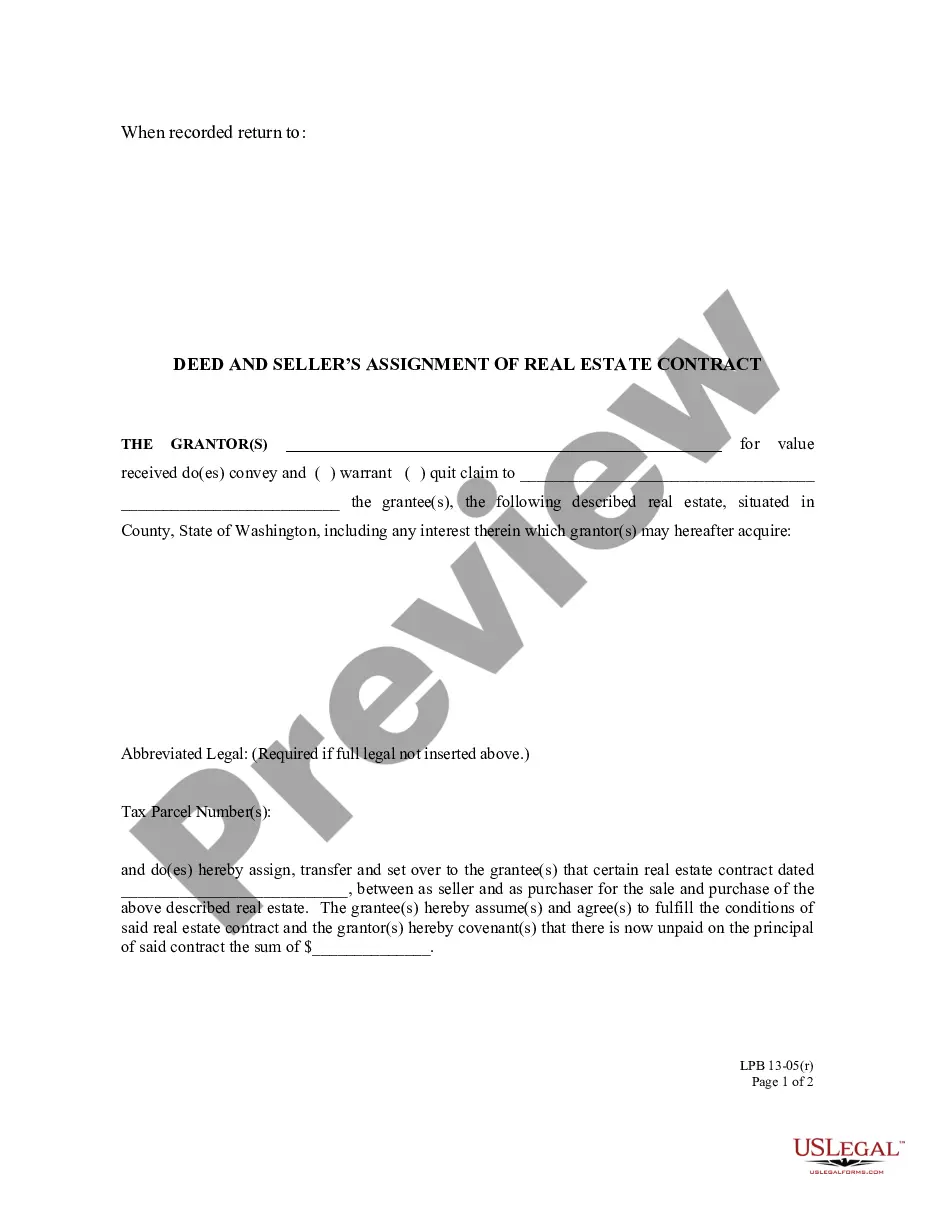
How to fill out Washington Deed And Seller's Assignment Of Real Estate Contract - With Representative Acknowledgment?
- If you are an existing member, log in to your account. Ensure that your subscription is active and locate your desired form through the Download button.
- For first-time users, begin by reviewing the available templates in Preview mode. Confirm that your selected document meets your needs and is valid in your local jurisdiction.
- If necessary, use the Search tab to find an alternate template that may better suit your requirements.
- Purchase the document by clicking on the Buy Now button. Select your preferred subscription plan and create an account for full access to the resources.
- Complete your purchase by providing credit card information or opting for your PayPal account to finalize the transaction.
- Download your document and save it to your device for easy completion. Access it later through the My Forms section of your profile.
With over 85,000 forms available, US Legal Forms not only provides a robust selection but also offers expert assistance for users needing help with their forms.
Take the stress out of real estate transactions today—explore US Legal Forms and ensure your documents are quick, accurate, and legally sound!
Form popularity
FAQ
To make $100,000 your first year in real estate, focus on building a strong network and generating leads. Learn effective marketing strategies and hone your negotiation skills. As a real estate seller, leveraging resources like US Legal Forms for professional documentation can help you close deals efficiently and grow your business.
An example of a listing might be: 'Beautiful 4-bedroom home in a desirable location, featuring an open-concept layout and updated kitchen. The backyard is perfect for family gatherings. As a real estate seller, your listing should entice potential buyers by painting a vivid picture of what living in the home feels like.'
Filling out a real estate sales contract requires you to enter specific details about the property, buyer, and seller. You should include terms of sale, contingencies, and any relevant dates, such as inspection and closing. As a real estate seller, using platforms like US Legal Forms can help streamline this process with customizable templates.
Writing a real estate listing involves outlining the property's key features and benefits while maintaining a concise format. Start with a captivating headline, followed by important details like square footage, number of bedrooms, and any recent upgrades. As a real estate seller, you should create a listing that tells a story, allowing potential buyers to envision their life in the space.
An effective property description could read: 'This charming three-bedroom home features a spacious living room and a modern kitchen with stainless steel appliances. Set in a peaceful neighborhood, this property offers a large backyard, perfect for entertaining. As a real estate seller, use such descriptions to showcase your property's best attributes.'
When writing a real estate listing, focus on highlighting key features that will attract buyers. Include the property's location, size, and unique characteristics. As a real estate seller, ensure that your description is clear and precise, using engaging language to capture interest.
An agent of the seller is commonly known as a listing agent or seller's agent. This professional works on behalf of the real estate seller to facilitate the sale of their property. They provide valuable market insights, handle negotiations, and ensure that the selling process goes smoothly.
The seller is the person or group that holds the legal title to the property being sold. This can be a homeowner, a bank, or even a corporation, depending on the situation. Identifying yourself as the real estate seller is vital for the transaction, as it establishes your rights and responsibilities.
In real estate, the seller is the individual or legal entity that owns a property and intends to sell it. This term is crucial as it defines the party that ultimately receives the proceeds from the sale. For anyone looking to list their home, knowing your role as a real estate seller is fundamental.
The person who sells a house is often referred to as the seller or real estate seller. This individual or entity owns the property and is looking to transfer ownership to a buyer. Understanding the position of the real estate seller can help you navigate the selling process more effectively.