Vermont Failure Reasonable For Conditions Of Release
Description


Get your form ready online
Our built-in tools help you complete, sign, share, and store your documents in one place.
Make edits, fill in missing information, and update formatting in US Legal Forms—just like you would in MS Word.
Download a copy, print it, send it by email, or mail it via USPS—whatever works best for your next step.
Sign and collect signatures with our SignNow integration. Send to multiple recipients, set reminders, and more. Go Premium to unlock E-Sign.
If this form requires notarization, complete it online through a secure video call—no need to meet a notary in person or wait for an appointment.
We protect your documents and personal data by following strict security and privacy standards.

Make edits, fill in missing information, and update formatting in US Legal Forms—just like you would in MS Word.

Download a copy, print it, send it by email, or mail it via USPS—whatever works best for your next step.

Sign and collect signatures with our SignNow integration. Send to multiple recipients, set reminders, and more. Go Premium to unlock E-Sign.

If this form requires notarization, complete it online through a secure video call—no need to meet a notary in person or wait for an appointment.

We protect your documents and personal data by following strict security and privacy standards.
Looking for another form?









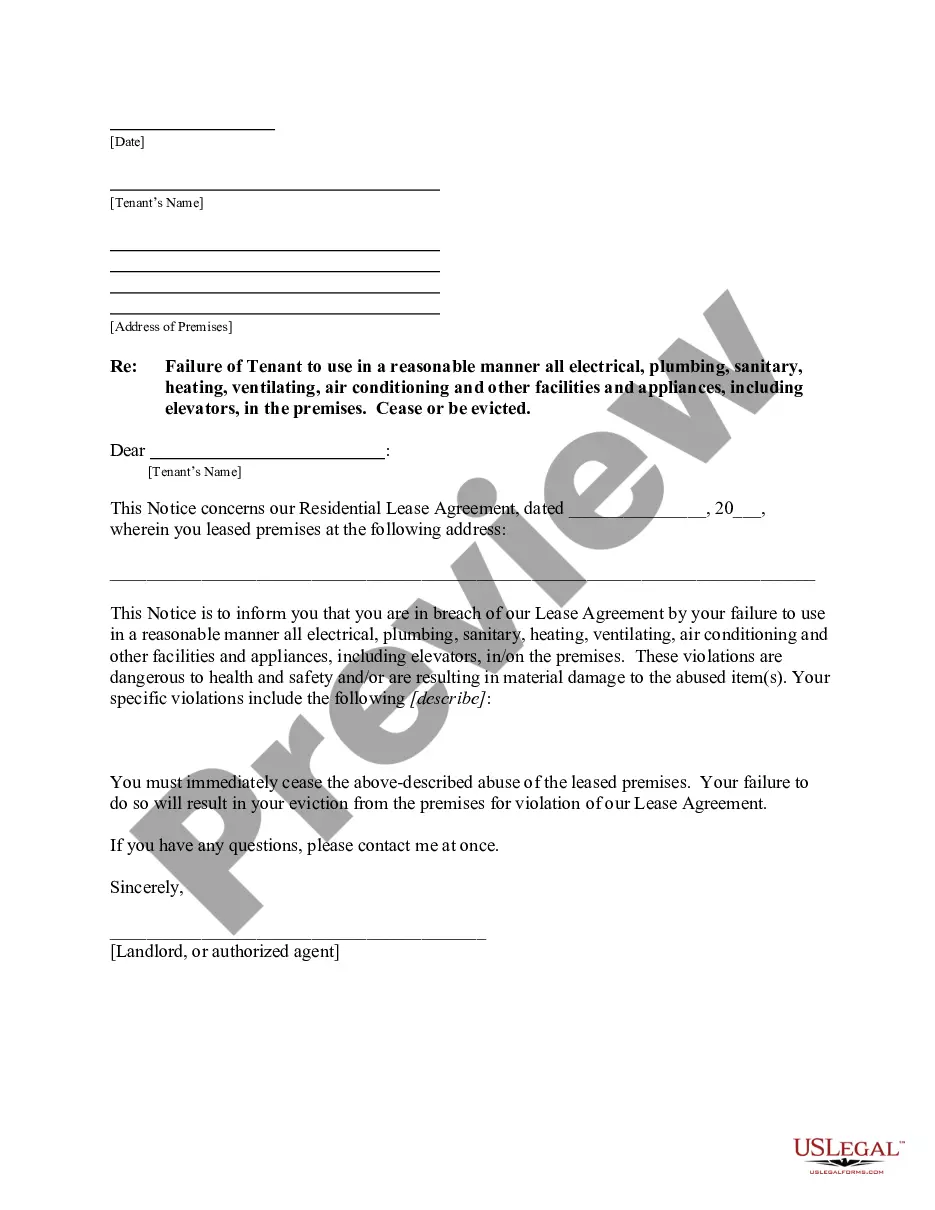
How to fill out Vermont Letter From Landlord To Tenant For Failure To Use Electrical, Plumbing, Sanitary, Heating, Ventilating, Air Conditioning And Other Facilities In A Reasonable Manner?
- Start by checking the document preview and description to verify it meets your requirements for Vermont conditions of release.
- If you need a different template or have specific requirements, use the Search feature to find the right document.
- Once you've identified the appropriate form, click on the Buy Now button and select your preferred subscription plan. You'll need to create an account to access all resources.
- Complete your purchase by entering your payment details using a credit card or PayPal.
- Finally, download your chosen form and save it to your device. You can also access it anytime through the My Forms section of your account.
In conclusion, US Legal Forms is an invaluable resource for anyone needing legal documents. With an extensive library and user-friendly interface, you can ensure your forms are legally sound and tailored to meet your needs.
Explore our offerings today and start simplifying your legal document process!
Form popularity
FAQ
Rule 3 of the Vermont Rules of Criminal Procedure also outlines the conditions under which a defendant can be formally charged and the procedures that follow. This rule is fundamental in establishing the legal framework for the prosecution and defense in criminal cases. Proper comprehension of this rule can significantly affect cases related to Vermont failure reasonable for conditions of release, guiding clients in navigating the legal process.
Vermont Rules of Criminal Procedure 4 deals with the issuance of warrants and the process of arrest. This rule outlines the requirements for law enforcement to make an arrest and ensures that individuals' rights are protected. In situations involving Vermont failure reasonable for conditions of release, understanding this rule is crucial for both defendants and their legal representatives.
The LSA statute, or the Vermont Legal Services Act, provides guidelines for legal aid organizations in Vermont. This statute aims to improve access to legal representation for low-income individuals facing legal challenges. It supports cases involving Vermont failure reasonable for conditions of release by ensuring resources are available for those who need assistance.
Vermont Rule of Evidence 404 addresses the admissibility of character evidence in court. It specifies that evidence of a person's character is generally not admissible to prove that the person acted in accordance with that character on a particular occasion. This rule plays a crucial role in cases concerning Vermont failure reasonable for conditions of release, as it impacts how evidence is presented.
Rule 3 of the Vermont Rules of Civil Procedure states that a civil action is initiated by filing a complaint with the court. This process ensures that all parties involved receive proper notice of the claims against them. Understanding this rule is important, especially in cases relating to Vermont failure reasonable for conditions of release, where timely action can impact legal outcomes.
Violating terms and conditions can lead to various legal outcomes, including penalties, charges, or even termination of agreements. Courts take these violations seriously, and the repercussions serve as a warning to adhere strictly to set terms. Consequently, understanding your obligations can help prevent complications related to a Vermont failure reasonable for conditions of release. Platforms like uslegalforms can assist you in navigating these issues effectively.
Rule 41 establishes the framework for dismissing cases in Vermont's civil courts. This rule offers guidelines on how and when a case can be dismissed, either voluntarily or involuntarily. A clear understanding of this rule can empower individuals to know their options when dealing with civil legal matters. This clarity can further aid in avoiding scenarios leading to Vermont failure reasonable for conditions of release.
If you violate conditions of release, the court may impose penalties, which could include revocation of your release and imprisonment. Furthermore, the judge may schedule a hearing to assess the violation's severity. Knowing the stakes emphasizes the need for adherence to the conditions laid out by the court. This experience can be critical in avoiding a Vermont failure reasonable for conditions of release.
A conditional release violation occurs when an individual fails to follow the terms set by the court during their release. This might include not attending mandated meetings or failing drug tests. Violations can lead to immediate legal repercussions, including a return to custody. Understanding these terms can help prevent a Vermont failure reasonable for conditions of release.
When you violate a conditional discharge, it can lead to serious consequences, including the possibility of facing additional charges. The court may revoke the conditional discharge and impose the original sentence. This outcome underscores the importance of adhering strictly to the terms of your release. Staying compliant can prevent issues related to Vermont failure reasonable for conditions of release.