Virginia Trust And Estate Lawyers
Description
Get your form ready online
Our built-in tools help you complete, sign, share, and store your documents in one place.
Make edits, fill in missing information, and update formatting in US Legal Forms—just like you would in MS Word.
Download a copy, print it, send it by email, or mail it via USPS—whatever works best for your next step.
Sign and collect signatures with our SignNow integration. Send to multiple recipients, set reminders, and more. Go Premium to unlock E-Sign.
If this form requires notarization, complete it online through a secure video call—no need to meet a notary in person or wait for an appointment.
We protect your documents and personal data by following strict security and privacy standards.

Make edits, fill in missing information, and update formatting in US Legal Forms—just like you would in MS Word.

Download a copy, print it, send it by email, or mail it via USPS—whatever works best for your next step.

Sign and collect signatures with our SignNow integration. Send to multiple recipients, set reminders, and more. Go Premium to unlock E-Sign.

If this form requires notarization, complete it online through a secure video call—no need to meet a notary in person or wait for an appointment.

We protect your documents and personal data by following strict security and privacy standards.
Looking for another form?










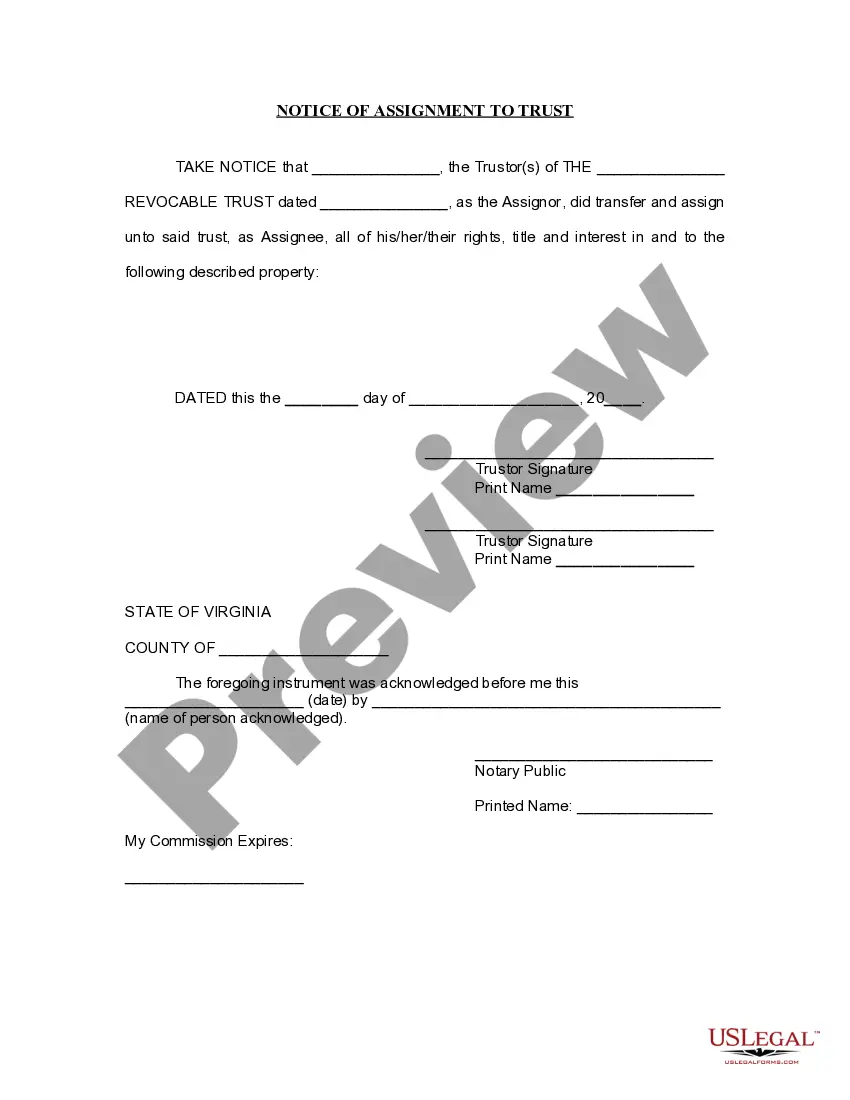
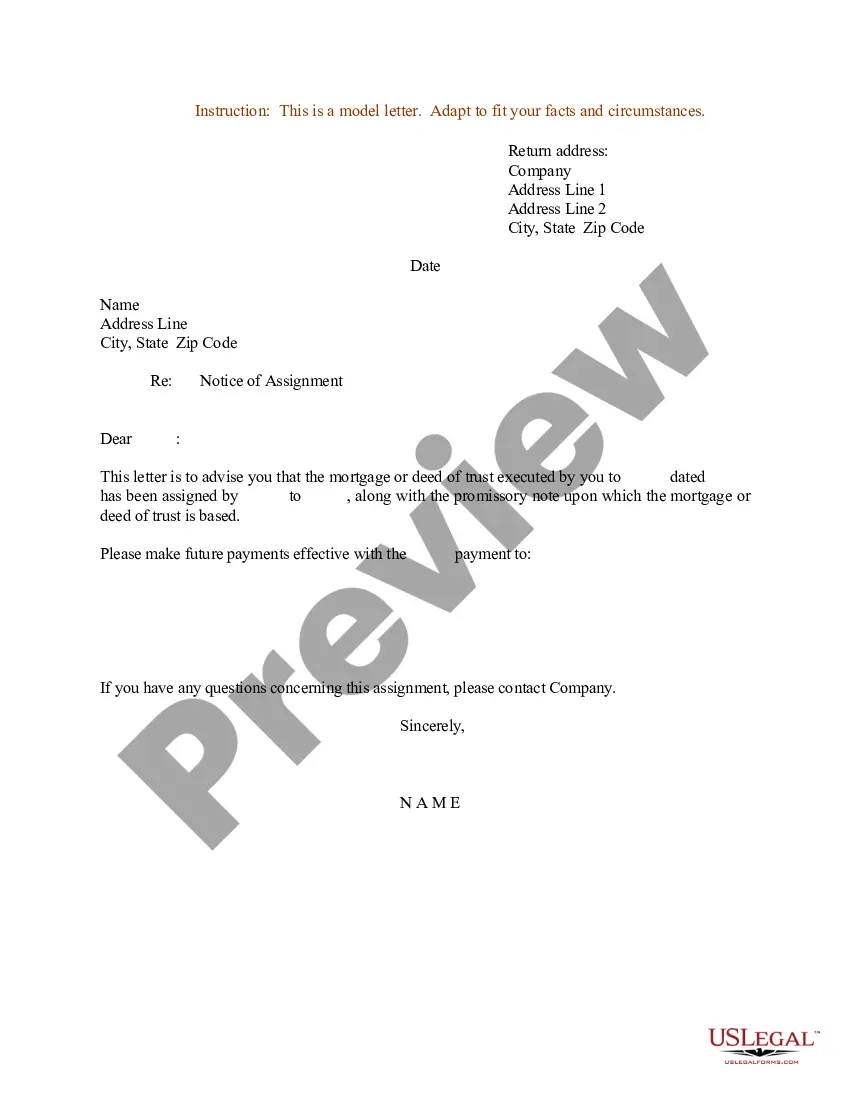
How to fill out Virginia Notice Of Assignment To Living Trust?
Locating a reliable source for acquiring the latest and pertinent legal templates is a significant part of navigating bureaucracy.
Selecting the appropriate legal documents requires accuracy and meticulousness, which is why it is crucial to obtain samples of Virginia Trust And Estate Attorneys exclusively from reputable providers, like US Legal Forms.
Once you have the document on your device, you can edit it using the editor or print it out and complete it manually. Eliminate the complications that come with your legal paperwork. Explore the extensive US Legal Forms library, where you can discover legal templates, assess their applicability to your situation, and download them instantly.
- Utilize the catalog search or search bar to locate your template.
- Examine the form’s details to verify if it meets the specifications of your state and locality.
- Open the form preview, if available, to ensure the template aligns with what you are looking for.
- Return to the search for the suitable document if the Virginia Trust And Estate Attorneys does not fulfill your needs.
- Once you are confident about the form’s applicability, download it.
- If you are a registered user, click Log in to validate and access your chosen documents in My documents.
- If you have yet to create an account, click Buy now to acquire the document.
- Select the payment plan that suits your requirements.
- Proceed with the registration to complete your transaction.
- Finalize your purchase by choosing a payment method (credit card or PayPal).
- Select the file format for downloading Virginia Trust And Estate Attorneys.
Form popularity
FAQ
The factors that will determine probate and a length of probate will be whether or not there was a testamentary trust, whether there are family disputes or complications, and what level of estate planning was done prior to the death of the decedent.
In Virginia, any estate valued at greater than $50,000 at the time of the owner's passing must go through the probate procedure.
To make a living trust in Virginia, you: Choose whether to make an individual or shared trust. Decide what property to include in the trust. Choose a successor trustee. Decide who will be the trust's beneficiaries?that is, who will get the trust property. Create the trust document.
There is a six-step process for making a living trust in Virginia: Select a type of trust. ... Inventory your assets and property. ... Choose a trustee. ... Put together your trust document. ... Visit a notary public and sign your living trust in front of them. Fund your trust.
Creating a living trust in Virginia occurs when you create a written trust document and sign it in the presence of a notary. The trust is not official until you transfer assets into it. A living trust can offer a variety of benefits that may appeal to you. Consider what is best for you.