Silent Partner Wise
Description
Get your form ready online
Our built-in tools help you complete, sign, share, and store your documents in one place.
Make edits, fill in missing information, and update formatting in US Legal Forms—just like you would in MS Word.
Download a copy, print it, send it by email, or mail it via USPS—whatever works best for your next step.
Sign and collect signatures with our SignNow integration. Send to multiple recipients, set reminders, and more. Go Premium to unlock E-Sign.
If this form requires notarization, complete it online through a secure video call—no need to meet a notary in person or wait for an appointment.
We protect your documents and personal data by following strict security and privacy standards.

Make edits, fill in missing information, and update formatting in US Legal Forms—just like you would in MS Word.

Download a copy, print it, send it by email, or mail it via USPS—whatever works best for your next step.

Sign and collect signatures with our SignNow integration. Send to multiple recipients, set reminders, and more. Go Premium to unlock E-Sign.

If this form requires notarization, complete it online through a secure video call—no need to meet a notary in person or wait for an appointment.

We protect your documents and personal data by following strict security and privacy standards.
Looking for another form?
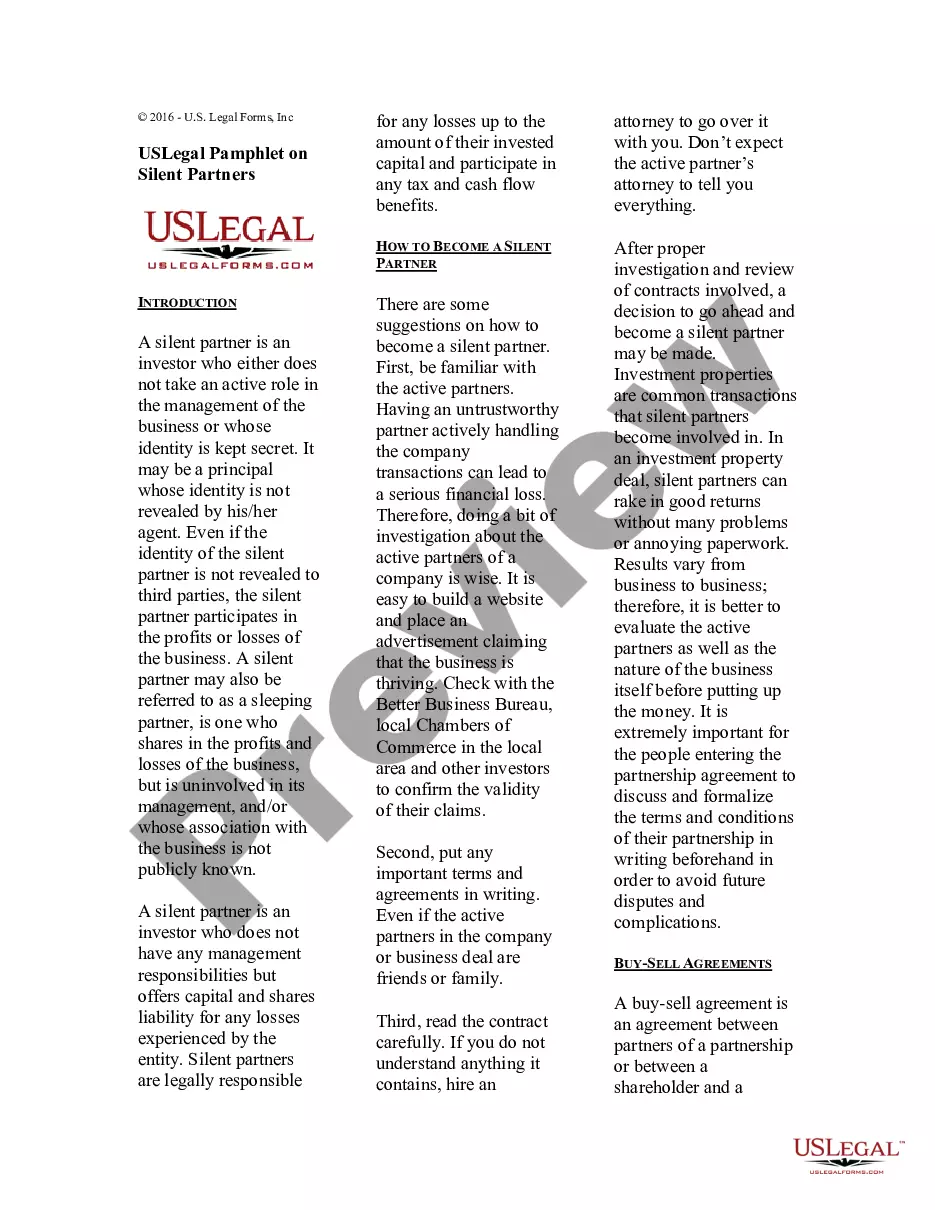
How to fill out USLegal Pamphlet On Silent Partners?
- Log into your account if you're a returning user, or create a new account if it's your first time. Ensure that your subscription is active to access the forms.
- Browse the extensive library and use the Preview mode to examine different templates. Verify that you select the right one that aligns with your local legal requirements.
- If you encounter any discrepancies, utilize the Search tab to explore other templates that may suit your needs better.
- Once you've found the appropriate document, click the Buy Now button and select your preferred subscription plan to proceed.
- Complete your purchase by entering your payment details using a credit card or PayPal.
- After successfully purchasing your form, download it to your device. You can easily access it anytime in the My Forms section of your account.
By following these steps, you can efficiently obtain legal forms tailored to your needs. Remember, US Legal Forms not only offers a robust collection of templates but also provides access to premium experts to ensure your documents are accurate and reliable.
Begin your journey with US Legal Forms today and empower yourself to handle legal matters with confidence!
Form popularity
FAQ
The percentage you should allocate to a business partner depends on various factors including their investment, expertise, and the value they bring. When considering equity distribution, balance their involvement against your contribution and the overall business strategy. Hence, a silent partner wise approach involves equitable negotiations and mutual respect, ensuring both parties feel valued.
Dealing with a silent partner requires clear communication and defined roles. Since they do not engage in daily operations, it's crucial to establish expectations upfront to avoid misunderstandings later. Regular updates on the business's performance and decisions can help maintain a positive relationship. Consequently, being transparent and organized contributes significantly to working together silent partner wise.
The percentage a silent partner should receive can vary widely based on the type of business and the amount of investment contributed. Generally, a silent partner may expect to receive anywhere from 10% to 49% equity, depending on their financial stake versus the active partners' contributions. Thus, having open discussions during negotiations can help you decide a silent partner wise percentage that benefits all parties.
Determining the equity share for a silent partner involves assessing the value they bring to the business. Silent partners typically invest capital without engaging in day-to-day operations. The equity percentage often corresponds to the amount of financial investment they contribute compared to the overall business valuation. Therefore, calculating this thoughtfully is essential when thinking in a silent partner wise context.
Silent treatment can lead to misunderstandings and emotional disconnect between partners. While some people believe it creates space for reflection, it often fosters resentment and confusion instead. Prolonged silent treatment can damage trust and communication, essential in healthy relationships. Open dialogue and clear communication are crucial to resolving conflicts effectively, making silent partner wise interactions in relationships more constructive.
As a silent partner, you face certain risks, primarily regarding the lack of control over day-to-day operations. In addition, your investment is subject to the business’s performance, which could lead to financial losses. Silent partners must also consider the potential for conflicts with active partners, impacting the business's stability. It's essential to evaluate these risks carefully and discuss them in a silent partner wise agreement.
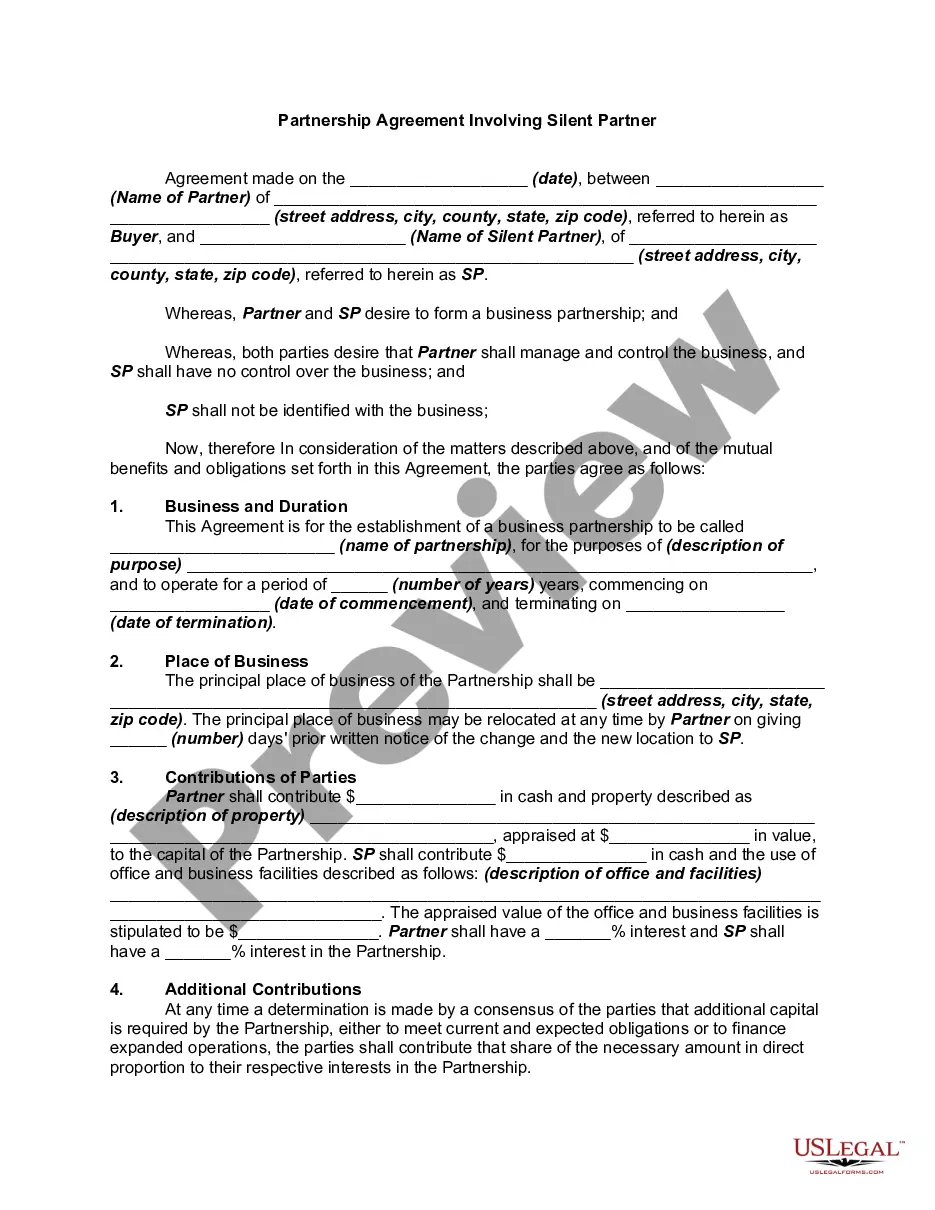
Structuring a silent partnership agreement involves detailing the roles, responsibilities, and profit-sharing arrangements between partners. It’s crucial to outline how decisions will be made and how conflicts will be resolved. A silent partner wise agreement should also include terms for exit strategies and asset distribution. Using a reliable platform like USLegalForms can help you create a comprehensive agreement that meets your business needs.
Determining a fair percentage for a silent partner depends on various factors, including the type of business and the capital invested. Generally, a common range falls between 10% and 50% ownership. A silent partner wise arrangement allows for flexibility, so it's important to consider the contributions and risks each partner brings to the table. Ultimately, both parties should agree on a percentage that reflects their investment and involvement.
Determining a good percentage for a business partner depends on several factors, including their contributions, the capital invested, and the role they play. A common range is between 10% to 50%, depending on the balance of responsibilities and risk. Finding a fair percentage encourages a strong partnership and aligns both parties' interests. Consider using resources like US Legal Forms to draft agreements that reflect these terms and keep both partners satisfied.
The percentage that a silent partner receives often varies based on the pre-established partnership agreement. Typically, this percentage is proportional to their investment in the business compared to the total capital invested. Many partnerships have varied arrangements, so it's essential to document these terms clearly. The US Legal Forms platform offers templates that can help you outline these percentages effectively.