Legal Temperature For Schools
Description


Get your form ready online
Our built-in tools help you complete, sign, share, and store your documents in one place.
Make edits, fill in missing information, and update formatting in US Legal Forms—just like you would in MS Word.
Download a copy, print it, send it by email, or mail it via USPS—whatever works best for your next step.
Sign and collect signatures with our SignNow integration. Send to multiple recipients, set reminders, and more. Go Premium to unlock E-Sign.
If this form requires notarization, complete it online through a secure video call—no need to meet a notary in person or wait for an appointment.
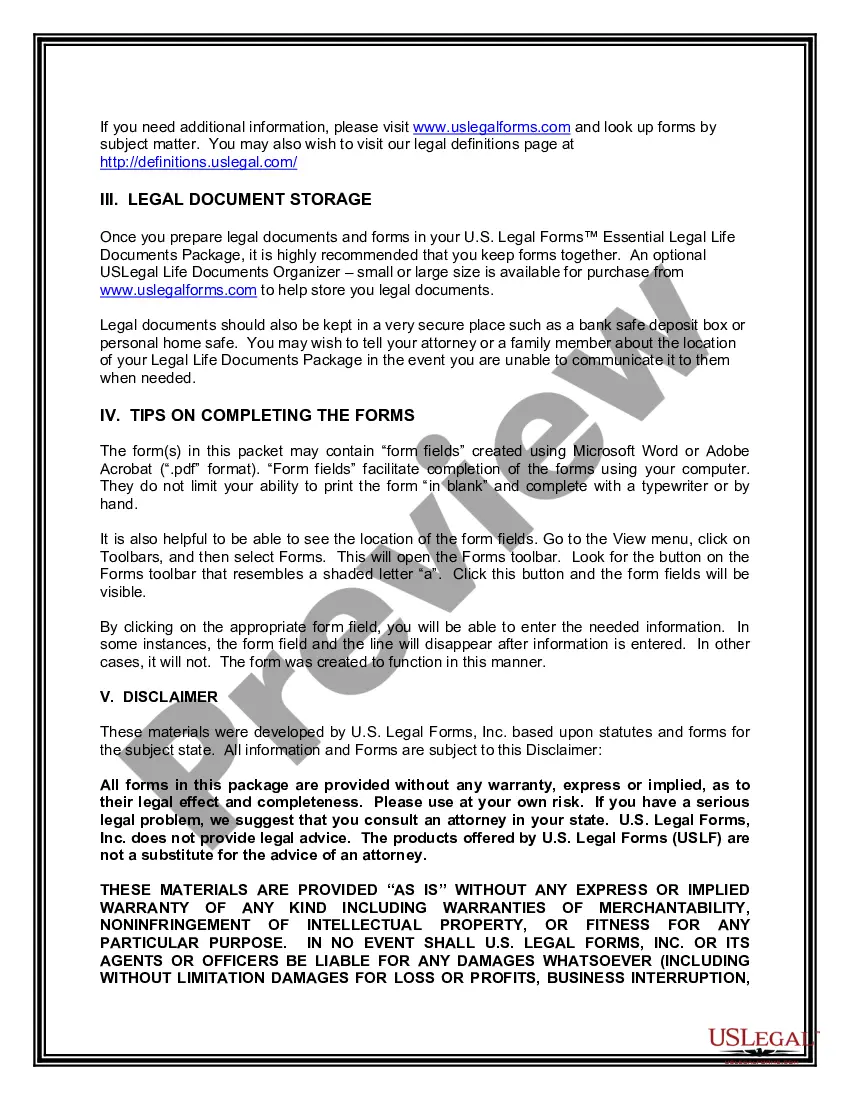
We protect your documents and personal data by following strict security and privacy standards.

Make edits, fill in missing information, and update formatting in US Legal Forms—just like you would in MS Word.

Download a copy, print it, send it by email, or mail it via USPS—whatever works best for your next step.

Sign and collect signatures with our SignNow integration. Send to multiple recipients, set reminders, and more. Go Premium to unlock E-Sign.

If this form requires notarization, complete it online through a secure video call—no need to meet a notary in person or wait for an appointment.

We protect your documents and personal data by following strict security and privacy standards.
Looking for another form?










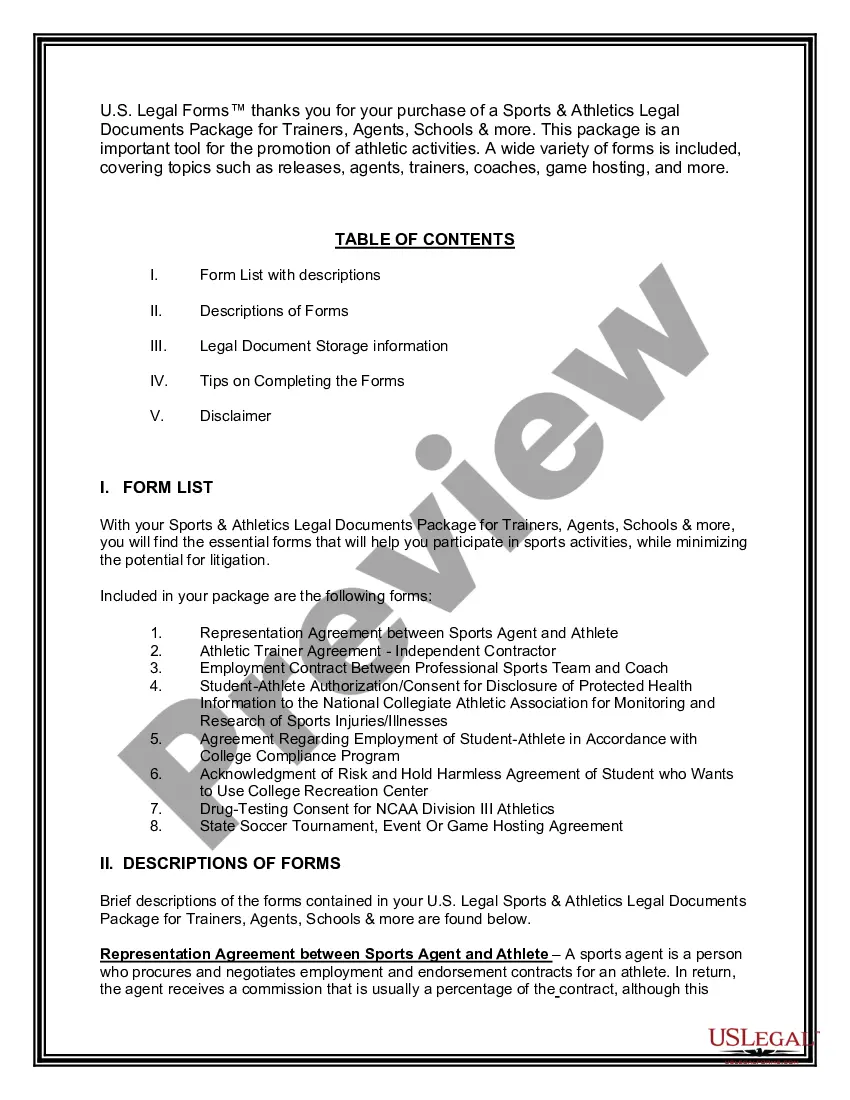
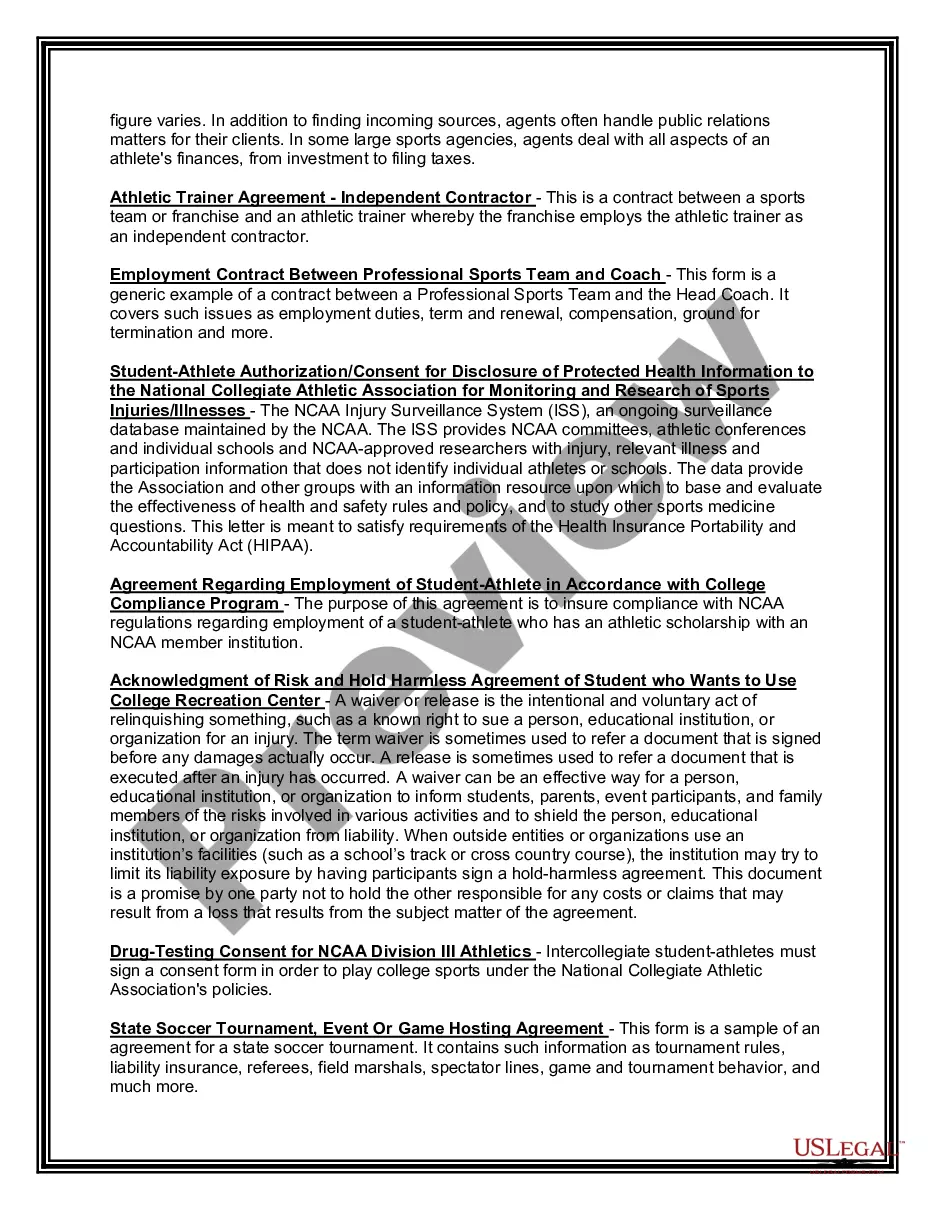
How to fill out Sports & Athletics Legal Documents Package For Trainers Or Training, Agents, Schools & More?
- Access your account at US Legal Forms if you're a returning user. Ensure that your subscription is active, or renew it as needed.
- Review the available forms in the Preview mode. Make sure the template selected is appropriate for your jurisdiction and needs.
- If the desired form isn't available, use the Search function to find an alternative that fits your requirements.
- Purchase the selected document by clicking the Buy Now button and choose your preferred subscription plan. You'll need to create an account to access all resources.
- Complete your purchase by entering your payment information, either via credit card or PayPal.
- Download the necessary form to your device, and find it later in the My Forms section of your profile for any additional needs.
US Legal Forms empowers both individuals and attorneys by providing a vast collection of over 85,000 forms, ensuring you can find the specific legal documents you need.
Start taking control of your legal needs today with US Legal Forms. Sign up now to access our invaluable resources for efficient and accurate form completion.
Form popularity
FAQ
While there isn't a straightforward answer, many schools consider temperatures exceeding 90°F or below 32°F as indicators for possible closure. Local policies may also take into account humidity and wind chill factors. Students should always be protected from extreme weather conditions, which is why schools regularly reassess the situation. For clarity on your local policies, reach out to your school district.
Schools do not have a one-size-fits-all temperature threshold for closure; it often depends on local policies and conditions. When temperatures reach extremes—both high and low—many schools err on the side of caution. This ensures they uphold student well-being. To find specific requirements, consult on your district's guidelines regarding the legal temperature for schools.
The legal temperature for schools to ensure safety usually falls below 60°F in colder months and above 90°F in warmer seasons. These temperatures can hamper a student’s ability to focus and participate in learning activities. School officials should monitor classroom conditions to maintain an environment conducive to education. Parents should discuss any concerns they have about temperature impacts with school administrators.
Much like cold weather, there is no universal maximum temperature for school operation. Some states have regulations that outline acceptable temperature ranges. As a rule, extremely high temperatures can create unsafe learning conditions, leading schools to implement heat policies. It is best to check local educational regulations for specific heat-related guidelines.
The legal temperature for schools to close varies by state and district policy. Generally, schools consider factors such as outdoor temperatures, wind chill, and unsafe conditions. When temperatures drop significantly, schools prioritize student safety and may choose to close. It is important for parents to stay informed about local guidelines regarding school closures.
When it comes to outdoor practices, a temperature above 90 degrees Fahrenheit can be too hot for kids, increasing the risk of heat-related illnesses. It's essential for coaches and parents to monitor weather conditions and ensure hydration during practices. Ensuring that practices are safe relates back to the broader concept of legal temperature for schools, as conditions should always be favorable for student activities.
Generally, a school classroom becomes too hot and uncomfortable when temperatures exceed 80 degrees Fahrenheit. High temperatures can lead to decreased concentration and increased fatigue among students. Establishing effective temperature controls is crucial for ensuring students can thrive academically throughout the school day.
An acceptable temperature for school environments usually falls between 68 and 74 degrees Fahrenheit. This range allows students to focus on their studies without the distraction of extreme temperature discomfort. Maintaining temperatures within this range supports student wellbeing and encourages a productive classroom atmosphere.
Temperature regulations in schools help ensure safe and comfortable learning conditions. Most states have guidelines that suggest maintaining classroom temperatures within a certain range, typically 68 to 74 degrees Fahrenheit. Schools are responsible for regularly checking and adjusting their heating and cooling systems to meet these regulations.
The minimum legal temperature for schools can vary by state but generally falls around 60 degrees Fahrenheit. It’s crucial for schools to provide a comfortable environment, especially during winter months. Keeping temperatures at or above this level helps ensure student comfort and supports better academic performance.