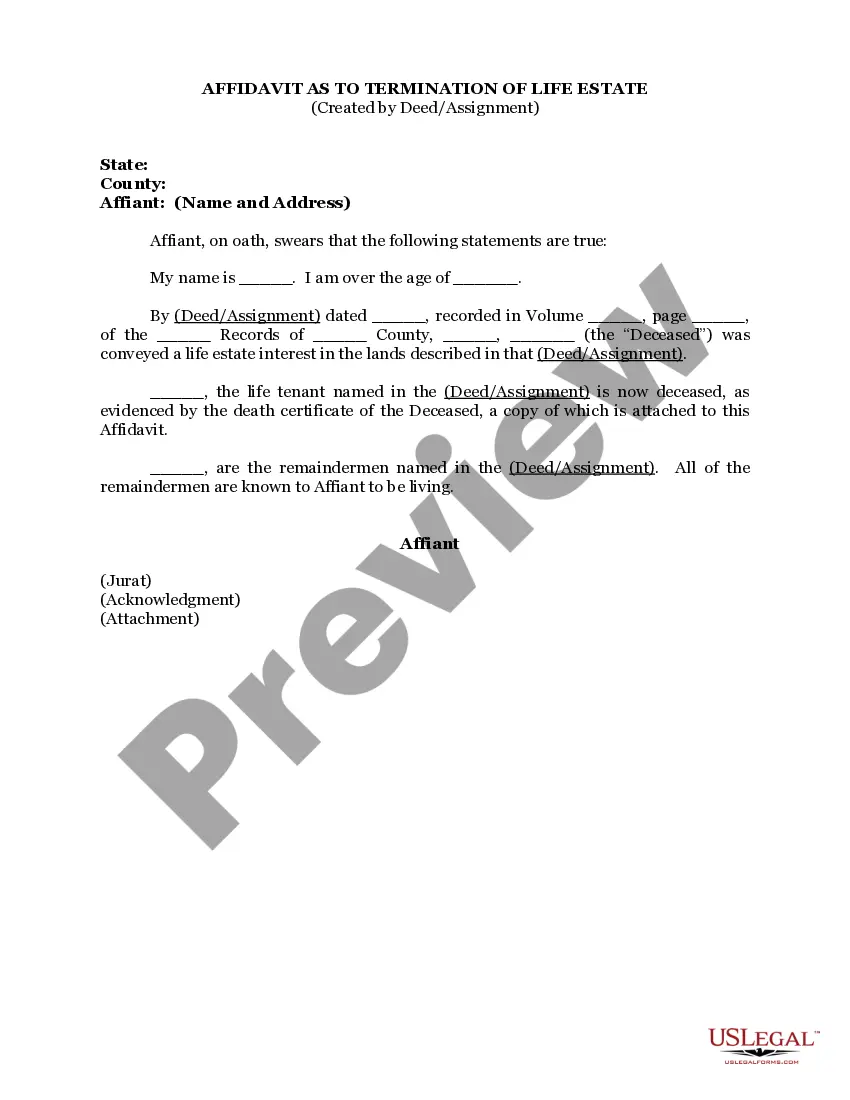
Affidavit Terminating Life Estate Without Will
Description
Get your form ready online
Our built-in tools help you complete, sign, share, and store your documents in one place.
Make edits, fill in missing information, and update formatting in US Legal Forms—just like you would in MS Word.
Download a copy, print it, send it by email, or mail it via USPS—whatever works best for your next step.
Sign and collect signatures with our SignNow integration. Send to multiple recipients, set reminders, and more. Go Premium to unlock E-Sign.
If this form requires notarization, complete it online through a secure video call—no need to meet a notary in person or wait for an appointment.
We protect your documents and personal data by following strict security and privacy standards.

Make edits, fill in missing information, and update formatting in US Legal Forms—just like you would in MS Word.

Download a copy, print it, send it by email, or mail it via USPS—whatever works best for your next step.

Sign and collect signatures with our SignNow integration. Send to multiple recipients, set reminders, and more. Go Premium to unlock E-Sign.

If this form requires notarization, complete it online through a secure video call—no need to meet a notary in person or wait for an appointment.

We protect your documents and personal data by following strict security and privacy standards.
Looking for another form?
How to fill out Affidavit As To Termination Of Life Estate Created By Deed / Assignment?
Whether for corporate reasons or personal matters, everyone must confront legal issues at some point in their life.
Completing legal documents demands meticulous care, starting with choosing the correct form template.
Once downloaded, you can fill out the form using editing software or print it out and complete it manually. With an extensive US Legal Forms catalog readily available, you do not have to waste time searching for the correct sample online. Utilize the library’s straightforward navigation to find the appropriate form for any situation.
- For instance, if you choose an incorrect version of an Affidavit Terminating Life Estate Without Will, it will be declined upon submission.
- Thus, it is vital to secure a trustworthy source of legal documents such as US Legal Forms.
- If you need to acquire an Affidavit Terminating Life Estate Without Will template, follow these simple steps.
- Obtain the desired sample using the search feature or catalog browsing.
- Review the form’s description to ensure it aligns with your situation, state, and county.
- Click on the form’s preview to inspect it.
- If it is not the correct form, return to the search function to find the Affidavit Terminating Life Estate Without Will sample you require.
- Download the template when it meets your specifications.
- If you have a US Legal Forms account, simply click Log in to access previously saved templates in My documents.
- If you don’t have an account yet, you can acquire the form by clicking Buy now.
- Select the appropriate pricing option.
- Complete the profile registration form.
- Choose your payment method: use a credit card or PayPal account.
- Select the file format you desire and download the Affidavit Terminating Life Estate Without Will.
Form popularity
FAQ
While a life estate deed can be beneficial, it does come with some drawbacks. One major issue is that the life tenant, the person holding the life estate, cannot sell or mortgage the property without the remainderman's consent. Additionally, if the life tenant incurs debts or faces legal issues, the property might still be exposed. Understanding these nuances is crucial, and using an affidavit terminating life estate without will can help address potential concerns.
When someone with a life estate dies, the property automatically transfers to the remainderman, the individual named in the deed, without being subjected to probate. This ensures a smooth transition of ownership, provided that the life estate was well-defined. If issues arise, an affidavit terminating life estate without will can serve as a useful tool to clarify ownership and intentions.
Yes, a life estate deed generally takes precedence over a will when it comes to the distribution of the property specified in the deed. This means that the property will pass directly to the named beneficiary without going through the probate process outlined in the will. If you have an affidavit terminating life estate without will, it can further clarify the intentions behind your estate planning.
A life estate deed allows you to retain control over your property during your lifetime while also enabling a designated beneficiary to inherit it afterward. This can help avoid probate, which often simplifies the transfer process. Additionally, an affidavit terminating life estate without will can provide clear instructions for property distribution after your death, minimizing disputes among heirs.
A remainderman can be removed from a life estate under certain conditions. If the life tenant, the person holding the life estate, decides to change the terms, they may use an affidavit terminating the life estate without a will. This process involves legal documentation that effectively removes the remainderman's rights to the property. It's essential to consult with a legal expert or utilize platforms like USLegalForms to ensure the termination is done correctly and meets all legal requirements.
Generally, a will cannot override a life estate since the life tenant has a legal interest in the property during their lifetime. The will may outline what happens to the property after the life tenant's death, but it cannot change the existing life estate terms. If you encounter complexities in this area, consider using an affidavit terminating life estate without will to help clarify ownership and intentions, ensuring the property is handled according to your wishes.
Yes, a life estate can be terminated under specific circumstances. For instance, if the life tenant passes away, the estate automatically ends. Alternatively, parties may consider an affidavit terminating life estate without will as a legal tool that allows for a clear termination of the estate, ensuring that the property can be transferred to the desired parties without controversy.
A life estate may become invalid due to several factors, such as lack of proper creation, failure to comply with state laws, or the absence of a clear intent from the property owner. If the original deed does not clearly define the life estate or if the property owner did not have the legal capacity, disputes may arise. Additionally, an affidavit terminating life estate without will can be used in situations where conflicts require resolution, ensuring that property ownership is clarified for all parties involved.
Yes, an affidavit of death usually needs to be notarized to ensure its legitimacy and legal standing. Notarization provides a level of verification that protects all parties involved. Utilizing resources like uslegalforms can help facilitate the completion and proper notarization of your affidavit, particularly in cases involving an affidavit terminating life estate without will.
The right to property after the termination of a life estate is known as the right of remainderman. This means the remainderman has a claim to the property once the life estate ends. It is vital for both life tenants and remaindermen to understand these rights to avoid disputes during the transition.