False Imprisonment For Tort
Description
Get your form ready online
Our built-in tools help you complete, sign, share, and store your documents in one place.
Make edits, fill in missing information, and update formatting in US Legal Forms—just like you would in MS Word.
Download a copy, print it, send it by email, or mail it via USPS—whatever works best for your next step.
Sign and collect signatures with our SignNow integration. Send to multiple recipients, set reminders, and more. Go Premium to unlock E-Sign.
If this form requires notarization, complete it online through a secure video call—no need to meet a notary in person or wait for an appointment.
We protect your documents and personal data by following strict security and privacy standards.

Make edits, fill in missing information, and update formatting in US Legal Forms—just like you would in MS Word.

Download a copy, print it, send it by email, or mail it via USPS—whatever works best for your next step.

Sign and collect signatures with our SignNow integration. Send to multiple recipients, set reminders, and more. Go Premium to unlock E-Sign.

If this form requires notarization, complete it online through a secure video call—no need to meet a notary in person or wait for an appointment.

We protect your documents and personal data by following strict security and privacy standards.
Looking for another form?




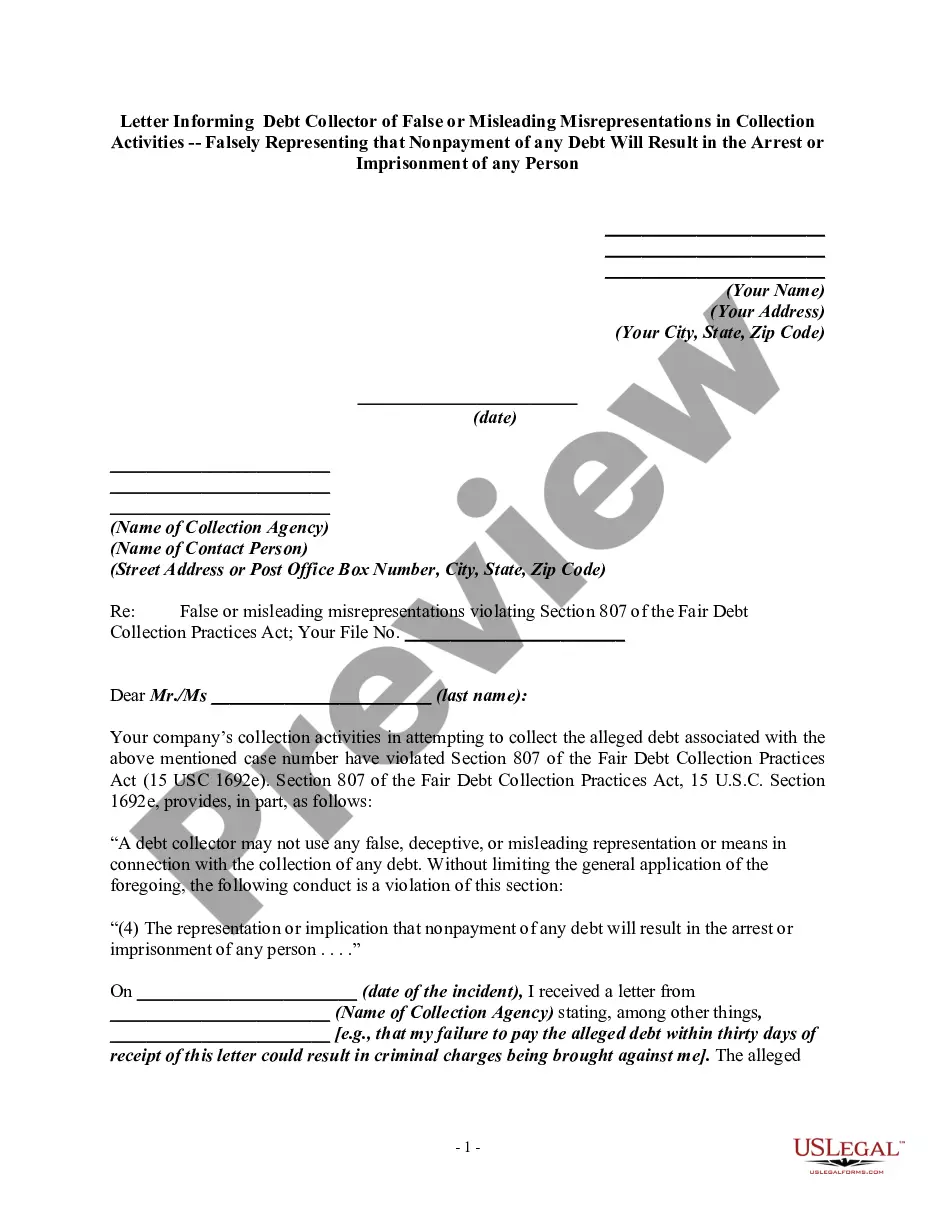
How to fill out Letter Informing Debt Collector Of False Or Misleading Misrepresentations In Collection Activities - Falsely Representing That Nonpayment Of Any Debt Will Result In The Arrest Or Imprisonment Of Any Person?
The False Imprisonment For Tort you observe on this page is a versatile legal template crafted by expert attorneys in accordance with federal and state laws and regulations.
For over 25 years, US Legal Forms has offered individuals, businesses, and legal practitioners more than 85,000 validated, state-specific forms for any business and personal circumstance. It’s the fastest, simplest, and most reliable method to acquire the documentation you require, as the service ensures the utmost level of data security and anti-virus protection.
Select the format you desire for your False Imprisonment For Tort (PDF, Word, RTF) and download the document onto your device. Complete the template by printing it out manually or use an online multifunctional PDF editor to quickly and accurately fill out and sign your form with a legally binding electronic signature. Use the same document again whenever necessary by accessing the My documents tab in your profile to redownload any previously saved forms. Enroll in US Legal Forms to have authenticated legal templates for all of life’s situations at your fingertips.
- Search for the document you require and examine it.
- Browse through the file you looked for and preview it or review the form description to confirm it meets your needs. If it doesn’t, utilize the search bar to find the right one. Click Buy Now when you have located the template you need.
- Select and Log In.
- Choose the pricing option that fits you and create an account. Use PayPal or a credit card to make a swift payment. If you already possess an account, Log In and check your subscription to continue.
- Obtain the editable template.
Form popularity
FAQ
To win a false imprisonment lawsuit, you need to prove the essential elements of the tort. Gather evidence showing that you were intentionally confined without legal justification and that you suffered harm as a result. Utilizing the resources available on US Legal Forms can help you prepare your case effectively and navigate the legal process with confidence. Ultimately, presenting a strong case will enhance your chances of success in a false imprisonment for tort claim.
The tort outline for false imprisonment involves several key elements. First, there must be an intentional act by the defendant that restricts the plaintiff's freedom of movement. Additionally, the plaintiff must be aware of the confinement or be harmed by it. Understanding these elements is crucial for anyone looking to pursue a claim of false imprisonment for tort.
The standard of proof for someone to be found guilty of a tort is typically based on the 'preponderance of the evidence.' This means that the evidence must show that it is more likely than not that the tort occurred. In the case of false imprisonment for tort, this standard helps establish accountability. If you need assistance with legal documentation or navigating your case, consider using US Legal Forms for reliable resources.
The tort of false imprisonment requires that an individual is confined against their will without lawful justification. This means that the person must be intentionally restricted in their freedom of movement. To establish this tort, you must show that the confinement was not consented to and that it was done without legal authority. Understanding these elements can help you navigate potential claims of false imprisonment for tort.
False imprisonment is an act punishable under criminal law as well as under tort law. Under tort law, it is classified as an intentional tort.
Physically restraining a person from leaving an area. Locking the doors of a room to prevent escape. Store owner detaining a suspected theft for an unreasonable amount of time. A robber enters a store, waves his gun and tells people not to leave.
The tort of false imprisonment involves an unlawful restraint on freedom of movement or personal liberty. Therefore, two essential elements to constitute false imprisonment are: Detention or restraint against a person's will, Unlawfulness of the detention or restraint.
The tort of false imprisonment involves an unlawful restraint on freedom of movement or personal liberty. Therefore, two essential elements to constitute false imprisonment are: Detention or restraint against a person's will, Unlawfulness of the detention or restraint.
To prove a false imprisonment claim as a tort in a civil lawsuit, the following elements must be present: There was a willful detention; The detention was without consent; and. The detention was unlawful.