Us Lawyer
Description

Get your form ready online
Our built-in tools help you complete, sign, share, and store your documents in one place.
Make edits, fill in missing information, and update formatting in US Legal Forms—just like you would in MS Word.
Download a copy, print it, send it by email, or mail it via USPS—whatever works best for your next step.
Sign and collect signatures with our SignNow integration. Send to multiple recipients, set reminders, and more. Go Premium to unlock E-Sign.
If this form requires notarization, complete it online through a secure video call—no need to meet a notary in person or wait for an appointment.
We protect your documents and personal data by following strict security and privacy standards.

Make edits, fill in missing information, and update formatting in US Legal Forms—just like you would in MS Word.

Download a copy, print it, send it by email, or mail it via USPS—whatever works best for your next step.

Sign and collect signatures with our SignNow integration. Send to multiple recipients, set reminders, and more. Go Premium to unlock E-Sign.

If this form requires notarization, complete it online through a secure video call—no need to meet a notary in person or wait for an appointment.

We protect your documents and personal data by following strict security and privacy standards.
Looking for another form?


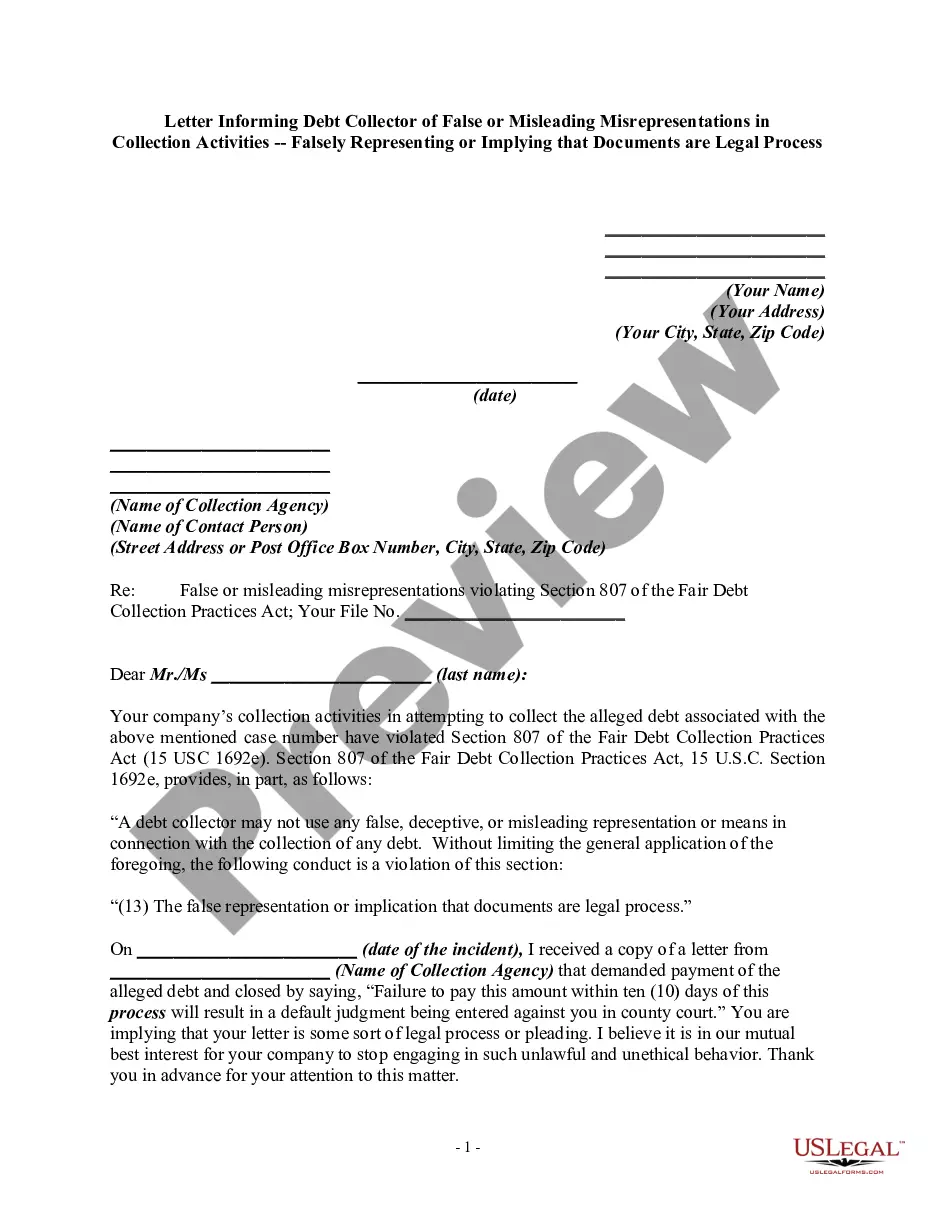
How to fill out Letter Informing Debt Collector Of False Or Misleading Misrepresentations In Collection Activities - Falsely Representing Or Implying That Documents Are Legal Process?
- If you are a returning user, log in to your account and download the desired form by clicking the Download button. Ensure that your subscription remains active.
- For first-time users, begin by exploring the Preview mode and reading the form descriptions. Verify that you've selected the correct document that aligns with your local jurisdiction's requirements.
- If you encounter any issues or need a different form, utilize the Search tab to locate the appropriate template.
- Once you find the correct document, click the Buy Now button and select your preferred subscription plan. Create an account to unlock full access to the library's resources.
- Proceed to payment by entering your credit card information or using your PayPal account to complete your purchase.
- Finally, download your form to your device, allowing easy access for future use, available in the My Forms section of your profile.
Using US Legal Forms empowers you to draft essential legal documents accurately and efficiently.
Get started today and secure your access to a vast collection of legal forms by visiting US Legal Forms!
Form popularity
FAQ
The proper salutation for a U.S. attorney is typically 'Dear Mr./Ms. Last Name' or 'Dear Full Name, Esq.' The 'Esq.' designation indicates their professional status as a lawyer. Ensure to use the appropriate title to convey professionalism in your correspondence. This respects their role and enhances the formal tone of your communication.
You can check if a lawyer is legit in the USA by reviewing their credentials on the state bar association website. This resource will provide essential information, including their licensing status and any disciplinary actions. Additionally, consider reading reviews on legal services websites for a clearer picture of their practice. By taking these steps, you can confidently select an attorney.
Knowing if an attorney is legit involves a few simple steps. First, verify their status through the state bar association's website, which shows if they are licensed and in good standing. Next, look for client reviews or testimonials online for additional insights. Finally, consider setting up a consultation to assess their communication and professionalism.
In the U.S., you usually write a lawyer’s name by including their full name followed by their credentials. For example, you would write 'John Doe, Esq.' to denote that he is an attorney. It is essential to use 'Esq.' only after you confirm the individual is a practicing lawyer. This format showcases respect for their professional status.
In the U.S., attorneys do not typically need to be confirmed in the same way as federal judges. However, all licensed lawyers must pass their state bar exams and adhere to legal professional standards. For attorneys taking on government positions, confirmation may be necessary, but this does not apply to general practice lawyers. Always check state regulations for specific requirements.
To verify a U.S. lawyer, start by checking your state’s bar association website. Most states provide an online directory where you can search for registered lawyers. This directory typically includes essential details such as their status, disciplinary history, and contact information. Additionally, you can request references from the lawyer to further ensure their credibility.
Verifying a US lawyer involves checking their licensure and any disciplinary history. You can typically do this through your state's bar association, which provides resources to confirm if an attorney is licensed to practice law. Online databases may also showcase reviews and additional information about their expertise. Using platforms like USLegalForms can guide you through this process effortlessly.
When addressing a letter to a US attorney, begin with 'Dear Title Last Name' for a formal touch. Ensure to include their full address on the envelope and in the letterhead, including any firm names. If you are unsure of their title or gender, using 'Dear Attorney Last Name' is a safe and respectful choice. Properly addressing your correspondence shows professionalism and clarity.
Lawyers generally prefer to be addressed using their formal titles to signify professionalism. This includes terms such as 'Attorney,' 'Counselor,' or even their academic title if applicable. In informal settings, first names may be acceptable, but it's best to start with a formal address until they indicate otherwise. Respecting their preference helps build a positive rapport with your US lawyer.
You should address a US lawyer as 'Mr.', 'Ms.', or 'Mrs.' followed by their last name, or you may use 'Attorney' followed by their last name. If the US lawyer holds a title such as 'Judge' or 'Doctor,' that title should be used instead. Addressing them correctly shows respect for their professional standing and establishes a courteous tone in your communication.