Fmla Rolling Calendar For Calculate
Description
Get your form ready online
Our built-in tools help you complete, sign, share, and store your documents in one place.
Make edits, fill in missing information, and update formatting in US Legal Forms—just like you would in MS Word.
Download a copy, print it, send it by email, or mail it via USPS—whatever works best for your next step.
Sign and collect signatures with our SignNow integration. Send to multiple recipients, set reminders, and more. Go Premium to unlock E-Sign.
If this form requires notarization, complete it online through a secure video call—no need to meet a notary in person or wait for an appointment.
We protect your documents and personal data by following strict security and privacy standards.
Make edits, fill in missing information, and update formatting in US Legal Forms—just like you would in MS Word.
Download a copy, print it, send it by email, or mail it via USPS—whatever works best for your next step.
Sign and collect signatures with our SignNow integration. Send to multiple recipients, set reminders, and more. Go Premium to unlock E-Sign.
If this form requires notarization, complete it online through a secure video call—no need to meet a notary in person or wait for an appointment.
We protect your documents and personal data by following strict security and privacy standards.
Looking for another form?



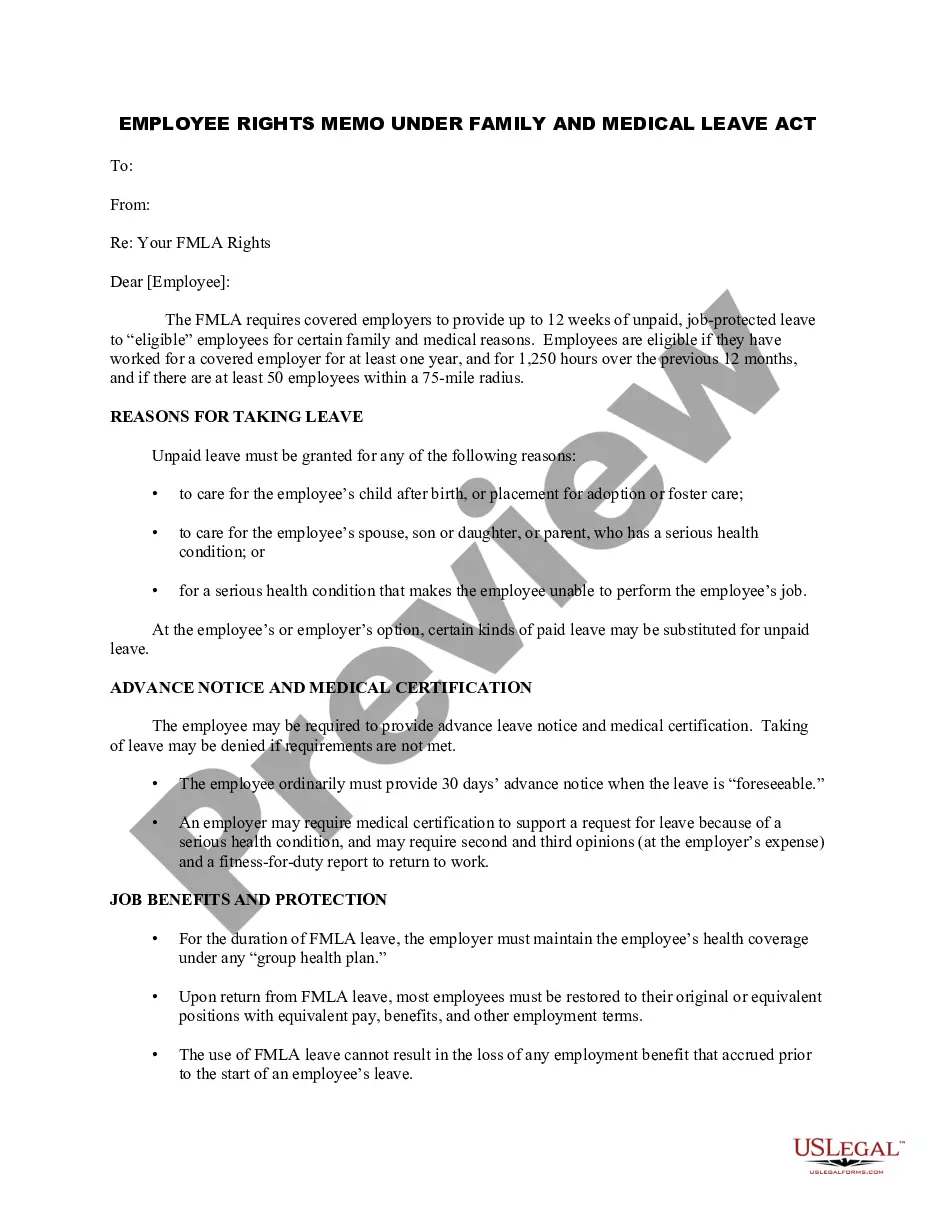
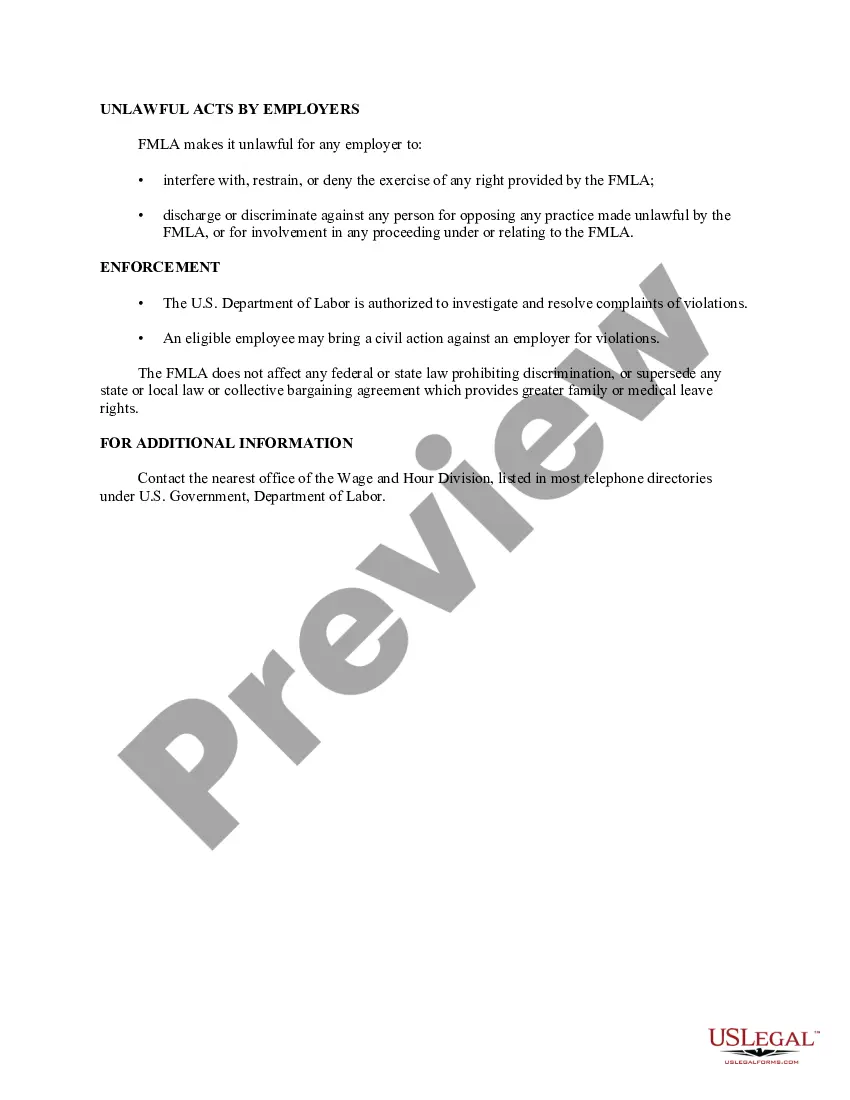
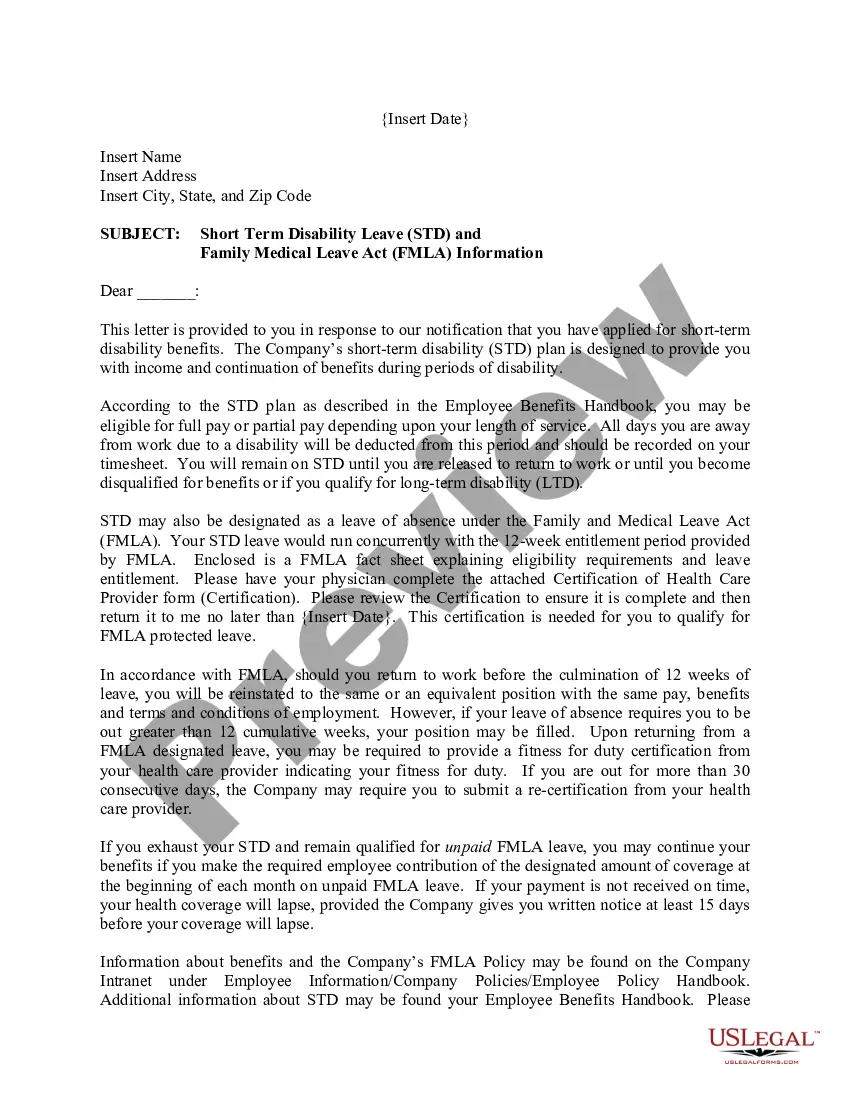
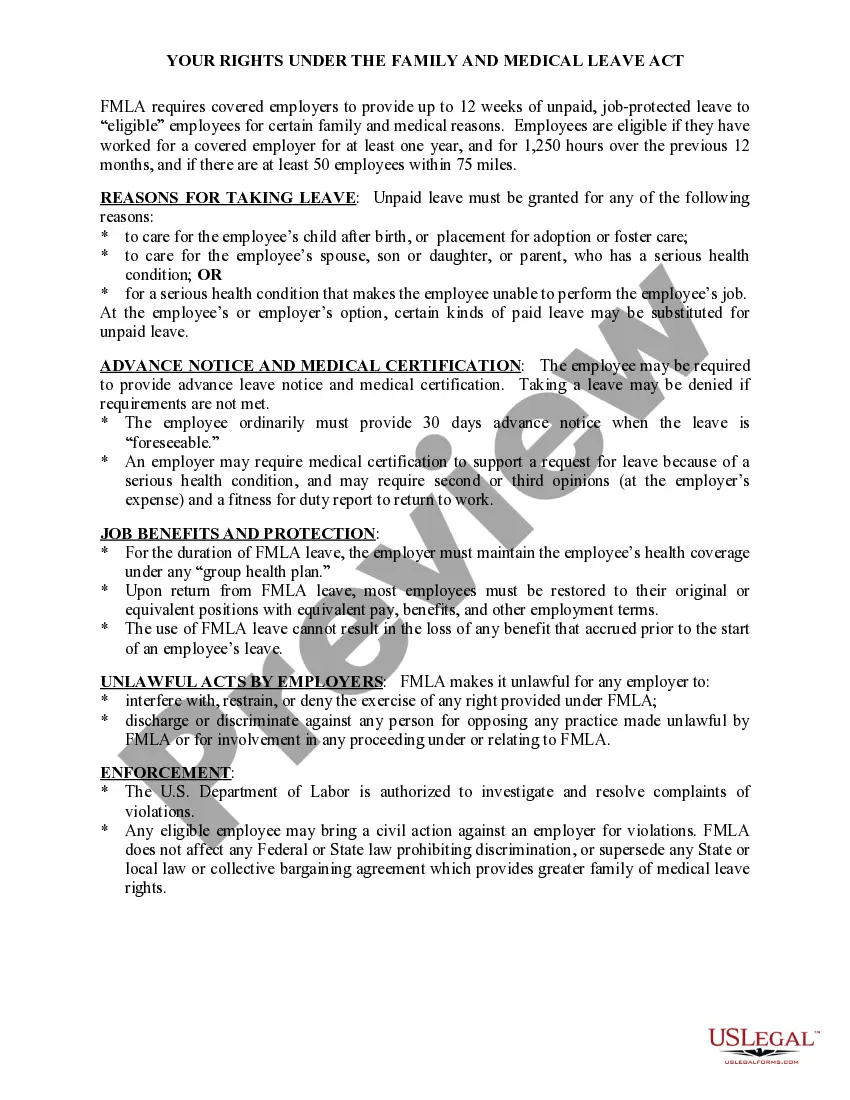
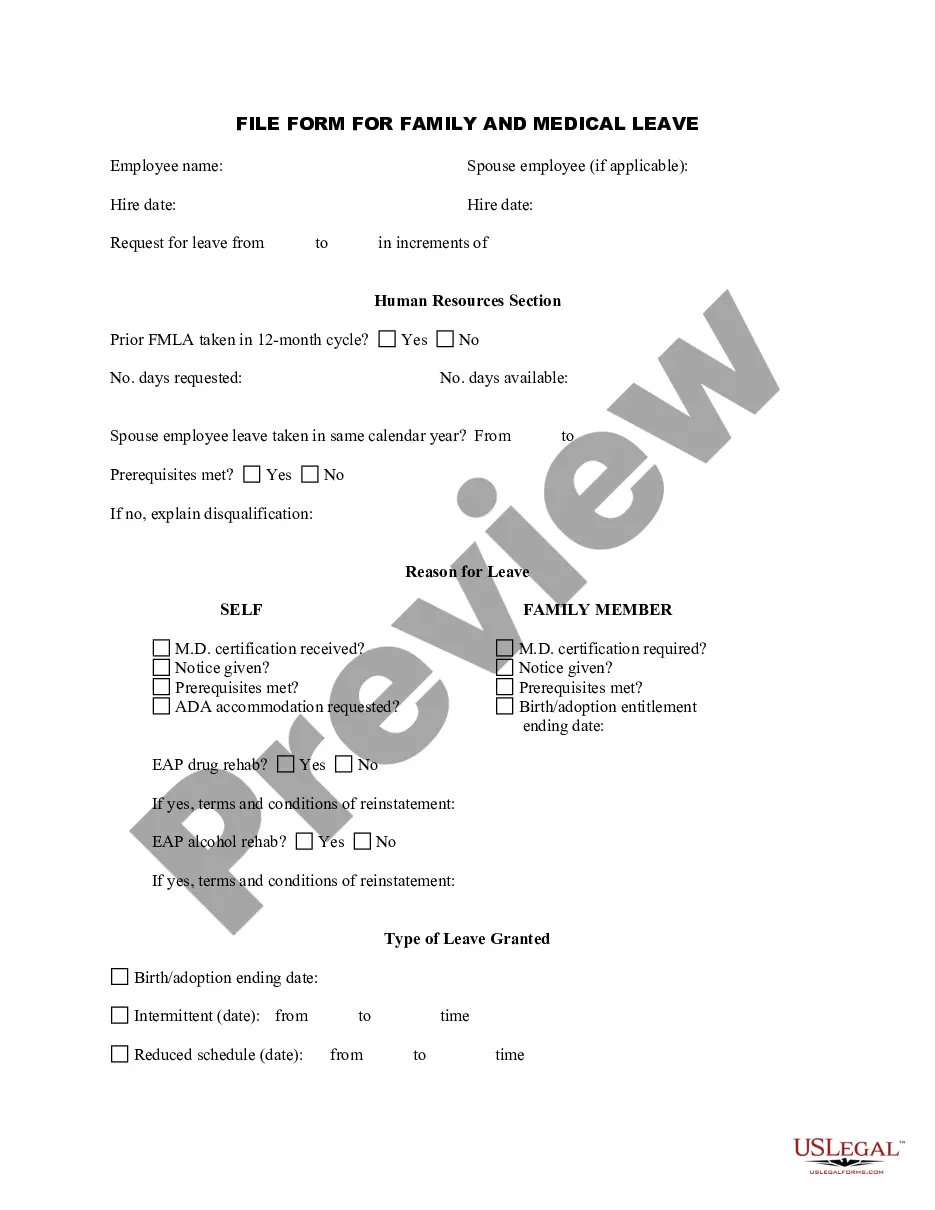
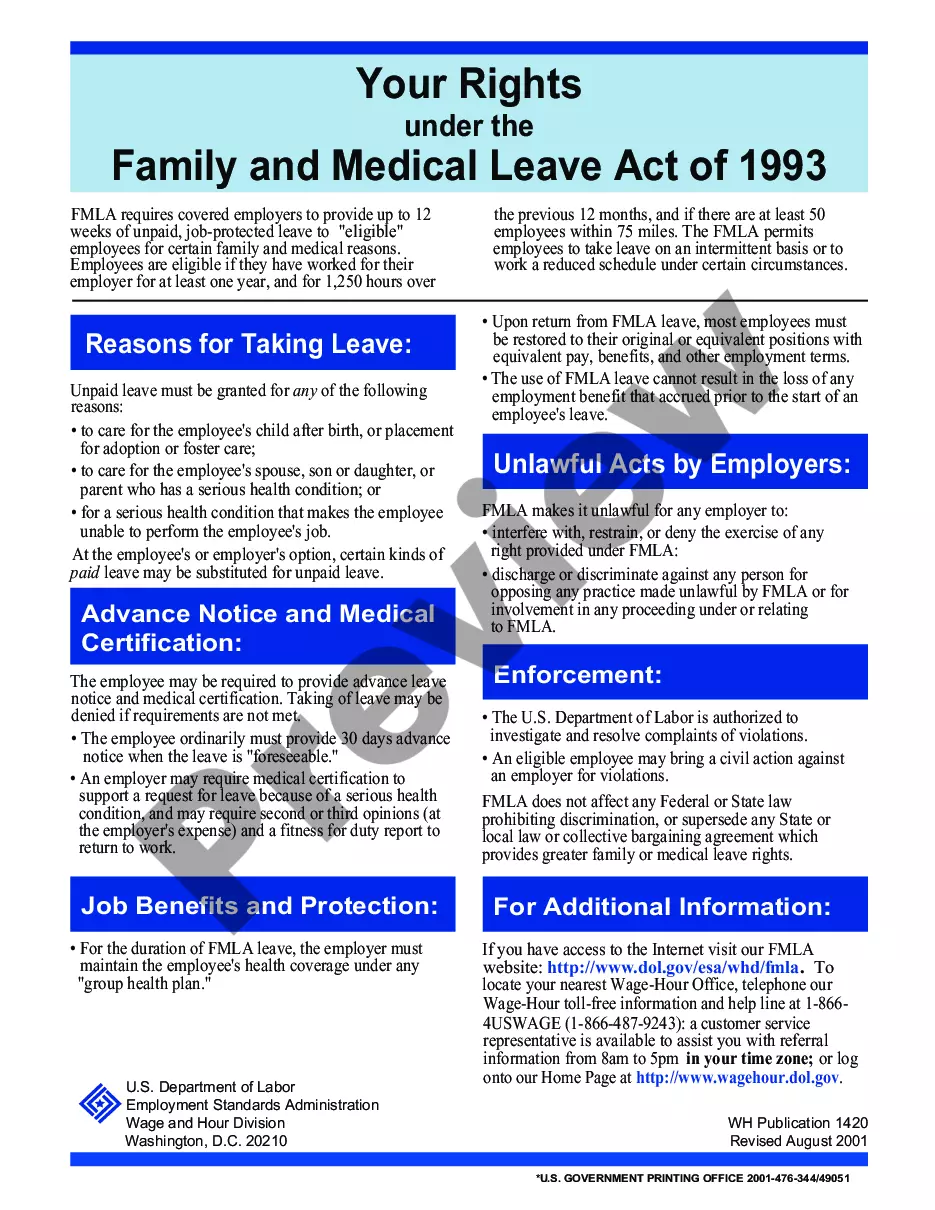
How to fill out Employee Rights Memo Under The Family And Medical Leave Act?
- If you're an existing user, log into your account and download your desired form template by selecting the Download button. Ensure your subscription is active; if it’s not, please renew it per your payment plan.
- For first-time users, start by selecting a template that meets your requirements. Review the Preview mode and form description to verify it complies with your local jurisdiction.
- If needed, utilize the Search tab at the top to find an alternative template. Once you confirm it aligns with your needs, proceed to the next step.
- Purchase the document by clicking the Buy Now button. Select your preferred subscription plan, and you'll need to create an account to access the library's resources.
- Complete your purchase by providing your payment details via credit card or PayPal.
- Finally, download your form and save it on your device. You can also retrieve it anytime from the My Forms section in your profile.
US Legal Forms stands out with a robust collection of over 85,000 fillable and editable legal forms. Users benefit from premium expert assistance for completing forms accurately.
In conclusion, utilizing the FMLA rolling calendar for calculation with US Legal Forms simplifies legal documentation. Start today and empower yourself with the right tools for success!
Form popularity
FAQ
To calculate FMLA on a rolling calendar, start with the first day of your leave and count forward 12 months. During this period, keep track of the total hours you take as FMLA leave, ensuring it does not exceed 12 weeks. Tools and resources, such as those provided by uslegalforms, can help simplify this process, allowing you to manage your leave confidently.
FMLA does not technically roll over each year. Instead, it provides a specific amount of leave—12 weeks—within a designated calculation period. Depending on whether your employer follows the rolling or calendar year method, your available FMLA leave may change each year, making it essential to track using the FMLA rolling calendar for calculate.
Whether your FMLA eligibility resets each calendar year or on a rolling twelve-month basis depends on your employer’s policy. Some employers may choose the calendar year method, which resets every January 1. Others might implement the rolling year calculation for more flexibility in managing leave across different times of the year.
The calendar method for FMLA uses a fixed 12-month period that runs from January 1 to December 31 each year. Under this method, your 12 weeks of leave reset on January 1 of each year. This structured approach differs from the rolling method, ensuring that your entitlements are straightforward and predictable, making it easy to use the FMLA rolling calendar for calculate.
An example of the 12-month period measured forward starts from, say, March 1, 2023, through the end of February 2024. If you take FMLA leave on , you would then look at your leave balance starting from that point forward. This forward-looking calculation helps ensure clarity in your FMLA entitlements using the FMLA rolling calendar for calculate.
To calculate the FMLA rolling year method, you begin with the date of your first FMLA leave. Count forward 12 months from that date to establish your leave period. During this time, you are entitled to a total of 12 weeks of leave. By understanding this FMLA rolling calendar for calculate, you can effectively manage your leave without confusion.
The 12 weeks of FMLA are calculated based on a rolling calendar that begins when you take your first leave. This means that any time you take leave within a 12-month period counts towards the total. Consequently, if you use part of your leave this month, you can only use the remaining time left in the next 12 months. Utilizing a well-structured FMLA rolling calendar for calculate can help you manage your leave effectively, ensuring you understand how much time you have available.
When your 12 weeks of FMLA leave is exhausted, you may not have additional FMLA protections available unless your employer offers additional leave options. However, you can explore other leave policies your company may have in place, such as unpaid leave or short-term disability. It's beneficial to discuss your situation with your HR department. Using an FMLA rolling calendar for calculation can help you manage your leave effectively and prepare for any transition after your leave.
The FMLA start date is determined based on the first day you take leave for a qualified reason. However, it’s essential to notify your employer as soon as possible, preferably 30 days in advance for foreseeable leave. This enables your employer to manage staffing and ensure compliance. To streamline this process, you can utilize an FMLA rolling calendar for calculation, which helps clarify your available leave and any impact on your job.
Twelve weeks of FMLA leave translates to 60 workdays, assuming a standard five-day workweek. However, this can vary depending on your work schedule, including part-time positions. When calculating your leave, it’s vital to refer to your company's policies and use an FMLA rolling calendar for calculation, as this helps you keep track of used and available leave days accurately. Understanding this can prevent miscommunications with your employer.