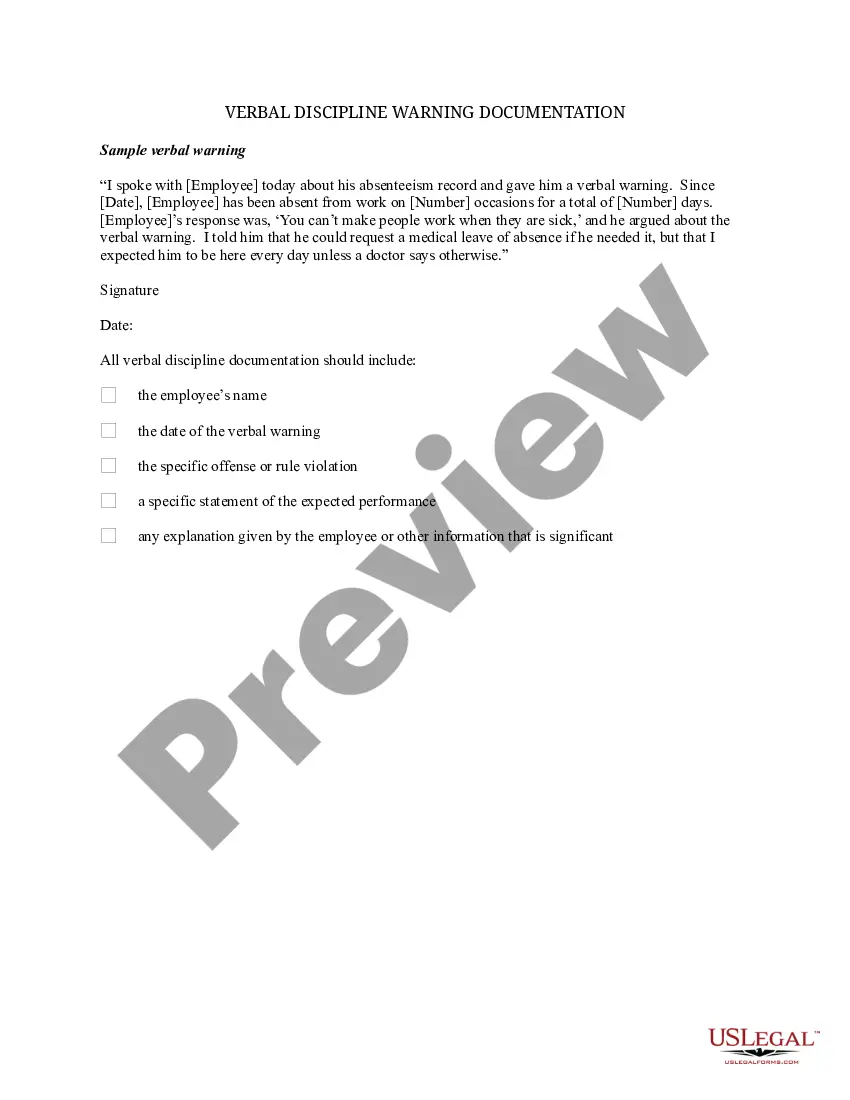
Verbal Warning Documentation Without Disciplinary
Description
Get your form ready online
Our built-in tools help you complete, sign, share, and store your documents in one place.
Make edits, fill in missing information, and update formatting in US Legal Forms—just like you would in MS Word.
Download a copy, print it, send it by email, or mail it via USPS—whatever works best for your next step.
Sign and collect signatures with our SignNow integration. Send to multiple recipients, set reminders, and more. Go Premium to unlock E-Sign.
If this form requires notarization, complete it online through a secure video call—no need to meet a notary in person or wait for an appointment.
We protect your documents and personal data by following strict security and privacy standards.

Make edits, fill in missing information, and update formatting in US Legal Forms—just like you would in MS Word.

Download a copy, print it, send it by email, or mail it via USPS—whatever works best for your next step.

Sign and collect signatures with our SignNow integration. Send to multiple recipients, set reminders, and more. Go Premium to unlock E-Sign.

If this form requires notarization, complete it online through a secure video call—no need to meet a notary in person or wait for an appointment.

We protect your documents and personal data by following strict security and privacy standards.
Looking for another form?



How to fill out Verbal Discipline Warning Documentation Checklist?
Managing legal documents can be overwhelming, even for the most skilled professionals.
When you seek a Verbal Warning Documentation Without Disciplinary and lack the time to invest in finding the accurate and updated version, the processes may be challenging.
Gain access to a resource library of articles, tutorials, manuals, and materials pertinent to your circumstances and requirements.
Save time and effort in searching for the documents you need, and use US Legal Forms’ sophisticated search and Preview feature to locate Verbal Warning Documentation Without Disciplinary and obtain it.
Explore the US Legal Forms online catalog, supported by 25 years of experience and reliability. Transform your daily document management into a seamless and user-friendly process right now.
- Log into your US Legal Forms account if you have a monthly subscription, search for the form, and retrieve it.
- Check your My documents section to see the documents you've previously saved and manage your folders as desired.
- If it's your first time using US Legal Forms, register for a free account and gain unrestricted access to all the benefits of the library.
- Ensure it’s the correct form by previewing it and reading its description.
- Confirm that the template is authorized in your state or county.
- Press Buy Now when you are prepared.
- Access state- or county-specific legal and corporate documents.
- US Legal Forms fulfills any needs you may have, from personal to business documentation, all in one location.
- Leverage advanced tools to complete and manage your Verbal Warning Documentation Without Disciplinary.
Form popularity
FAQ
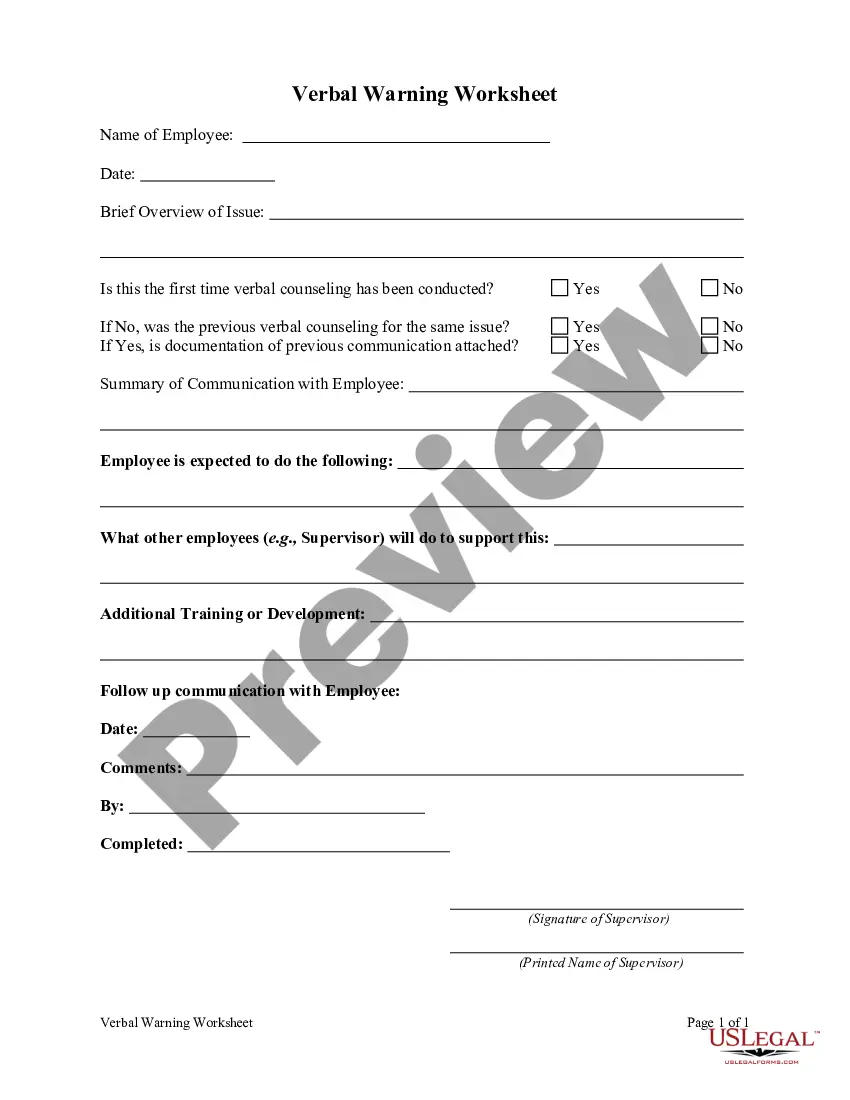
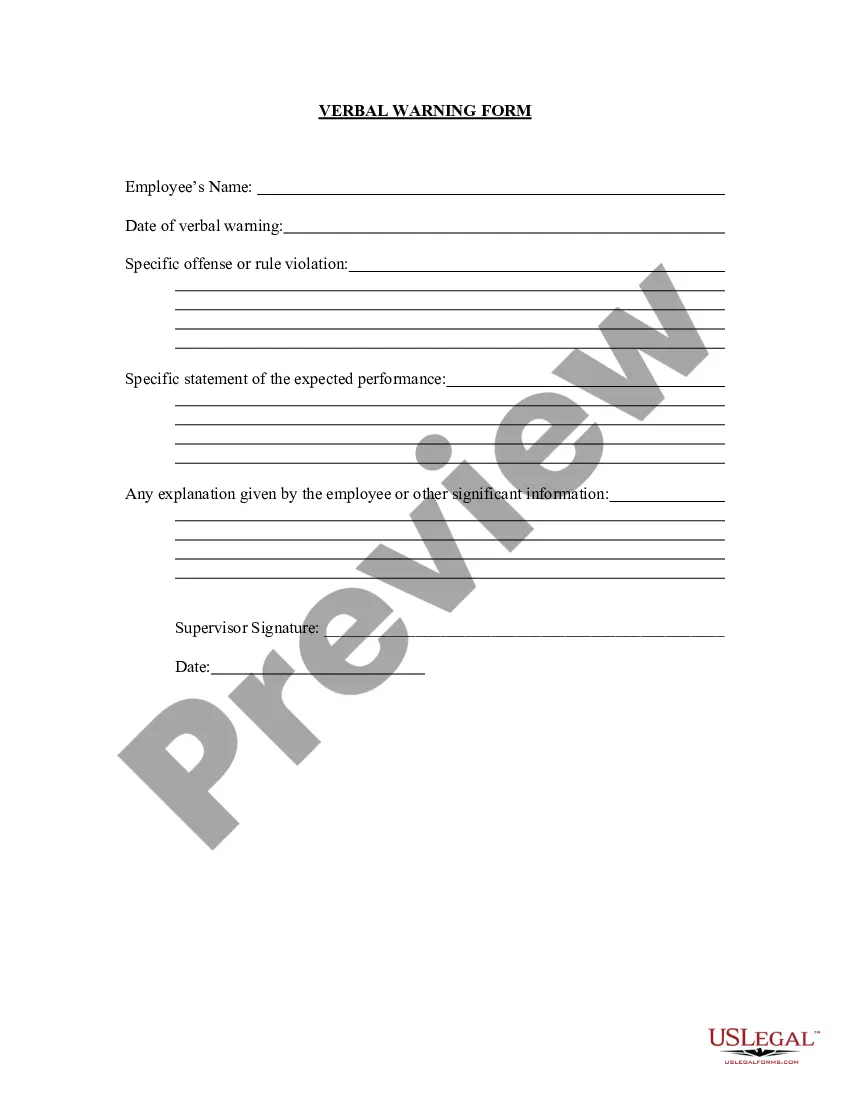
To document a formal verbal warning, start by summarizing the key points discussed during the conversation. Include details like the date, time, and names of those present, along with a description of the specific behaviors or issues addressed. Be sure to mention any expectations set for improvement and timelines for follow-up. Implementing effective verbal warning documentation without disciplinary measures ultimately supports a clear and organized record-keeping process.
Yes, a verbal warning can and should be documented. Proper documentation ensures there is a record of the conversation and the issues discussed. This documentation is vital for future reference and is a key aspect of maintaining clear, accurate verbal warning documentation without disciplinary actions. It reinforces the seriousness of the conversation and helps track progress or patterns over time.
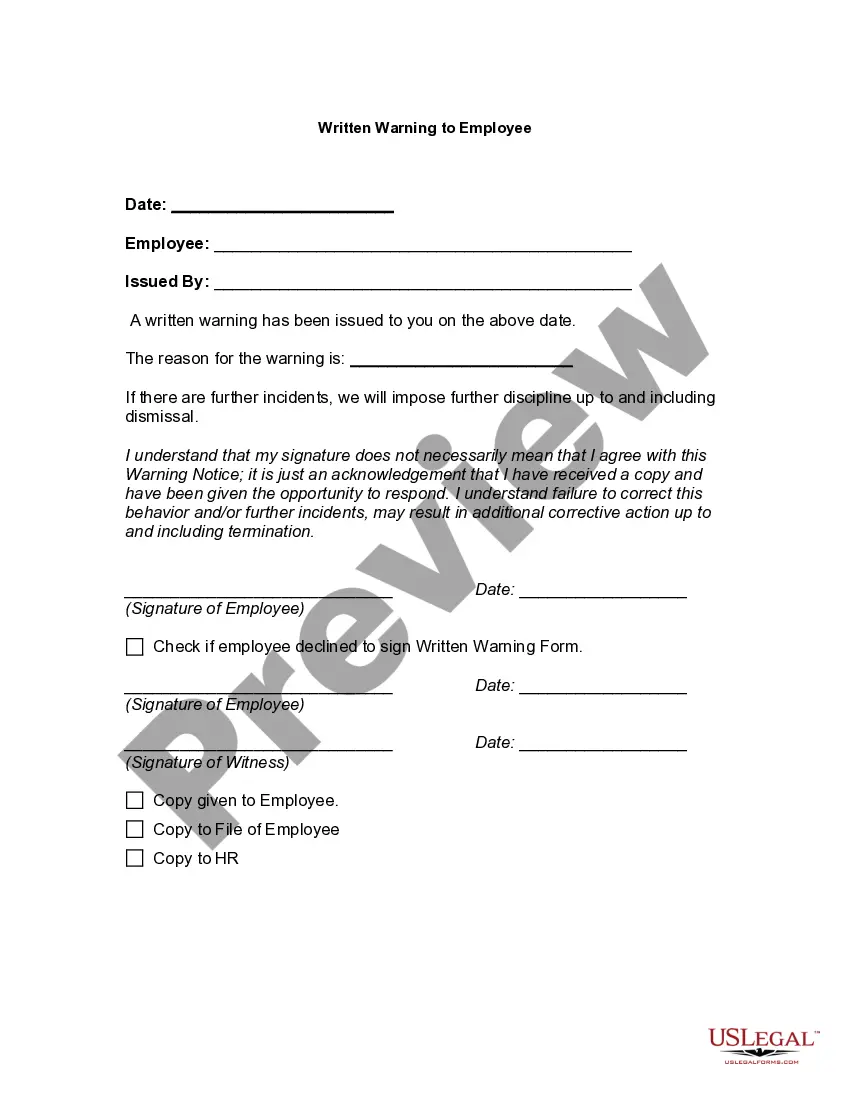
Yes, a verbal warning can be issued without a disciplinary hearing. In many cases, a verbal warning acts as an initial step in addressing issues directly with the employee. This informal approach fosters open communication and enables immediate feedback. However, it's essential to document the warning effectively, supporting your verbal warning documentation without disciplinary processes.
Yes, you can give a verbal warning without subjecting the employee to disciplinary action. Verbal warnings serve as a proactive approach to address concerns before escalating to formal discipline. The focus should be on coaching and improvement rather than punishment, allowing the employee to correct behavior with guidance. This strategy is particularly effective when combined with proper verbal warning documentation without disciplinary measures.
The procedure for a verbal warning typically starts with a one-on-one conversation between the supervisor and the employee. During this discussion, the supervisor highlights the specific behavior or performance issues that need improvement. It is crucial to document this conversation for future reference, especially when it comes to verbal warning documentation without disciplinary actions. The supervisor should follow up with clear expectations and timelines for improvement.
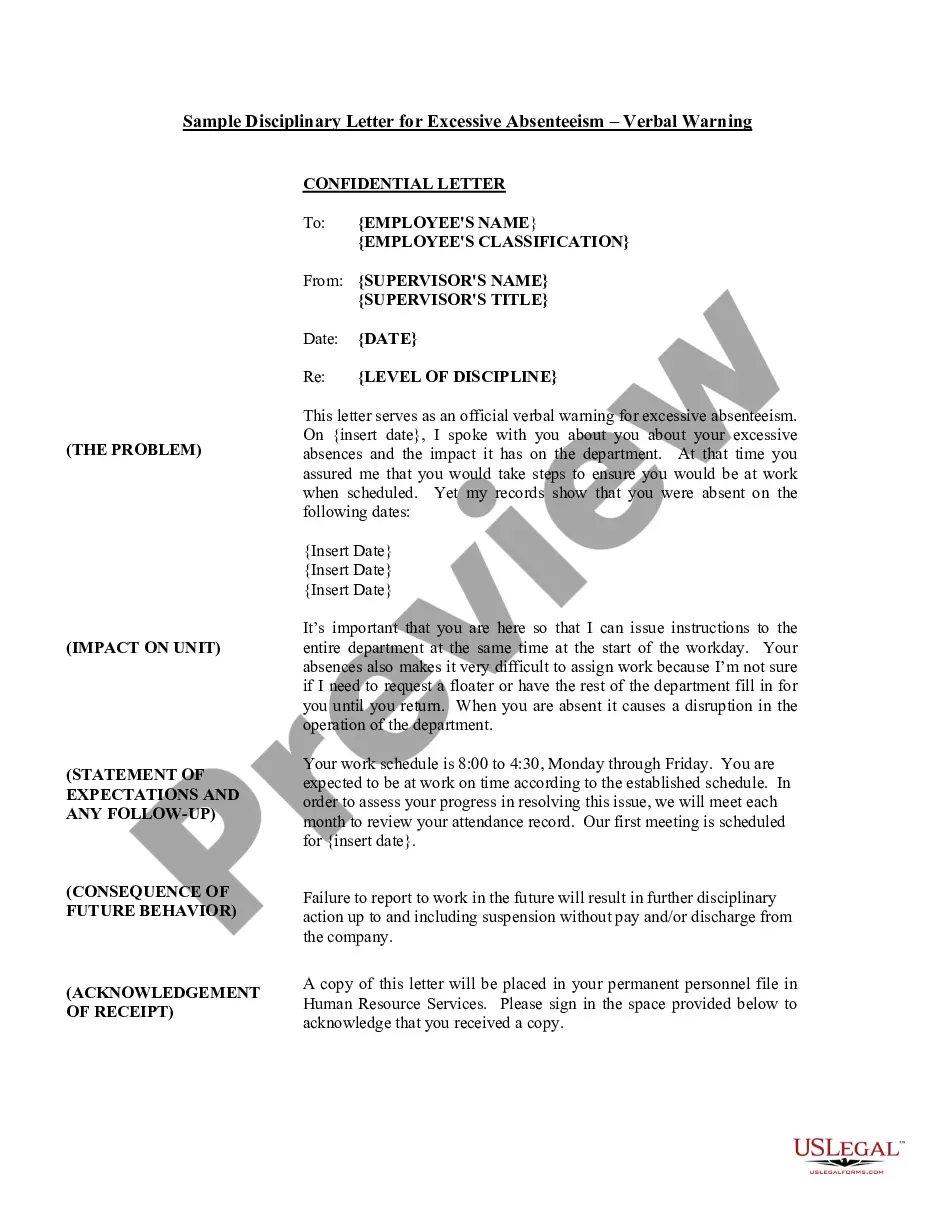
Alternatives to disciplinary action include verbal coaching, performance improvement plans, and constructive feedback sessions. These options help address performance issues without resorting to formal discipline, allowing for better communication and employee engagement. Verbal warning documentation without disciplinary can serve as a record of discussions, which provides clarity for both managers and employees. Utilizing the US Legal Forms platform can simplify this process, offering templates for effective verbal warning documentation that fosters a supportive environment.
Further, even in circumstances where the employer has decided that there is a case to answer, no disciplinary action should be taken against the employee without a hearing, not even to issue a verbal warning.
Verbal warning should follow previous coaching/feedback session with employee. Complete Disciplinary Documentation Form if appropriate. ... Schedule a private meeting with employee. ... Have with you documented facts/examples. Present facts of the situation. Ask the employee for his/her response. Listen.
In order to issue any type of warning, you need to invite the person to a formal meeting, usually badged as a disciplinary hearing. Although there is no legal notification of specific timescales, it is good practice to offer at least a couple of days notice so that the person can prepare their side of the story.