Irs Form Contractor Vs Employee
Description
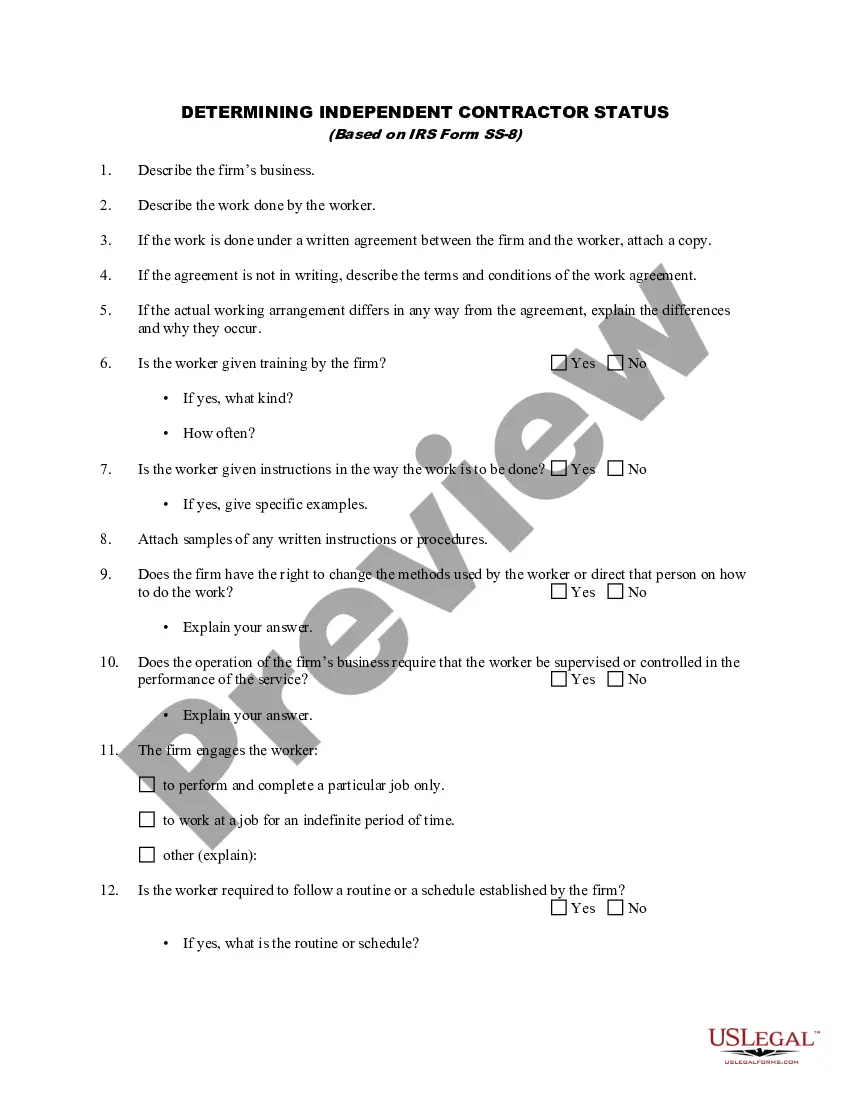
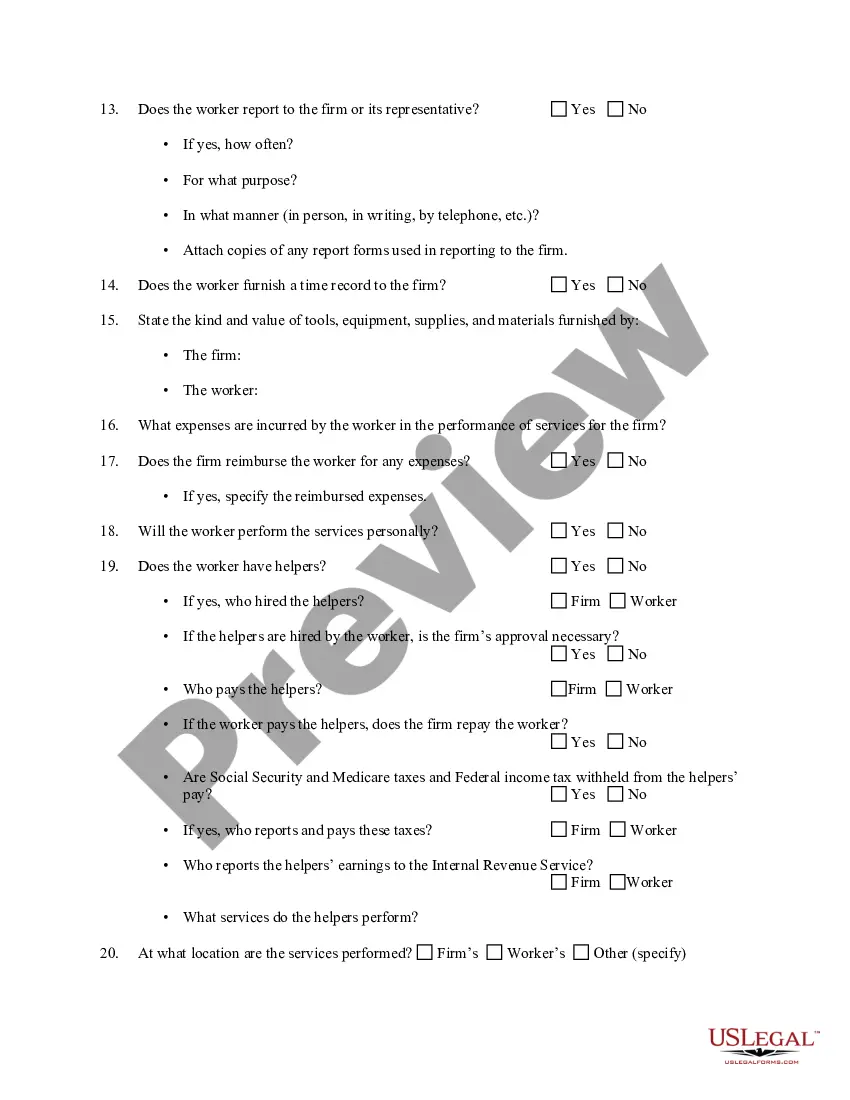
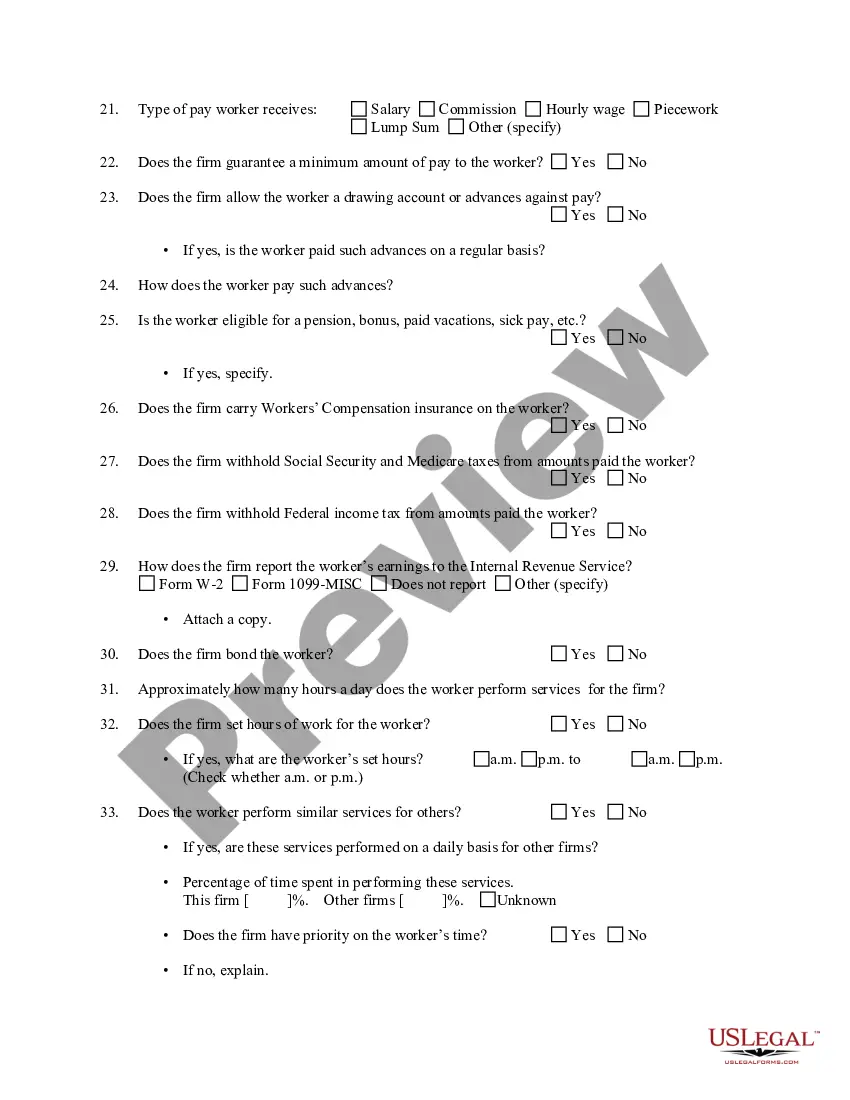
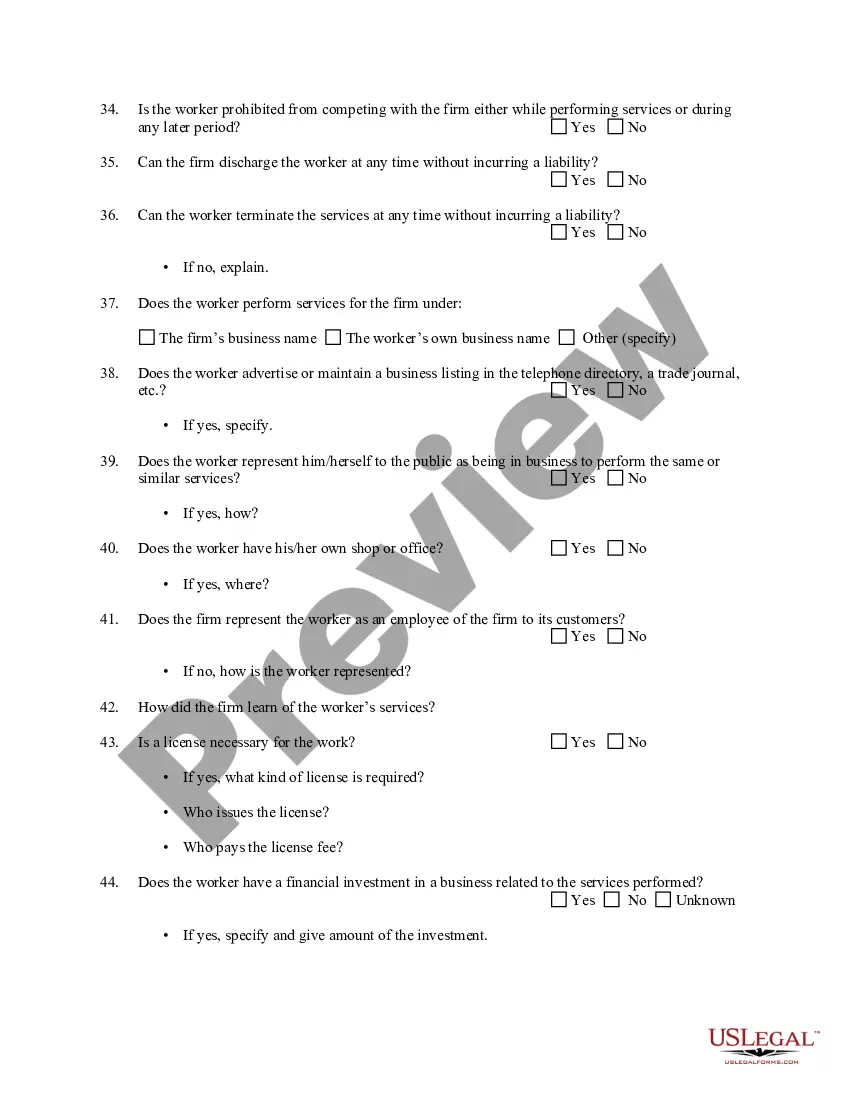
Get your form ready online
Our built-in tools help you complete, sign, share, and store your documents in one place.
Make edits, fill in missing information, and update formatting in US Legal Forms—just like you would in MS Word.
Download a copy, print it, send it by email, or mail it via USPS—whatever works best for your next step.
Sign and collect signatures with our SignNow integration. Send to multiple recipients, set reminders, and more. Go Premium to unlock E-Sign.
If this form requires notarization, complete it online through a secure video call—no need to meet a notary in person or wait for an appointment.
We protect your documents and personal data by following strict security and privacy standards.

Make edits, fill in missing information, and update formatting in US Legal Forms—just like you would in MS Word.

Download a copy, print it, send it by email, or mail it via USPS—whatever works best for your next step.

Sign and collect signatures with our SignNow integration. Send to multiple recipients, set reminders, and more. Go Premium to unlock E-Sign.

If this form requires notarization, complete it online through a secure video call—no need to meet a notary in person or wait for an appointment.

We protect your documents and personal data by following strict security and privacy standards.
Looking for another form?

How to fill out Determining Self-Employed Independent Contractor Status?
Creating legal documents from the ground up can frequently be intimidating.
Certain situations may demand extensive research hours and significant financial investment.
If you’re looking for a simpler and more affordable method of producing Irs Form Contractor Vs Employee or any other documentation without unnecessary obstacles, US Legal Forms is consistently available for you.
Our online library of over 85,000 current legal documents encompasses nearly every facet of your financial, legal, and personal matters.
Review the document preview and descriptions to ensure you have located the document you need. Confirm that the form you choose adheres to the regulations and laws of your respective state and county. Select the most appropriate subscription plan to obtain the Irs Form Contractor Vs Employee. Download the form, then complete, validate, and print it. US Legal Forms boasts an impeccable reputation and more than 25 years of expertise. Become a member now and simplify document completion into a straightforward and efficient process!
- With just a few clicks, you can swiftly obtain state- and county-compliant templates meticulously crafted by our legal experts.
- Utilize our site whenever you require a dependable service through which you can effortlessly discover and download the Irs Form Contractor Vs Employee.
- If you’re already familiar with our website and have previously registered an account with us, simply Log In to your account, find the form and download it or re-download it whenever you like in the My documents section.
- Not yet registered? No problem. Setting it up and browsing the catalog takes just a few minutes.
- However, before diving into downloading Irs Form Contractor Vs Employee, consider these suggestions.
Form popularity
FAQ
To determine whether a person is an employee or an independent contractor, assess the level of control and independence in their work. Consider factors such as how much guidance they receive, their financial investment in their work, and whether they offer services to multiple clients. This evaluation is essential for correctly addressing the IRS form contractor vs employee classification. Utilizing resources like USLegalForms can help clarify these distinctions and ensure compliance.
To provide proof of your employment as an independent contractor, compile relevant contracts, invoices, and payment records. Additionally, you might want to include testimonials or letters from clients that confirm your work. This documentation can help clarify your status during tax season and address the IRS form contractor vs employee distinction. Properly organized records will support your position and simplify your tax filing.
The IRS employs a three-factor test to differentiate between independent contractors and employees. These factors include behavioral control, financial control, and the type of relationship. Analyzing these aspects can provide insight into the nature of the work arrangement, ultimately impacting the IRS form contractor vs employee classification. Understanding this test can guide both employers and contractors.
To prove your status as an independent contractor, gather documentation that outlines your work agreements. This can include contracts, invoices, and proof of your own business operations. Maintaining records of your clients and how you manage your work can also substantiate your claim. Clarity in your documentation helps clarify the IRS form contractor vs employee issue.
The IRS uses various criteria to assess whether a worker qualifies as an independent contractor. They focus on the degree of control and independence in the relationship. Factors include how much control the employer has over the work, the worker's opportunity for profit or loss, and the level of skill required. Understanding these distinctions is crucial for navigating the IRS form contractor vs employee landscape.
Choosing between being a contractor or an employee for tax purposes involves understanding the IRS form contractor vs employee. As a contractor, you may enjoy greater flexibility and the ability to deduct business expenses, but you also face self-employment taxes. On the other hand, employees typically benefit from employer-sponsored tax withholdings and certain benefits. To make an informed decision, consider using resources like US Legal Forms to understand the tax implications and find the right forms for your situation.
An employer fills out a 1099 form to report payments made to an independent contractor. It is the employer's responsibility to ensure that the form is completed accurately and submitted to the IRS. This process is vital in distinguishing the IRS form contractor vs employee classifications.
The employer is responsible for filling out the 1099 form, not the employee. The employer must provide accurate information about the payments made to the contractor. Understanding the IRS form contractor vs employee aspect is essential to ensure proper reporting and compliance.
For workers classified as 1099 employees, the appropriate form to fill out is the 1099-MISC or 1099-NEC, depending on the nature of the payments made. This distinction is important for accurate reporting to the IRS. Utilizing US Legal Forms can help streamline the process and ensure you comply with the IRS form contractor vs employee requirements.
Yes, there is a significant difference between a 1099 employee and a 1099 contractor. A 1099 employee typically works under more supervision and has a structured schedule, while a 1099 contractor operates independently, offering services based on a contract. Understanding this distinction is crucial when navigating the IRS form contractor vs employee guidelines.