Civil W
Description

Get your form ready online
Our built-in tools help you complete, sign, share, and store your documents in one place.
Make edits, fill in missing information, and update formatting in US Legal Forms—just like you would in MS Word.
Download a copy, print it, send it by email, or mail it via USPS—whatever works best for your next step.
Sign and collect signatures with our SignNow integration. Send to multiple recipients, set reminders, and more. Go Premium to unlock E-Sign.
If this form requires notarization, complete it online through a secure video call—no need to meet a notary in person or wait for an appointment.
We protect your documents and personal data by following strict security and privacy standards.

Make edits, fill in missing information, and update formatting in US Legal Forms—just like you would in MS Word.

Download a copy, print it, send it by email, or mail it via USPS—whatever works best for your next step.

Sign and collect signatures with our SignNow integration. Send to multiple recipients, set reminders, and more. Go Premium to unlock E-Sign.

If this form requires notarization, complete it online through a secure video call—no need to meet a notary in person or wait for an appointment.

We protect your documents and personal data by following strict security and privacy standards.
Looking for another form?








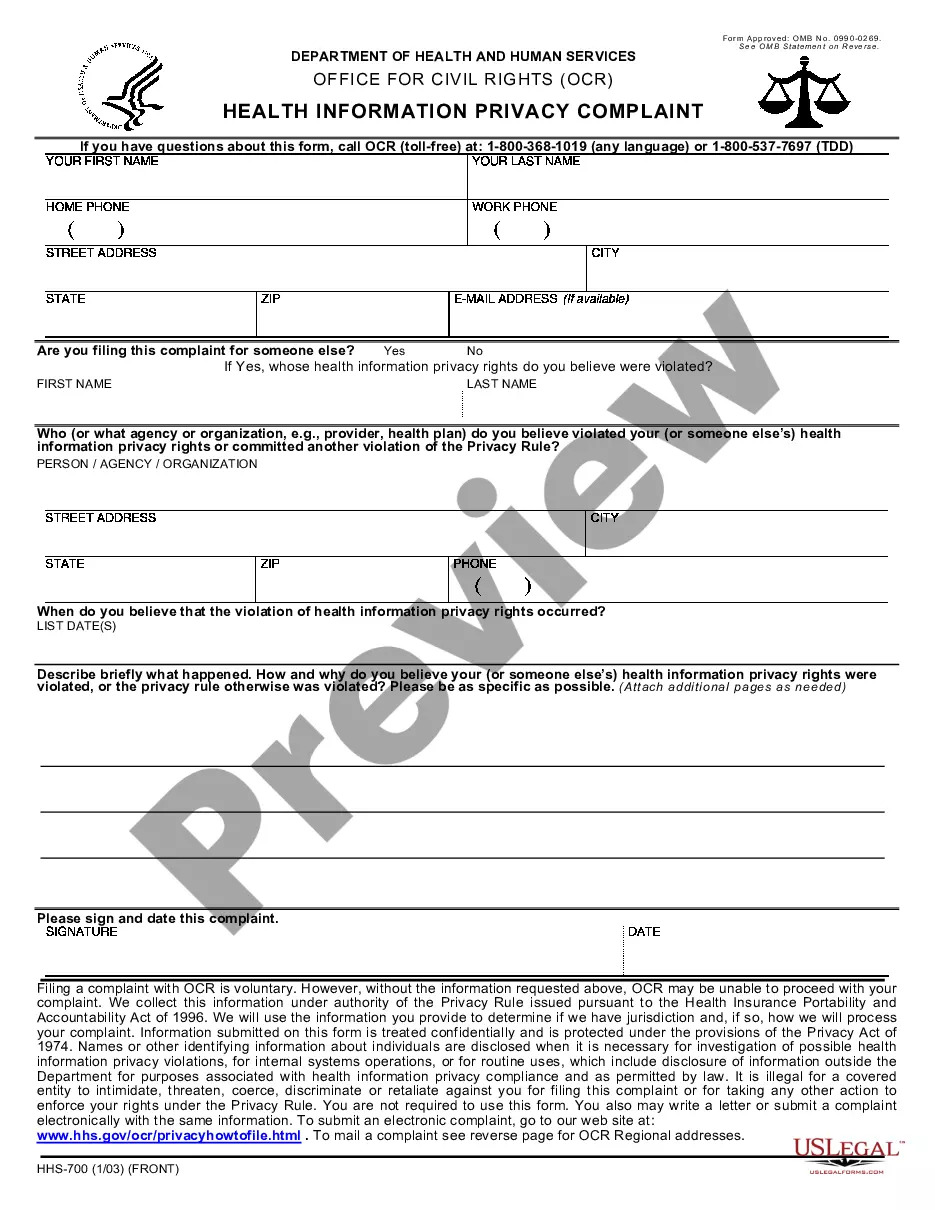
How to fill out Health Information Privacy Complaint For Filing With Dept. Of Health And Human Services Office Of Civil Rights?
- If you’re a returning user, log into your account and click the Download button for the form template you need. Ensure your subscription is active; if not, renew it through your payment plan.
- For first-time users, start by exploring the form descriptions to ensure you select the correct civil w document that meets your local jurisdiction’s needs.
- If you can’t find the right template, use the Search tab to discover more options. Once you find a suitable form, proceed to the next step.
- Purchase your selected document by clicking the Buy Now button and choose your preferred subscription plan, making sure to register an account for full access.
- Complete your purchase by entering your credit card details or using your PayPal account to finalize it.
- Download the form to your device for completion. You can also access it later in the My Forms section of your profile.
By following these straightforward steps, you can easily obtain the legal documents you need for civil w matters. US Legal Forms not only provides a vast selection of forms but also ensures accuracy and legal compliance, thanks to access to premium experts.
Take control of your legal needs today by visiting US Legal Forms and find the perfect civil w documents for your requirements.
Form popularity
FAQ
The term 'civil war' may be used in academic literature, historical analyses, and educational resources discussing internal conflict. While you can find insights and discussions on various platforms, USLegalForms offers valuable resources for understanding civil matters in a broader context. This platform provides legal documents and guides that can assist those navigating complex disputes. Accessing reliable information is crucial for informed decision-making during conflicts.
Defining a civil war involves examining criteria such as the intensity and duration of the conflict, as well as the involvement of organized groups with established leadership. Typically, scholars consider a conflict to be civil when it results in higher casualties and a struggle for political control. By focusing on these factors, communities can better understand their societal dynamics. Recognizing these indicators can help prevent similar situations from arising.
For a situation to escalate into a civil war, specific criteria must be met, such as sustained armed conflict between organized groups and recognition of both sides by the public or government. Additionally, they must have the ability to engage in prolonged military action, not just sporadic skirmishes. These requirements are crucial in distinguishing civil wars from other types of conflicts. Understanding this framework can provide insight into social instability.
A civil war is defined by its conflict occurring within a country, involving groups that challenge the central authority. Unlike international wars, a civil war often reflects deep social or political divides within the population. The fight typically revolves around differing ideologies, which create factions striving for power. Recognizing these elements helps better understand the fractures that can lead to internal conflict.
Civil wars can arise from a variety of factors, including deep-seated political grievances, ethnic tensions, economic disparity, and social injustice. Typically, when a significant portion of the population feels marginalized or oppressed, they may resort to armed conflict to fight for their rights. It’s important to address these underlying issues to prevent the escalation toward a civil war. Understanding these causes can help societies take proactive measures toward peace.
In a civil case, the evidence needed typically includes documents, witness testimonies, photos, and any material that supports your claims. It is crucial to gather all pertinent information that can substantiate your arguments and demonstrate the merits of your case. Proper organization and presentation of evidence can significantly impact the outcome. For assistance, US Legal Forms provides useful templates and guidance to help you prepare your evidence effectively.
Filing a civil lawsuit typically begins with the plaintiff preparing a complaint that outlines their legal claims against the defendant. Next, the plaintiff files the complaint with the appropriate court and serves a copy to the defendant. Following this, the defendant has a chance to respond, leading to a period of discovery where both parties gather evidence. Using platforms like US Legal Forms can simplify this process by providing the necessary templates and guidance for filing your civil lawsuit.
The three main causes of a civil war typically include political power struggles, social injustice, and economic disparities. When groups feel oppressed or marginalized, they often resort to conflict to voice their grievances. Additionally, failure to address these issues can escalate tensions, pushing factions towards war. Utilizing resources like US Legal Forms can provide insights and legal frameworks to help prevent such conflicts through dialogue and compromise.
The Civil War in the United States was a four-year conflict between the North and the South. It stemmed from deep-rooted societal issues, including slavery and economic disparities. Ultimately, the Civil War resulted in significant changes, such as the emancipation of enslaved people and the preservation of the Union. Understanding this historical event is vital for recognizing the ongoing impact of civil rights and unity in our nation.
One of the most well-known examples of a civil war is the American Civil War, which took place from 1861 to 1865. This conflict involved the Northern states fighting against the Southern states primarily over issues such as slavery and states' rights. The consequences of this civil war significantly shaped the future of the United States, leading to the abolition of slavery and strengthening federal authority. Studying such examples helps us appreciate the importance of conflict resolution.