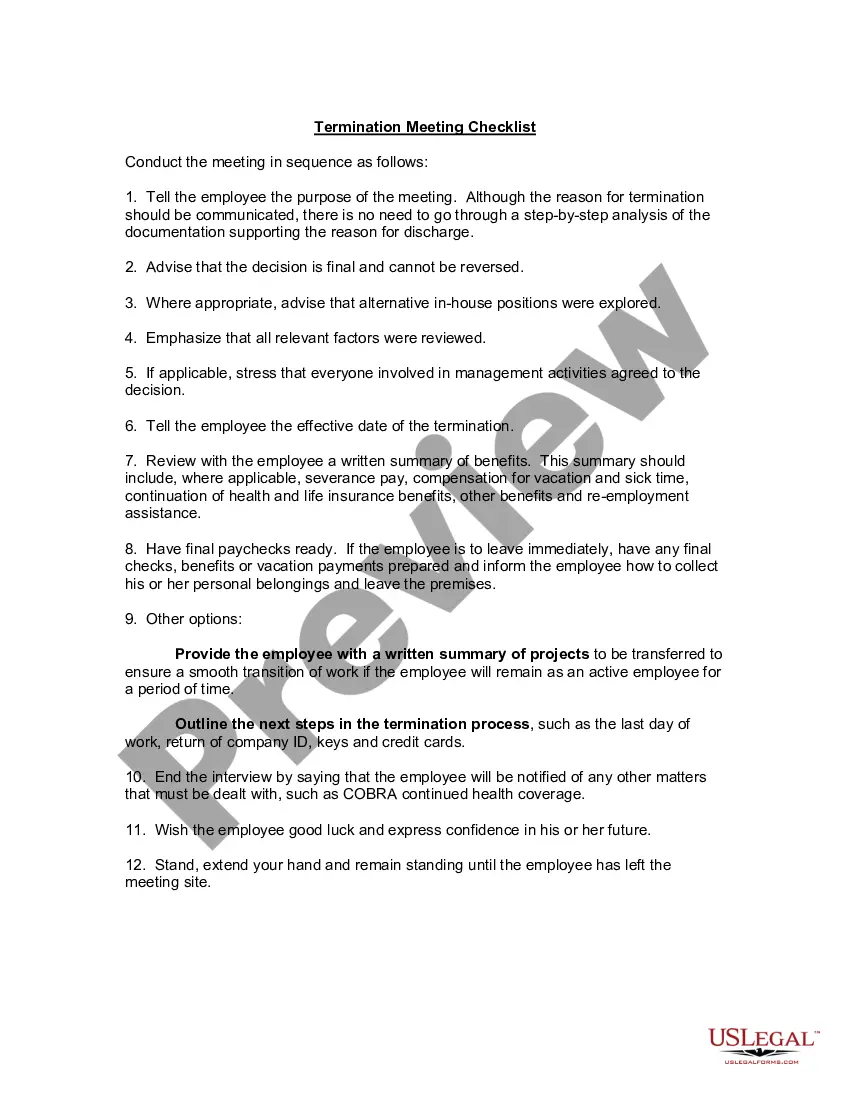
Termination Final Pay For Deceased Employee
Description
Get your form ready online
Our built-in tools help you complete, sign, share, and store your documents in one place.
Make edits, fill in missing information, and update formatting in US Legal Forms—just like you would in MS Word.
Download a copy, print it, send it by email, or mail it via USPS—whatever works best for your next step.
Sign and collect signatures with our SignNow integration. Send to multiple recipients, set reminders, and more. Go Premium to unlock E-Sign.
If this form requires notarization, complete it online through a secure video call—no need to meet a notary in person or wait for an appointment.
We protect your documents and personal data by following strict security and privacy standards.

Make edits, fill in missing information, and update formatting in US Legal Forms—just like you would in MS Word.

Download a copy, print it, send it by email, or mail it via USPS—whatever works best for your next step.

Sign and collect signatures with our SignNow integration. Send to multiple recipients, set reminders, and more. Go Premium to unlock E-Sign.

If this form requires notarization, complete it online through a secure video call—no need to meet a notary in person or wait for an appointment.

We protect your documents and personal data by following strict security and privacy standards.
Looking for another form?









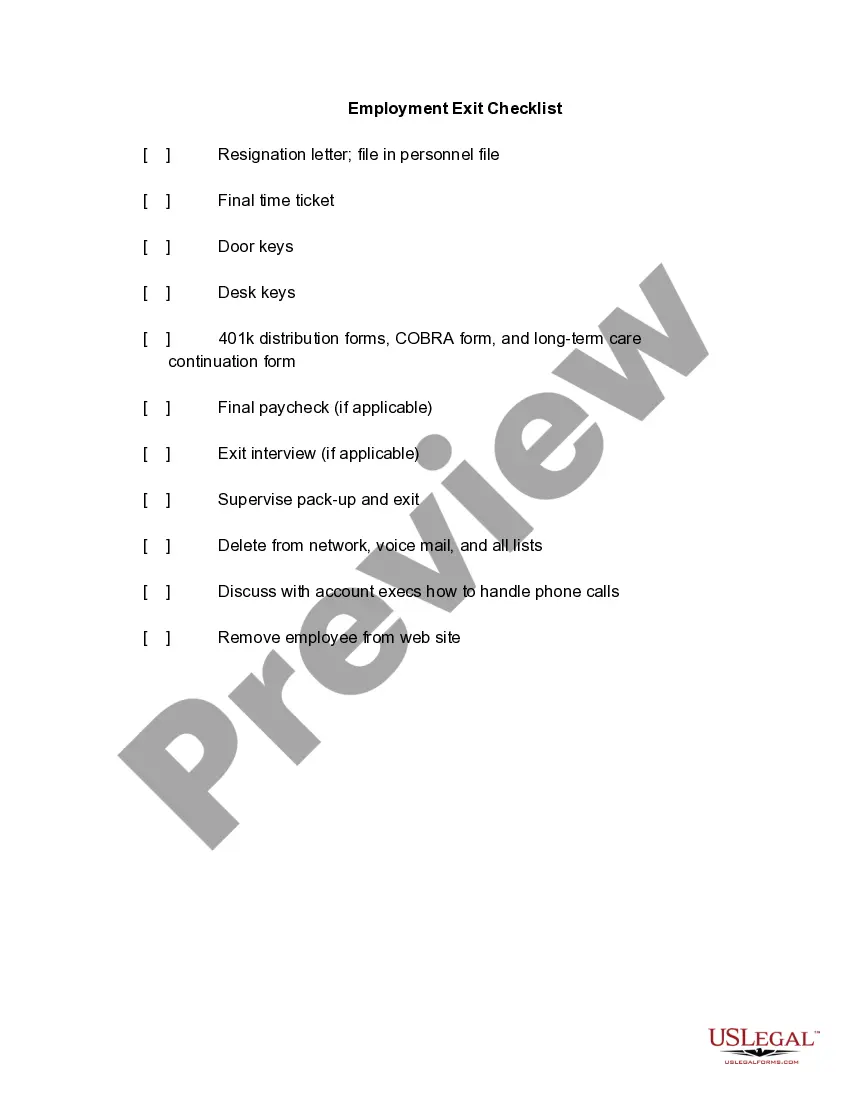
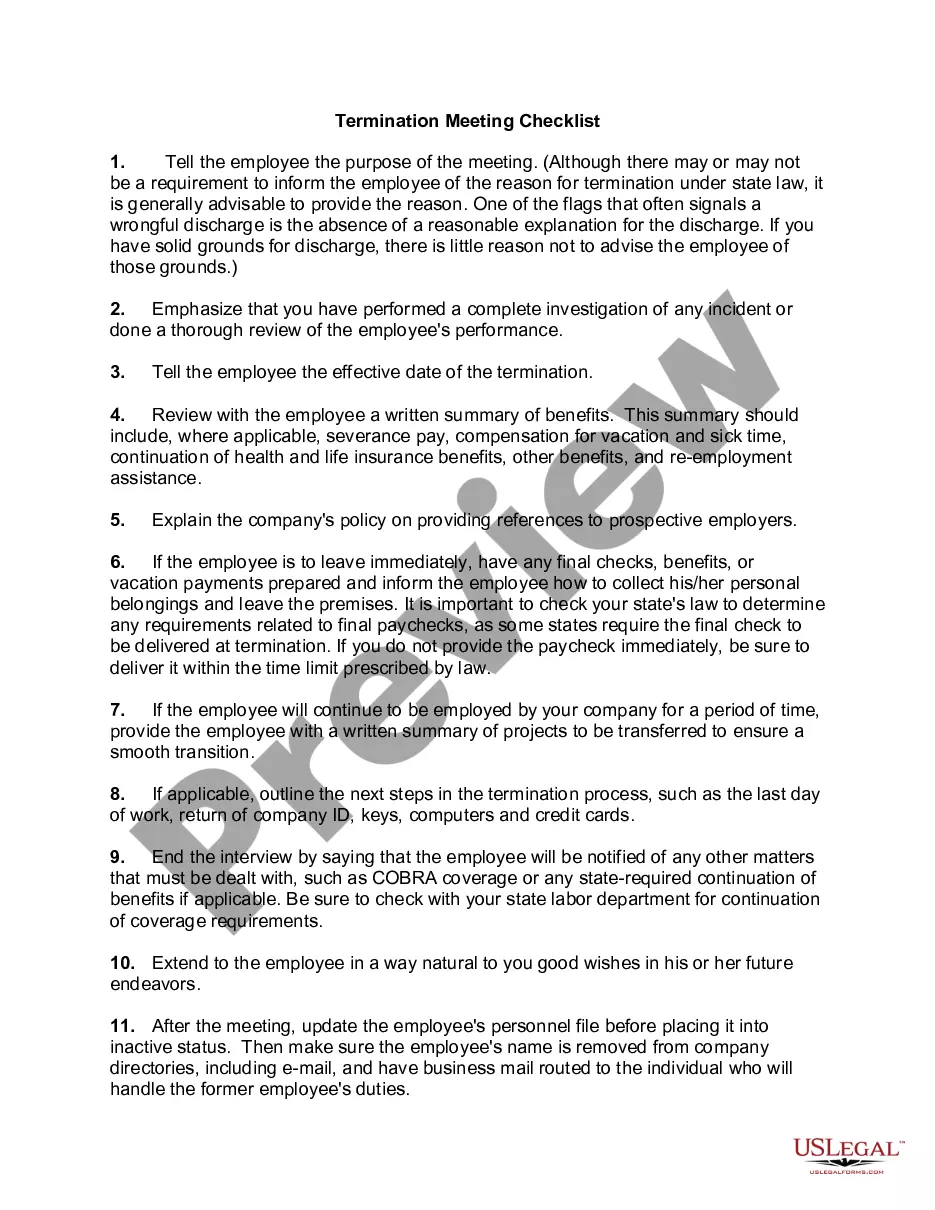
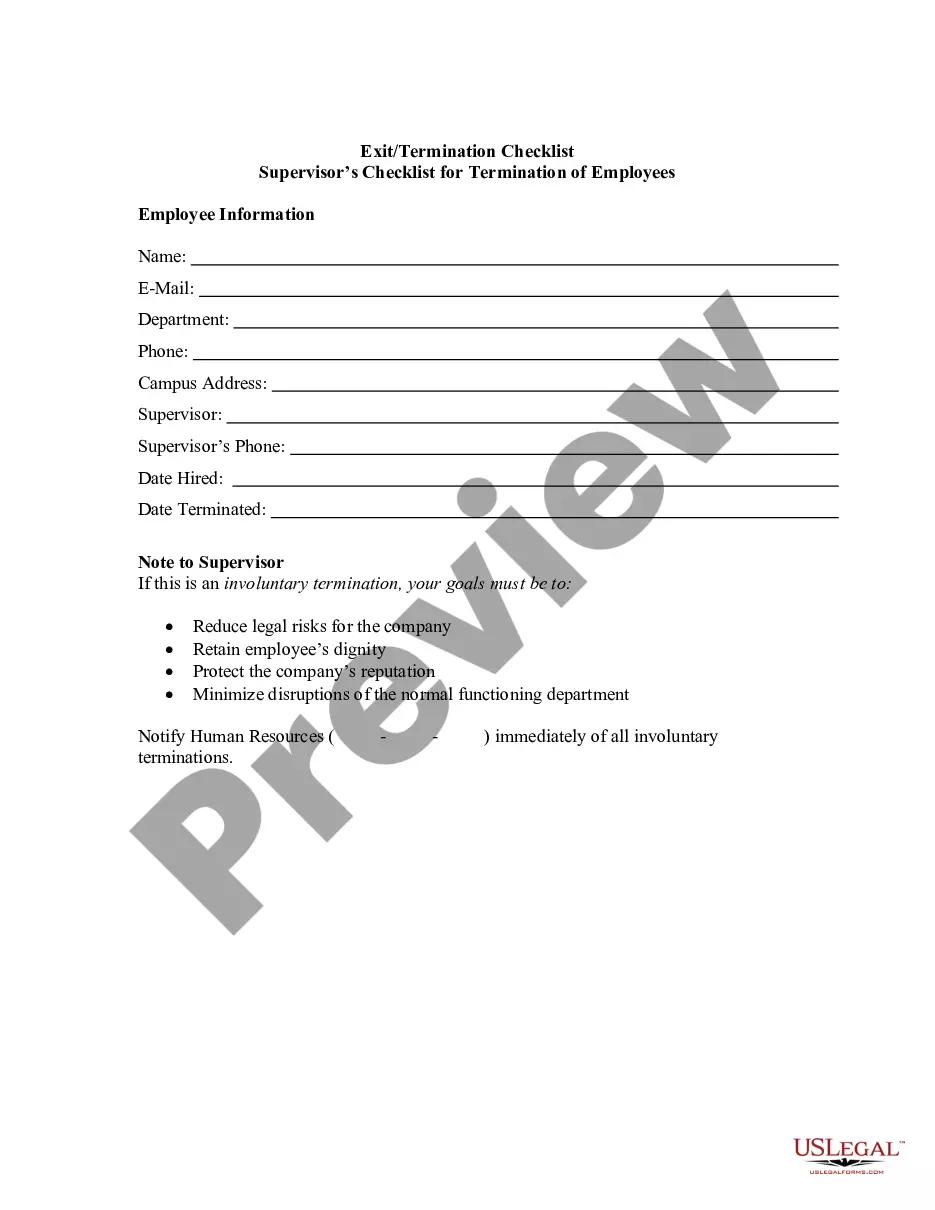
How to fill out Termination Meeting Checklist?
Legal administration can be daunting, even for the most proficient experts.
When you need a Termination Final Pay For Deceased Employee and lack the time to search for the correct and updated version, the process can be overwhelming.
Utilize sophisticated tools to complete and manage your Termination Final Pay For Deceased Employee.
Access a library of articles, guides, handbooks, and resources relevant to your situation and needs.
Ensure the form is accurate by previewing it and reviewing its details.
- Save time and energy in locating the documents you require, and use US Legal Forms’ advanced search and Preview feature to find Termination Final Pay For Deceased Employee.
- If you possess a subscription, Log In to your US Legal Forms account, search for the form, and obtain it.
- Check the My documents tab to review the documents you have previously downloaded and to organize your folders as needed.
- If it is your initial interaction with US Legal Forms, establish a free account and gain unlimited access to all platform benefits.
- Here are the steps to follow after accessing the form you desire.
- A comprehensive online form repository could be transformative for anyone looking to handle these situations effectively.
- With US Legal Forms, you can access a vast array of state- or county-specific legal and business forms.
- US Legal Forms accommodates any requirements you may have, from personal to business documentation, all consolidated in one location.
Form popularity
FAQ
When an employee passes away, it is essential to follow a clear protocol to ensure compliance and respect for the deceased. First, notify the HR department to initiate the process for handling matters related to the employee's termination. Next, address the termination final pay for the deceased employee, which includes any owed wages, unused vacation time, and other benefits. Utilizing platforms like US Legal Forms can help create the necessary documentation and ensure that all legal requirements are met during this difficult time.
When an employer dies, the business operations may transition to a designated executor or an heir according to their will or estate plan. The responsibilities for payroll, including the final paycheck for deceased employees, often fall on the executor or surviving partners. It is important for all parties involved to understand the implications of termination final pay for deceased employees to ensure timely and compliant payments. Utilizing resources like USLegalForms can provide clarity in these complex situations.
In Texas, the final paycheck for a deceased employee is usually provided to the beneficiary or the estate of the employee. If the employee has not designated a beneficiary, the funds may be payable to their heirs according to state inheritance laws. It is vital for employers to understand their obligations related to termination final pay for deceased employees to avoid legal issues. For more detailed information, consider leveraging tools such as USLegalForms to navigate these cases effectively.
In California, the final paycheck for a deceased employee typically goes to the deceased's spouse or registered domestic partner. If there is no spouse or partner, the pay may go to the children or other dependents. Employers should ensure that they follow the state laws regarding the distribution of these funds, especially when dealing with termination final pay for a deceased employee. For clarity and assistance, you can use platforms like USLegalForms for guidance on legal procedures.
No, an eviction notice does not have to be notarized to be legally binding. While the laws may vary slightly from state to state, an eviction notice only requires the signature of the landlord or landlord's agent.
To appeal the case, the tenant must file the paperwork and pay money to the court within those 10 days. The money a tenant has to pay to the court includes an appeal fee and everything the judge decided the tenant owes the landlord.
If a tenant is behind on rent or has violated certain provisions of the rental agreement, a landlord may go directly to court and file an action to evict him or her without giving prior written notice. Notably, a landlord cannot forcibly evict a tenant without first going to court.
§37-6-30. Landlord to deliver premises; duty to maintain premises in fit and habitable condition.
If you do not have all the money that's owed, you may be able to prevent the eviction by getting a written commitment from a local government or nonprofit agency to pay the rent due, plus late charges, attorney fees, and court costs within 10 days of the first date set to appear in court (called the ?return date?).
To appeal the case, the tenant must file the paperwork and pay money to the court within those 10 days. The money a tenant has to pay to the court includes an appeal fee and everything the judge decided the tenant owes the landlord.