Workers Compensation Injury In Parking Lot
Description
Get your form ready online
Our built-in tools help you complete, sign, share, and store your documents in one place.
Make edits, fill in missing information, and update formatting in US Legal Forms—just like you would in MS Word.
Download a copy, print it, send it by email, or mail it via USPS—whatever works best for your next step.
Sign and collect signatures with our SignNow integration. Send to multiple recipients, set reminders, and more. Go Premium to unlock E-Sign.
If this form requires notarization, complete it online through a secure video call—no need to meet a notary in person or wait for an appointment.
We protect your documents and personal data by following strict security and privacy standards.

Make edits, fill in missing information, and update formatting in US Legal Forms—just like you would in MS Word.

Download a copy, print it, send it by email, or mail it via USPS—whatever works best for your next step.

Sign and collect signatures with our SignNow integration. Send to multiple recipients, set reminders, and more. Go Premium to unlock E-Sign.

If this form requires notarization, complete it online through a secure video call—no need to meet a notary in person or wait for an appointment.

We protect your documents and personal data by following strict security and privacy standards.
Looking for another form?








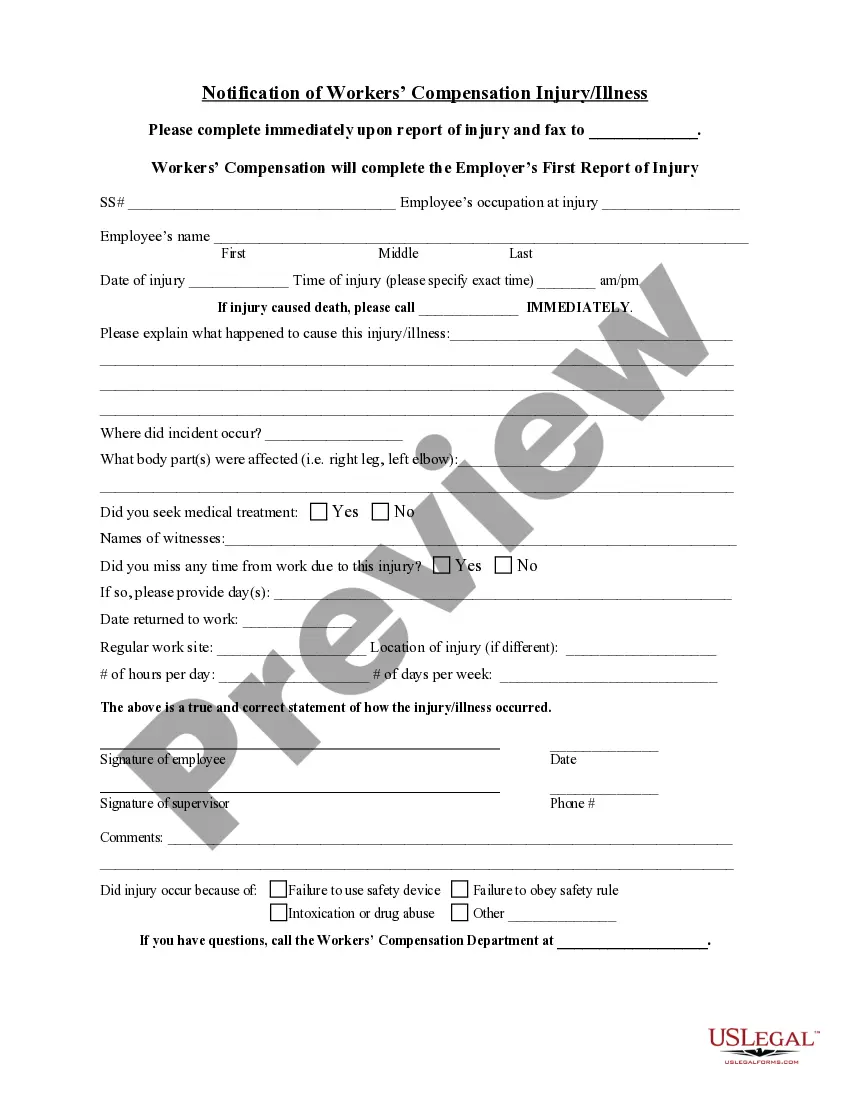
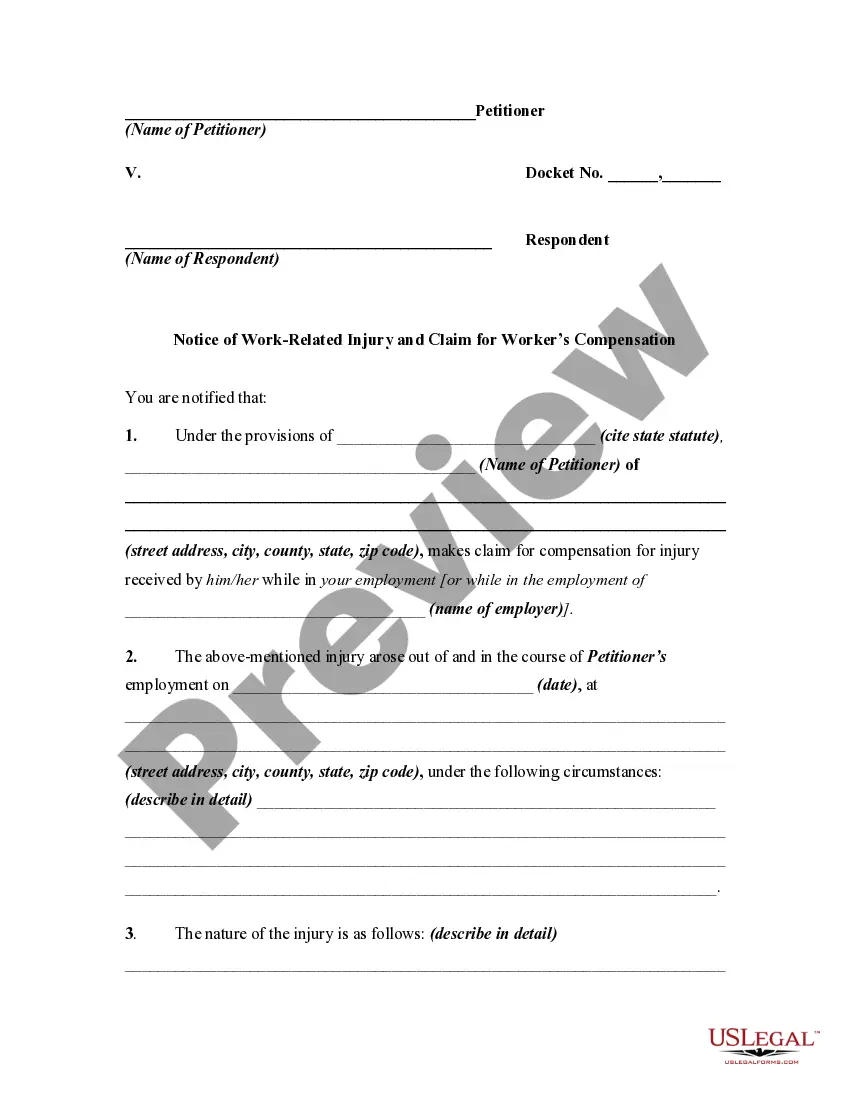
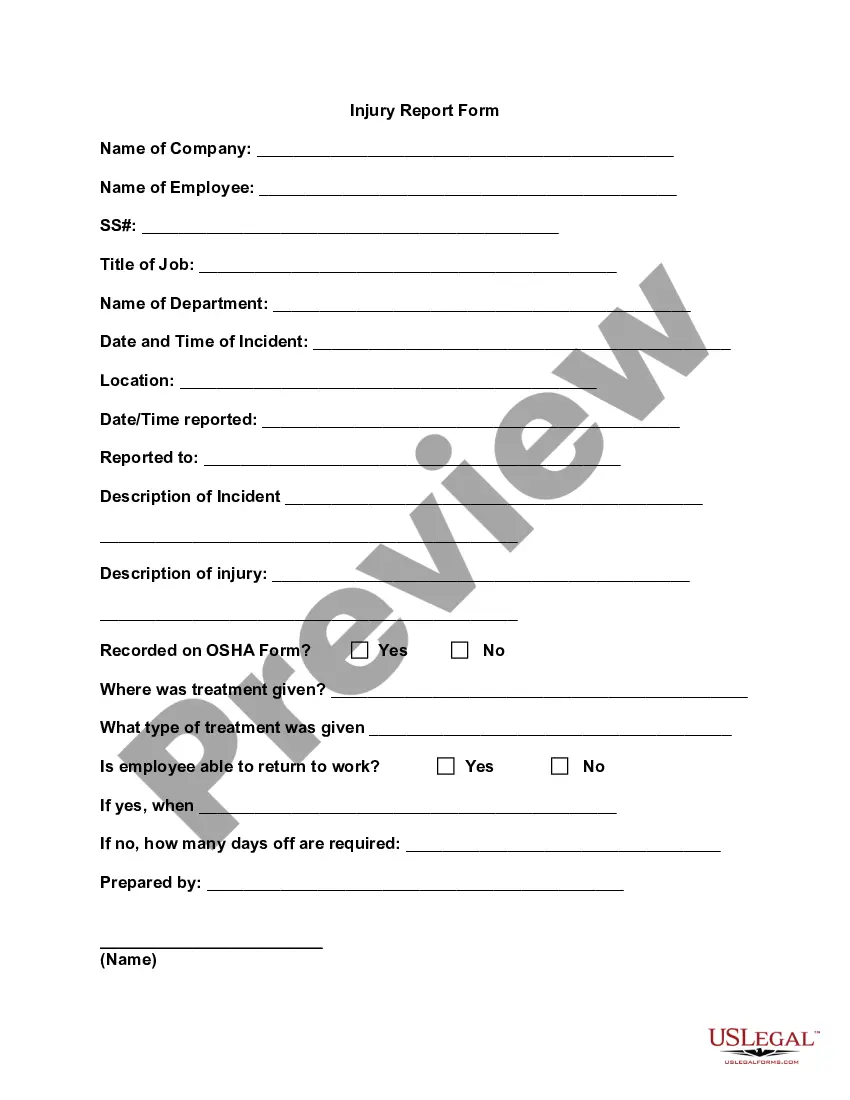
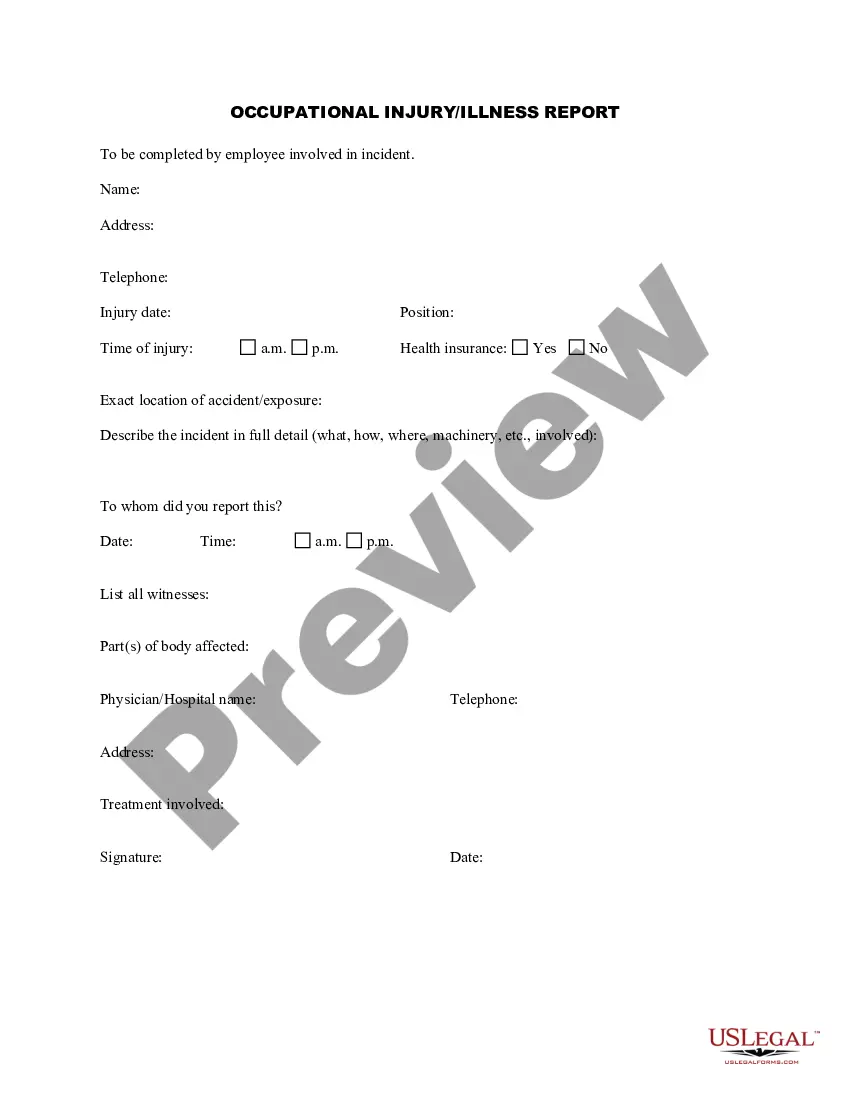
How to fill out Notification Of Workers' Compensation Injury - Illness?
Whether for commercial reasons or for personal matters, everyone must deal with legal issues eventually in their lives.
Completing legal paperwork necessitates meticulous attention, starting from choosing the appropriate form template.
With an extensive US Legal Forms catalog available, you do not need to waste time searching for the appropriate template online. Utilize the library’s simple navigation to locate the suitable form for any event.
- Acquire the form you require by utilizing the search box or catalog browsing.
- Review the form’s details to ensure it aligns with your circumstances, state, and county.
- Select the form's preview to view it.
- If it is not the correct form, return to the search tool to find the Workers Compensation Injury In Parking Lot example you need.
- Download the template if it fulfills your criteria.
- If you possess a US Legal Forms account, click Log in to access previously stored documents in My documents.
- If you do not have an account yet, you can acquire the form by clicking Buy now.
- Select the appropriate pricing option.
- Fill out the profile registration form.
- Choose your payment method: you can use a credit card or PayPal account.
- Select the file format you desire and download the Workers Compensation Injury In Parking Lot.
- After it is downloaded, you can complete the form with the aid of editing software or print it and finish it manually.
Form popularity
FAQ
In the case of an accident in a company vehicle, your employer typically holds responsibility if the driver was performing work duties. Workers compensation injury in parking lot claims may apply if injuries happen during this incident. However, it's crucial to report the accident to your employer and insurance company promptly. Utilizing USLegalForms can streamline your reporting process and ensure you have the correct documentation.
Under the ?coming and going? rule, generally, if an employee is injured while commuting to and from a fixed site of employment at the beginning or end of his or her shift, this would not be a workers' compensation injury. The ?coming and going? rule ends once the employee reaches the employer's premises.
Under any of these circumstances, the employee is probably entitled to file a Workers' Comp claim for the accident. However, employees who fall under the ?coming and going? rule?those who are traveling on a public road, going to or coming home from work?may find an accident falls outside the course of their employment.
There is a work-related rule in New York called the "coming and going" rule. It says that a worker is not considered to be acting in the course of employment while commuting to and from work, under the New York Workers' Compensation Law.
An injury or illness is work-related if an event or exposure in the work environment either caused or contributed to the resulting condition or significantly aggravated a pre-existing injury or illness. The company parking lot is part of the work-environment.
The ?Going and Coming? rule essentially states that the employer is not liable for injuries which occur during an employee's regular/routine commute. (Hartline v. Kaiser Foundation Hospitals (2005) 132 Cal. App.