Limited Liability Companies File For Tax Return
Description
Get your form ready online
Our built-in tools help you complete, sign, share, and store your documents in one place.
Make edits, fill in missing information, and update formatting in US Legal Forms—just like you would in MS Word.
Download a copy, print it, send it by email, or mail it via USPS—whatever works best for your next step.
Sign and collect signatures with our SignNow integration. Send to multiple recipients, set reminders, and more. Go Premium to unlock E-Sign.
If this form requires notarization, complete it online through a secure video call—no need to meet a notary in person or wait for an appointment.
We protect your documents and personal data by following strict security and privacy standards.

Make edits, fill in missing information, and update formatting in US Legal Forms—just like you would in MS Word.

Download a copy, print it, send it by email, or mail it via USPS—whatever works best for your next step.

Sign and collect signatures with our SignNow integration. Send to multiple recipients, set reminders, and more. Go Premium to unlock E-Sign.

If this form requires notarization, complete it online through a secure video call—no need to meet a notary in person or wait for an appointment.

We protect your documents and personal data by following strict security and privacy standards.
Looking for another form?









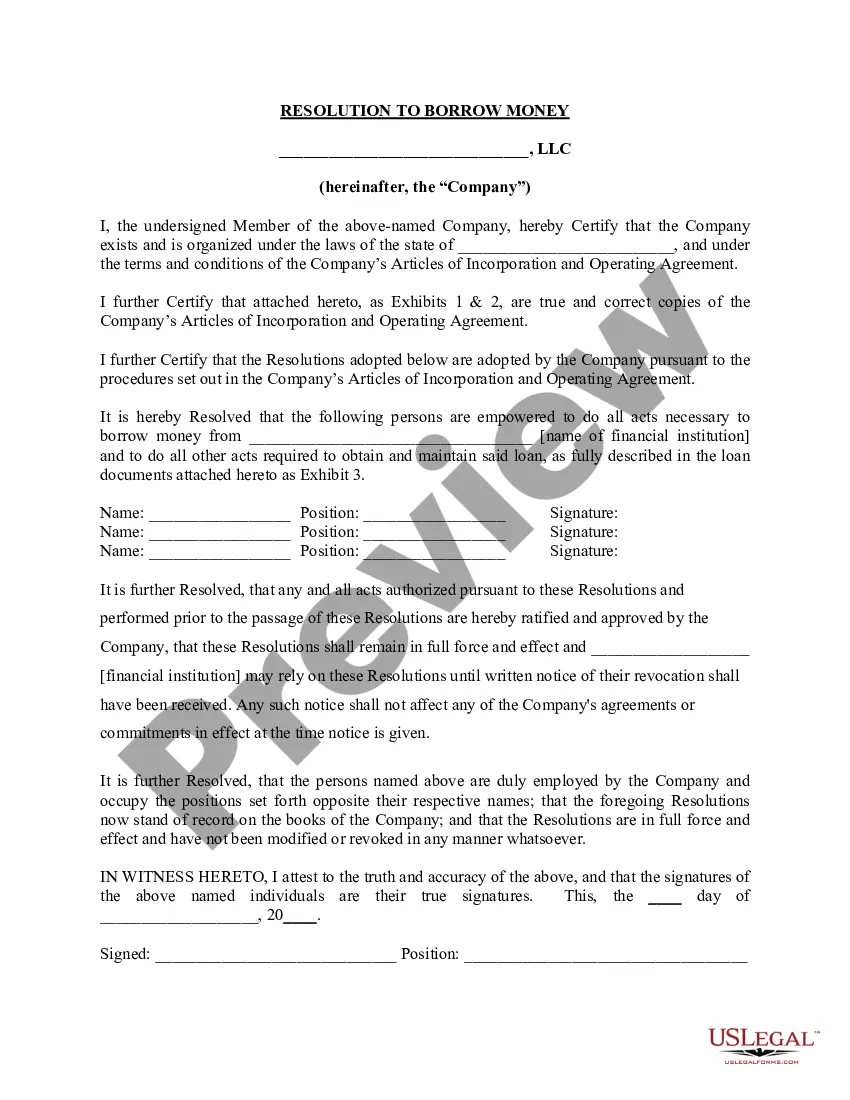
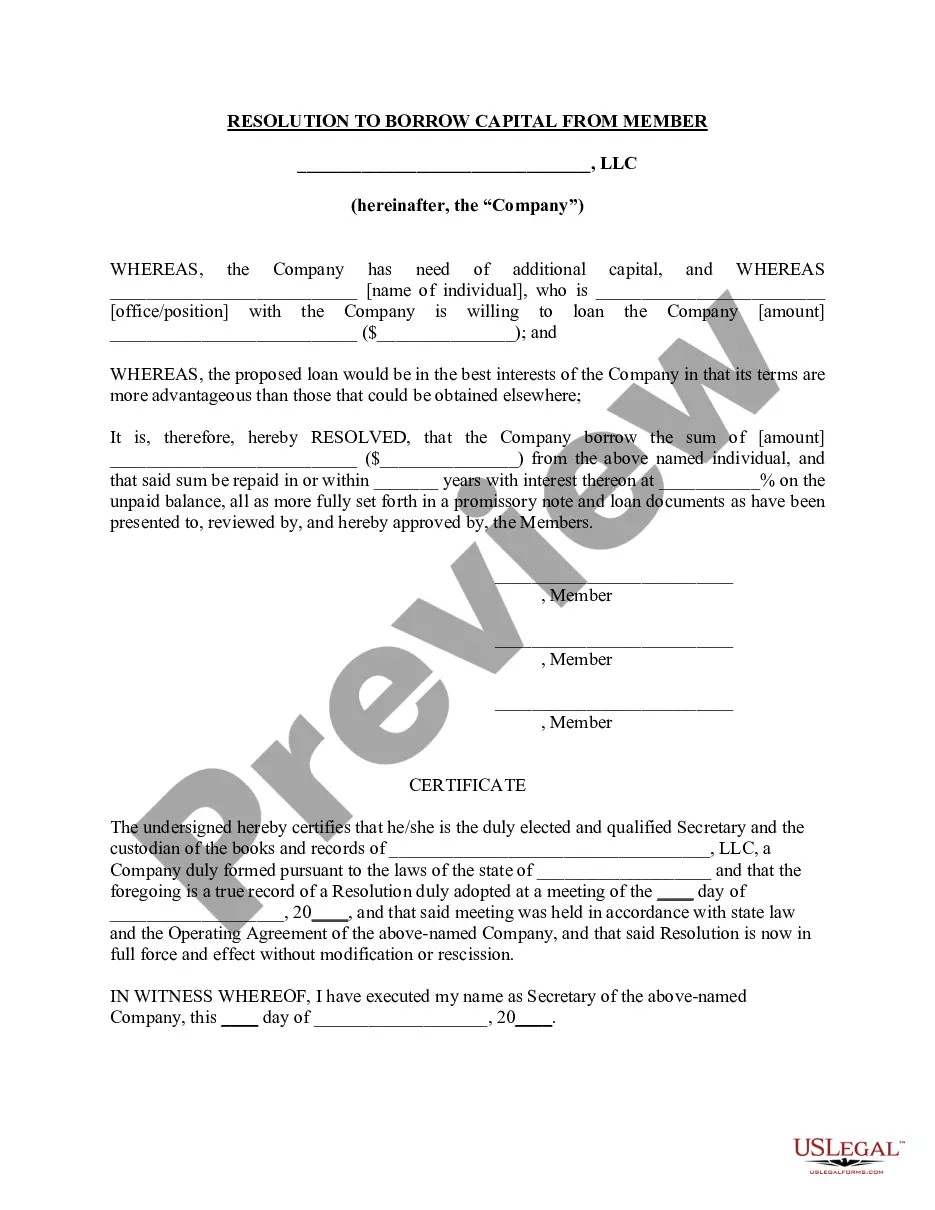
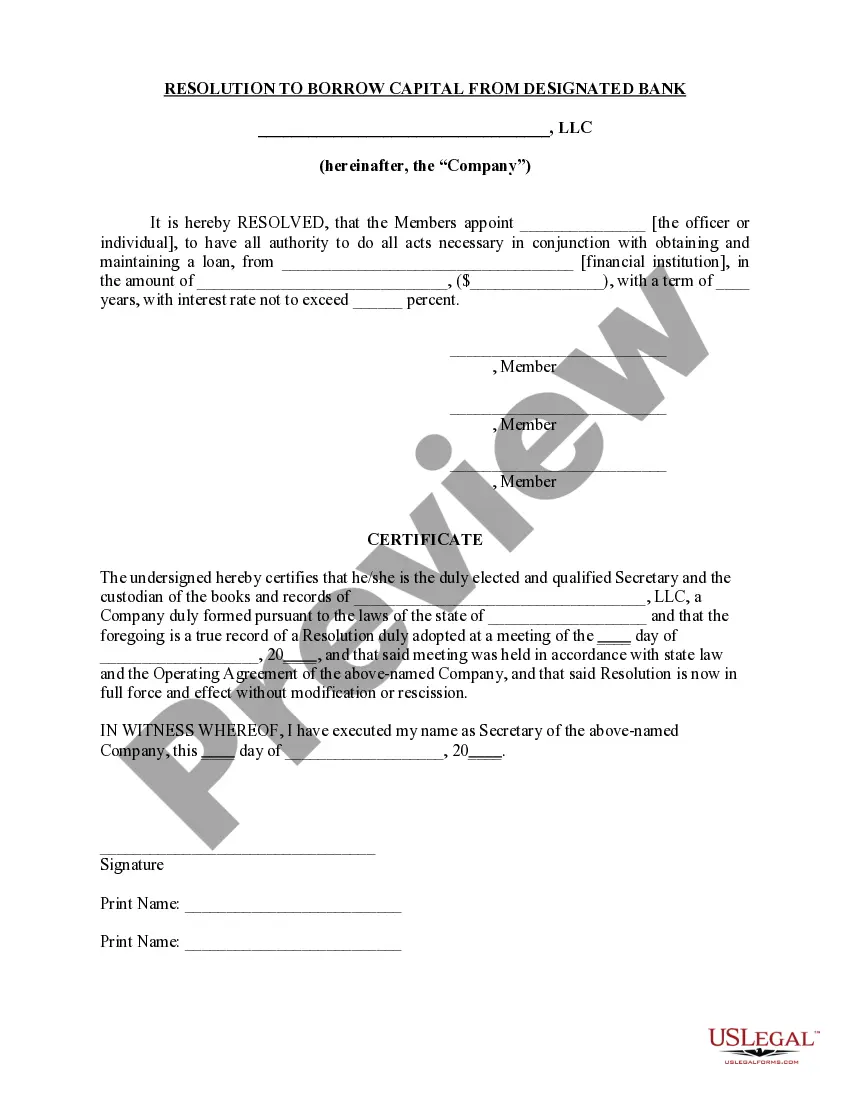
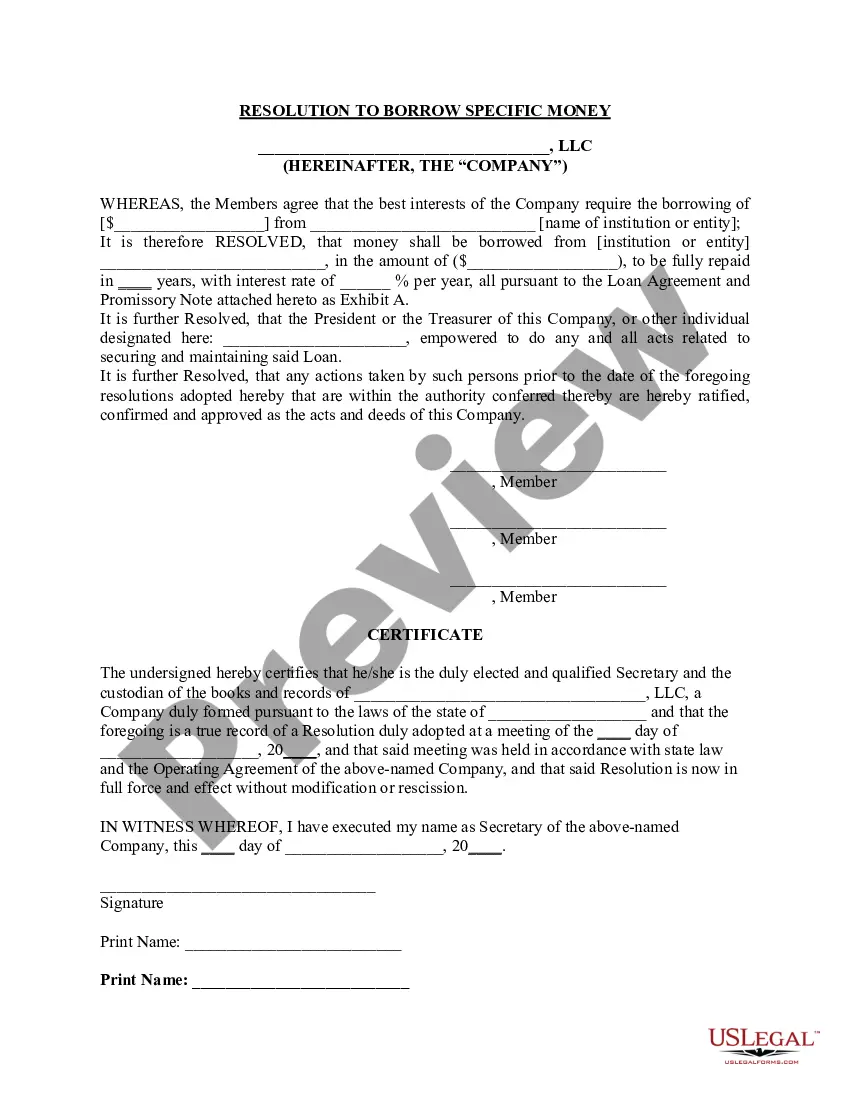
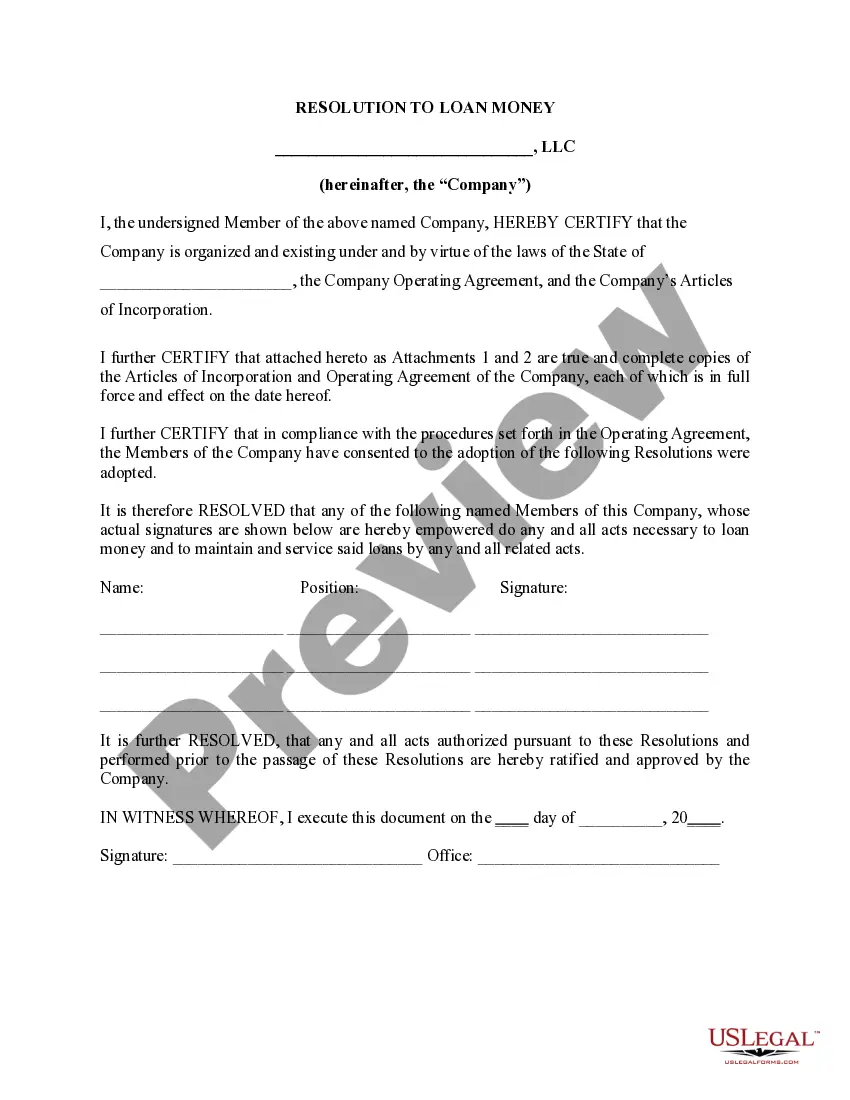
How to fill out Resolution Of Meeting Of LLC Members To Borrow Money?
- Log into your account if you're a returning user, and ensure your subscription is current to access the necessary templates. If not, renew your plan as needed.
- For first-time users, start by checking the preview and description of the forms to find the one that meets your specific requirements and adheres to your local jurisdiction.
- Utilize the search function to explore additional templates if your initial choice doesn't align perfectly. Finding the right document is crucial.
- Purchase the document by clicking on the Buy Now button and selecting your preferred subscription plan. An account registration is required for library access.
- Complete your purchase by entering your payment details either through credit card or PayPal.
- Download your form directly to your device, allowing you to start the completion process right away, with further access through the My Forms section of your account.
In conclusion, using US Legal Forms empowers you to efficiently file taxes for your LLC by providing an extensive collection of legal documents tailored to your needs. With easy navigation and access to expert assistance, you're well-equipped to file your tax return correctly.
Get started today and simplify your tax filing experience with US Legal Forms!
Form popularity
FAQ
Yes, usually you file taxes separately from your LLC, especially if you run a multi-member or corporation-style LLC. For single-member LLCs, income can flow through to your personal tax return, but maintaining separate filings can provide better financial clarity. Using the uslegalforms platform can help you navigate the nuances of tax filing for your LLC, ensuring you stay compliant with the law.
Limited liability companies must file taxes regardless of their income level. There is no specific amount an LLC must earn to trigger the requirement to file a tax return. It is advisable to prepare accurate financial records to facilitate the filing process and ensure adherence to tax laws.
Typically, limited liability companies file for tax returns separately from personal taxes. If your LLC is a single-member entity, you may report the income on your personal tax return, though it remains beneficial to keep them distinct. This strategy can lead to clearer financial records and might help you maximize your deductions.
There is no minimum income threshold for limited liability companies to file for tax return. Regardless of income, LLCs are required to file their taxes annually. It's important to document any income, even if it’s below a certain amount, to ensure compliance with tax regulations and avoid penalties.
Limited liability companies file for tax return as separate entities, so it is recommended to keep your personal and business taxes separate. This separation helps in maintaining clarity in your finances and can reduce your risk during an audit. However, if you are a single-member LLC, your business income can be reported on your personal tax return using a Schedule C. Consider consulting a tax professional to understand the best approach for your situation.
When filing your personal tax return, you will report your share of the LLC's income or losses on Schedule E of Form 1040. Limited liability companies file for tax return, which means you will take the information from Form 1065 and input it into your tax return. This helps create a clearer picture of your overall financial situation and aids the IRS in processing your taxes.
An LLC files a 1065 to report its financial performance to the IRS, which facilitates compliance with tax laws. By filing this form, limited liability companies can detail their income and expenses, allowing for accurate tax assessment. This filing also provides benefits for members, such as establishing the basis for future distributions and losses.
1065 is required for partnerships, including most limited liability companies that are treated as partnerships. If your LLC has two or more members, you must file this form to report the financial activities of the business. Additionally, even if your LLC operates at a loss, you still need to file 1065 to document those losses.
The purpose of Form 1065 is to report the income, deductions, gains, and losses from the operation of a partnership. Limited liability companies file for tax return using this form to provide the IRS with a complete overview of their financial performance. This helps ensure proper accounting and tax reporting for both the LLC and its members.
Yes, limited liability companies must file Form 1065 if they are classified as partnerships for tax purposes. This requirement helps the IRS track the income and expenses of the LLC. However, if your LLC has only one member, it is typically treated as a disregarded entity and does not file Form 1065.