Work Employee Policies For Small Business
Description

Get your form ready online
Our built-in tools help you complete, sign, share, and store your documents in one place.
Make edits, fill in missing information, and update formatting in US Legal Forms—just like you would in MS Word.
Download a copy, print it, send it by email, or mail it via USPS—whatever works best for your next step.
Sign and collect signatures with our SignNow integration. Send to multiple recipients, set reminders, and more. Go Premium to unlock E-Sign.
If this form requires notarization, complete it online through a secure video call—no need to meet a notary in person or wait for an appointment.
We protect your documents and personal data by following strict security and privacy standards.

Make edits, fill in missing information, and update formatting in US Legal Forms—just like you would in MS Word.

Download a copy, print it, send it by email, or mail it via USPS—whatever works best for your next step.

Sign and collect signatures with our SignNow integration. Send to multiple recipients, set reminders, and more. Go Premium to unlock E-Sign.

If this form requires notarization, complete it online through a secure video call—no need to meet a notary in person or wait for an appointment.

We protect your documents and personal data by following strict security and privacy standards.
Looking for another form?




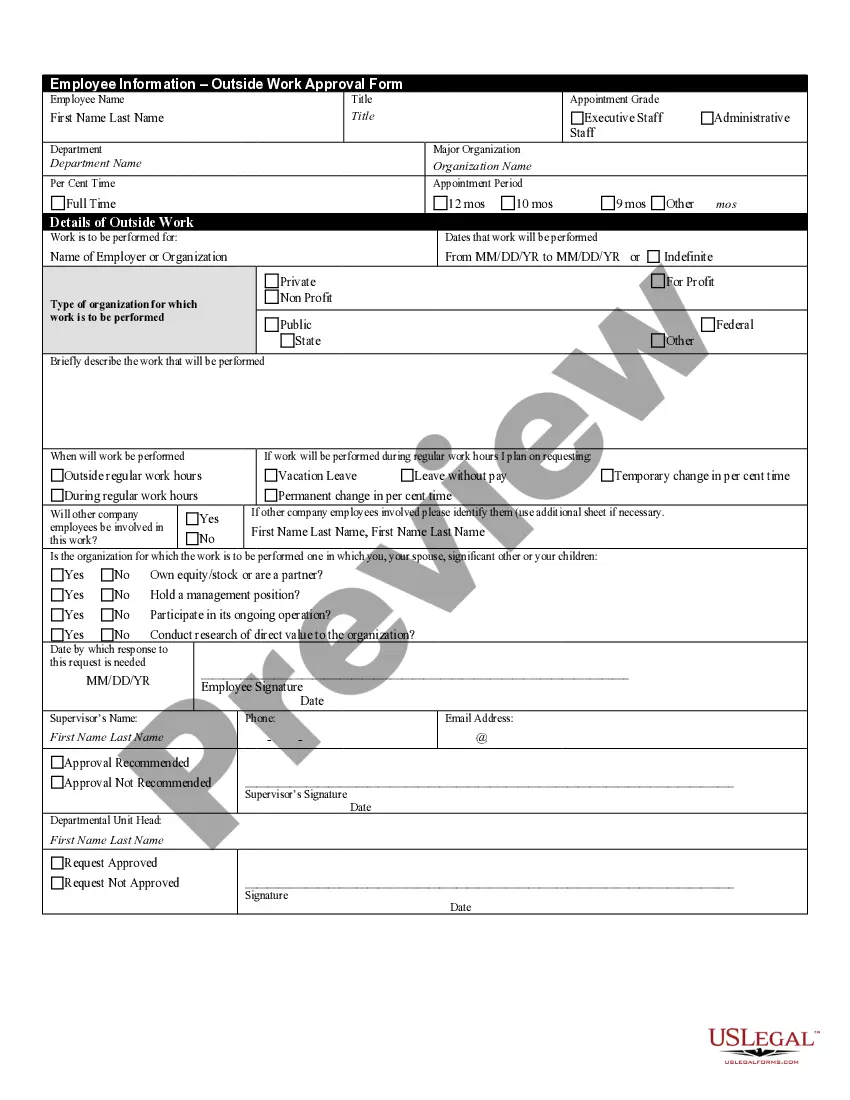
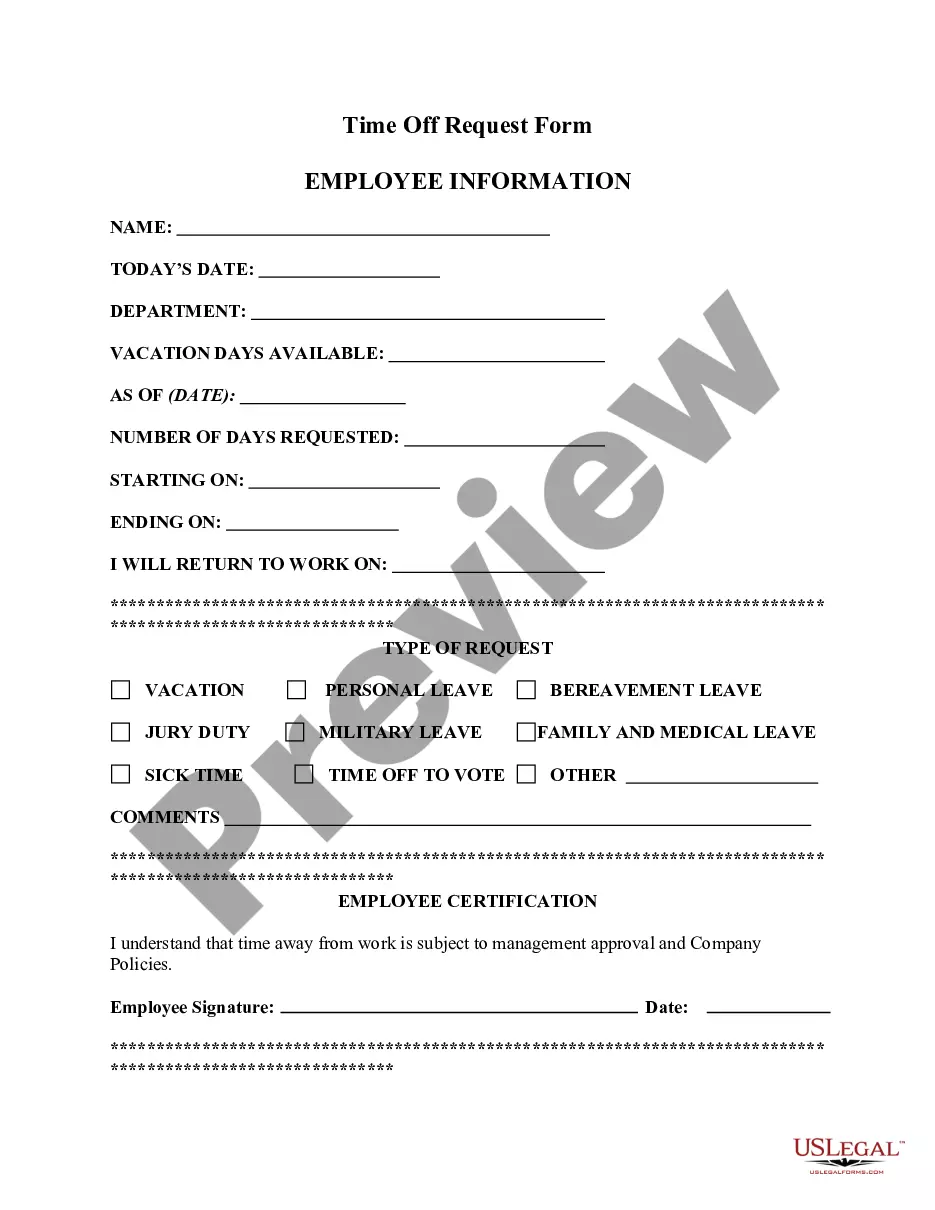
How to fill out Outside Work Approval Form?
Securing a reliable source for obtaining the most up-to-date and pertinent legal templates is half the battle when navigating through bureaucracy.
Selecting the appropriate legal documents necessitates precision and carefulness, which is why it is crucial to source Work Employee Policies For Small Business exclusively from credible providers, such as US Legal Forms. An incorrect template could squander your time and delay your current situation. With US Legal Forms, your concerns are minimal. You can access and review all the specifics regarding the document’s applicability and significance for your circumstances in your state or county.
Once you have the form on your device, you may modify it using the editor or print it and complete it manually. Eliminate the hassle associated with your legal documentation. Browse the extensive US Legal Forms catalog where you can discover legal templates, assess their relevance to your needs, and download them immediately.
- Utilize the catalog navigation or search option to locate your template.
- Review the form’s details to confirm it meets the requirements of your state and locality.
- Preview the form, if available, to verify that the template is genuinely the one you seek.
- Return to the search to find the suitable template if the Work Employee Policies For Small Business does not meet your needs.
- Once you are confident about the form’s applicability, download it.
- If you are a registered member, click Log in to verify and access your selected templates in My documents.
- If you do not have an account yet, click Buy now to acquire the template.
- Select the pricing plan that aligns with your preferences.
- Proceed to the registration to finalize your purchase.
- Complete your transaction by choosing a payment method (credit card or PayPal).
- Select the file format for downloading Work Employee Policies For Small Business.
Form popularity
FAQ
Writing policies and procedures for a small business involves several key steps. Begin by identifying the specific work employee policies for small business that you need, such as attendance, workplace conduct, and safety. Next, outline each policy clearly, ensuring that it is easy for employees to understand. Finally, consider using a platform like USLegalForms to access templates and resources that can simplify the process and ensure compliance.
Yes, a small business should have an employee handbook. This document serves as a guide that clarifies your work employee policies for small business. It helps establish clear expectations for your employees and protects your business from potential legal issues. Additionally, an employee handbook can enhance communication and create a positive workplace culture.
In a nutshell, it sets clear expectations for your employees while also stating your legal obligations and defining employee rights. The employee handbook can help protect your business against employee lawsuits and claims, such as wrongful termination, harassment and discrimination.
Key Sections of an Employee Handbook Introduction & Welcome. Welcome new employees and write briefly about how the company began and who's in charge. ... Workplace Commitments. ... Company Policies and Procedures. ... Employment Classification. ... Attendance Policies. ... Leave Policies. ... Work Performance. ... Discipline Policy.
Must-Have Items For Every Employee Handbook Notice and disclaimer / Acknowledgement of Receipt. ... Employment at-will policy. ... Equal opportunity statement and anti-harassment statement. ... Work authorization. ... Policy on employment classification. ... Overtime. ... Leaves of absence. ... Parental leave.
8 Keys to Creating an Effective Employee Handbook #1: Know your history. ... #2: Identify required policies. ... #3: Include other must-have policies. ... #4: Know what policies to avoid. ... #5: Draft policies that reflect company values. ... #6: Set the tone. ... #8: Gather feedback.
Nine Tips for Writing an Employee Handbook Keep It Simple & Engaging. Use Your Handbook As A Communication Tool. Pay Attention to Format and Visuals. Clearly Mention Work Hours, Compensations, and Benefits. Mention Your Company Culture & How Employees Can Maintain The Same. Mention Legal Issues. Mention Employee Appreciation.