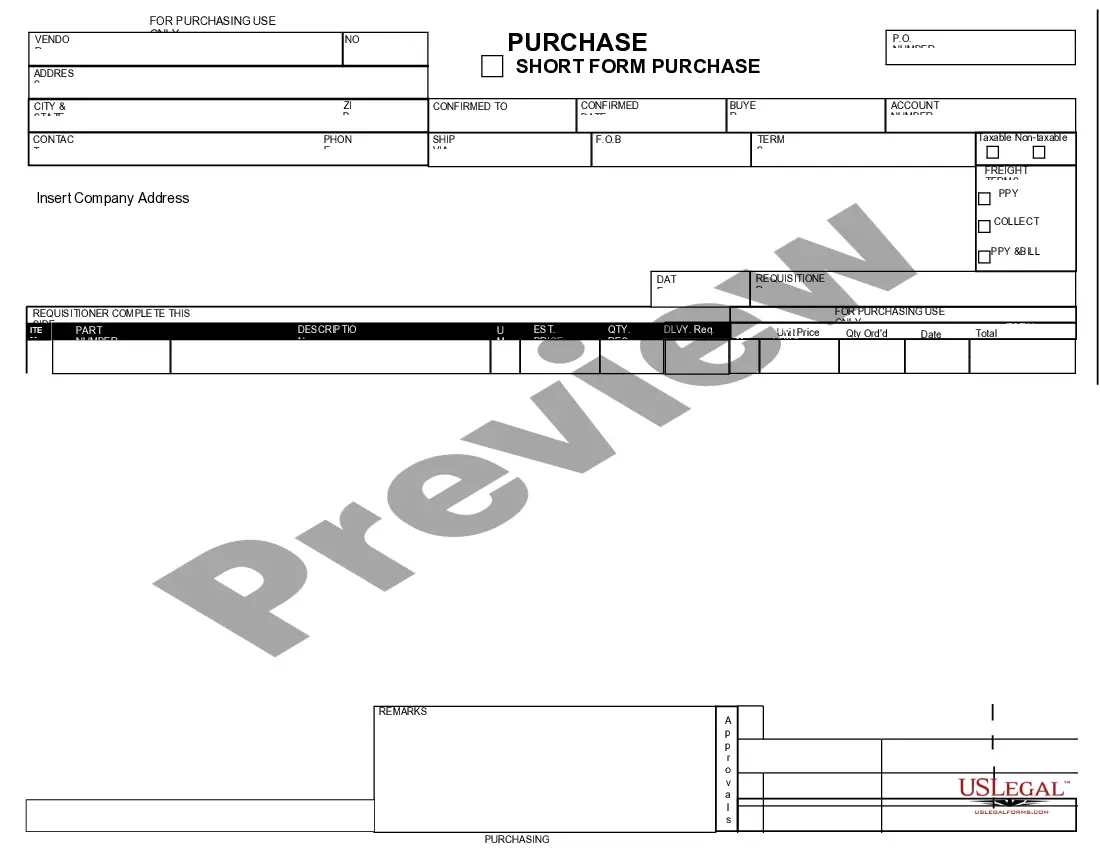
Difference Between Order Form And Purchase Order
Description
Get your form ready online
Our built-in tools help you complete, sign, share, and store your documents in one place.
Make edits, fill in missing information, and update formatting in US Legal Forms—just like you would in MS Word.
Download a copy, print it, send it by email, or mail it via USPS—whatever works best for your next step.
Sign and collect signatures with our SignNow integration. Send to multiple recipients, set reminders, and more. Go Premium to unlock E-Sign.
If this form requires notarization, complete it online through a secure video call—no need to meet a notary in person or wait for an appointment.
We protect your documents and personal data by following strict security and privacy standards.

Make edits, fill in missing information, and update formatting in US Legal Forms—just like you would in MS Word.

Download a copy, print it, send it by email, or mail it via USPS—whatever works best for your next step.

Sign and collect signatures with our SignNow integration. Send to multiple recipients, set reminders, and more. Go Premium to unlock E-Sign.

If this form requires notarization, complete it online through a secure video call—no need to meet a notary in person or wait for an appointment.

We protect your documents and personal data by following strict security and privacy standards.
Looking for another form?

How to fill out Purchase Requisition?
It’s clear that you cannot transform into a legal expert instantly, nor can you determine how to swiftly prepare the Distinction Between Order Form And Purchase Order without possessing a specialized foundation.
Drafting legal documents is a lengthy endeavor that demands specific education and competencies.
So why not entrust the creation of the Distinction Between Order Form And Purchase Order to the professionals.
Preview it (if this feature is available) and review the accompanying description to verify whether the Distinction Between Order Form And Purchase Order is what you seek.
Initiate your search again if you require a different template.
- With US Legal Forms, one of the most comprehensive libraries of legal templates, you can discover everything from court documents to templates for in-office correspondence.
- We understand how crucial compliance and adherence to national and state laws are.
- That’s why, on our site, all forms are location-specific and current.
- Here’s how to get started with our site and acquire the document you require in just a few minutes.
- Locate the form you need by utilizing the search bar at the top of the webpage.
Form popularity
FAQ
Common purchase order mistakes often arise from miscommunication, unclear terms, or incorrect quantities. When businesses confuse the difference between order form and purchase order, it can lead to processing errors and misunderstandings. Ensuring clear communication and reviewing all documents can help prevent these issues. Tools like US Legal Forms can assist in creating accurate and compliant purchase orders.
The main difference between an order and a Purchase Order (PO) lies in their function. An order is a general request for items, often informal, while a PO is a legally binding document that confirms a purchase. Understanding these differences can help businesses manage their procurement better. To assist with this process, US Legal Forms offers resources that clarify the difference between order form and purchase order, ensuring you make informed decisions.
The four primary types of Purchase Orders (PO) include standard, planned, blanket, and contract POs. A standard PO is issued for one-time purchases, while a planned PO is used for goods delivered at scheduled intervals. Blanket POs allow for multiple deliveries without issuing new orders each time, and contract POs are agreements to purchase specific goods or services over time. Familiarizing yourself with the difference between order form and purchase order can enhance your purchasing strategy.
An order form serves as a document that details the specific items or services a buyer intends to purchase from a seller. It simplifies the purchasing process by listing quantities, prices, and terms clearly. This tool is essential in ensuring accurate transactions and reducing misunderstandings. Therefore, knowing the difference between order form and purchase order is crucial for efficient ordering.
In the procurement process, a Purchase Request (PR) typically comes first, followed by a Purchase Order (PO). The PR serves as an internal request for goods or services, allowing a company to assess needs and budget. Once approved, the PO is created to formally order the requested items from a vendor. Understanding the difference between order form and purchase order can help streamline your procurement process.
The four P's of procurement encompass People, Process, Product, and Platform. Engaging skilled personnel ensures effective purchasing decisions. A well-defined process enhances efficiency and reduces errors. Meanwhile, selecting the right product demands a clear understanding of your needs, and utilizing a robust platform like uslegalforms can simplify this process and clarify the difference between order form and purchase order.
The four types of purchasing include direct, indirect, services, and capital purchasing. Direct purchasing involves acquiring goods that are essential for production, like raw materials. Indirect purchasing refers to non-essential items, such as office supplies. Understanding the difference between an order form and a purchase order is crucial when managing these various purchasing types effectively.
There are four common types of purchase orders: standard, blanket, contract, and planned purchase orders. A standard purchase order is used for straightforward, one-time purchases. In contrast, a blanket purchase order is beneficial for ongoing agreements over a set period. Knowing the difference between an order form and a purchase order can guide you in selecting the appropriate type for your procurement process.
The best type of purchase order (PO) varies based on your specific needs and circumstances. Generally, a standard purchase order is very effective for most businesses, as it clearly outlines the items and services being purchased. Understanding the difference between an order form and a purchase order helps ensure that you choose the right option for your transactions. For complex orders, consider utilizing blanket purchase orders for efficiency.