Exiting Intel Pxe Rom
Description


Get your form ready online
Our built-in tools help you complete, sign, share, and store your documents in one place.
Make edits, fill in missing information, and update formatting in US Legal Forms—just like you would in MS Word.
Download a copy, print it, send it by email, or mail it via USPS—whatever works best for your next step.
Sign and collect signatures with our SignNow integration. Send to multiple recipients, set reminders, and more. Go Premium to unlock E-Sign.
If this form requires notarization, complete it online through a secure video call—no need to meet a notary in person or wait for an appointment.
We protect your documents and personal data by following strict security and privacy standards.

Make edits, fill in missing information, and update formatting in US Legal Forms—just like you would in MS Word.

Download a copy, print it, send it by email, or mail it via USPS—whatever works best for your next step.

Sign and collect signatures with our SignNow integration. Send to multiple recipients, set reminders, and more. Go Premium to unlock E-Sign.

If this form requires notarization, complete it online through a secure video call—no need to meet a notary in person or wait for an appointment.

We protect your documents and personal data by following strict security and privacy standards.
Looking for another form?





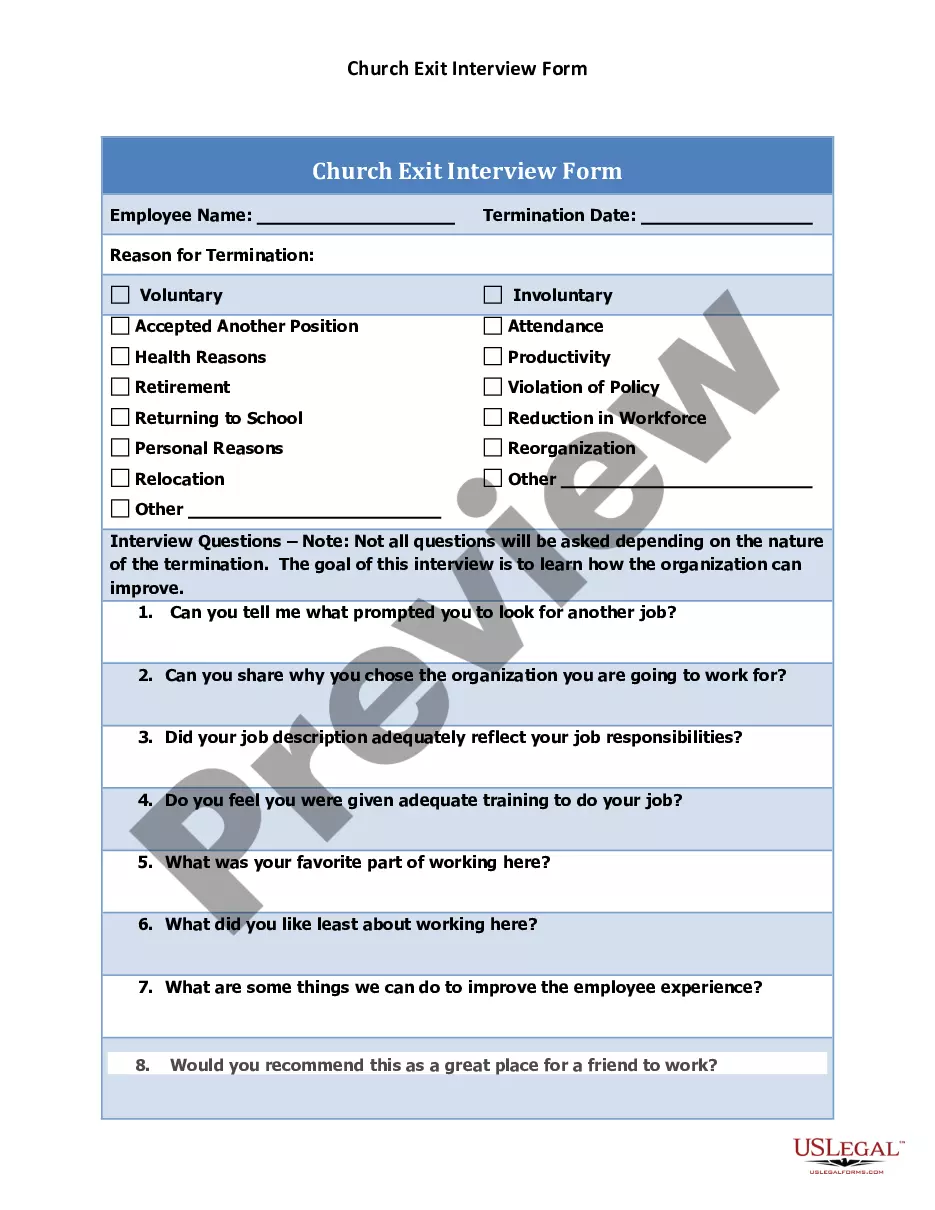
How to fill out Church Exit Interview Form?
- Log into your US Legal Forms account if you're a returning user. Ensure your subscription is active; if it's expired, renew it according to your plan.
- For new users, start by browsing through the available templates. Use the Preview mode to verify that the selected form meets your jurisdiction's requirements.
- If the chosen document isn't suitable, utilize the Search feature to find an alternative that fits your needs.
- Once you've selected the right form, click the Buy Now button and choose a subscription plan that works for you. You'll need to create an account to access the library.
- Complete your purchase by entering your payment details or using your PayPal account.
- After payment, download the desired form to your device. You can always revisit this document later in the My Forms section of your account.
By utilizing US Legal Forms, you gain access to a robust library of legal forms and expert assistance, ensuring your documents are not only completed correctly but also comply with legal standards.
Start using US Legal Forms today and streamline your legal documentation process!
Form popularity
FAQ
To exit Network Boot, go to the BIOS or UEFI setup when your computer starts. Find the option related to boot devices, and adjust the settings to prioritize your hard drive or SSD over the network boot option. This adjustment will prevent your computer from attempting to connect via exiting intel pxe rom and should resolve any related issues.
If you want to remove the start PXE over IPv4 message, enter your BIOS or UEFI settings during startup. Look for the Boot Order or Boot Priority list and move the hard drive above the network options. By ensuring your hard drive is the primary boot device, your system will bypass any attempts to utilize exiting intel pxe rom for booting.
To turn off PXE boot, you need to access your computer's BIOS or UEFI firmware settings. Upon startup, press the appropriate key, usually F2, F10, or DEL, to enter the setup menu. Once there, navigate to the Boot tab, locate the PXE or Network Boot option, and disable it. This will stop your system from attempting to boot using exiting intel pxe rom.
Exiting PXE ROM refers to the process of leaving the PXE boot mode, usually triggered when the system fails to find a valid boot device or operating system to load. This situation can arise due to incorrect BIOS settings or hardware problems. Understanding exiting Intel PXE ROM can empower you to resolve boot issues efficiently.
To fix PXE errors, start by checking your computer's boot settings to ensure the hard drive is prioritized properly. You might also need to inspect your network connection or reconfigure the PXE server settings. Addressing these elements can help you overcome problems related to exiting Intel PXE ROM.
Intel PXE ROM is a built-in feature in Intel network adapters that supports network booting capabilities. It helps computers start up by downloading the operating system from a remote server. Familiarity with Intel PXE ROM can aid you in troubleshooting issues related to exiting Intel PXE ROM procedures.
PXE boot ROM refers to the firmware feature that allows computers to boot from a network rather than local storage. It facilitates the retrieval of crucial system files required to initiate the startup process. Issues with exiting Intel PXE ROM often stem from incorrect configurations within this boot ROM.
To get out of PXE boot, access your BIOS settings and change the boot priority to your hard disk. This setting tells your computer to load the operating system from local storage instead of the network. If you continue facing problems, check for hardware issues that might trigger exiting Intel PXE ROM.
The PXE ROM is a network booting protocol that enables your computer to load an operating system over a network connection. It allows systems without a local hard drive to boot from a server. Understanding the PXE ROM is key to resolving issues related to exiting Intel PXE ROM functionalities.
To fix the PXE boot failed issue, first check your system's boot order in the BIOS settings. Ensure that your hard drive is listed before the PXE options. If the boot order is correct, consider repairing or reinstalling your operating system, as a corrupted system can lead to exiting Intel PXE ROM problems.