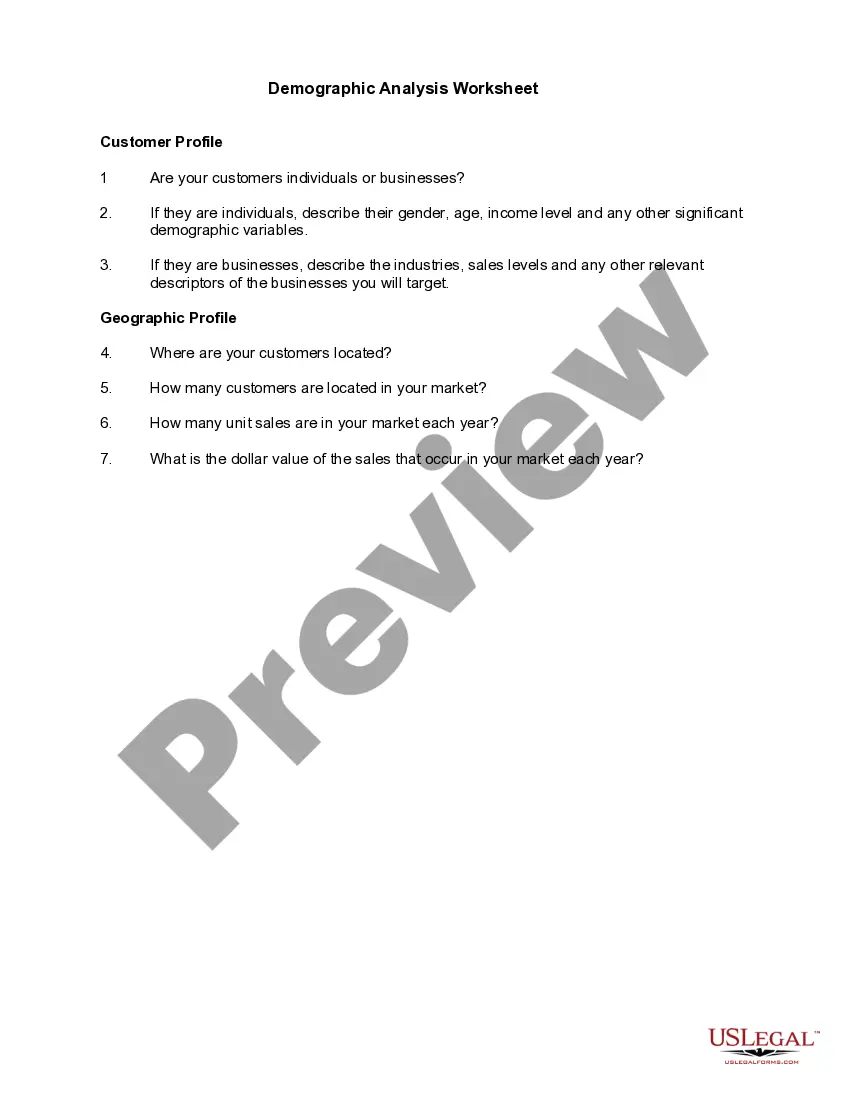
Audience Analysis Example
Description
Get your form ready online
Our built-in tools help you complete, sign, share, and store your documents in one place.
Make edits, fill in missing information, and update formatting in US Legal Forms—just like you would in MS Word.
Download a copy, print it, send it by email, or mail it via USPS—whatever works best for your next step.
Sign and collect signatures with our SignNow integration. Send to multiple recipients, set reminders, and more. Go Premium to unlock E-Sign.
If this form requires notarization, complete it online through a secure video call—no need to meet a notary in person or wait for an appointment.
We protect your documents and personal data by following strict security and privacy standards.

Make edits, fill in missing information, and update formatting in US Legal Forms—just like you would in MS Word.

Download a copy, print it, send it by email, or mail it via USPS—whatever works best for your next step.

Sign and collect signatures with our SignNow integration. Send to multiple recipients, set reminders, and more. Go Premium to unlock E-Sign.

If this form requires notarization, complete it online through a secure video call—no need to meet a notary in person or wait for an appointment.

We protect your documents and personal data by following strict security and privacy standards.
Looking for another form?

How to fill out Demographic Analysis Worksheet?
Dealing with legal documents and processes can be a lengthy addition to your entire schedule.
Audience Analysis Sample and similar forms generally require you to search for them and find the optimal way to finish them efficiently.
Consequently, whether you are managing financial, legal, or personal affairs, utilizing a complete and user-friendly online library of forms readily available will significantly help.
US Legal Forms is the leading online platform for legal templates, providing over 85,000 state-specific documents and various tools to help you complete your paperwork effortlessly.
Is this your first time using US Legal Forms? Register and create your account in just a few minutes, and you will gain access to the form library and Audience Analysis Sample. Then, follow the steps outlined below to complete your document: Ensure that you have located the correct form using the Review feature and examining the form details. Click Buy Now when ready, and select the monthly subscription plan that suits your requirements. Choose Download, then fill out, sign, and print the form. US Legal Forms has twenty-five years of expertise assisting clients manage their legal documentation. Acquire the form you need today and streamline any procedure without breaking a sweat.
- Browse the collection of relevant documents accessible to you with just one click.
- US Legal Forms offers state- and county-specific forms available for download at any time.
- Protect your document management processes by utilizing a high-quality service that enables you to prepare any form within minutes without extra or hidden charges.
- Simply Log In to your account, find Audience Analysis Sample, and obtain it immediately from the My documents section.
- You can also access previously saved documents.
Form popularity
FAQ
The five steps of audience analysis include identifying your audience, gathering data, analyzing the information, interpreting the results, and implementing findings. First, clarify who your audience is. Then, collect relevant data through various methods. After that, analyze the data to uncover insights. Next, interpret these insights to understand your audience better. Finally, utilize these findings in your marketing strategies, and platforms like US Legal Forms can support each step with valuable resources.
An audience analysis example could involve a nonprofit organization aiming to increase community engagement. By analyzing demographics, such as age and income level, the organization can tailor its outreach efforts to attract more volunteers. This targeted approach increases the likelihood of engagement and support. Using resources from US Legal Forms can enhance this analysis by providing templates and guides for effective outreach.
To conduct an audience analysis, start by defining your target audience. Next, gather data through surveys, interviews, or online analytics. Then, interpret the data to identify trends and preferences among your audience. Finally, apply these insights to inform your marketing strategies, ensuring that your content and services align with your audience's needs. Platforms like US Legal Forms can assist in simplifying this process with their user-friendly tools.
An audience analysis example involves assessing your target demographic to understand their needs and preferences. For instance, a law firm may analyze its audience by researching their age, location, and legal needs. This analysis helps in creating tailored marketing strategies that resonate with potential clients. By utilizing tools available on platforms like US Legal Forms, you can gather valuable insights into your audience.
Ask These 8 Questions To Artfully Analyze Your Audience General educational background of those in attendance? Job experience and background? Knowledge level of your topic? Number of people expected? General age range of audience members? Geographical or cultural norms? Attitude and interest level in your topic?
Here's how to conduct audience analysis effectively. Identify your target audience. The first stage of audience analysis involves defining your target audience. ... Segment your audience. ... Identify priority characteristics. ... Identify barriers and facilitators to change. ... Identify key influencers. ... Create data-informed buyer personas.
Audience analysis includes consideration of demographic informationInformation about the audience's gender, age range, marital status, ethnicity, socioeconomic status, and other variables that can influence their frame of reference., such as the gender, age range, marital status, race, and ethnicity of the people in ...