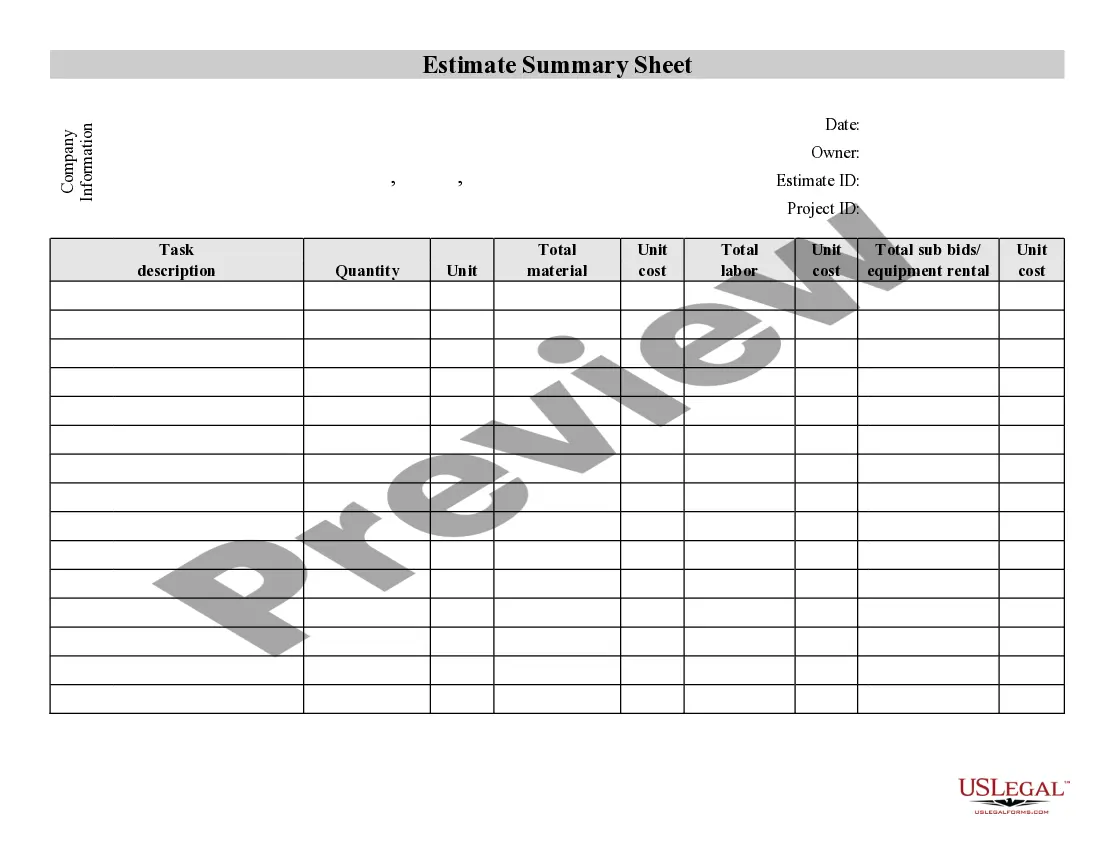
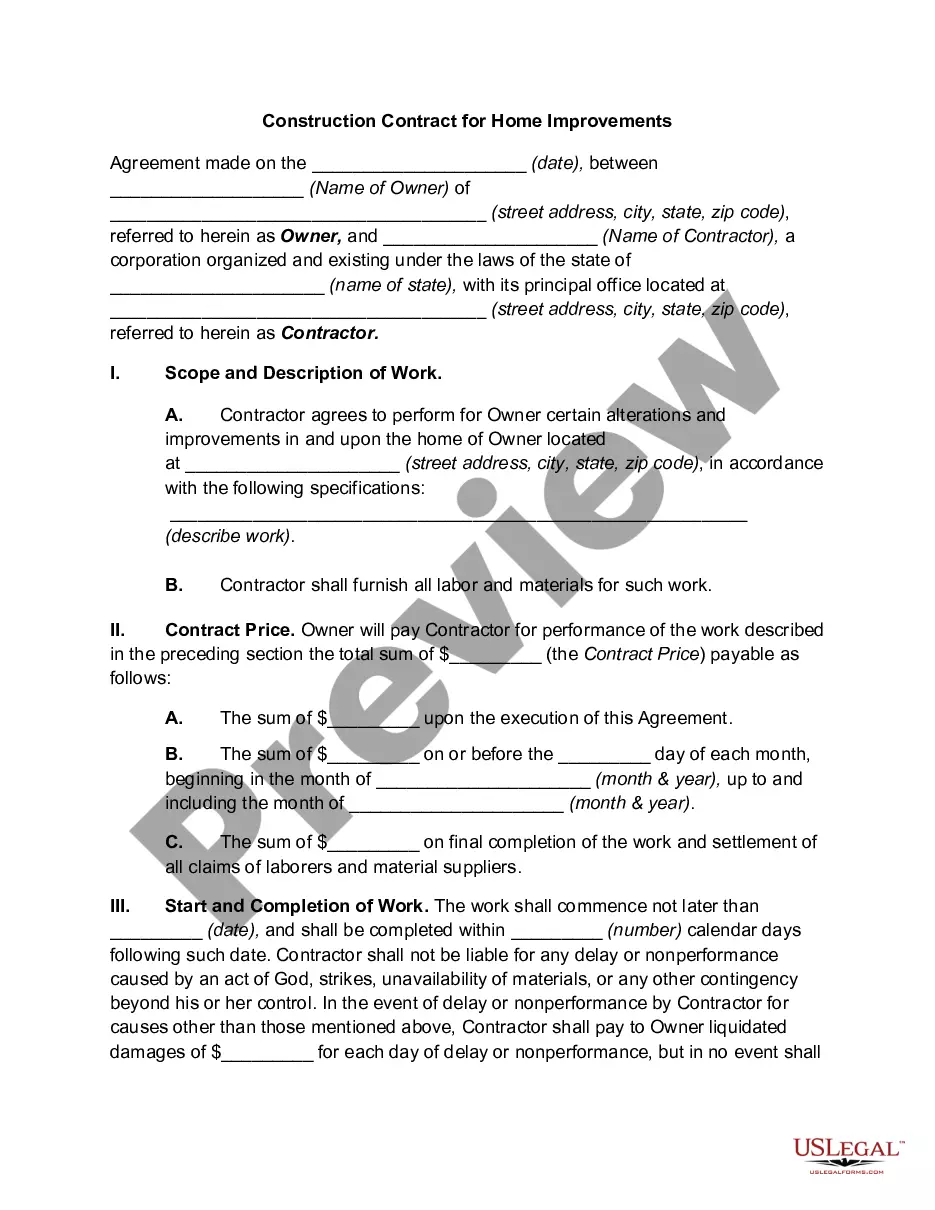
Construction Estimate For Bank Loan
Description
Get your form ready online
Our built-in tools help you complete, sign, share, and store your documents in one place.
Make edits, fill in missing information, and update formatting in US Legal Forms—just like you would in MS Word.
Download a copy, print it, send it by email, or mail it via USPS—whatever works best for your next step.
Sign and collect signatures with our SignNow integration. Send to multiple recipients, set reminders, and more. Go Premium to unlock E-Sign.
If this form requires notarization, complete it online through a secure video call—no need to meet a notary in person or wait for an appointment.
We protect your documents and personal data by following strict security and privacy standards.

Make edits, fill in missing information, and update formatting in US Legal Forms—just like you would in MS Word.

Download a copy, print it, send it by email, or mail it via USPS—whatever works best for your next step.

Sign and collect signatures with our SignNow integration. Send to multiple recipients, set reminders, and more. Go Premium to unlock E-Sign.

If this form requires notarization, complete it online through a secure video call—no need to meet a notary in person or wait for an appointment.

We protect your documents and personal data by following strict security and privacy standards.
Looking for another form?







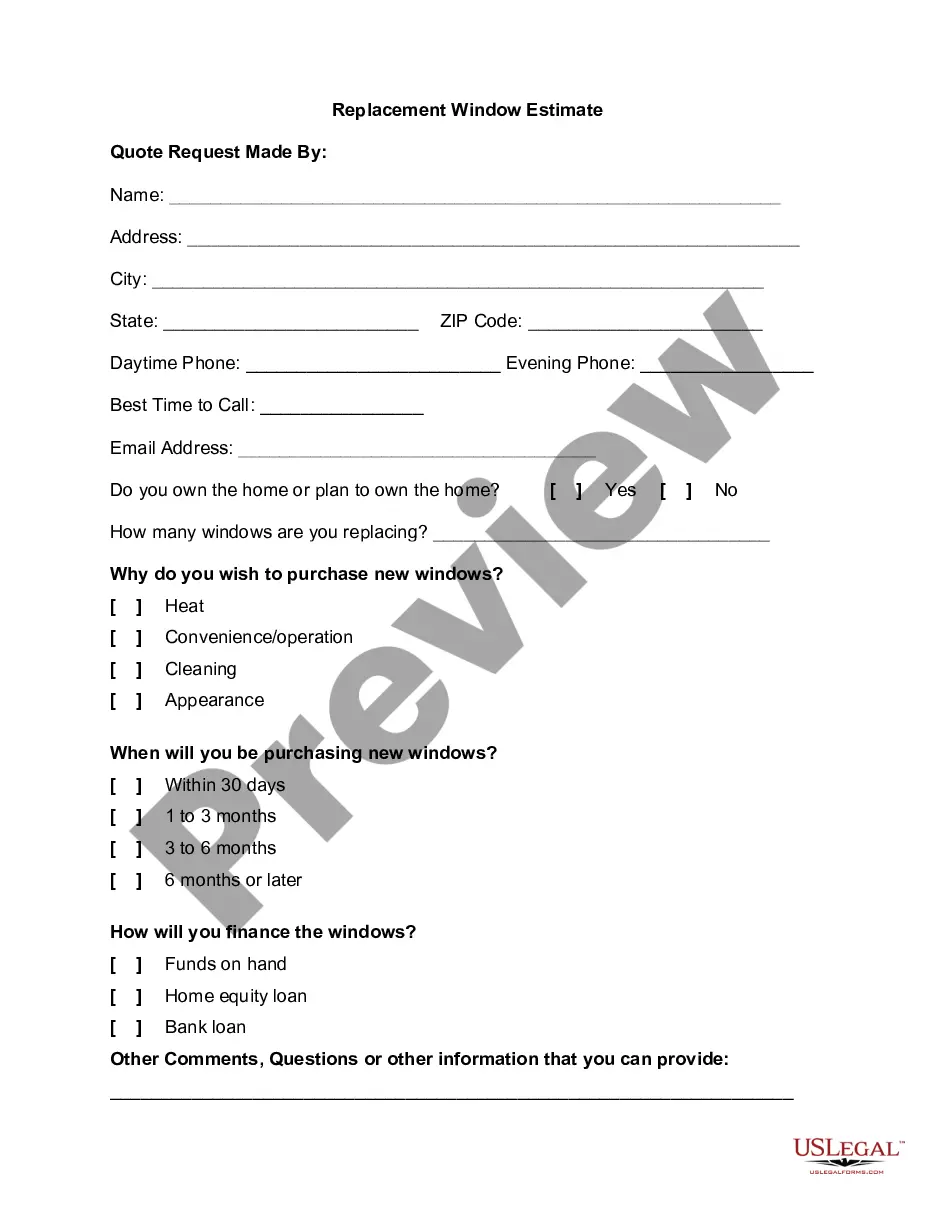
How to fill out Replacement Window Estimate?
When you need to complete a Construction Estimate For Bank Loan in accordance with your local state's laws and regulations, there may be numerous options to choose from.
There's no need to verify every form to ensure it satisfies all the legal requirements if you are a US Legal Forms subscriber.
It is a reliable source that can assist you in obtaining a reusable and current template on any topic.
Utilize the Preview mode and examine the form description if available.
- US Legal Forms is the largest online directory with a compilation of over 85k ready-to-use documents for business and personal legal situations.
- All templates are verified to comply with each state's laws and regulations.
- Thus, when downloading the Construction Estimate For Bank Loan from our site, you can be assured that you possess a legitimate and up-to-date document.
- Acquiring the necessary sample from our platform is straightforward.
- If you already have an account, simply Log In to the platform, ensure your subscription is active, and save the chosen file.
- In the future, you can navigate to the My documents tab in your profile and access the Construction Estimate For Bank Loan at any time.
- If this is your first experience with our website, please follow the instructions below.
- Review the suggested page and check it for alignment with your needs.
Form popularity
FAQ
To qualify for a construction loan, your debt-to-income ratio should not exceed 45 percent. This is the percentage of your income that goes toward debt repayment each month. Calculate this ratio by dividing your total debt payments by your gross monthly income.
In order to prepare a detailed estimate of the proposed work, the following information is required:(i) Complete Set of Detailed Drawings:(ii) Specifications of Items of Works:(iii) Prevalent Rates of Items of Construction:(iv) Standard Mode of Measurement:(v) Details of foundation strata likely to encounter.More items...?
The most important ratio in commercial construction loan underwriting is, by far, the Loan-To-Cost Ratio. The Loan-to-Cost Ratio is the construction loan amount divided by the total cost of the project, the result being mutiplied by 100%. Loan-to-Cost Ratio's look like this: 86.1% LTC or 80.0% LTC or 76.4% LTC.
To increase the likelihood that borrowers will be able to make payments, lenders typically require a DTI ratio no higher than 45% when issuing construction loans. A down payment of at least 20%. Borrowers usually are required to make a down payment of at least 20% when taking out a construction loan.
The form provides you with important information, including the estimated interest rate, monthly payment, and total closing costs for the loan. The Loan Estimate also gives you information about the estimated costs of taxes and insurance, and how the interest rate and payments may change in the future.
