Choosing Name Business With Business
Description

Get your form ready online
Our built-in tools help you complete, sign, share, and store your documents in one place.
Make edits, fill in missing information, and update formatting in US Legal Forms—just like you would in MS Word.
Download a copy, print it, send it by email, or mail it via USPS—whatever works best for your next step.
Sign and collect signatures with our SignNow integration. Send to multiple recipients, set reminders, and more. Go Premium to unlock E-Sign.
If this form requires notarization, complete it online through a secure video call—no need to meet a notary in person or wait for an appointment.
We protect your documents and personal data by following strict security and privacy standards.

Make edits, fill in missing information, and update formatting in US Legal Forms—just like you would in MS Word.

Download a copy, print it, send it by email, or mail it via USPS—whatever works best for your next step.

Sign and collect signatures with our SignNow integration. Send to multiple recipients, set reminders, and more. Go Premium to unlock E-Sign.

If this form requires notarization, complete it online through a secure video call—no need to meet a notary in person or wait for an appointment.

We protect your documents and personal data by following strict security and privacy standards.
Looking for another form?









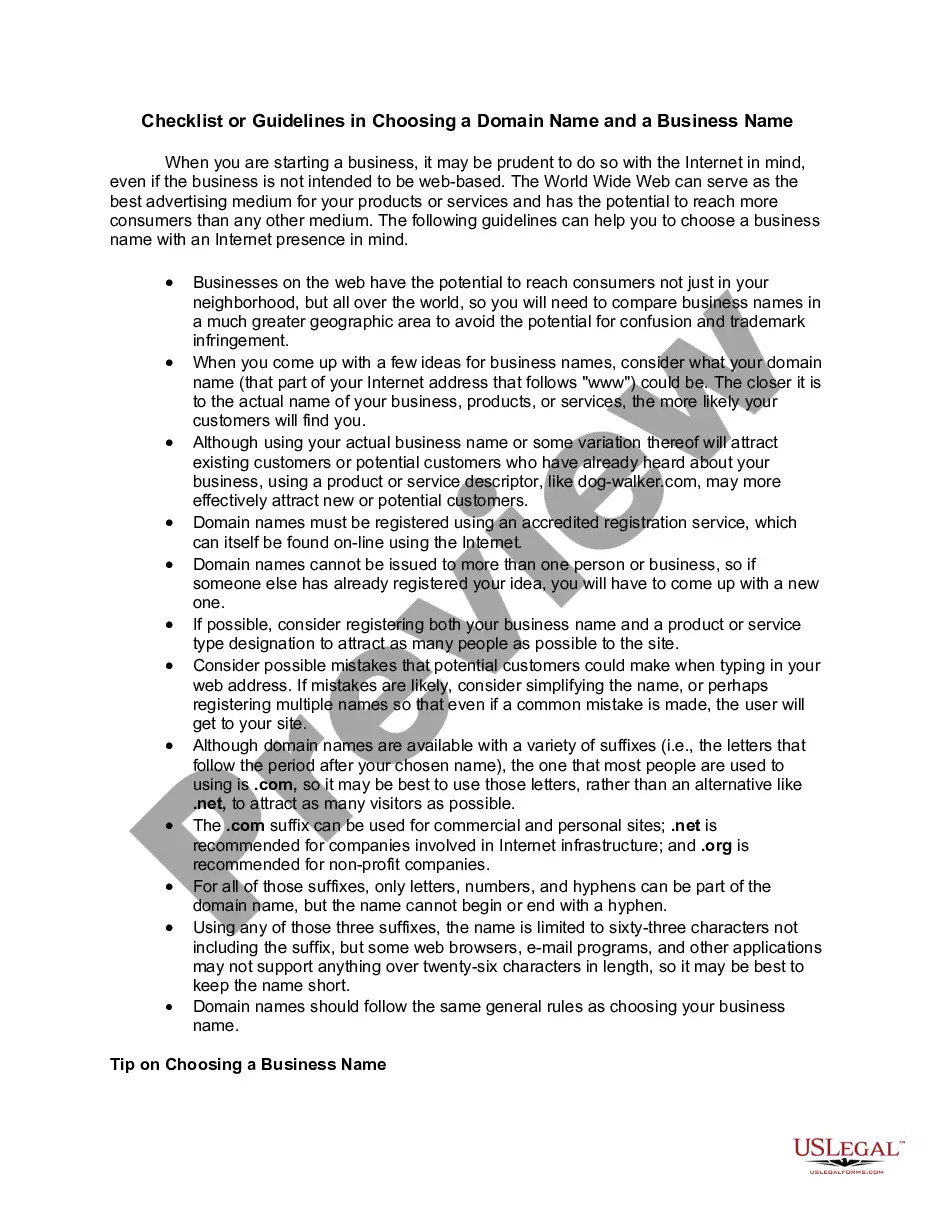
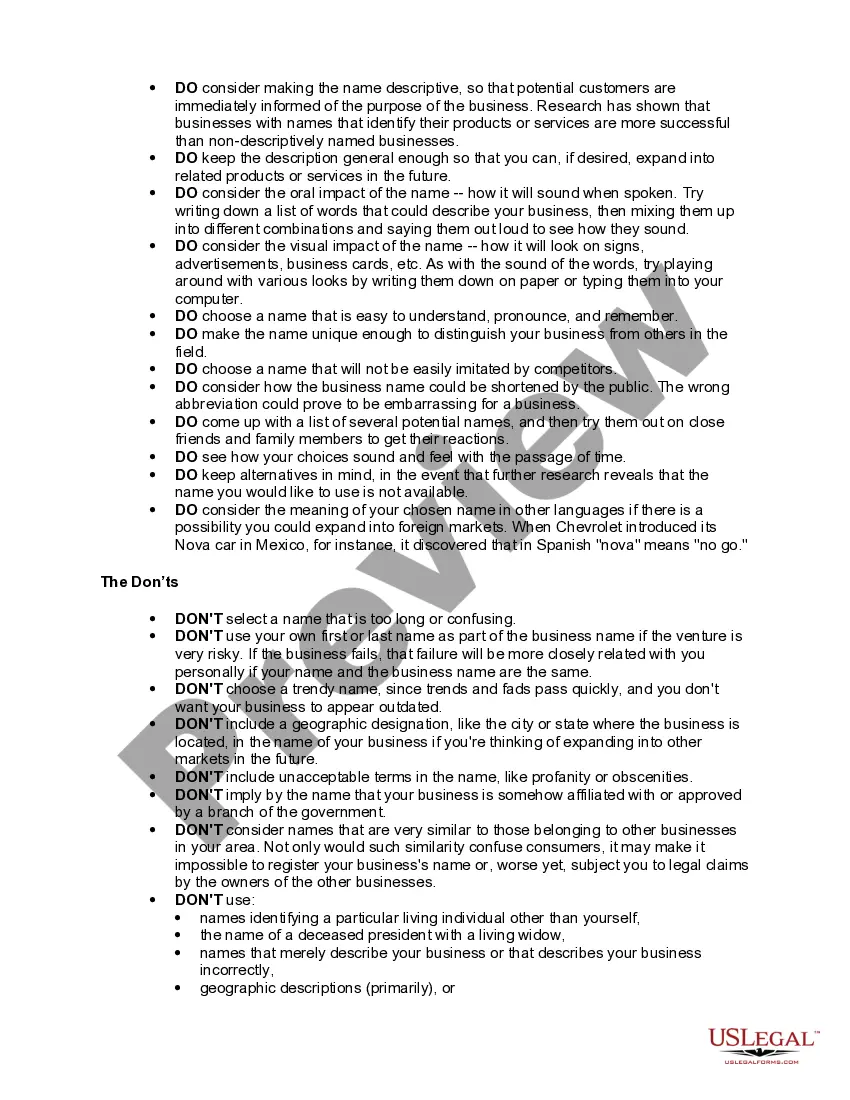
How to fill out Checklist Or Guidelines In Choosing A Domain Name And A Business Name?
Regardless of whether it's for professional reasons or personal issues, every individual encounters legal challenges at some stage in their lives.
Filling out legal documentation necessitates meticulous focus, beginning with selecting the correct form model. For example, if you opt for an incorrect version of the Choosing Name Business With Business, it will be rejected upon submission.
With a comprehensive US Legal Forms library available, you never need to waste time searching for the suitable template online. Utilize the library’s straightforward navigation to locate the correct form for any scenario.
- Obtain the template you require by utilizing the search bar or catalog browsing.
- Review the details of the form to ensure it aligns with your circumstance, state, and locality.
- Click on the preview of the form to examine it.
- If it is not the right form, return to the search feature to find the necessary Choosing Name Business With Business sample.
- Download the document if it satisfies your needs.
- If you already possess a US Legal Forms account, click Log in to access previously saved files in My documents.
- If you haven't created an account yet, you may acquire the form by selecting Buy now.
- Choose the correct pricing option.
- Fill out the profile registration form.
- Select your payment method: you can pay with a credit card or PayPal account.
- Choose your desired file format and download the Choosing Name Business With Business.
- Once downloaded, you can fill out the form using editing software or print it to complete manually.
Form popularity
FAQ
Dear (landlord's name), I, (Tenant's Name), am writing to inform you that I intend to terminate my lease agreement. I am delivering this notice (number of days before your lease ends) days before my lease for (rental unit address) comes to an end. The last day of my tenancy will be on (day, month, year).
The California 60-Day Notice to Vacate is a letter that CA Landlords use when they are terminating a tenancy after a Tenant has lived in the rental unit for at least one year. This notice is for no fault just cause evictions for rental units subject to the California Tenant Protection Act (AB 1482).
The California 60-Day Notice to Vacate is a letter that CA Landlords use when they are terminating a tenancy after a Tenant has lived in the rental unit for at least one year. This notice is for no fault just cause evictions for rental units subject to the California Tenant Protection Act (AB 1482).
If you are not behind in your rent but the landlord wants you to move out, they must give you a written notice. Only a 30-day notice is required if all tenants have lived there less than a year. A 60-day notice is required if all tenants have lived there a year or longer. There is an exception to this rule.
When Breaking a Lease is Justified in California You or a Family Member Are a Victim of Domestic Violence, Sexual Assault, Stalking, or Elder Abuse. ... You Are Starting Active Military Duty. ... The Rental Unit Is Unsafe or Violates California Health or Safety Codes. ... Your Landlord Harasses You or Violates Your Privacy Rights.
tomonth tenancy may be terminated by either the landlord or the tenant simply by giving written notice from one side to the other. Unless the rental agreement or lease provides for a different time period, the notice to terminate must be given to the landlord at least 30 days before the tenant moves out.
A landlord uses a 30-day Notice to Quit (move out) to end a month-to-month tenancy if the tenant has been renting for less than 1 year. A landlord uses a 60-day Notice to Quit if their tenant has been renting for 1 year or more. In many cases, landlords can't cancel a month-to-month tenancy for just any reason.
A tenancy or other estate at will, however created, may be terminated by the landlord's giving notice in writing to the tenant, in the manner prescribed by Section 1162 of the Code of Civil Procedure, to remove from the premises within a period of not less than 30 days, to be specified in the notice.