Non-profit With Hyphen
Description
Get your form ready online
Our built-in tools help you complete, sign, share, and store your documents in one place.
Make edits, fill in missing information, and update formatting in US Legal Forms—just like you would in MS Word.
Download a copy, print it, send it by email, or mail it via USPS—whatever works best for your next step.
Sign and collect signatures with our SignNow integration. Send to multiple recipients, set reminders, and more. Go Premium to unlock E-Sign.
If this form requires notarization, complete it online through a secure video call—no need to meet a notary in person or wait for an appointment.
We protect your documents and personal data by following strict security and privacy standards.

Make edits, fill in missing information, and update formatting in US Legal Forms—just like you would in MS Word.

Download a copy, print it, send it by email, or mail it via USPS—whatever works best for your next step.

Sign and collect signatures with our SignNow integration. Send to multiple recipients, set reminders, and more. Go Premium to unlock E-Sign.

If this form requires notarization, complete it online through a secure video call—no need to meet a notary in person or wait for an appointment.

We protect your documents and personal data by following strict security and privacy standards.
Looking for another form?





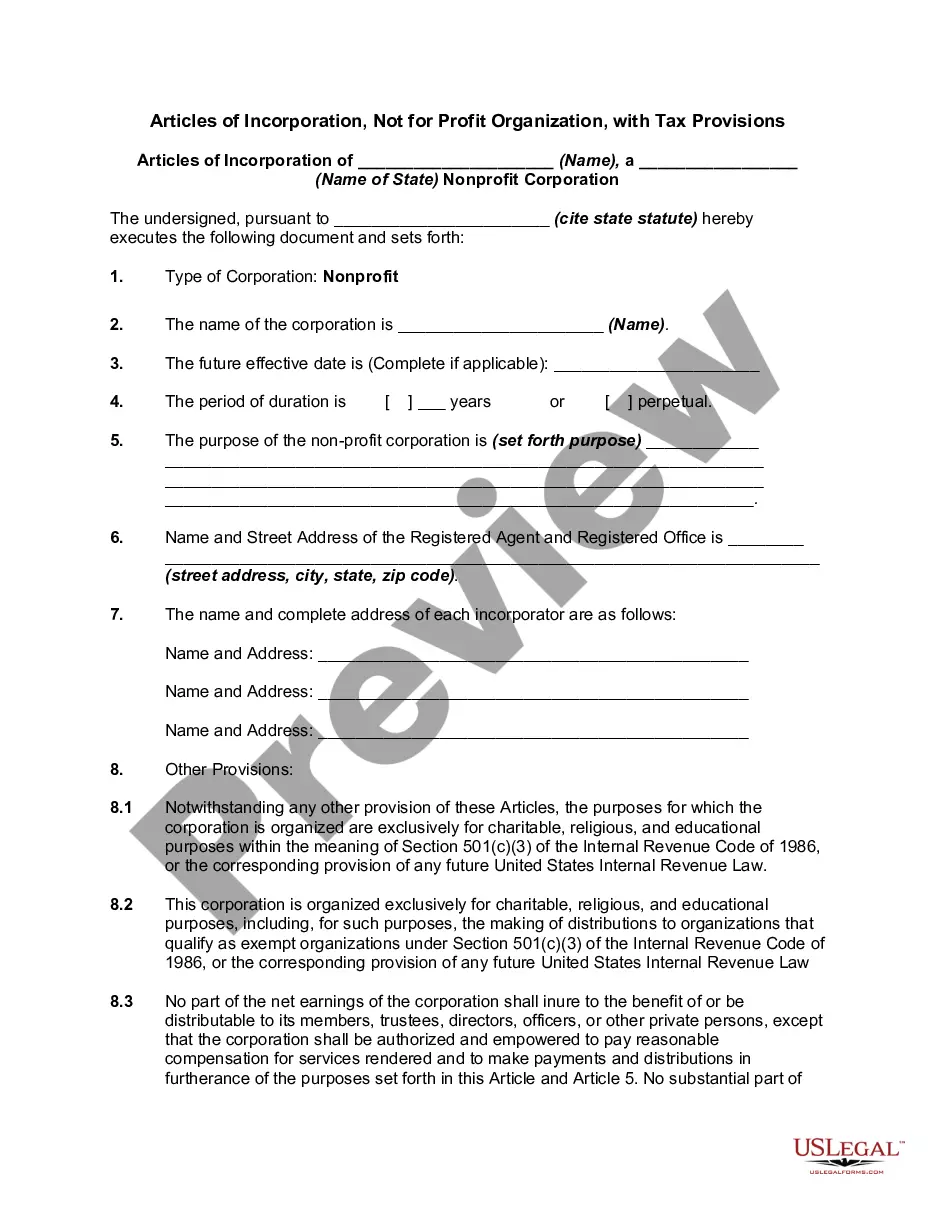
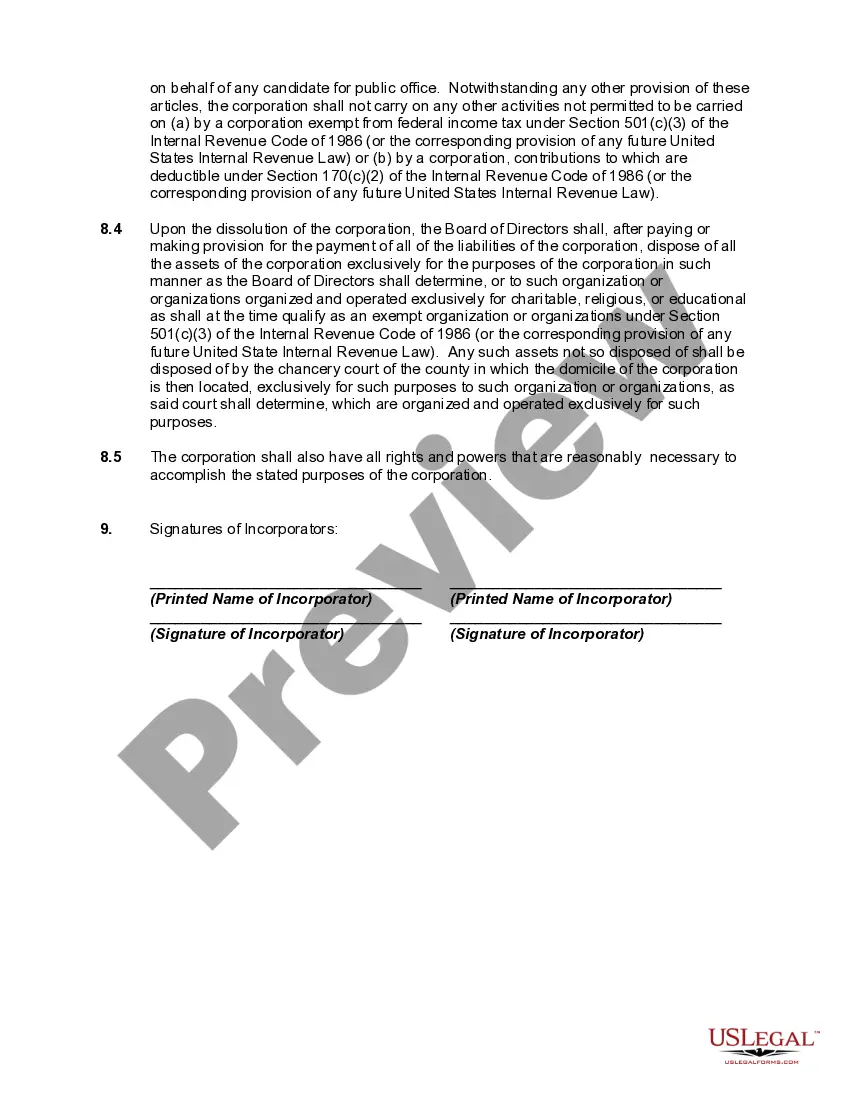
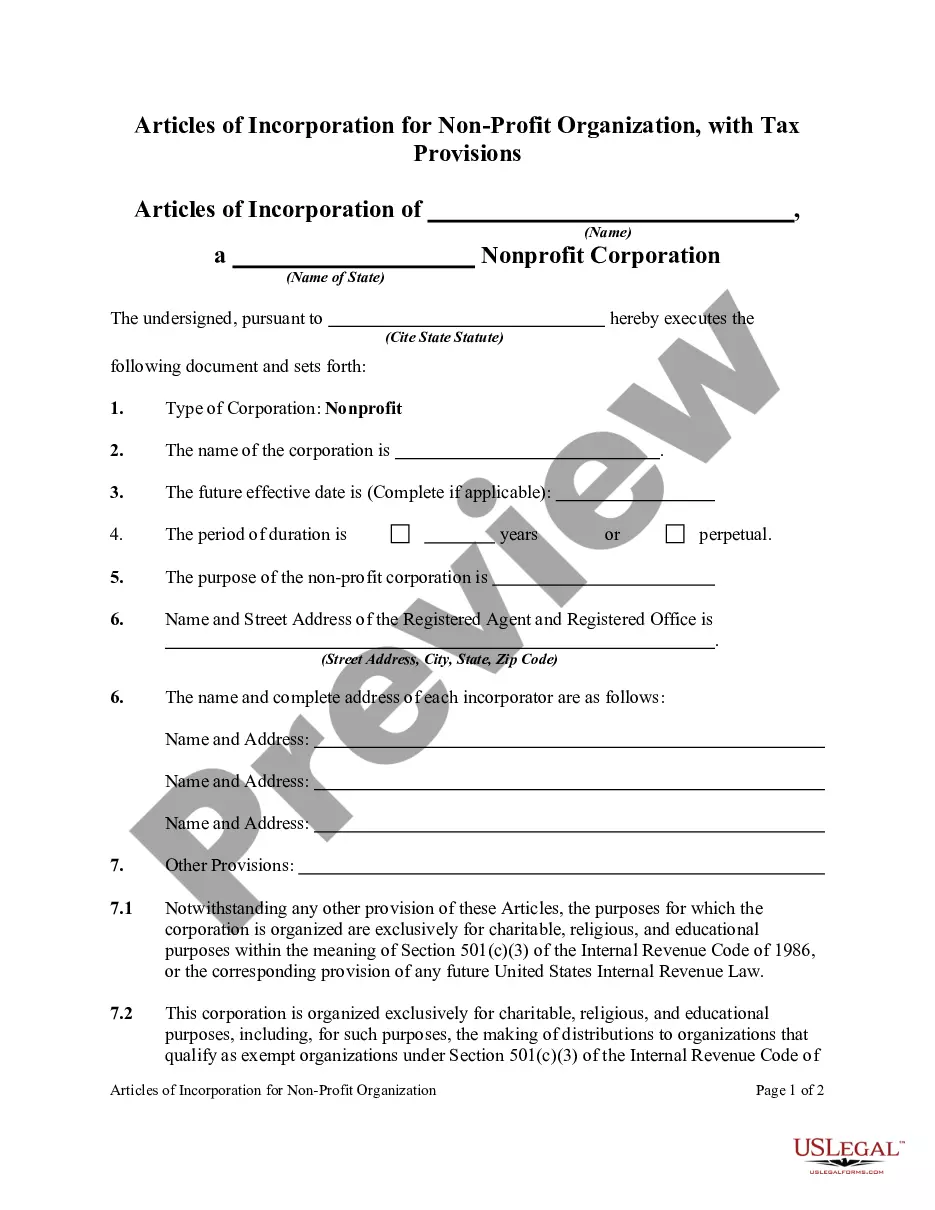
How to fill out Articles Of Incorporation, Not For Profit Organization, With Tax Provisions?
Acquiring legal document examples that comply with federal and local regulations is essential, and the internet presents various alternatives to select from.
However, why spend time searching for the appropriate Non-profit With Hyphen template online when the US Legal Forms digital library already houses such documents in a single location.
US Legal Forms is the most extensive online legal repository with over 85,000 customizable templates prepared by legal professionals for any business and personal situation.
Review the template using the Preview function or through the written description to confirm it fulfills your requirements.
- They are easy to navigate with all documents organized by state and intended use.
- Our experts stay informed on legislative changes, guaranteeing that your form is current and compliant when obtaining a Non-profit With Hyphen from our platform.
- Securing a Non-profit With Hyphen is fast and straightforward for both existing and new users.
- If you already possess an account with an active subscription, Log In and retrieve the document example you need in your preferred format.
- If you are new to our site, follow the steps below.
Form popularity
FAQ
Both terms are acceptable, but some prefer 'non-profit' for its brevity. While 'not-for-profit' is also accurate, it might feel longer in discussions. Whichever you choose, aim for consistency in your messaging. US Legal Forms can assist with using the right term in your documents to maintain professionalism and clarity.
'Non-profit' is not a true compound word. Instead, it is a hyphenated term combining 'non' and 'profit.' This structure clarifies the term's meaning, ensuring users recognize the organization’s non-revenue goals. Always remember to clarify this in your communications to avoid any misunderstandings.
The primary difference lies in their purpose and profit distribution. A nonprofit, including any 'non-profit' with a hyphen, focuses on supporting a mission and reinvests surplus into that mission. In contrast, for-profit organizations aim to generate capital for owners or shareholders. Understanding this distinction can guide your choices in advocacy or investment.
You can usually determine if an organization is for-profit or nonprofit by examining its IRS status. Non-profit organizations often have a 501(c)(3) designation, meaning they are tax-exempt. Additionally, look at how the organization operates: if it prioritizes profits for shareholders, it is likely for-profit. US Legal Forms provides resources to help you verify these statuses easily.
The abbreviation for 'not-for-profit' is typically 'NFP.' However, some organizations may simply use 'non-profit' or 'nonprofit' as shorthand. Regardless of the abbreviation, it is vital to ensure the intent remains clear in any communication. For legal documentation related to non-profits, consider using US Legal Forms for precise terminology.
Yes, the correct way to spell it is 'non-profit' with a hyphen. This form emphasizes the nonprofit nature of the organization. Writing it as 'nonprofit' is common as well, but using the hyphen can provide clarity. At US Legal Forms, we support clarity in documentation to help you navigate these terms.
Both terms refer to organizations that do not operate for profit. The term 'non-profit' with a hyphen emphasizes that these organizations do not distribute profits to owners. Instead, any surplus funds are reinvested into the organization’s mission. This distinction can help clarify their purpose for the public.
The correct way to write non profit is as non-profit with a hyphen. This format helps to clearly convey that the organization does not operate for profit. While some may write it without a hyphen, using non-profit aligns with standard conventions in the nonprofit sector. If you're drafting documents or content, using this style ensures clarity and consistency in your communications.
Yes, non-profit typically requires a hyphen when used as an adjective. This hyphen aids in clarifying the meaning, making it easier for your audience to understand the term. For example, you might say, 'The non-profit organization aims to improve environmental policies.' By incorporating the hyphen, your writing maintains professionalism and clarity.
You can use nonprofit in a sentence like this: 'The new nonprofit organization focuses on providing educational resources to underprivileged communities.' Using non-profit with hyphen in your writing helps clarify the organization's purpose and legal status. This usage is not only correct but also aligns with common understanding. Always ensure your audience recognizes your intent by clearly stating the type of organization.