Waive Breach With Insurance
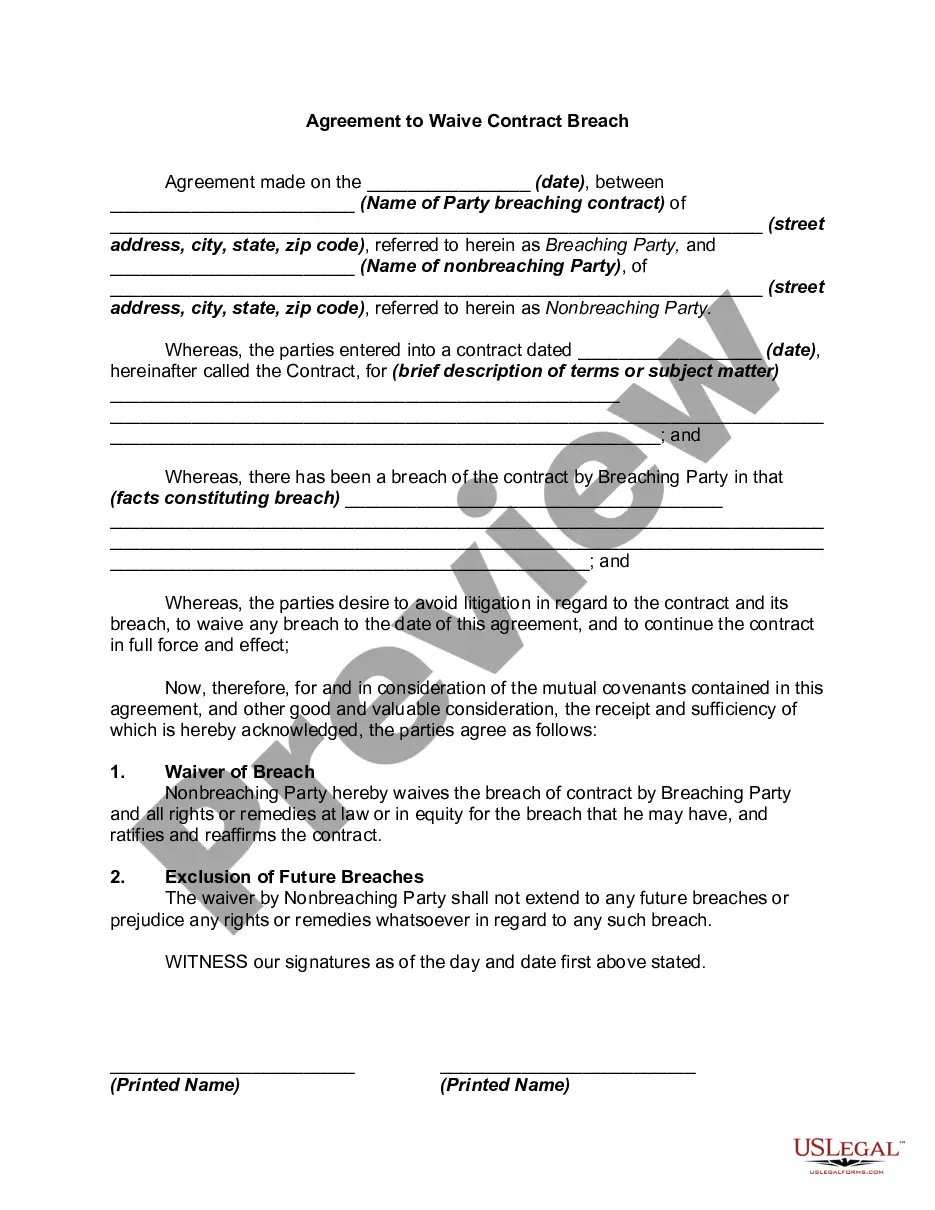
Description

Get your form ready online
Our built-in tools help you complete, sign, share, and store your documents in one place.
Make edits, fill in missing information, and update formatting in US Legal Forms—just like you would in MS Word.
Download a copy, print it, send it by email, or mail it via USPS—whatever works best for your next step.
Sign and collect signatures with our SignNow integration. Send to multiple recipients, set reminders, and more. Go Premium to unlock E-Sign.
If this form requires notarization, complete it online through a secure video call—no need to meet a notary in person or wait for an appointment.
We protect your documents and personal data by following strict security and privacy standards.

Make edits, fill in missing information, and update formatting in US Legal Forms—just like you would in MS Word.

Download a copy, print it, send it by email, or mail it via USPS—whatever works best for your next step.

Sign and collect signatures with our SignNow integration. Send to multiple recipients, set reminders, and more. Go Premium to unlock E-Sign.

If this form requires notarization, complete it online through a secure video call—no need to meet a notary in person or wait for an appointment.

We protect your documents and personal data by following strict security and privacy standards.
Looking for another form?

How to fill out Agreement To Waive Contract Breach?
Whether for business purposes or for individual affairs, everybody has to handle legal situations sooner or later in their life. Filling out legal paperwork needs careful attention, beginning from selecting the proper form sample. For example, if you select a wrong version of a Waive Breach With Insurance, it will be rejected once you submit it. It is therefore essential to get a dependable source of legal papers like US Legal Forms.
If you have to get a Waive Breach With Insurance sample, follow these easy steps:
- Find the sample you need by utilizing the search field or catalog navigation.
- Look through the form’s information to make sure it suits your case, state, and region.
- Click on the form’s preview to examine it.
- If it is the incorrect form, get back to the search function to locate the Waive Breach With Insurance sample you need.
- Get the template when it meets your requirements.
- If you have a US Legal Forms account, simply click Log in to gain access to previously saved documents in My Forms.
- If you don’t have an account yet, you may download the form by clicking Buy now.
- Select the proper pricing option.
- Complete the account registration form.
- Choose your payment method: you can use a bank card or PayPal account.
- Select the file format you want and download the Waive Breach With Insurance.
- After it is downloaded, you can fill out the form with the help of editing software or print it and complete it manually.
With a large US Legal Forms catalog at hand, you do not have to spend time seeking for the right sample across the web. Utilize the library’s simple navigation to find the proper template for any situation.
Form popularity
FAQ
A waiver is a legally binding provision where either party in a contract agrees to voluntarily forfeit a claim without the other party being liable.
A waiver of subrogation is a contractual provision whereby an insured waives the right of their insurance carrier to seek redress or seek compensation for losses from a negligent third party. Typically, insurers charge an additional fee for a waiver of subrogation endorsement.
If you decide to waive a breach of contract, it means you are giving up your right to pursue remedies for the breach. You should also remember that you will still be responsible for performing your contractual duties, and will not be able to use the breach as an excuse for nonperformance.
If someone is the claimant in, say, a car accident, an insurance company would have the claimant sign a waiver as part of their settlement offer. This means that although the insurance company is paying a settlement to the claimant, the claimant can no longer pursue legal action against the insurance company.
One way that remedies for a breach of contract are waived is through a mutual agreement by both parties to the contract. After the breach occurs, the party making the breach and the aggrieved party may sign an agreement that assures no claim will arise as a result of the breach.