Termo On-premise
Description




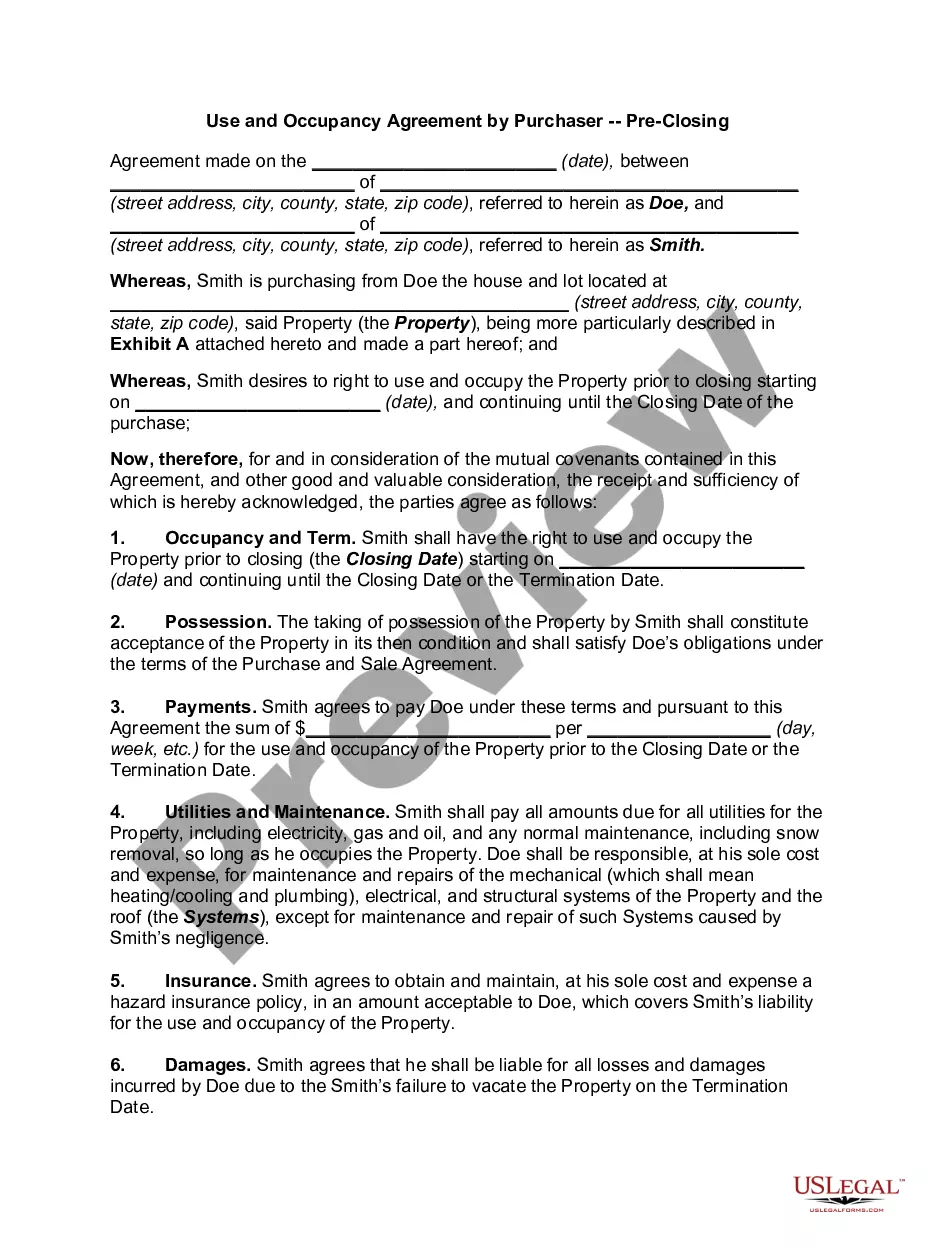

How to fill out Early Possession Agreement?
- Log in to your account on the US Legal Forms website. Ensure your subscription is active or renew it based on your payment plan.
- Review the preview mode and descriptions of forms available. Verify that the selected form matches your legal needs and adheres to your local jurisdiction.
- If necessary, utilize the Search tab to find alternative templates. Ensure consistency with your requirements before proceeding.
- Choose the appropriate document by clicking the Buy Now button. Select a subscription plan and create an account for full access to the library.
- Complete your purchase by entering your payment details through credit card or PayPal.
- Download the required legal form to your device, and access it anytime from the My Forms menu in your profile for future reference.
By utilizing US Legal Forms, you'll not only benefit from a comprehensive and diverse collection of documents but also have the support of premium experts to help ensure that your forms are completed accurately.
Start simplifying your legal documentation process today with US Legal Forms and take advantage of our unparalleled library.
Form popularity
FAQ
In most cases, you should use 'on-premise' when referring to software solutions installed on your servers. Although 'on-premises' describes the physical location itself, it’s common for people to confuse the two. To maintain precision in your language around technology, especially when discussing Termo on-premise, choose the correct form based on the context.
Yes, it is correct to use 'on-premise' when discussing software or systems that are installed and run at your location. Many individuals mistakenly use ‘on-premises’ in this context, but on-premise accurately describes the solution. Utilizing solutions like Termo on-premise ensures clarity in your IT terminology and strategy.
IT is referred to as on-premise because it denotes systems that are physically located within the organization's own infrastructure. This model allows businesses to maintain direct oversight and management of their IT resources. Implementing Termo on-premise can significantly enhance your organization's IT reliability and responsiveness.
The term on-premise signifies that a software solution is hosted locally, meaning it is installed on your own computers or servers. This option is appealing for organizations that prioritize data control and compliance. With Termo on-premise, you can leverage the full benefits of self-hosted infrastructure tailored to your business operations.
The correct spelling is 'on-premise' when you refer to software or systems that are installed on your own site. It is often confused with 'on-premises,' but the latter refers specifically to the physical location. For clarity and consistency, always use Termo on-premise in your communications about your IT solutions.
On-premise generally includes any software or hardware that operates within your organization’s physical space, such as servers, databases, and applications. This setup contrasts with cloud-based services, where resources are hosted remotely. Choosing Termo on-premise allows organizations to tailor their technology environment to suit specific needs.
'On premises' refers to the physical location where the software or service is deployed. It indicates that the resources are located on your property, rather than in the cloud. This distinction is vital when considering solutions like Termo on-premise, as it affects how your data is managed and secured.
When we refer to on-premise, we mean that the software or system is installed and runs on your own hardware, within your physical location. This setup allows for greater control over data security and privacy. For example, Termo on-premise can help your organization manage sensitive information without relying on external servers.
Examples of on-premise servers include local dedicated servers for running applications, file storage servers for managing documents, and database servers for handling user data. Companies may choose to implement Termo on-premise solutions for their specific needs, such as sensitive data storage or tailored application hosting, enhancing both performance and security.
An on-premise file server is a dedicated server that stores and manages data within your organization’s physical environment. This setup allows employees to access files quickly and securely without relying on external internet connections. By utilizing a Termo on-premise file server, you can enhance data management and ensure your sensitive information remains protected.