Sample Irrevocable Trust For Property Tax
Description



Get your form ready online
Our built-in tools help you complete, sign, share, and store your documents in one place.
Make edits, fill in missing information, and update formatting in US Legal Forms—just like you would in MS Word.
Download a copy, print it, send it by email, or mail it via USPS—whatever works best for your next step.
Sign and collect signatures with our SignNow integration. Send to multiple recipients, set reminders, and more. Go Premium to unlock E-Sign.
If this form requires notarization, complete it online through a secure video call—no need to meet a notary in person or wait for an appointment.
We protect your documents and personal data by following strict security and privacy standards.

Make edits, fill in missing information, and update formatting in US Legal Forms—just like you would in MS Word.

Download a copy, print it, send it by email, or mail it via USPS—whatever works best for your next step.

Sign and collect signatures with our SignNow integration. Send to multiple recipients, set reminders, and more. Go Premium to unlock E-Sign.

If this form requires notarization, complete it online through a secure video call—no need to meet a notary in person or wait for an appointment.

We protect your documents and personal data by following strict security and privacy standards.
Looking for another form?






How to fill out Irrevocable Trust Agreement For Benefit Of Trustor's Children And Grandchildren With Spendthrift Trust Provisions?
Managing legal documents can be challenging, even for the most experienced professionals.
If you are in search of a Sample Irrevocable Trust For Property Tax and lack the time to find the appropriate and current version, the process can be tough.
With US Legal Forms, you can access a valuable collection of articles, guides, and resources tailored to your situation and requirements.
Save time and energy searching for the necessary documents, and take advantage of US Legal Forms’ sophisticated search and Review tool to find Sample Irrevocable Trust For Property Tax effortlessly.
Ensure the sample is recognized in your state or county. Select Buy Now when you're ready. Choose a subscription plan. Decide on your preferred file format, and Download, complete, sign, print, and submit your document. Experience the US Legal Forms web library, backed by 25 years of expertise and dependability. Revamp your everyday document management into a seamless and user-friendly experience today.
- If you possess a monthly subscription, Log In to your US Legal Forms account, search for the form, and acquire it.
- Visit the My documents tab to review the documents you have previously downloaded and manage your files as desired.
- If this is your first experience with US Legal Forms, establish a free account and gain unlimited access to all platform advantages.
- Here's how to proceed once you find the form you need.
- Confirm it is the correct document by previewing it and examining its description.
- A comprehensive online form library can revolutionize the way people handle these matters efficiently.
- US Legal Forms is a leader in virtual legal forms, offering over 85,000 region-specific legal forms available at your convenience.
- Utilize cutting-edge tools to complete and manage your Sample Irrevocable Trust For Property Tax.
Form popularity
FAQ
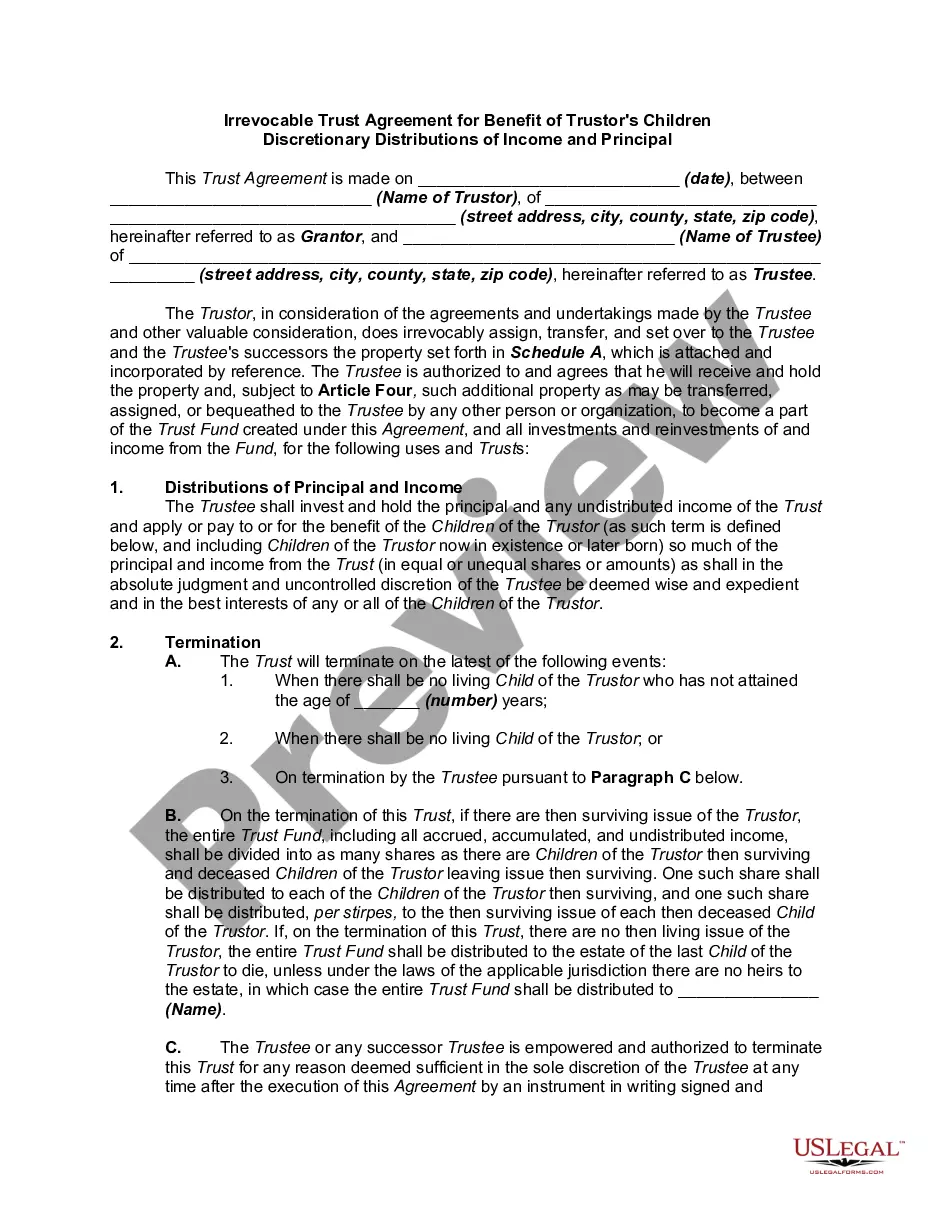
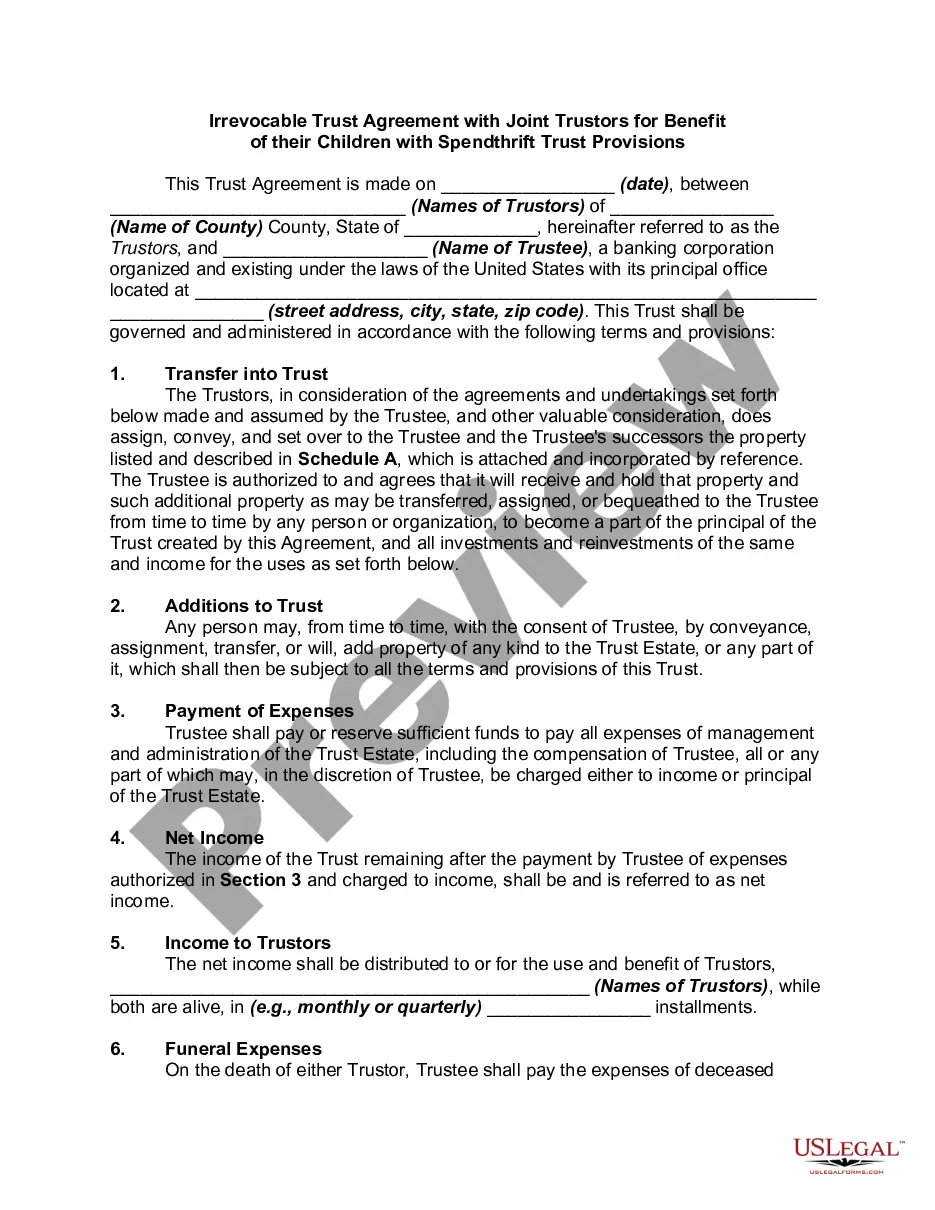
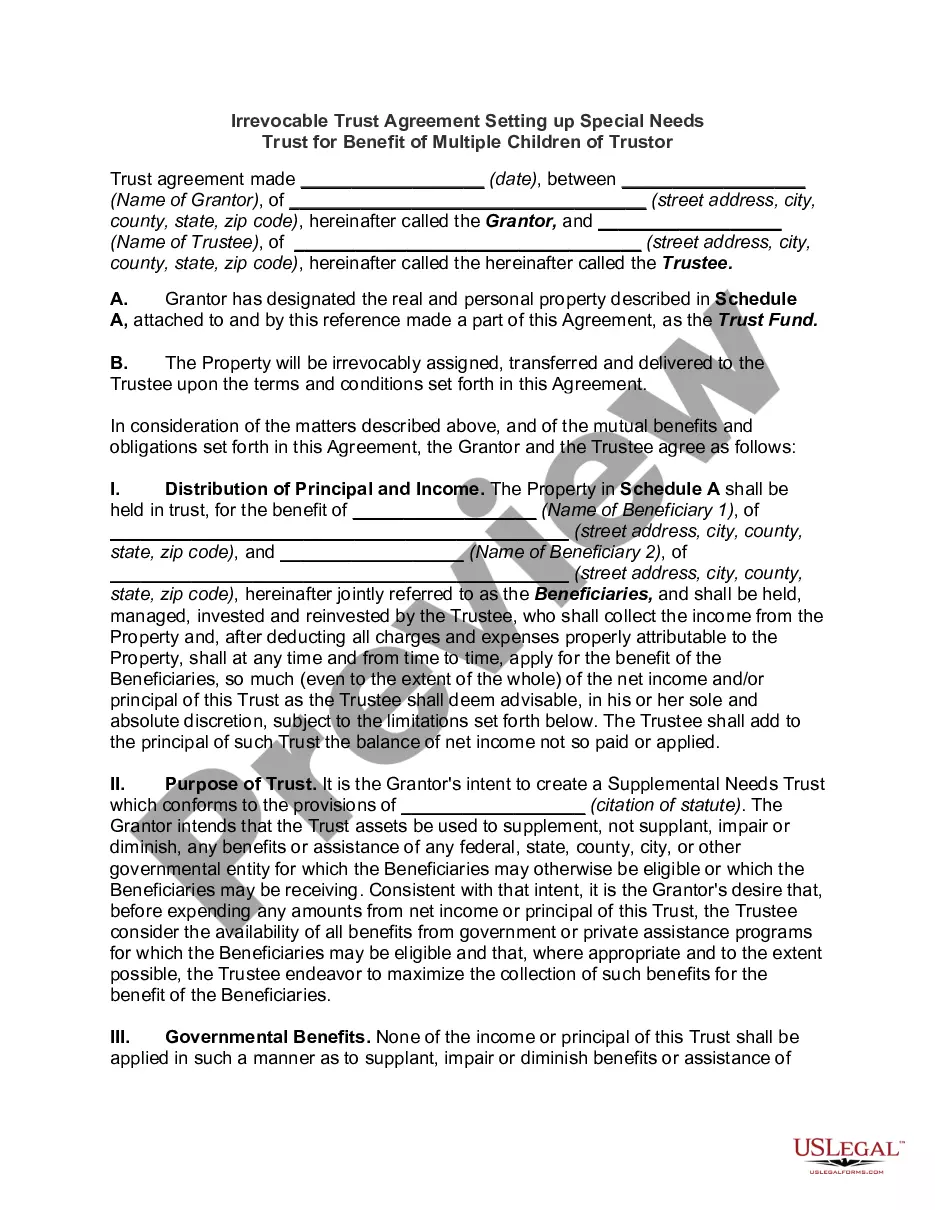
A common example of an irrevocable trust is a Medicaid Asset Protection Trust. This type of trust can protect your assets while qualifying you for Medicaid benefits. By transferring property into this trust, you can manage how these assets are distributed after your passing. As you consider a Sample irrevocable trust for property tax, exploring this option can be a worthwhile strategy for long-term financial planning.
How do you write an irrevocable trust document? Draft the written irrevocable trust agreement. Spell out which assets will be placed into the trust, name a trustee and beneficiaries, and outline the terms by which the trust assets will be distributed (how, when, to whom, etc.).
Unlike a Revocable Trust, which allows for flexibility, you cannot change or revoke this type of trust. Like a Revocable Trust, however, an Irrevocable Trust should be set up with the assistance of a reputable estate planning attorney.
The trusts shall be irrevocable, and the Grantor expressly waives all rights and powers, whether alone or in conjunction with others, and regardless of when or from what source he may have acquired such rights or powers, to alter, amend, revoke, or terminate the trusts, or any of the terms of this Agreement, in whole ...
Since an irrevocable trust is under the trustee's care, they will be responsible for filing Form 1041 and reporting the income stream. This differs from a revocable trust, where the grantor controls the trust and reports income on their personal Form 1040.
Irrevocable trusts can provide legal and financial protection for you and your assets. However, when you sell your home, who pays the capital gains on the sale of a home in an irrevocable trust? Although irrevocable trusts distribute income to beneficiaries, it is responsible for paying capital gains taxes.